

TL;DR:
- A cybersecurity review assesses an organization’s security governance, risks, controls, and operational readiness across multiple core domains. It provides a prioritized improvement roadmap based on actual threats and business impact, not just compliance. Regular, continuous reviews ensure the security posture remains current amid evolving threats and organizational changes.
A cyber security review is a structured assessment of an organization's security governance, risk management, technical controls, and operational readiness. Unlike a one-time audit or a narrow vulnerability scan, a proper review examines 10–15 core domains spanning people, processes, and technology. The industry standard term is "cybersecurity assessment," though "cyber security review" is widely used to describe the same structured evaluation. Frameworks like ISO 27001 and SOC 2 define the governance expectations that reviews measure against. The goal is not a compliance checkbox. A well-executed review produces a prioritized roadmap that tells leadership exactly where the organization is exposed and what to fix first.
What does a cyber security review actually cover?
A thorough cybersecurity assessment covers far more than firewalls and antivirus software. It evaluates the full security posture across domains that most organizations underestimate until something breaks.
The core domains in a standard review include:
- Asset inventory: Every device, application, and data repository in scope. Attackers target sensitive data stores and command-and-control systems, so unclear asset scope leads directly to missed risks.
- Access management: Who has access to what, and whether least-privilege principles are enforced.
- Incident response: Whether documented plans exist, whether teams have practiced them, and whether detection capabilities are in place.
- Third-party risk: Vendors and partners with access to your systems represent a significant and often underreviewed attack surface.
- Cloud security: Configuration reviews, identity controls, and logging coverage across cloud environments.
The evaluation method matters as much as the domain list. Effective reviews combine document review, stakeholder interviews, technical testing, and log analysis. Relying on self-reported questionnaires alone produces a false picture of security maturity. Evidence-based evaluation, where reviewers verify claims against actual configurations and logs, is the standard that frameworks like NIST and ISO 27001 expect.
Scoping is where most reviews fail before they start. A scope that is too broad produces a shallow assessment. A scope that is too narrow misses critical risks. The right approach is to define scope around business-critical systems and data flows, then expand from there.

Pro Tip: Map your data flows before finalizing scope. If you do not know where sensitive data lives and how it moves, your review will miss the assets attackers care about most.
How does a cybersecurity review differ from vulnerability scans and penetration tests?
Security teams often treat these three assessment types as interchangeable. They are not. Each serves a distinct purpose, and using the wrong one for the wrong situation wastes time and creates false confidence.
A vulnerability scan is automated. It identifies known weaknesses in software versions, configurations, and exposed services. It produces a list, not a judgment. A penetration testing review goes further: a skilled tester actively exploits weaknesses to demonstrate real-world impact. Both are technical in focus.
A cyber security review is different in scope and purpose. Assessments contextualize vulnerabilities based on the actual threat landscape and business impact, rather than simply listing them. A critical vulnerability in an isolated test system ranks differently than the same flaw in a customer-facing payment platform. That context is what a review provides and what a scan cannot.
| Assessment type | Focus | Output | Best used when |
|---|---|---|---|
| Vulnerability scan | Technical weaknesses | Findings list | Routine, frequent checks |
| Penetration test | Exploitability | Attack narrative | Pre-launch, post-change |
| Cybersecurity review | Governance, risk, controls | Maturity roadmap | Annual, post-major-change |
The timing question matters too. Assessments should follow major system changes or new tool deployments to verify that controls still work as intended. A penetration test after a cloud migration confirms whether new infrastructure is exploitable. A full review after a merger confirms whether the combined organization's governance and controls are coherent.
The most effective security programs run all three in rotation. Scans run continuously or monthly. Penetration tests run annually or after significant changes. Full reviews run annually and after major organizational shifts.
What is the typical process for conducting an effective cybersecurity review?
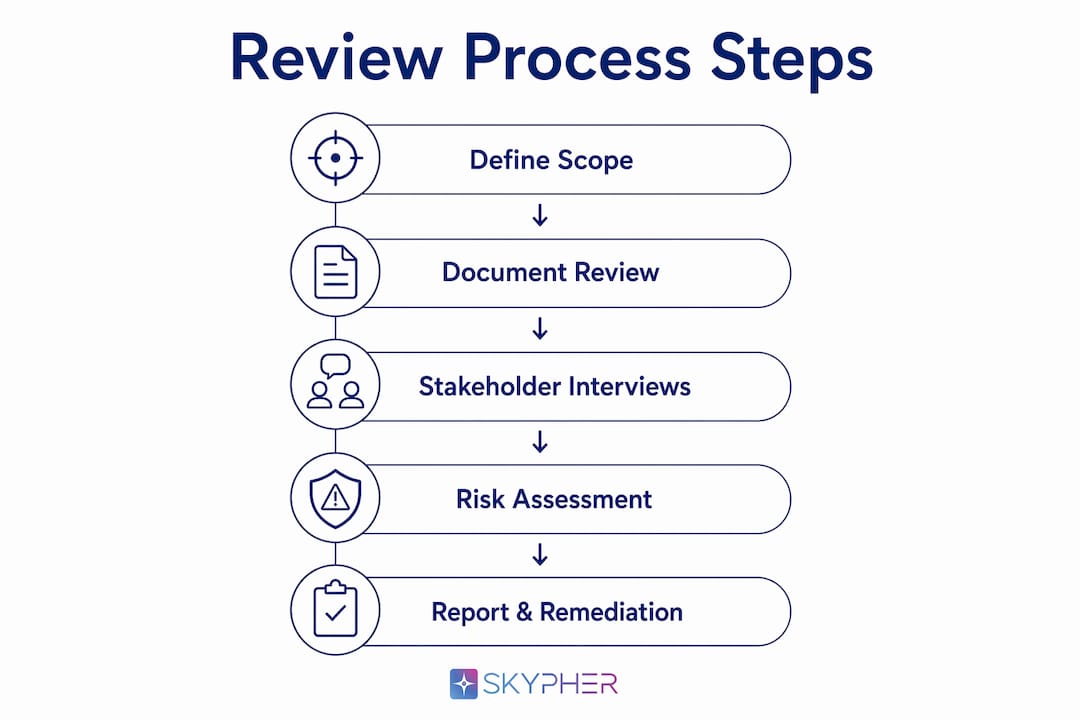
A standard cybersecurity review follows six phases. Skipping or compressing any phase degrades the quality of the output.
- Planning and scoping: Define what systems, processes, and data are in scope. Identify stakeholders and assign responsibilities. Set the review timeline and agree on evidence collection methods.
- Information gathering: Collect policies, network diagrams, asset inventories, access control lists, and previous audit findings. Interview key personnel in IT, operations, legal, and HR.
- Risk assessment: Identify threats relevant to the organization's industry and infrastructure. Map threats to assets and evaluate existing controls against those threats.
- Security testing: Run technical validation including vulnerability scans, configuration reviews, and where scoped, penetration testing. Evaluate identity and access controls and monitoring capabilities against real attack scenarios.
- Reporting: Produce findings organized by risk level and business impact. Leadership needs to understand not just what is broken, but what it means for business continuity.
- Remediation and monitoring: Build a prioritized action plan. Assign owners, set deadlines, and schedule follow-up assessments to verify fixes.
The difference between a useful review and a shelf document is what happens after reporting. Most organizations complete the first five phases adequately. Remediation tracking is where discipline breaks down. Assign a named owner to every finding. Without ownership, findings age without resolution.
Pro Tip: Involve legal and compliance teams during the planning phase, not after reporting. They will flag regulatory requirements that change your scope and save you from having to redo evidence collection.
Continuous review practices outperform annual one-time audits. Treating reviews as repeatable processes aligned with ongoing infrastructure changes keeps the security posture current. Annual reviews that sit untouched for 11 months give a false sense of security in a threat environment that changes weekly. Building security review best practices into quarterly check-ins between full annual reviews is the approach that mature security programs use.
How can organizations prioritize findings and build remediation roadmaps?
Raw findings lists do not drive action. A report with 200 unranked findings paralyzes security teams and frustrates leadership. Prioritization by business impact is the only approach that produces results.
Effective reviews prioritize remediation based on the combination of likelihood and business impact, not just technical severity scores. A critical CVSS score on a system with no network exposure ranks lower than a medium-severity misconfiguration on a customer data platform. Risk scoring must account for context.
The remediation roadmap should organize findings into three tiers:
- Immediate: Critical findings with high likelihood and direct business impact. Fix within 30 days.
- Short-term: High-severity findings that require planning or resource allocation. Fix within 90 days.
- Long-term: Medium and low findings that feed into the next planning cycle. Address within 6–12 months.
| Priority tier | Criteria | Target resolution |
|---|---|---|
| Immediate | Critical risk, high business impact | 30 days |
| Short-term | High severity, requires planning | 90 days |
| Long-term | Medium or low, systemic issues | 6–12 months |
Communicating findings to leadership in business terms, not technical jargon, is what gets remediation funded. "We have an unpatched server" does not move budgets. "An unpatched server exposes customer payment data and creates regulatory liability" does. Translate every critical finding into a business risk statement before presenting to executives.
Continuous monitoring between reviews catches regression. A finding marked resolved in month one can reappear by month six if the underlying process that caused it has not changed. Schedule quarterly spot checks on the highest-priority findings to confirm fixes hold. The cybersecurity checklist approach works well here: a structured list of controls to verify at each interval without running a full review.
A cybersecurity assessment produces a maturity roadmap, not just a problem list. The roadmap shows the path from current state to target state, with milestones that leadership can track and fund. That framing transforms the review from a cost center into a decision-making tool.
Key Takeaways
A cyber security review produces its greatest value when it is treated as a continuous, business-aligned process rather than an annual compliance exercise.
| Point | Details |
|---|---|
| Define scope before starting | Unclear asset inventory leads to missed risks and wasted review effort. |
| Use all three assessment types | Scans, penetration tests, and full reviews serve different purposes and work best in rotation. |
| Follow all six phases | Skipping planning or remediation tracking turns findings into shelf documents with no impact. |
| Prioritize by business impact | Rank findings by likelihood and business consequence, not just technical severity scores. |
| Make reviews continuous | Quarterly check-ins between annual reviews keep the security posture current as threats evolve. |
Why I think most security reviews fail before they start
The most common failure I see in cybersecurity evaluations is not a technical gap. It is a scoping problem disguised as a resource problem. Teams rush into information gathering without agreeing on what is actually in scope, then spend weeks collecting evidence for systems that do not matter while missing the ones that do.
The second failure is treating the review as a deliverable rather than a process. Microsoft Deputy CISO Rico Mariani makes this point directly: asking the right probing questions transforms security data into proactive insights rather than reactive lists. That shift in mindset is what separates a useful review from a document that collects dust.
The third failure is the reporting gap. Security teams write findings for other security professionals. Executives read them, understand nothing, and fund nothing. Every critical finding needs a business risk translation. "Lateral movement risk due to flat network architecture" becomes "An attacker who breaches one system can reach all systems, including payroll and customer data." That sentence gets budget.
Good cyber hygiene practices form the foundation that makes reviews meaningful. Without baseline hygiene, every review surfaces the same foundational gaps year after year. Fix the basics first, then use reviews to find what is actually hard to see.
The organizations that get the most value from security reviews are the ones that treat them as a living process. They assign owners to findings, track remediation in their project management systems, and run spot checks between full assessments. The review is not the end. It is the beginning of a cycle.
— Gaspard
How Skypher fits into your security review workflow
Security reviews generate a significant volume of documentation, questionnaires, and compliance evidence. Managing that volume manually slows down every phase of the process, from information gathering to reporting.

Skypher's Trust Center platform gives security teams a single place to manage and share their security and compliance posture with reviewers, auditors, and clients. The platform's AI-powered questionnaire automation handles incoming security questionnaires in under a minute, even at 200 questions, pulling from a verified knowledge base rather than requiring manual responses each time. With integrations across Slack, ServiceNow, OneTrust, Confluence, and over 40 third-party risk management platforms, Skypher fits into the workflows your team already uses. For teams running frequent security questionnaire responses, the time savings compound quickly across every review cycle.
FAQ
What is a cyber security review?
A cyber security review is a structured assessment of an organization's security governance, risk management, technical controls, and operational processes across multiple domains. It produces a prioritized roadmap for improving security maturity, not just a list of vulnerabilities.
How often should a cybersecurity review be conducted?
Annual reviews are the baseline, but continuous repeatable assessments are the industry best practice. Major system changes, mergers, or new tool deployments should also trigger a targeted review.
What is the difference between a security audit and a cybersecurity review?
A security audit typically verifies compliance against a specific standard like ISO 27001 or SOC 2. A cybersecurity review is broader, assessing overall security posture, risk context, and maturity across governance and technical controls.
What frameworks guide a cyber security review?
ISO 27001, SOC 2, and NIST are the most widely used frameworks. They define control expectations, governance requirements, and maturity criteria that reviews measure against.
How do you prioritize findings from a security review?
Prioritize findings by combining likelihood of exploitation with business impact, not just technical severity. Remediation roadmaps organized into immediate, short-term, and long-term tiers give leadership a clear picture of what to fund and when.