

TL;DR:
- Security and compliance activities like audits and scans often create an illusion of coverage, but they fall short without layered, context-aware security reviews. Human oversight uncovers complex vulnerabilities, such as business logic flaws, that automated tools cannot detect, emphasizing the need for continuous, risk-based monitoring. Ultimately, effective security relies on ongoing assessment, layered approaches, and organizational humility to adapt to evolving threats.
Passing a compliance audit feels like a win. Running automated vulnerability scans every week feels like due diligence. But for security and compliance teams at mid-to-large tech and finance organizations, those two activities can create a dangerous illusion of coverage. Security reviews detect issues early before they escape into production and generate real evidence that controls actually work. This guide moves past the checkbox mentality to explain what reviews truly accomplish, where they fall short, and how to build a program that holds up under scrutiny from both auditors and attackers.
Table of Contents
- What a security review really accomplishes
- Limitations of automation and the need for layered review
- Continuous monitoring and the move beyond point-in-time audits
- Designing security reviews for risk, context, and defensible oversight
- The uncomfortable truth: What security reviews don't guarantee
- Get more value from security reviews with Skypher
- Frequently asked questions
Key Takeaways
| Point | Details |
|---|---|
| Early detection advantage | Security reviews catch issues before they reach production, reducing risk and remediation costs. |
| Human insight matters | Automated tools alone miss critical flaws—expert human review provides depth and context. |
| Ongoing validation required | Continuous monitoring and testable controls are essential for covering gaps between audits. |
| Evidence for compliance | Strong review programs produce defensible audit evidence, not just checklist artifacts. |
| No silver bullet | No process guarantees future security, so resilience demands adaptable, layered reviews. |
What a security review really accomplishes
The term "security review" gets used loosely, and that looseness causes real organizational harm. In practice, a security review is any structured activity that examines your systems, code, processes, or configurations against defined security requirements. That includes secure code review, architecture review, penetration testing, access control audits, and formal risk analysis. Each type surfaces a different category of risk. Using only one means leaving others unchecked.
The biggest misconception is that reviews are purely a compliance obligation. They are not. A well-executed review catches issues automated scanners miss and prevents vulnerabilities from ever reaching production. That distinction matters enormously. Scanners find known patterns. Reviews find context. An automated tool might flag an insecure direct object reference in isolation, but only a human reviewer understands whether that flaw, combined with a specific user role and a downstream API call, creates a complete attack chain.
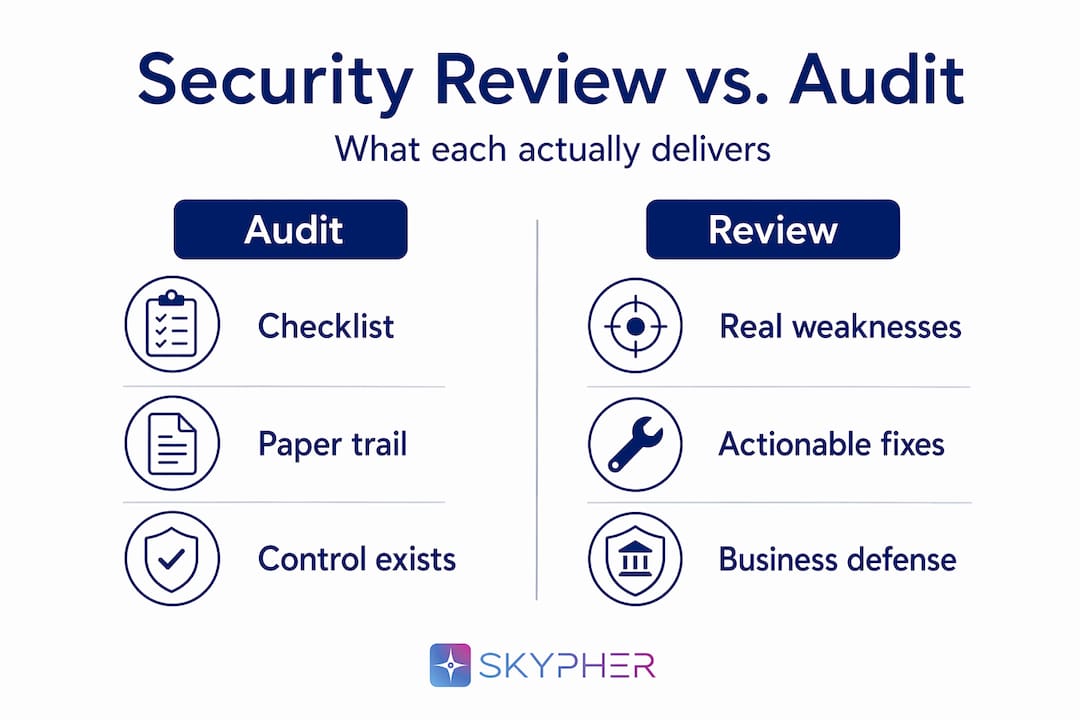
Understanding how security reviews work at a structural level also reveals their business value. When a security review produces documented evidence of control effectiveness, you are building a defensible record. That record answers the question auditors, customers, and board members all eventually ask: "How do we know our controls actually work?" Checkbox audits answer a different question: "Do these controls exist?"
"Audits validate controls and ensure compliance, while continuous monitoring protects organizations between audits and assessments."
The distinction shapes everything about how you design your program.
Checkbox audit vs. actionable remediation: what you actually get
| Audit type | Output | Business value | Weakness |
|---|---|---|---|
| Checkbox compliance audit | Control exists / does not exist | Regulatory defensibility | No evidence of effectiveness |
| Penetration test | Exploitable finding with proof of concept | Real attack surface reduction | Point-in-time, scoped |
| Secure code review | Code-level vulnerabilities with remediation guidance | Prevents production defects | Resource-intensive |
| Continuous monitoring | Real-time control drift and anomaly detection | Closes gaps between formal reviews | Requires mature tooling |
| Risk analysis | Prioritized threat register | Resource allocation clarity | Depends on threat model accuracy |
The organizations that treat security reviews as a genuine defense mechanism, rather than a paperwork exercise, see compounding returns. Each review cycle produces better threat models, sharper remediation prioritization, and stronger relationships with the engineering teams that actually fix things. The value compounds because automating security reviews for the repeatable parts frees your team to focus human judgment where it counts most.
Limitations of automation and the need for layered review
Automation is genuinely powerful. Static application security testing (SAST) and dynamic analysis (DAST) tools scan thousands of code paths in minutes. Software composition analysis (SCA) tools flag outdated dependencies with known CVEs. These tools provide breadth that no human team can match manually. They are also, in a very specific and critical way, blind.

Human reviewers identify exploitable paths that static analysis and automated tools simply cannot find, particularly in business logic and context-dependent issues. Consider a financial application where a user can transfer funds. An automated scanner validates that authentication is present, that inputs are sanitized, and that the API uses HTTPS. What the scanner cannot determine is whether a user who initiates a transfer, then navigates mid-flow to an administrative summary screen, retains elevated permissions they should have dropped. That is a business logic flaw. It requires a reviewer who understands the intended flow, the user role model, and the business rules around permission escalation.
This is not a theoretical concern. Business logic vulnerabilities consistently rank among the most impactful findings in financial services security assessments because they require domain knowledge to find and exploit. No signature-based tool has that domain knowledge.
Typical vulnerability coverage by review method
| Review method | Injection flaws | Business logic flaws | Auth/session issues | Config weaknesses | Third-party risks |
|---|---|---|---|---|---|
| Automated SAST | High | Very low | Low | Medium | Low |
| Automated DAST | Medium | Low | Medium | Low | Very low |
| Manual code review | High | High | High | Medium | Low |
| Penetration testing | Medium | High | High | High | Medium |
| Architecture review | Low | High | High | Very high | High |
The data makes a clear case for layering. Automated tools provide the foundation: broad, consistent, fast, and cheap to run. Human review builds on top of that foundation with contextual judgment. The goal is never to replace one with the other. The goal is to use each method where it is most effective.
- Use automation to scan every pull request, every build, and every configuration change continuously
- Reserve manual code review for high-risk modules, payment flows, authentication systems, and anything that handles regulated data
- Run penetration tests at major release milestones or after significant architectural changes
- Conduct architecture reviews when introducing new third-party services, cloud environments, or major data flows
Pro Tip: Ask your reviewers to specifically focus on authorization logic and multi-step workflows. These are the areas where efficient security review strategies consistently surface the highest-impact findings that automated tools miss entirely.
Layering also improves your signal-to-noise ratio. When automated tools flag a vulnerability that manual review then confirms as exploitable in context, the combined evidence makes prioritization and remediation far cleaner. Teams stop arguing about whether a finding is real and start fixing it. Strengthening cybersecurity posture depends on that combination working well, and AI in security reviews is increasingly closing the gap between automated breadth and contextual accuracy.
Continuous monitoring and the move beyond point-in-time audits
Here is the core problem with annual audits: your environment does not freeze between them. Engineers push code daily. Infrastructure changes weekly. New third-party integrations go live constantly. A penetration test conducted in January tells you about the attack surface as it existed in January. By March, it may tell you very little.
NIST IR 8011 describes this shift clearly. The core methodology change is moving from one-time, periodic assessments toward continuous monitoring and testable controls. This is not just an academic recommendation. It is a response to how quickly real threats move. Ransomware operators, state-sponsored actors, and opportunistic attackers do not respect your audit calendar.
Statistic to consider: Organizations that rely exclusively on annual audits operate with security assurance that is, by definition, already months old on the day the audit report is published. Any change introduced after the scope window is unexamined.
The stale findings problem is what drives the most damaging breaches. An organization passes its SOC 2 audit in Q1, gets a clean report, and then a developer introduces a misconfigured storage bucket in Q3. Nobody catches it until a researcher reports exposed customer data in Q4. The audit was real. The controls were real at the time. The gap between the audit and the incident is where the risk lived.
How to implement continuous monitoring in practice:
- Map your critical control points. Identify the controls that, if they fail, create the highest business impact. These are your monitoring priorities: access control policies, encryption at rest and in transit, logging and alerting configurations, and privileged account activity.
- Automate control validation. Use tooling that tests whether controls are actually functioning, not just whether they are configured. A firewall rule that exists but is misconfigured provides no defense.
- Build change detection into your pipeline. Any infrastructure-as-code change should trigger an automated policy check. Any new third-party dependency should trigger a supply chain review.
- Set a regular cadence for human review of automated findings. Continuous monitoring generates data. Data requires human judgment to interpret. Schedule weekly triage sessions where your security team reviews drift reports and anomaly alerts.
- Document everything as it happens. Continuous monitoring is also continuous evidence collection. When an auditor asks for proof of control effectiveness, you have a time-series record rather than a point-in-time snapshot.
Streamlining review processes so they integrate naturally into your development and operations workflow is what separates organizations that sustain continuous monitoring from those that plan to implement it perpetually but never do.
Designing security reviews for risk, context, and defensible oversight
Not all assets carry equal risk, and treating them as if they do is a fast path to audit fatigue and missed critical vulnerabilities. A security review program that applies the same depth of scrutiny to an internal wiki as it does to your payment processing API is wasting resources and probably doing both inadequately.
Focusing reviews on likely attacker targets and understanding the context of each system drives practical, proportionate security outcomes. Start with a threat model. Ask who would want to attack this system, what they would gain, and what path they would take. Then align your review depth and frequency to that threat model.
The harder problem is producing evidence that satisfies both external auditors and internal stakeholders without drifting into pure paperwork. Audits can drift into demonstrating that controls exist rather than proving they are effective under real conditions. That drift happens gradually, almost invisibly. Teams start collecting policy documents instead of test results. Review reports describe process instead of outcome. Suddenly, you have a beautifully organized evidence repository that an attacker would find completely irrelevant.
Common pitfalls that undermine review quality:
- Scoping reviews to only previously known risk areas, effectively reviewing what you already understand
- Relying on control documentation rather than control testing as audit evidence
- Treating findings as complete when they are remediated in a test environment but not verified in production
- Conducting reviews with insufficient context about the system's actual use in production workflows
- Failing to track remediation to closure, leaving findings open indefinitely
Pro Tip: When designing review scope for cybersecurity compliance purposes, separate "evidence of existence" from "evidence of effectiveness." An effective control has test results, not just documentation. Build your review templates to collect both. For third-party security reviews, the same principle applies: a vendor's SOC 2 report tells you their controls existed at audit time. Your own questionnaire process tells you whether those controls align with your specific risk requirements today.
Defensible oversight means your review program can answer hard questions under pressure. Not just "do we have security reviews?" but "what did those reviews find, what did we do about it, and how do we know the fix worked?"
The uncomfortable truth: What security reviews don't guarantee
Here is what fifteen-plus years of enterprise security programs teaches you: there is no such thing as a clean bill of health. Every review is, by design, a bounded activity. It covers specific systems, specific time periods, and specific threat assumptions. The moment a review concludes, the world it examined has already started changing.
Security audits are scoped and time-boxed and simply cannot guarantee future security. This is not a criticism of reviews. It is a structural reality that the best security programs internalize deeply. The risk is not in conducting reviews. The risk is in treating a completed review as a destination rather than a data point.
The most dangerous outcome of a successful security review is organizational complacency. Teams that pass a penetration test often experience a measurable reduction in security activity in the following quarter. The "we just got audited" effect is real, and it creates exactly the kind of coverage gap that sophisticated attackers look for. Passing a review is evidence of past effort. It is not a predictor of future resilience.
Experienced security leaders approach reviews with deliberate humility. They use security review best practices not because they expect to achieve certainty, but because structured, recurring reviews create the best available approximation of it. The program's value comes from its continuity and its capacity to adapt as the threat landscape shifts. Attack techniques that did not exist when you built your threat model may be in active use by the time your next audit cycle begins.
The organizations that get this right treat every clean review finding as a prompt to ask harder questions, not as permission to relax. They ask: what did we not look at? What assumptions in our threat model are six months old? What changed in our environment since the last review that we have not examined? That posture, built on honest acknowledgment of limits, is what genuine resilience looks like.
Get more value from security reviews with Skypher
Building a security review program that is thorough, continuous, and defensible requires not just the right methodology but the right operational infrastructure to support it.

Skypher helps security and compliance teams at tech and finance organizations operationalize exactly that. The security questionnaire automation platform handles the high-volume, repeatable parts of the review process, including third-party security questionnaires, with AI-driven accuracy that answers up to 200 questions in under a minute. The AI-powered recommendation engine surfaces the most accurate, context-aware responses from your existing documentation. And the trust center platform gives you a centralized, always-current evidence hub that auditors, customers, and partners can access on demand. When your team spends less time on manual questionnaire responses, they spend more time on the high-judgment work that automation cannot replace.
Frequently asked questions
How do security reviews support audit readiness?
Security reviews validate controls and produce evidence for regulated stakeholders, demonstrating that your security program is proactive rather than reactive. This documented evidence becomes the foundation of defensible responses during formal audits.
Are automated scans enough for strong security?
No. Automated tools miss authorization gaps and business logic flaws that require human understanding of workflows and context. Automation provides essential breadth, but human review is irreplaceable for finding the vulnerabilities that actually get exploited.
Why is continuous monitoring becoming the norm?
Continuous monitoring protects organizations between formal audits by catching control drift, misconfigurations, and new risks as they emerge rather than months later. As environments change daily, point-in-time reviews simply cannot keep pace with the actual risk surface.
Can a single security review future-proof our organization?
No. Reviews are time-boxed and scoped, and they cannot account for changes in your systems or attack methods that occur after the review closes. Resilience requires ongoing review cycles, not a one-time assessment.