

TL;DR:
- Most organizations underestimate their vendor exposure, leaving gaps that attackers can exploit through supply chain vulnerabilities. Traditional, questionnaire-based reviews are insufficient since they are static, self-reported snapshots that fail to detect ongoing security drift and fourth-party risks. Modern, continuous monitoring and AI-driven automation enable organizations to proactively identify and mitigate third-party security threats in real time.
Your organization's security is only as strong as the weakest vendor in your supply chain, and most enterprises have far more vendor exposure than they realize. A single misconfigured API at a payroll provider or a cloud subcontractor running unpatched software can hand attackers a direct path into your systems, bypassing every internal control you've built. The traditional response, sending out annual questionnaires and checking compliance boxes, creates a false sense of assurance that sophisticated threat actors are actively counting on. This article breaks down the real reasons third-party security reviews matter, where conventional programs fall short, and what modern, risk-driven programs actually look like in practice.
Table of Contents
- Understanding the scope and necessity of third-party security reviews
- What traditional approaches miss: Key blind spots in third-party reviews
- Modernizing the review process: Toward real security and resilience
- What experienced risk leaders have learned: Practical tips and common pitfalls
- The uncomfortable truth about third-party security reviews few admit
- Empower your third-party review process with modern automation
- Frequently asked questions
Key Takeaways
| Point | Details |
|---|---|
| Beyond compliance | Effective third-party reviews go beyond checklists and address real, evolving risks. |
| Modernization is essential | Automation, AI, and continuous monitoring are transforming how reviews deliver value. |
| Identify hidden gaps | Common blind spots like fourth-party risk and vendor fatigue require new strategies. |
| Practical tips matter | Field-tested guidance helps avoid fatigue and drive risk reduction in real operations. |
| Real impact requires action | Reviews only improve security when they drive tangible improvements, not just documentation. |
Understanding the scope and necessity of third-party security reviews
Third-party security reviews are structured evaluations of the security posture, policies, and practices of external vendors, partners, and service providers who interact with your data, systems, or operations. In tech and finance, these relationships are practically unavoidable. The average enterprise now works with hundreds of third-party vendors, from cloud infrastructure providers and SaaS platforms to professional services firms and payment processors. Every one of those relationships represents a potential attack surface.
Regulatory frameworks have made these reviews mandatory in many sectors. GDPR requires organizations to verify that processors handle personal data securely. PCI DSS mandates assessments of service providers handling cardholder data. SOC 2 audits evaluate whether vendors meet trust service criteria covering security, availability, and confidentiality. These regulations don't just suggest reviews, they require documented evidence that your vendors meet specific standards, with real consequences for gaps.
The risks you're managing span several distinct categories:
- Data exposure: Vendors with access to sensitive customer, employee, or financial data can leak or mishandle it, triggering regulatory penalties and breach notifications.
- Operational disruption: A vendor outage or ransomware attack that cascades into your environment can halt business-critical processes.
- Reputational damage: When a vendor breach becomes public and your organization is implicated, the reputational fallout can outlast the technical incident.
- Regulatory exposure: Failure to demonstrate due diligence on vendor security can result in fines, sanctions, or loss of operating licenses.
One dimension that's often underestimated is what practitioners call fourth-party risk: the security posture of your vendors' own subcontractors and service providers. As fourth-party risks and supply chain complexity grow, concentration risk, audit fatigue, and point-in-time assessment gaps are creating dangerous blind spots that traditional programs simply weren't designed to catch.
"Basic audits and static questionnaires can't capture the dynamic nature of modern vendor risk. By the time a report is filed, the security posture it describes may have already changed."
If you're building or refining your program, a solid vendor risk assessment guide and a grounding in vendor risk management essentials will give you the foundational framework to work from before layering in more advanced controls.
What traditional approaches miss: Key blind spots in third-party reviews
Here's the uncomfortable reality most risk programs face: sending a 200-question spreadsheet to a vendor once a year and accepting their written answers at face value is not a security program. It's documentation theater. The term "questionnaire theater" has gained traction among senior CISOs because it captures exactly what's happening in organizations that prioritize the appearance of compliance over real exposure reduction.

The core problem is structural. Questionnaires are self-reported, point-in-time snapshots. A vendor can answer "yes" to having a patch management policy on the day they complete the form, and be running critical unpatched servers two weeks later. There's no mechanism in a traditional questionnaire to detect that drift. Security questionnaire effectiveness depends heavily on how they're used, not just whether they're used.
Here's how traditional and modern approaches compare at a structural level:
| Dimension | Traditional approach | Modern approach |
|---|---|---|
| Assessment frequency | Annual or periodic | Continuous monitoring |
| Data source | Self-reported answers | Technical telemetry plus self-reporting |
| Scope | Direct vendors only | Direct plus fourth-party mapping |
| Risk scoring | Static checklist scoring | Dynamic, weighted risk scoring |
| Escalation process | Manual review cycle | Automated alerts and workflows |
| Fatigue factor | High, repetitive forms | Streamlined, automated data collection |
The blind spots in conventional programs are consistent and predictable. Organizations frequently miss:
- Post-certification backsliding: Vendors who pass an audit then reduce security investments until the next cycle.
- Fourth-party and aggregation risk: When multiple critical vendors rely on the same cloud provider or subcontractor, your concentration risk multiplies quietly.
- Right-to-audit limitations: Many enterprise contracts with major cloud providers explicitly restrict audit rights, making thorough technical validation nearly impossible. These right-to-audit challenges are frequently glossed over in risk documentation but represent genuine governance gaps.
- Vendor fatigue: Overwhelmed security teams at vendor organizations learn to answer questionnaires efficiently rather than honestly, reducing the signal-to-noise ratio in your data.
Understanding questionnaire compliance nuances helps you distinguish between documentation that reduces liability and documentation that reduces risk. They're not always the same thing. And when it comes to questionnaire mistakes and formats, the way questions are structured often determines whether you get useful answers or carefully worded non-answers.
Pro Tip: Supplement every major vendor questionnaire with at least three targeted technical questions that can't be answered correctly without real system access. Ask for specific log samples, recent vulnerability scan summaries, or evidence of recent patching cadence. Self-reported answers to these questions are easy to spot as inaccurate, giving you a quick signal on response quality.
Modernizing the review process: Toward real security and resilience
Moving from point-in-time audits to genuinely effective third-party risk management requires rethinking both the tools and the workflow. The shift toward technical telemetry and AI-driven automation isn't just a technology upgrade. It's a philosophical change in what you're trying to accomplish. You're no longer trying to generate a defensible paper trail. You're trying to actually know your exposure.
Here's a practical numbered framework for modernizing your review process:
- Tier your vendor portfolio by criticality. Not every vendor deserves the same depth of review. Map vendors by data access level, operational dependency, and regulatory sensitivity. Apply deep technical reviews to Tier 1 vendors and streamlined automated monitoring for Tier 3.
- Integrate continuous monitoring tools. Deploy external attack surface management and security rating platforms that provide real-time signals on vendor posture, including open ports, certificate expiration, dark web exposure, and known vulnerabilities.
- Map your supply chain beyond direct vendors. Identify the top subcontractors and infrastructure providers your critical vendors rely on. This fourth-party mapping reveals concentration risks that never appear in standard questionnaire programs.
- Embed threat intelligence into risk scoring. Connect your vendor risk scores to threat intelligence feeds so that when a vendor's technology stack appears in a newly disclosed vulnerability advisory, your risk score updates automatically.
- Automate questionnaire workflows. Use AI-driven platforms to distribute, collect, and analyze questionnaire responses at scale, freeing your team to focus on exception handling rather than data entry.
- Establish clear escalation and remediation paths. Every risk finding needs an owner, a deadline, and a defined escalation path if it isn't resolved. Reviews without action paths generate documentation, not security.
The operational difference between these approaches is significant:
| Factor | Traditional audit cycle | AI-driven automated review |
|---|---|---|
| Time per vendor review | Days to weeks | Minutes to hours |
| Coverage depth | Direct vendors only | Direct plus continuous surface monitoring |
| Team fatigue | High, manual process | Low, exception-based attention |
| Detection lag | Months between assessments | Near real-time alerting |
| Actionability | Report-based, delayed | Integrated with remediation workflows |
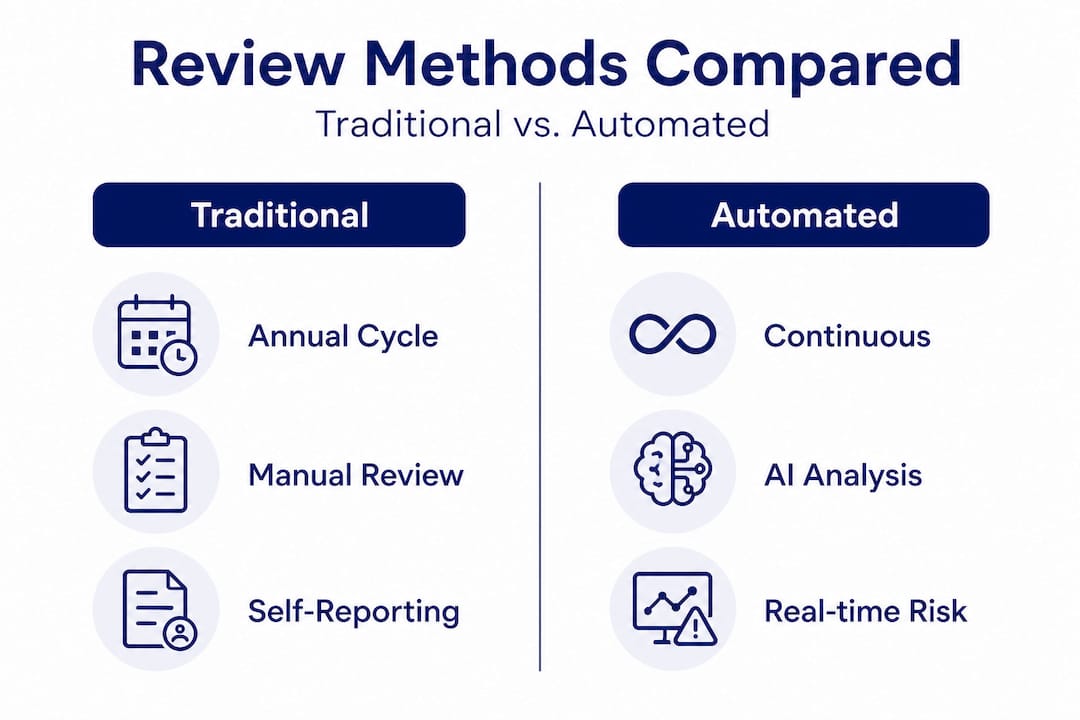
For CISOs specifically, the benefit isn't just speed. It's the ability to prioritize attention on genuine risk rather than administrative overhead. AI in risk assessments is making it realistic to cover a vendor portfolio of hundreds of organizations with a small security team. AI in process automation at the enterprise level has demonstrated measurable reductions in cycle time and human error across complex workflows, and vendor risk is no different.
Pro Tip: Start your modernization with your top 10 to 15 vendors by data access and operational dependency. Instrument continuous monitoring for those accounts first, then expand outward. This delivers immediate risk reduction where it matters most and builds internal momentum for broader program transformation. For workflow design, vendor security workflow tips offer concrete starting points for organizations at different maturity levels.
What experienced risk leaders have learned: Practical tips and common pitfalls
Risk leaders who have run third-party programs across multiple organizations and regulatory environments share a few consistent lessons. The most important one: a review program that doesn't change vendor behavior isn't a security program. It's an audit function.
Field-proven tips from experienced practitioners include:
- Prioritize ruthlessly. You cannot do deep technical reviews on 500 vendors with a team of five analysts. Rigorous tiering and triage are not shortcuts, they're the strategy.
- Negotiate before you sign. The best time to establish audit rights, security requirements, and incident notification obligations is during contract negotiation, not after a breach. Many organizations discover their right-to-audit clause is unenforceable only when they need it.
- Rotate questionnaire formats. Vendors who respond to the same form repeatedly start answering from memory rather than from actual practice. Rotating formats and adding scenario-based questions disrupts rote answers.
- Train your vendors, not just your team. Providing vendors with clear guidance on what you expect, and why, produces better responses and stronger security outcomes than adversarial audits alone.
- Build real escalation paths. If a vendor fails a critical control and nothing happens, your program loses credibility internally and externally. Document what happens when a vendor scores poorly, and enforce it.
Organizations that modernize their third-party review programs consistently report meaningful improvements in both efficiency and risk detection. The key data point is lead time: the gap between a vendor's security posture deteriorating and your organization detecting it. Traditional programs measure this gap in months. Modern, continuous programs measure it in days or hours.
Common pitfalls to avoid are equally predictable:
- Over-reliance on paperwork as a proxy for actual security controls.
- Ignoring fourth-party dependencies, which create concentrated, aggregated risk across your vendor portfolio.
- No defined remediation workflow, meaning findings sit in reports without driving action.
- Audit fatigue on both sides, where vendors stop engaging seriously because the process feels performative.
For practical program design, vendor management best practices and guidance on how to implement vendor risk programs with built-in controls are valuable reference points for teams at any stage of maturity.
Pro Tip: Create a short internal scorecard for each vendor that tracks not just their questionnaire score but their responsiveness, remediation rate, and historical incident record. Vendors who score well on paper but have poor responsiveness are a red flag worth tracking separately from their formal risk rating.
The uncomfortable truth about third-party security reviews few admit
Most third-party security programs exist primarily to satisfy auditors, not to stop attackers. That's not a cynical observation. It's the logical outcome of how these programs are typically resourced, measured, and incentivized. When the success metric for your program is "percentage of vendors with completed questionnaires," you've already optimized for documentation rather than defense.
Sophisticated attackers understand this dynamic better than most compliance teams do. They specifically target vendor ecosystems precisely because they know that most organizations apply far weaker scrutiny to their supply chain than to their own internal systems. The SolarWinds breach, the MOVEit attacks, and numerous other supply chain compromises succeeded not because technical controls failed but because third-party review programs were designed to pass audits rather than catch threats.
The shift from checklist theater to meaningful, data-driven assurance is happening, but unevenly. Organizations in regulated financial services and critical infrastructure are moving faster, partly because regulatory pressure is more intense and partly because the business consequences of a supply chain compromise are too severe to ignore. Smaller tech organizations, often with lighter compliance obligations, are still running programs that primarily generate paper.
The questionnaire impact insights that matter most come from organizations that treat security reviews as an input into real risk decisions, not a documentation exercise. CISOs who push for transformation, specifically by advocating for technical telemetry, continuous monitoring, and AI-driven workflow automation, are producing programs that actually reduce exposure. The ones who accept the status quo are producing programs that produce reports.
The question to ask your team today: if a critical vendor's security posture degraded significantly tomorrow morning, how long before you'd know? If the honest answer is "until next year's review," the program needs to change.
Empower your third-party review process with modern automation
Closing the gap between compliance documentation and genuine risk management requires tools designed for the actual scale and complexity of modern vendor ecosystems. Traditional manual processes simply can't keep pace.

Skypher's security questionnaire automation tool is built specifically for organizations that need to move faster, with more accuracy and less team burnout. With the ability to process even 200 questions in under a minute, integrations with over 40 TPRM platforms, and an AI recommendation engine that learns from your existing security content, Skypher dramatically reduces the time your team spends on questionnaire cycles without sacrificing depth or accuracy. The platform's trust center enables proactive, transparent communication with vendors and customers alike, shifting your program from reactive auditing toward continuous, collaborative assurance. If you're ready to stop generating reports and start reducing real exposure, Skypher is built for exactly that.
Frequently asked questions
How often should we conduct third-party security reviews?
Annual reviews are the baseline for critical vendors, but modern programs increasingly use continuous monitoring to close the point-in-time assessment gaps that leave organizations exposed between scheduled cycles.
What are the main risks of skipping third-party security reviews?
Without reviews, you leave your organization open to data breaches, regulatory penalties, operational disruption, and reputational damage, all stemming from vendor-side security failures that could have been identified and remediated.
Is compliance alone enough for vendor security?
No. Compliance-focused programs systematically underinvest in technical validation and real exposure measurement, creating documented programs that don't actually reduce attack surface.
What is fourth-party risk?
Fourth-party risk refers to the security exposure introduced when your vendors rely on their own subcontractors and service providers, expanding your supply chain threat surface well beyond the vendors you directly manage.