

TL;DR:
- Third-party vendors are the primary entry point for 59% of cyber breaches, costing an average of 4.45 million dollars.
- Traditional VRM methods like spreadsheets create blind spots; modern programs focus on continuous monitoring and risk tiering.
- Emerging risks include fourth-party, concentration, and AI-related vulnerabilities, requiring expanded visibility and contracts.
Third-party vendors are now the most common entry point for attackers targeting tech and finance organizations. 59% of organizations suffered a data breach caused by a third party in the past year, yet many compliance teams still treat vendor oversight as a secondary concern. The reality is that your security posture is only as strong as the weakest vendor in your ecosystem. This guide breaks down the real impact of vendor risk, why legacy approaches consistently fail, and what effective vendor risk management (VRM) looks like in practice for organizations that can't afford to get it wrong.
Table of Contents
- The real-world impact of vendor-related risk
- Why traditional approaches fall short: Regulatory, operational, and board pressures
- Key VRM strategies: From risk tiering to continuous monitoring
- Emerging challenges: Fourth parties, concentration, and AI risk
- What most organizations get wrong about vendor risk management
- Streamline vendor risk management with automated solutions
- Frequently asked questions
Key Takeaways
| Point | Details |
|---|---|
| Vendor risk shapes security | Most breaches and major disruptions now originate from vendors or their subcontractors. |
| Financial and compliance stakes | Vendor failures drive huge costs, regulatory fines, and board scrutiny. |
| Modern VRM strategies win | Risk tiering, continuous monitoring, and recognized frameworks address today's threats effectively. |
| Centralized management matters | Integrated VRM platforms outperform fragmented approaches in both results and efficiency. |
| Emerging risks require vigilance | Fourth-party exposures and AI-based vendor services are introducing new risk layers. |
The real-world impact of vendor-related risk
Vendor relationships create enormous value, but they also introduce exposure that most organizations underestimate until something goes wrong. The numbers are striking. 51% of breaches involved supply chain attacks from vendors, and the average cost of a third-party breach now sits at $4.45 million. That figure doesn't account for regulatory fines, reputational damage, or the operational downtime that follows a serious incident.
Understanding vendor risk management basics is the starting point, but the scope of exposure goes well beyond a single contract or integration. Consider the range of consequences organizations face:
- Financial losses from breach remediation, legal fees, and regulatory penalties
- Reputational harm when customer data is exposed through a vendor's systems
- Operational disruptions when a critical vendor goes offline or is compromised
- Regulatory scrutiny triggered by inadequate third-party controls
- Loss of client trust, which is especially damaging in financial services
Vendors are attractive targets precisely because they often hold privileged access to multiple clients at once. A single compromised vendor can become a launchpad for attacks across dozens of organizations simultaneously. This is the supply chain attack model, and it has become the preferred method for sophisticated threat actors.
| Consequence type | Frequency | Estimated impact |
|---|---|---|
| Data breach via vendor | 59% of orgs | $4.45M average cost |
| Supply chain attack | 51% of breaches | Multi-org exposure |
| Regulatory fine | Increasing | Varies by jurisdiction |
| Operational downtime | Common | Revenue and SLA loss |
The third-party risk data also shows that 70% of organizations experienced at least one third-party incident in the past year. That's not an edge case. That's the norm. Understanding third party risk meaning in this context means recognizing that vendor risk is not a compliance checkbox. It's an ongoing operational reality that demands structured, continuous attention.
"Vendor risk isn't a one-time assessment. It's a continuous relationship that requires the same rigor as your internal security program."
Why traditional approaches fall short: Regulatory, operational, and board pressures
Spreadsheets and annual questionnaires were never designed to handle the complexity of modern vendor ecosystems. Yet many organizations still rely on them. The problem isn't just inefficiency. It's that these methods create dangerous blind spots at exactly the moments when visibility matters most.

Regulatory pressure is intensifying. 76% of GDPR fines are tied to third-party failures, and DORA now impacts the vendor relationships of 85% of EU-based firms. Boards are demanding clear, auditable evidence that vendor risk is being managed, not just documented. Fragmented programs built on email threads and static spreadsheets can't produce that evidence reliably.
Here's how legacy approaches compare to modern VRM programs:
| Capability | Legacy approach | Modern VRM program |
|---|---|---|
| Risk visibility | Periodic, manual | Continuous, automated |
| Regulatory mapping | Ad hoc | Built-in compliance controls |
| Vendor coverage | High-profile vendors only | Tiered across all vendors |
| Board reporting | Inconsistent | Standardized dashboards |
| Audit readiness | Reactive | Always-on |
The security compliance pressures facing risk teams in 2026 are not slowing down. GDPR, DORA, SOC 2, and sector-specific regulations all require demonstrable controls over third-party access and behavior. When those controls live in disconnected spreadsheets, the gaps are inevitable.
Common pitfalls of outdated VRM methods include:
- Incomplete vendor inventories that miss shadow IT or informal vendor relationships
- Static risk ratings that don't reflect changes in a vendor's security posture
- Siloed ownership where procurement, IT, and legal each manage different pieces with no unified view
- Delayed response when a vendor incident occurs because there's no real-time alerting
- Audit failures caused by missing documentation or inconsistent assessment records
Pro Tip: Before investing in new VRM tools, audit your current vendor inventory. Most organizations discover they have 30 to 40% more active vendor relationships than their records show. That gap alone justifies a more structured approach to risk review processes.
For compliance officers navigating these pressures, the compliance officer guidance available today makes clear that the bar for acceptable VRM practice has risen sharply. Informal programs are no longer defensible under modern regulatory frameworks.
Key VRM strategies: From risk tiering to continuous monitoring
Effective VRM doesn't mean treating every vendor the same. It means knowing which vendors represent the highest risk and focusing your resources accordingly. Risk tiering is the foundation of any mature program.
Risk tiering means segmenting vendors based on factors like the sensitivity of data they access, the criticality of the services they provide, and their level of integration with your systems. A payroll processor with access to employee banking data sits in a completely different risk category than a vendor supplying office furniture. Treating them identically wastes resources and leaves your highest-risk relationships under-scrutinized.
Key strategies that work in 2026:
- Risk tiering and segmentation: Assign vendors to tiers (critical, high, medium, low) based on data access and service criticality. Focus deep assessments on Tier 1 vendors.
- Continuous monitoring: Move beyond annual reviews. Continuous monitoring reduces risks by up to 40% compared to point-in-time assessments.
- Standardized frameworks: NIST SP 800-161, ISO 27001, and FAIR provide reliable structures. See VRM methodologies for tech for how these apply in practice.
- Centralized governance: A single source of truth for all vendor data, contracts, risk scores, and assessment history enables faster decisions and cleaner audits.
- Lifecycle management: VRM doesn't end at onboarding. Controls must apply through the entire vendor relationship, including offboarding and data deletion.
"The organizations that manage vendor risk most effectively aren't the ones with the most tools. They're the ones with the clearest processes and the most consistent execution."
For practical examples of how these strategies play out, VRM real-world examples show how tech and finance teams apply tiering and monitoring in real vendor ecosystems. A solid vendor risk assessment guide can also help structure the assessment process for each tier.
Pro Tip: When building your tiering model, start with data classification. If a vendor touches regulated data (PII, financial records, health data), that alone should push them to a higher tier regardless of contract size or perceived relationship maturity.
Emerging challenges: Fourth parties, concentration, and AI risk
Most VRM programs focus on direct vendors. But the risk landscape has expanded well beyond that. Fourth-party risk, concentration risk, and AI-related vendor exposures are now real operational concerns that your program needs to address.
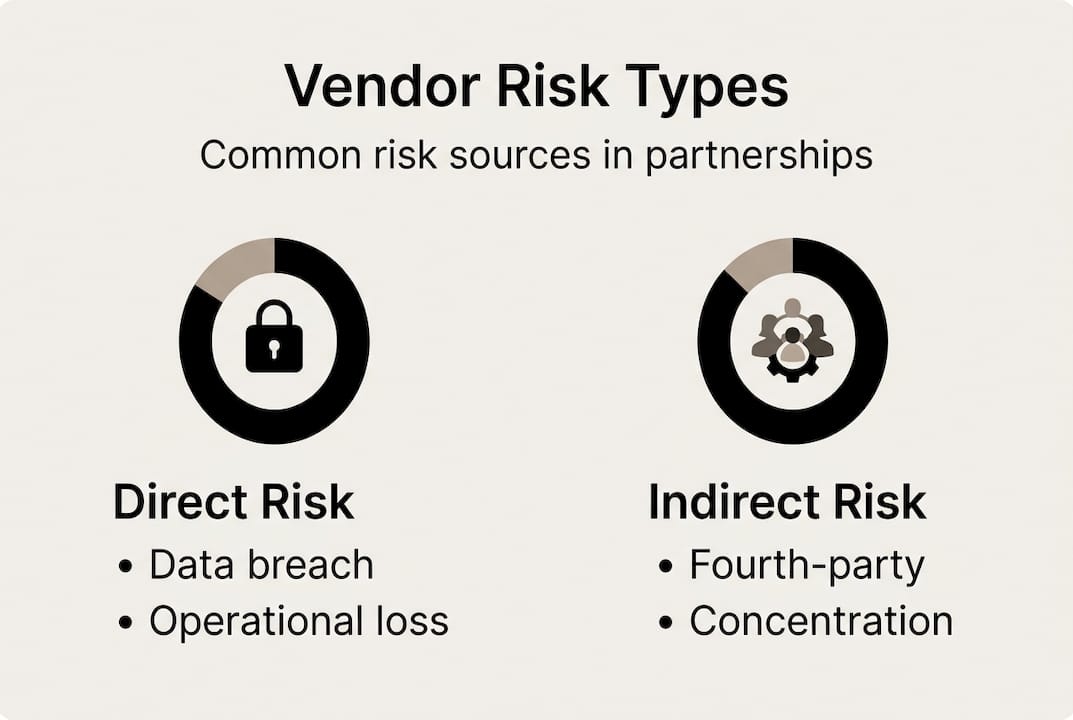
Fourth-party risk refers to the subcontractors and service providers that your vendors rely on. You may never have a direct relationship with them, but their failures can still reach you. 46% of incidents involved fourth-party risks, meaning the breach or disruption originated two levels removed from the affected organization. This is particularly relevant in cloud infrastructure, where a single provider failure can cascade across hundreds of clients.
Concentration risk is the exposure that comes from over-reliance on a single vendor or a small group of vendors for critical services. When many organizations share the same cloud provider, payment processor, or software platform, a single incident creates systemic risk across the sector. This is not hypothetical. Major cloud outages have disrupted financial services operations globally.
| Emerging risk type | Prevalence | Primary concern |
|---|---|---|
| Fourth-party exposure | 46% of incidents | Subcontractor blind spots |
| Concentration risk | Growing | Systemic sector disruption |
| AI model misuse by vendors | Increasing | Data privacy, model integrity |
| NBFI-specific exposure | Higher than banks | Lighter regulatory oversight |
AI risk in vendor offerings is a newer category that deserves serious attention. As vendors integrate AI into their products, questions arise about how your data is used to train models, whether outputs are auditable, and what happens when an AI-driven vendor decision causes harm. Non-bank financial institutions (NBFIs) face heightened exposure here because they often operate under lighter regulatory oversight than traditional banks, making them more attractive targets.
Best practices for addressing these emerging risks:
- Map your fourth-party ecosystem: Require key vendors to disclose their critical subcontractors and assess those relationships.
- Diversify critical services: Avoid single-vendor dependency for any service that would cause significant disruption if it failed.
- Add AI-specific clauses to contracts: Address data usage, model transparency, and liability for AI-driven errors.
- Assess NBFIs with extra scrutiny: Their lighter compliance burden can translate to weaker controls.
Pro Tip: Ask vendors directly which third-party services they rely on for delivering your contracted service. Most will answer honestly, and the response often reveals concentration risks you didn't know existed. Explore fourth party risk meaning and review how to start mitigating new VRM challenges before they escalate.
What most organizations get wrong about vendor risk management
Here's the uncomfortable truth: most organizations treat VRM as a documentation exercise rather than a risk management discipline. They accumulate tools, questionnaires, and spreadsheets without ever building a coherent program. The result is a lot of activity that produces very little actual risk reduction.
The teams that get VRM right share one trait. They prioritize ruthlessly. They know which vendors can cause the most damage, and they focus their energy there. They use true VRM integration across procurement, security, legal, and compliance rather than managing each function in isolation.
Centralized models consistently outperform fragmented ones. They produce better data, faster response times, and cleaner audit trails. More importantly, they give boards and executives the visibility they need to make informed decisions. Checkbox compliance might satisfy an auditor for a single cycle. A mature, centralized VRM program builds the organizational resilience that actually protects the business.
The shift from tool proliferation to process maturity is where real VRM progress happens. More questionnaires don't equal more security. Better processes, consistently applied, do.
Streamline vendor risk management with automated solutions
Managing vendor risk at scale requires more than good intentions. It requires infrastructure that can keep up with the volume, complexity, and pace of modern vendor ecosystems.

Skypher's AI security questionnaire automation helps risk and compliance teams respond to vendor security reviews faster and with greater accuracy, cutting the manual effort that slows down onboarding and reassessment cycles. With integrations across 40-plus TPRM platforms, real-time collaboration features, and automated review cycles, Skypher gives your team the tools to operationalize the strategies covered in this guide. Less time on paperwork means more time on the vendor relationships that actually need your attention.
Frequently asked questions
What are the top risks of vendor relationships in tech and finance?
The main risks include data breaches, supply chain attacks, regulatory penalties, and operational disruptions. 59% of organizations experienced a vendor-caused breach, and 51% of breaches involved supply chain attacks.
How can organizations identify high-risk vendors?
Use risk tiering based on data access and service criticality, combined with continuous monitoring for emerging threats. Continuous monitoring reduces vendor-related risks by up to 40%.
What frameworks should be used for effective vendor risk management?
NIST SP 800-161, NIST CSF, ISO 27001, and FAIR are the most widely adopted. Standardized frameworks like these give teams a consistent structure for assessing and mitigating vendor risks.
Why are fourth-party risks becoming important?
Subcontractors used by your primary vendors can introduce vulnerabilities you never directly assess. 46% of incidents involve fourth-party exposure, making subcontractor visibility a critical gap to close.
How does vendor risk management enhance operational productivity?
Centralized VRM reduces duplicated effort, speeds up compliance reviews, and cuts vendor-related disruptions. Centralized TPRM governance delivers better risk data, measurable cost savings, and the board-level confidence that supports faster business decisions.