

Managing third-party vendors has become one of the most critical challenges for compliance officers in tech and finance companies. A single vendor security breach can expose sensitive customer data, trigger regulatory penalties, and damage organizational reputation. With regulatory scrutiny intensifying in 2026 and supply chains growing more interconnected, vendor risk management is critical for compliance and operational integrity in tech and finance sectors. This guide delivers actionable strategies for building robust vendor risk programs, implementing efficient assessment processes, and leveraging automation to transform security questionnaire workflows from time-consuming bottlenecks into streamlined compliance assets.
Table of Contents
- Understanding Vendor Risk Management And Its Challenges
- Preparation: Prerequisites And Tools For Effective Vendor Risk Management
- Execution: Implementing An Effective Vendor Risk Management Process
- Verification And Continuous Monitoring For Sustained Vendor Risk Control
- Explore Skypher's Vendor Risk Management Solutions
- Frequently Asked Questions
Key takeaways
| Point | Details |
|---|---|
| Vendor risks are multifaceted | Third-party vendors introduce security, compliance, operational, and reputational risks that require systematic assessment and ongoing monitoring. |
| Preparation is foundational | Establishing governance policies, selecting risk frameworks, and implementing appropriate tools before vendor onboarding prevents costly gaps. |
| Automation transforms efficiency | AI-powered security questionnaire tools reduce response time from weeks to minutes while improving accuracy and consistency. |
| Continuous monitoring is essential | Annual assessments alone are insufficient as vendor risk profiles change with new threats, acquisitions, and operational shifts. |
| Integration drives success | Connecting vendor risk management with existing compliance workflows and technology platforms ensures sustainable program effectiveness. |
Understanding vendor risk management and its challenges
Vendor risk management encompasses the systematic identification, assessment, mitigation, and monitoring of risks introduced when organizations rely on third-party vendors, suppliers, and service providers. For tech and finance companies, where data sensitivity and regulatory obligations intersect, understanding what vendor risk management entails becomes mission-critical. The stakes extend beyond operational convenience to encompass customer trust, regulatory compliance, and competitive positioning.
Third-party vendors introduce several distinct risk categories that compliance officers must address:
- Security risks from inadequate cybersecurity controls that could expose sensitive data or create attack vectors into your network
- Compliance risks when vendors fail to meet industry regulations like SOC 2, GDPR, HIPAA, or PCI DSS requirements
- Operational risks including service disruptions, performance failures, or vendor financial instability affecting business continuity
- Reputational risks when vendor misconduct or data breaches reflect negatively on your organization
Tech and finance sectors face unique amplification of these challenges. Financial institutions handle massive volumes of personally identifiable information and transaction data while operating under strict regulatory oversight from bodies like the SEC, FINRA, and OCC. Technology companies often process data across global jurisdictions, manage complex cloud infrastructure dependencies, and face rapid innovation cycles that outpace traditional risk assessment methodologies.
The operational burden compounds these challenges. Compliance officers typically manage hundreds or thousands of vendor relationships simultaneously, each requiring initial due diligence, contract review, ongoing monitoring, and periodic reassessment. Security questionnaires alone can contain 200 or more questions across multiple frameworks, demanding subject matter expertise and cross-functional coordination to complete accurately. When vendor failures occur, whether through data breaches, service outages, or compliance violations, the impact cascades through your risk profile, potentially triggering regulatory investigations, customer notification requirements, and remediation costs.
Pro Tip: Map your vendor ecosystem by criticality and data access levels before diving into detailed assessments. This tiering approach allows you to allocate resources proportionally, focusing intensive due diligence on high-risk vendors while streamlining reviews for lower-risk relationships.
Preparation: prerequisites and tools for effective vendor risk management
Successful vendor risk management begins long before you evaluate your first vendor. The foundation rests on establishing clear governance structures, documented policies, and appropriate technological infrastructure. Organizations that skip this preparatory phase often find themselves conducting inconsistent assessments, missing critical risk factors, or struggling to scale their programs as vendor portfolios grow.
Establishing policies and governance creates the framework for all subsequent vendor risk activities. Your vendor management policies should define roles and responsibilities, establish risk tolerance thresholds, specify assessment frequencies based on vendor criticality, and outline escalation procedures for identified risks. Governance committees typically include representatives from compliance, legal, information security, procurement, and relevant business units to ensure cross-functional alignment.
Selecting appropriate risk assessment frameworks provides the methodology for evaluating vendors consistently. Common frameworks include:
- NIST Cybersecurity Framework for technology and security controls evaluation
- ISO 27001 standards for information security management systems
- COBIT for IT governance and management practices
- Industry-specific frameworks like PCI DSS for payment processors or HITRUST for healthcare vendors
Your chosen framework should align with your regulatory obligations, industry best practices, and organizational risk appetite. Many organizations adopt hybrid approaches, combining elements from multiple frameworks to address their specific risk landscape.
The technology landscape for vendor risk management spans manual processes, specialized platforms, and integrated automation solutions. Understanding the capabilities and limitations of each approach helps you build an appropriate toolset:
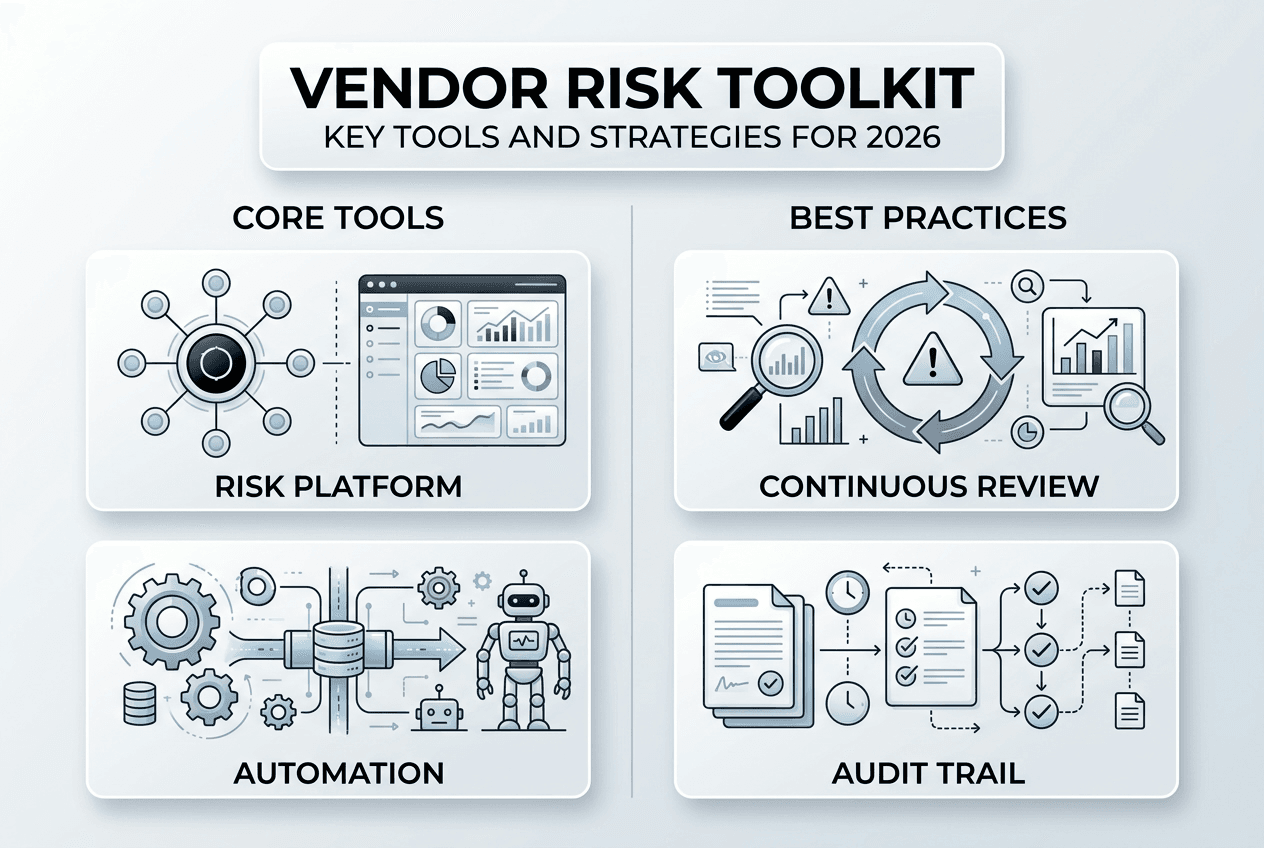
| Tool Category | Purpose | Key Benefit |
|---|---|---|
| Vendor risk platforms | Centralize vendor data, assessments, and documentation | Single source of truth for vendor relationships |
| Security questionnaire automation | Streamline completion of security assessments | Reduce response time from weeks to minutes |
| Contract management systems | Track vendor agreements and renewal dates | Ensure timely reviews and renegotiations |
| Continuous monitoring tools | Track vendor security posture and incidents | Enable proactive risk detection |
| Integration platforms | Connect vendor data across enterprise systems | Eliminate data silos and manual transfers |
The choice between manual spreadsheet-based tracking and sophisticated automation platforms depends on your vendor portfolio size, regulatory requirements, and available resources. Organizations managing fewer than 50 vendors might function adequately with manual processes, though they sacrifice efficiency and consistency. Those with hundreds or thousands of vendor relationships require automation to maintain program effectiveness without exponentially expanding headcount.
A comprehensive vendor risk assessment framework serves as your blueprint for evaluating vendors systematically. This framework should specify assessment criteria across security, compliance, operational, and financial dimensions, define scoring methodologies, establish evidence requirements, and outline remediation expectations for identified gaps.
Pro Tip: Align your vendor risk assessment criteria directly with your organizational compliance frameworks and regulatory obligations. This alignment ensures every assessment activity serves dual purposes of vendor evaluation and compliance documentation, maximizing efficiency while minimizing redundant work.
Execution: implementing an effective vendor risk management process
With preparation complete, executing your vendor risk management program involves systematic steps that transform policy into practice. The execution phase encompasses vendor identification, risk assessment, mitigation planning, and leveraging automation to eliminate bottlenecks that traditionally plague security questionnaire workflows.
Follow these steps to implement vendor management programs with effective risk control:
- Identify and inventory all third-party vendors across your organization, capturing key details like services provided, data access levels, contract terms, and business criticality.
- Categorize vendors into risk tiers based on factors like data sensitivity, regulatory scope, service criticality, and vendor security maturity.
- Conduct initial risk assessments appropriate to each vendor tier, with high-risk vendors receiving intensive due diligence and lower-risk vendors undergoing streamlined reviews.
- Issue security questionnaires tailored to vendor type and risk level, requesting evidence of security controls, compliance certifications, and operational practices.
- Review vendor responses against your assessment framework, identifying gaps, requesting clarification, and validating claims with supporting documentation.
- Develop risk mitigation plans for identified gaps, which may include contractual requirements, additional controls, insurance provisions, or acceptance of residual risk.
- Document assessment findings, risk decisions, and mitigation plans in your vendor risk platform for ongoing reference and audit trails.
- Establish monitoring cadences based on vendor risk tier, with high-risk vendors reviewed quarterly or semi-annually and lower-risk vendors assessed annually.
Security questionnaires represent one of the most time-intensive elements of vendor risk assessment. The traditional manual approach involves sending questionnaires via email, waiting days or weeks for responses, manually reviewing answers for completeness and accuracy, following up on gaps, and consolidating information across multiple formats and platforms. This workflow creates significant delays in vendor onboarding, consumes substantial staff time, and introduces consistency issues when different team members interpret questions or evaluate responses differently.

Automating security questionnaires significantly reduces time and error in vendor evaluations. Modern automation platforms leverage AI to parse questionnaires in any format, map questions to your existing documentation and previous responses, generate accurate answers in minutes, and maintain centralized knowledge bases that improve with each use.
| Aspect | Manual Process | Automated Process |
|---|---|---|
| Time to complete 200-question assessment | 2-3 weeks | Under 1 hour |
| Accuracy and consistency | Variable by team member | Standardized across all responses |
| Knowledge retention | Scattered across emails and files | Centralized in searchable database |
| Scalability | Requires proportional headcount growth | Handles volume increases without additional staff |
| Integration capability | Manual data transfer between systems | API connections to 30+ platforms |
The efficiency gains from automation extend beyond time savings. Automated platforms provide version control for policy updates, audit trails showing who answered what and when, collaboration features enabling real-time input from subject matter experts, and analytics identifying common question patterns or areas requiring documentation improvements.
Implementing automation requires selecting a platform that integrates with your existing technology stack, migrating historical vendor data and documentation, training team members on new workflows, and establishing governance for maintaining your knowledge base accuracy. The initial investment pays dividends through faster vendor onboarding, reduced compliance staff burnout, and improved ability to mitigate vendor management risks effectively.
Pro Tip: Start your automation journey by documenting your 50 most frequently asked security questionnaire questions and their approved answers. This foundational knowledge base delivers immediate value while you build out more sophisticated automation capabilities.
Verification and continuous monitoring for sustained vendor risk control
Completing initial vendor assessments represents just the beginning of effective vendor risk management. Verification activities ensure assessment accuracy while continuous monitoring detects emerging risks before they materialize into incidents. Organizations that treat vendor risk as a one-time checkbox exercise rather than an ongoing discipline consistently face preventable vendor-related incidents.
Key verification and monitoring activities include:
- Validating vendor-provided certifications and attestations by reviewing actual audit reports rather than accepting summary claims
- Conducting periodic on-site or virtual audits for high-risk vendors to observe controls in practice
- Monitoring vendor security posture through threat intelligence feeds, breach databases, and security rating services
- Tracking vendor financial health through credit reports and financial statement analysis to identify stability risks
- Reviewing vendor incident reports and breach notifications to assess response capabilities and control effectiveness
- Updating risk assessments when vendors undergo significant changes like acquisitions, leadership transitions, or service expansions
Common pitfalls undermine even well-designed monitoring programs. Organizations frequently fail to act on monitoring signals, collecting data without defined response protocols. Assessment fatigue leads teams to rush through reviews or accept incomplete vendor responses rather than pursuing thorough documentation. Siloed information prevents compliance teams from learning about vendor issues identified by other departments like IT operations or customer support.
The importance of updating risk assessments cannot be overstated. Vendor risk profiles are dynamic, not static. A vendor with excellent security controls today might experience leadership changes, budget cuts, or acquisition by a less security-focused parent company that fundamentally alters their risk profile. New vulnerabilities emerge, regulatory requirements evolve, and your own use of vendor services may expand into higher-risk applications over time.
Continuous monitoring of vendors is essential for timely risk detection and compliance, transforming vendor risk management from periodic snapshots into real-time risk intelligence that enables proactive intervention before issues escalate into crises.
Establishing efficient monitoring workflows requires balancing thoroughness with resource constraints. Automated monitoring tools track vendor security ratings, certificate expirations, and public breach disclosures without manual effort. Integration between your vendor risk platform and operational systems surfaces relevant signals like performance degradation or support ticket trends that might indicate underlying problems. Regular touchpoints with critical vendors through quarterly business reviews create opportunities to discuss risk topics alongside operational matters.
Documentation remains critical throughout the verification and monitoring phase. Audit trails showing when assessments were conducted, what findings emerged, how risks were addressed, and who made key decisions provide essential evidence for regulatory examinations and internal audits. Your documentation should tell a coherent story of risk-based decision making rather than presenting disconnected data points.
Following best practices for vendor management ensures your monitoring program remains sustainable and effective as your vendor portfolio grows. These practices include defining clear ownership for vendor relationships, establishing escalation paths for identified risks, conducting regular program reviews to identify process improvements, and investing in team training to maintain assessment quality as personnel changes occur.
Explore Skypher's vendor risk management solutions
The strategies outlined in this guide deliver maximum value when supported by purpose-built technology that eliminates manual bottlenecks and scales with your vendor portfolio. Skypher's AI-powered platform transforms security questionnaire workflows from weeks-long ordeals into streamlined processes completed in minutes. Our proprietary AI models parse questionnaires in any format, map questions to your documentation automatically, and generate accurate responses that maintain consistency across your entire vendor portfolio.

Compliance officers using Skypher's automation tools report 90% time savings on security questionnaires while improving response accuracy and audit readiness. Our platform integrates with over 30 third-party risk management systems, connects to your existing documentation in Confluence, SharePoint, and Google Drive, and provides real-time collaboration features that bring subject matter experts into the process seamlessly. Explore how Skypher can transform your vendor risk management program from a compliance burden into a strategic advantage.
Frequently asked questions
How do I start a vendor risk management program in my company?
Begin by establishing governance policies that define roles, responsibilities, and risk tolerance levels for vendor relationships. Identify and inventory your current vendors, categorizing them by criticality and data access to prioritize assessment efforts. Select a risk assessment framework appropriate to your industry and regulatory requirements, then conduct initial assessments starting with your highest-risk vendors.
What are the benefits of automating security questionnaires?
Automation reduces response time and minimizes errors in security questionnaires by leveraging AI to generate consistent, accurate answers from your centralized knowledge base. You can complete assessments in under an hour rather than waiting weeks, freeing compliance staff to focus on risk analysis and vendor relationship management instead of repetitive data entry. Automated platforms also improve audit readiness through comprehensive documentation and version control.
How often should vendor risk assessments be updated?
Annual reviews represent the baseline for most vendor relationships, with high-risk vendors requiring quarterly or semi-annual reassessments. Regular updates to vendor risk profiles are critical due to evolving threats and changes in vendor operations. Trigger additional assessments when vendors undergo significant changes like acquisitions, leadership transitions, security incidents, or expansions of services they provide to your organization.
What should I include in a vendor risk assessment?
Your assessment should evaluate security controls including data encryption, access management, and incident response capabilities. Review compliance certifications relevant to your industry such as SOC 2, ISO 27001, or PCI DSS. Assess operational factors like business continuity planning, financial stability, and service level agreement terms. Document findings, assign risk scores, and develop mitigation plans for identified gaps.
How does vendor risk management differ between tech and finance companies?
Both sectors face stringent regulatory requirements and handle sensitive data, but finance companies operate under prescriptive regulations from bodies like the OCC and SEC with specific vendor management expectations. Tech companies often deal with more diverse vendor types including cloud infrastructure providers, API services, and open source dependencies. Finance focuses heavily on operational resilience and third-party oversight, while tech emphasizes data protection and intellectual property considerations.