

Organizations face an average of 12 third-party breaches per year, yet only 36% of vendors undergo proper security assessments. This gap reveals a critical vulnerability in how we manage vendor risk. Security questionnaires serve as the frontline defense in evaluating third-party relationships, but their effectiveness remains hotly debated among compliance professionals. This guide examines both the limitations and best practices that can transform questionnaires from checkbox exercises into genuine risk management tools.
Table of Contents
- What security questionnaires are: purpose and scope
- The risks security questionnaires address—and where they fall short
- Recognizing edge cases and adapting questionnaires for high-risk vendors
- Modern solutions: automation, trust centers, and integrating external metrics
- Key takeaways for actionable security questionnaire strategies
- Upgrade your questionnaire process with AI-driven tools
- Frequently asked questions
Key Takeaways
| Point | Details |
|---|---|
| Assessment gaps persist | Even with frequent questionnaires, most organizations only assess a fraction of their vendors, creating risk blind spots. |
| Manual methods lag | Manual questionnaire workflows are slow and unreliable—automation and real-time evidence are now vital. |
| Customization is crucial | Standard questionnaires do not address all vendor risks, so tailoring for high-risk and industry-specific scenarios is key. |
| Best practices drive value | Combining automation, trust centers, and external metrics boosts security and compliance program effectiveness. |
| Next steps for teams | Implement smarter workflows, reassess vendors regularly, and leverage AI tools to streamline security questionnaire management. |
What security questionnaires are: purpose and scope
Security questionnaires function as standardized screening tools that help organizations evaluate vendor security postures before granting system access or sharing sensitive data. They serve three primary goals: assessing potential risks, validating existing security controls, and meeting regulatory compliance requirements.
These assessments typically cover IT infrastructure, cloud services, and any vendor touchpoints involving financial or customer data. For tech and finance organizations, questionnaires often represent the entry point for deeper security reviews. When a vendor passes initial screening, more rigorous evaluations like penetration testing or on-site audits may follow.
The scope varies dramatically based on vendor criticality. A marketing software provider might face 50 questions about data handling, while a payment processor could receive 300 questions covering encryption standards, incident response procedures, and disaster recovery protocols.
Here's what effective questionnaires typically assess:
- Access controls: Authentication methods, privilege management, and user monitoring
- Data protection: Encryption standards, backup procedures, and retention policies
- Incident response: Detection capabilities, response times, and communication protocols
- Compliance certifications: SOC 2, ISO 27001, PCI DSS, and industry-specific standards
Despite widespread use, research shows organizations assess only 36% of vendors, while 43% of assessed vendors require security remediation. This disconnect highlights why understanding questionnaire fundamentals matters for building robust vendor risk programs.
Pro Tip: Start with a tiered approach. Classify vendors by risk level and deploy questionnaires proportional to their access and data sensitivity. Low-risk vendors might need 20 questions, while critical vendors warrant 200.
For organizations seeking to modernize their approach, AI-driven questionnaire essentials offer frameworks that balance thoroughness with efficiency.
The risks security questionnaires address—and where they fall short
Questionnaires target specific threats that keep security teams awake at night: data breaches through vendor systems, regulatory violations from inadequate controls, and operational disruptions from non-responsive partners. When executed properly, they create accountability and establish baseline security expectations.

Yet the reality often disappoints. Only 34% of third-party risk management professionals trust self-reported questionnaire answers, citing concerns about accuracy and timeliness. Point-in-time snapshots become outdated quickly, especially in dynamic cloud environments where configurations change weekly.
| Risk Category | Annual Breach Frequency | Vendors Assessed | Remediation Required |
|---|---|---|---|
| Data breaches | 12 per organization | 36% | 43% |
| Compliance gaps | 8 per organization | 28% | 51% |
| Access violations | 15 per organization | 22% | 38% |
The fundamental problem? Security questionnaires can create compliance theater rather than genuine security improvements. Vendors learn to provide answers that pass screening without necessarily implementing robust controls. A vendor might claim 256-bit encryption while using outdated cipher suites, or report annual penetration testing that happened three years ago.
Resource constraints compound these issues. Security teams spend hundreds of hours annually processing questionnaires, leaving little time for meaningful analysis. The manual nature of traditional questionnaires creates bottlenecks that slow vendor onboarding and frustrate both parties.
Common pitfalls include:
- Static assessments: Annual questionnaires miss real-time security changes
- Self-reporting bias: Vendors overstate capabilities or misunderstand questions
- Checkbox mentality: Teams focus on completion rather than risk analysis
- Inconsistent standards: Different questionnaires ask similar questions differently
"Traditional questionnaires provide a false sense of security. Organizations believe they're protected because vendors answered questions, but those answers rarely reflect current security posture."
Pro Tip: Supplement questionnaires with external security ratings from services like SecurityScorecard or BitSight. These provide independent, continuous monitoring that catches issues self-assessments miss.
Organizations looking to streamline questionnaire responses while maintaining rigor should consider hybrid approaches that combine automation with targeted human review. This strategy addresses efficiency without sacrificing thoroughness.
The path forward involves overcoming questionnaire challenges through smarter workflows that prioritize evidence-based verification over self-reported claims.
Recognizing edge cases and adapting questionnaires for high-risk vendors
Standard questionnaires work reasonably well for low-risk vendors like office supply providers or marketing consultants. They fail spectacularly for high-risk scenarios involving operational technology, healthcare data, or financial systems. High-risk vendors require deeper verification including penetration tests, third-party audits, and industry-specific assessments.
Operational technology environments present unique challenges. A vendor managing industrial control systems needs questions about physical security, network segmentation, and safety protocols that generic IT questionnaires never address. Similarly, healthcare vendors must demonstrate HIPAA compliance through technical safeguards that go far beyond standard security practices.
| Assessment Type | Vendor Risk Level | Question Count | Verification Method | Update Frequency |
|---|---|---|---|---|
| Lite Assessment | Low | 20-50 | Self-reported | Annual |
| Standard Assessment | Medium | 100-150 | Self-reported + spot checks | Semi-annual |
| Deep Assessment | High | 200-300 | Audits + pentests + continuous monitoring | Quarterly |
Recognizing when to escalate from standard to deep assessments requires clear criteria. Trigger deeper reviews when vendors:
- Access production systems or databases containing customer information
- Process payment data or handle financial transactions
- Store regulated data subject to GDPR, HIPAA, or PCI DSS requirements
- Provide critical services where downtime directly impacts operations
- Operate in high-risk sectors like healthcare, finance, or critical infrastructure
Adapting questionnaires for these scenarios means adding industry-specific sections. A financial services vendor needs questions about transaction monitoring and fraud detection. A healthcare vendor requires detailed HIPAA technical safeguard documentation. Generic questionnaires miss these nuances entirely.
Pro Tip: Create questionnaire templates for each vendor tier and industry vertical. This approach maintains consistency while ensuring relevant coverage for specialized risks.
Successful vendor management programs build flexibility into their assessment frameworks, allowing security teams to scale rigor based on actual risk rather than applying one-size-fits-all approaches.
Implementing vendor management best practices means establishing clear escalation criteria and maintaining specialized questionnaire libraries that address sector-specific requirements without reinventing the wheel for each assessment.
Modern solutions: automation, trust centers, and integrating external metrics
The questionnaire landscape is evolving rapidly. Forward-thinking organizations are shifting from manual checkboxes to financial risk metrics using frameworks like FAIR (Factor Analysis of Information Risk), which quantify potential losses in dollar terms rather than vague risk scores.
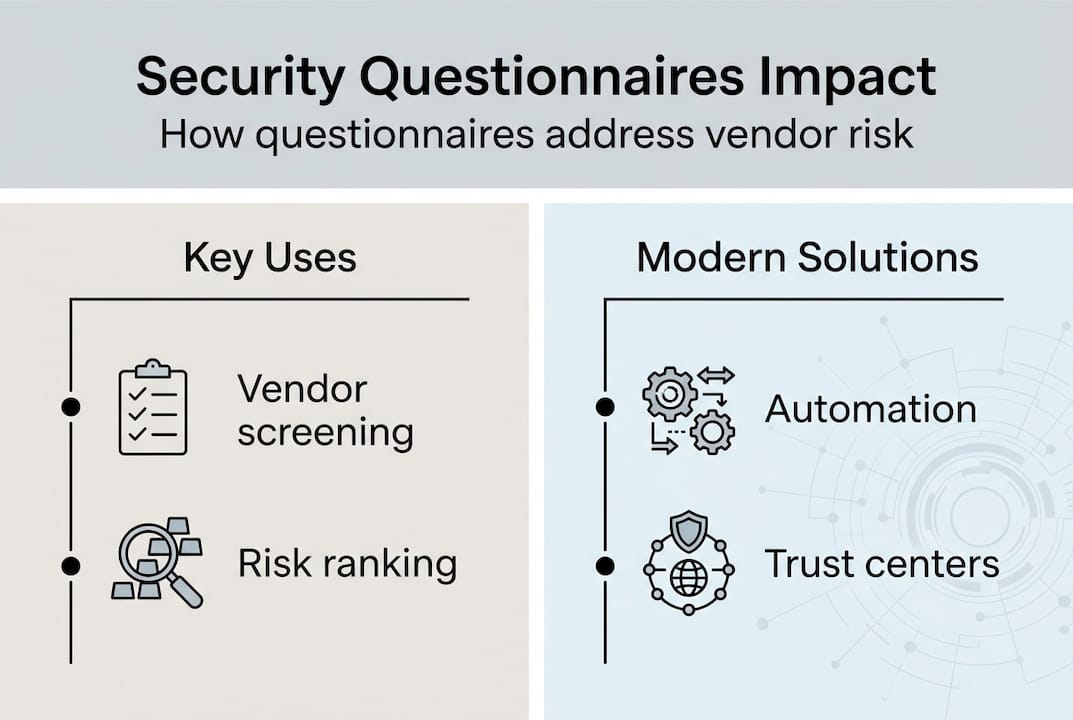
Automation addresses the resource drain that plagues traditional questionnaire programs. AI-powered platforms parse vendor responses, flag inconsistencies, and suggest follow-up questions based on risk indicators. This technology doesn't replace human judgment but amplifies it, allowing security professionals to focus on analysis rather than data entry.
AI-hybrid approaches combine automation with expert oversight. Machines handle routine questions about certifications and standard controls, while humans dive deep into complex areas like incident response procedures or business continuity planning. This division of labor can reduce questionnaire processing time by 95% while improving accuracy.
Trust centers represent another breakthrough. Instead of answering the same questions repeatedly, vendors publish security documentation, certifications, and audit reports in a centralized portal. Prospective customers review this evidence directly, deflecting many questionnaires entirely. When questions remain, they focus on gaps rather than rehashing publicly available information.
External metrics provide the continuous monitoring that point-in-time questionnaires lack. Security rating services scan vendor networks for vulnerabilities, misconfigurations, and exposed credentials. These independent assessments catch issues that self-reported questionnaires miss, like unpatched systems or leaked credentials on the dark web.
Practical implementation steps:
- Start with automation: Implement tools that pre-populate answers from previous questionnaires and internal documentation
- Build evidence libraries: Centralize security artifacts like SOC 2 reports, penetration test results, and policy documents
- Deploy trust centers: Publish security information proactively to reduce inbound questionnaire volume
- Integrate external ratings: Subscribe to security rating services for continuous vendor monitoring
- Establish hybrid workflows: Define which questions require human review versus automated responses
Organizations implementing these approaches report dramatic improvements. Questionnaire automation cuts compliance time by up to 95%, freeing security teams for strategic risk management rather than administrative tasks.
The AI advantages for questionnaires extend beyond speed. Machine learning models identify patterns across thousands of assessments, flagging vendors whose responses deviate from industry norms or contain red flags that human reviewers might miss.
For teams ready to modernize, automating questionnaire responses provides immediate relief while building toward more sophisticated risk management capabilities.
Key takeaways for actionable security questionnaire strategies
Transforming questionnaires from compliance burdens into strategic risk tools requires deliberate changes to process, technology, and mindset. Empirical data and expert perspectives demonstrate that automation and targeted questionnaires vastly improve risk management outcomes.
Five actionable takeaways:
- Tier your vendors: Apply assessment rigor proportional to actual risk rather than treating all vendors identically
- Automate ruthlessly: Use AI to handle routine questions and flag anomalies requiring human attention
- Verify independently: Supplement self-reported answers with external security ratings and continuous monitoring
- Publish proactively: Create trust centers that deflect repetitive questionnaires by providing evidence upfront
- Update continuously: Move from annual snapshots to ongoing assessments that reflect current security postures
| Best Practice | Implementation | Common Pitfall | Avoidance Strategy |
|---|---|---|---|
| Risk-based tiering | Classify vendors by data access and criticality | Treating all vendors equally | Create clear tier definitions with specific criteria |
| Automation adoption | Deploy AI tools for response management | Over-relying on automation without human oversight | Establish hybrid workflows with defined escalation points |
| Evidence verification | Require certifications and third-party audits | Accepting self-reported claims at face value | Integrate external security ratings and spot audits |
| Continuous monitoring | Implement real-time security scanning | Annual assessments that miss interim changes | Subscribe to continuous monitoring services |
| Trust center deployment | Publish security documentation centrally | Answering same questions repeatedly | Maintain updated evidence library with easy access |
The organizations seeing the greatest success combine these elements into cohesive programs. They recognize questionnaires as one tool among many, not a complete risk management solution. By supplementing questionnaires with external data, automation, and continuous monitoring, they build vendor risk programs that actually reduce incidents rather than just documenting compliance.
Implementing smarter workflows starts with understanding how to answer security questionnaires effectively, then building systems that scale those best practices across your entire vendor portfolio.
Upgrade your questionnaire process with AI-driven tools
The strategies outlined above work best when supported by purpose-built technology. Manual questionnaire management simply can't deliver the speed, accuracy, and scalability that modern vendor risk programs demand.
Skypher's security questionnaires automation platform addresses these challenges directly. Our AI models parse questionnaires in any format, automatically populate answers from your evidence library, and flag questions requiring expert review. Teams complete assessments in minutes rather than days, while maintaining higher accuracy than manual processes.

The AI-powered recommendation engine learns from your previous responses, suggesting optimal answers based on context and risk profile. This ensures consistency across assessments while adapting to nuanced questions that require customized responses. Integration with over 40 third-party risk management platforms means questionnaires flow seamlessly through your existing workflows.
For organizations managing multiple products or entities, easy import and export workflows handle complex scenarios without manual data manipulation. Whether you're responding to 10 questionnaires monthly or 100, the platform scales effortlessly while maintaining the evidence-based rigor that builds customer trust.
Frequently asked questions
Why do so many security questionnaires fail to accurately measure risk?
Most questionnaires rely on self-reported point-in-time snapshots that only 34% of professionals trust, making them prone to inaccuracy unless supplemented by continuous monitoring and independent verification.
How can organizations streamline security questionnaire responses?
Implementing AI-powered automation and trust centers can reduce manual work and response time, increasing efficiency by up to 95% while improving answer consistency and accuracy across assessments.
What types of vendors need deeper verification beyond standard questionnaires?
High-risk vendors who access sensitive systems or data require deeper checks like penetration tests, third-party audits, and continuous security monitoring rather than relying solely on self-reported questionnaire responses.
What is the recommended frequency for reassessing vendor security?
Annual reassessments remain standard, but continuous monitoring is increasingly recommended for dynamic environments where security postures change rapidly between formal assessment cycles.
Recommended
- How to Answer Security Questionnaires Effectively
- Security questionnaire tips: streamline responses in 2025
- Questions About Security – Key Impacts for Modern Organizations
- The ever growing number of security questionnaires and what you and your company can do to face it
- Site Security – Why It Matters For Your Business | Kickass Online