

Vendor security evaluations drain resources and slow down procurement. Security and compliance teams face mounting pressure to assess third-party risks accurately while keeping pace with business demands. A structured workflow transforms this challenge into a repeatable, efficient process that protects your organization without becoming a bottleneck. This guide walks you through a proven approach from initial preparation to ongoing verification, helping you build a vendor security evaluation system that scales with your needs.
Table of Contents
- Key Takeaways
- Preparing your vendor security evaluation
- Executing the vendor security evaluation workflow
- Verifying and maintaining vendor security post-evaluation
- Enhance your vendor security evaluations with Skypher
- FAQ
Key Takeaways
| Point | Details |
|---|---|
| Structured evaluation workflow | Using a documented and repeatable workflow reduces bottlenecks and scales vendor risk assessments across the procurement process. |
| Preparation drives efficiency | Clearly define security requirements and classify vendors by risk level to determine the appropriate depth of review. |
| Risk classification framework | Gather necessary documentation, assign ownership, and set realistic timelines to keep evaluations on track. |
| Standardized evaluation criteria | Set up clear communication protocols and a single point of contact to improve collaboration and provide an auditable history. |
Preparing your vendor security evaluation
Effective vendor security evaluations start with clearly defined requirements and risk classification. Before you send a single questionnaire, you need to establish what security controls matter most to your organization and which vendors warrant deeper scrutiny.
Start by documenting your organization's security requirements. These should align with your risk appetite, regulatory obligations, and industry standards. A fintech company will prioritize data encryption and access controls differently than a healthcare provider focused on HIPAA compliance. Your requirements become the foundation for every assessment decision that follows.
Next, classify vendors by risk level. Not every vendor deserves the same level of scrutiny. A marketing analytics tool that never touches customer data requires less rigorous evaluation than a cloud infrastructure provider hosting your production databases. Create clear criteria for high, medium, and low risk categories:
- High risk: Access to sensitive data, critical business functions, or regulatory scope
- Medium risk: Limited data access, indirect business impact, or established security certifications
- Low risk: No data access, minimal integration, or commodity services with standard controls
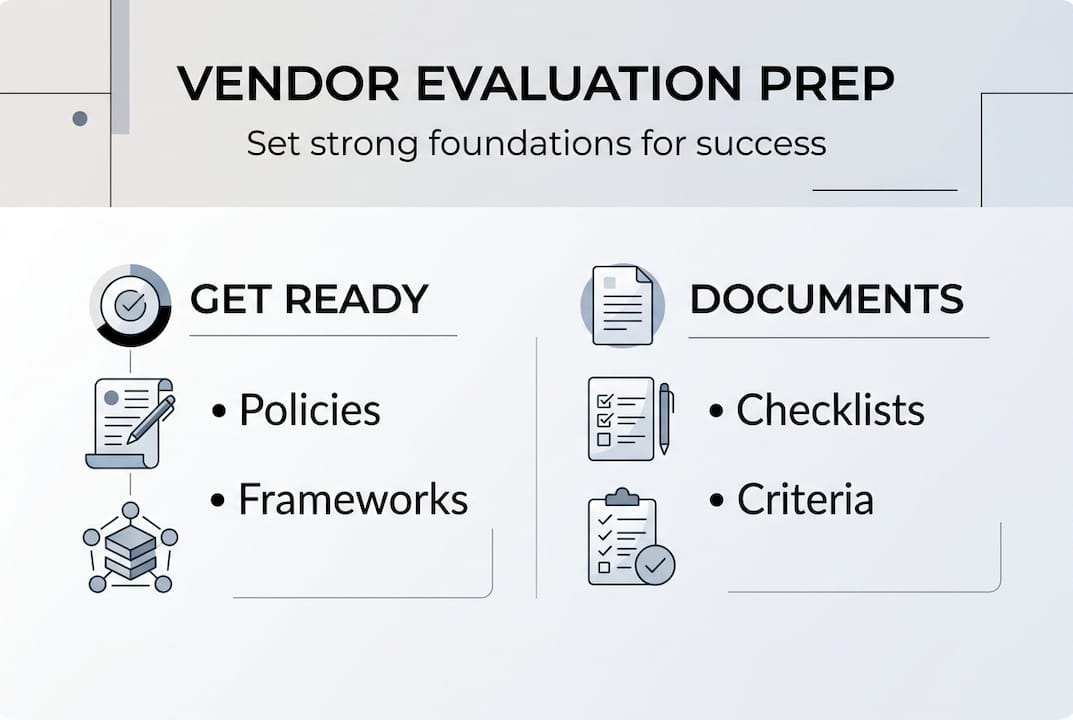
Gather necessary documentation before launching evaluations. This includes your security policies, compliance frameworks, and templates for questionnaires and risk assessments. Assign clear ownership for each step in the process. Someone needs to coordinate with vendors, another person reviews technical responses, and a decision maker approves or rejects based on findings.
Define evaluation criteria and timelines upfront. Vendors need to know what you expect and when you need responses. Set realistic deadlines that give vendors enough time to gather information without dragging out your procurement cycle. Most organizations allow 10-14 business days for initial questionnaire completion.
Establish communication protocols before assessments begin. Create a single point of contact for vendor questions. Use a shared inbox or ticketing system to track all interactions. This prevents confusion and ensures you have a complete audit trail if questions arise later.
Pro Tip: Build a risk matrix that maps vendor categories to specific evaluation requirements. High-risk vendors might require SOC 2 reports, penetration test results, and detailed technical questionnaires, while low-risk vendors complete a simplified assessment. This prevents over-engineering evaluations for low-impact relationships.
Here's a sample risk classification framework:
| Risk Level | Data Access | Business Impact | Required Documentation | Reassessment Frequency |
|---|---|---|---|---|
| High | PII, financial, or health data | Critical systems or revenue-generating functions | SOC 2, penetration tests, detailed questionnaire | Annual |
| Medium | Aggregated or anonymized data | Important but non-critical functions | Security questionnaire, certifications | Every 2 years |
| Low | No sensitive data | Minimal business impact | Basic security attestation | Every 3 years or on renewal |
This preparation phase sets the stage for efficient execution. You'll waste less time debating which questions to ask or how thoroughly to review responses when you've already established clear criteria and processes. Implementing vendor management programs becomes systematic rather than reactive, and your team can focus on analysis instead of administrative coordination. Following best practices for vendor management ensures your preparation translates into measurable efficiency gains.
Executing the vendor security evaluation workflow
With preparation complete, you're ready to conduct thorough assessments efficiently. The execution phase follows five distinct steps that transform raw vendor information into actionable risk decisions.

Step 1: Distribute standardized security questionnaires tailored to vendor risk level. High-risk vendors receive comprehensive questionnaires covering access controls, encryption, incident response, business continuity, and compliance certifications. Medium-risk vendors answer a subset focused on their specific integration points. Low-risk vendors complete abbreviated assessments confirming basic security hygiene. Standardization ensures you collect comparable data across all vendors while avoiding unnecessary burden on lower-risk relationships.
Step 2: Collect and review supporting documentation such as SOC 2 reports, ISO certifications, and penetration test results. Don't just accept that vendors have these documents. Review them for scope, recency, and relevance to your specific use case. A SOC 2 Type II report from 18 months ago tells you about historical controls, not current security posture. Look for recent reports and verify they cover the services you're actually using.
Step 3: Use automated tools to streamline data collection and initial risk scoring. Automation tools and standardized questionnaires improve accuracy and speed of vendor assessments. Manual spreadsheet tracking becomes unmanageable once you're evaluating dozens of vendors annually. Automation platforms parse questionnaire responses, flag high-risk answers, and calculate preliminary risk scores based on your predefined criteria. This frees your team to focus on nuanced analysis rather than data entry.
Step 4: Perform detailed risk analysis factoring in questionnaire results, supporting documentation, and external intelligence. Cross-reference vendor responses against publicly available information. Has the vendor disclosed any recent breaches? Do security researchers report vulnerabilities in their products? Combine quantitative scores with qualitative judgment to build a complete risk picture.
Step 5: Document findings and escalate critical risks for remediation or rejection. Create a standardized report template that captures key findings, risk ratings, and recommended actions. High-risk findings require immediate attention and may block vendor approval until addressed. Medium-risk issues become contractual requirements or ongoing monitoring items. Low-risk findings get documented but don't prevent vendor onboarding.
Pro Tip: Create a decision matrix that maps risk scores to approval authority levels. Scores below a certain threshold can be approved by security analysts. Mid-range scores require manager review. High-risk vendors need executive sign-off. This speeds decisions while maintaining appropriate oversight.
Comparing manual versus automated approaches reveals significant efficiency differences:
| Aspect | Manual Process | Automated Process |
|---|---|---|
| Questionnaire distribution | Email attachments, version control issues | Centralized portal, automatic tracking |
| Response collection | Chasing vendors via email | Automated reminders, real-time status |
| Initial review | Line-by-line spreadsheet analysis | AI-powered risk flagging and scoring |
| Documentation storage | Scattered files and email threads | Centralized repository with audit trail |
| Time to complete (200 questions) | 8-12 hours | Under 1 hour with AI assistance |
| Error rate | 15-20% due to manual data entry | Under 5% with automated validation |
The efficiency gains compound as you scale. Evaluating 10 vendors manually might be manageable. Evaluating 100 vendors requires automation to maintain quality and speed. Top security questionnaire automation tools have evolved significantly, offering features like natural language processing to understand vendor responses and recommendation engines that suggest risk ratings based on historical patterns.
Integration with your existing tools matters. Look for platforms that connect to your procurement systems, contract management tools, and risk dashboards. Data should flow seamlessly without manual exports and imports. When a vendor completes a questionnaire, that information should automatically update your vendor risk register and trigger appropriate workflows.
Understanding how to answer security questionnaires from the vendor perspective also helps you design better evaluation processes. Vendors appreciate clear questions, reasonable timelines, and minimal duplication. The easier you make it for vendors to provide accurate information, the better data you'll receive for your risk decisions.
Verifying and maintaining vendor security post-evaluation
Approving a vendor isn't the end of your security responsibility. Continuous monitoring and scheduled reassessments reduce risk exposure from third parties. Security postures change as vendors grow, get acquired, or face new threats. Your verification and maintenance processes ensure you catch deteriorating security before it impacts your organization.
Establish periodic reassessment schedules based on vendor risk classification. High-risk vendors warrant annual reviews at minimum. Some organizations reassess critical vendors every six months, especially if the vendor relationship involves sensitive data or regulatory requirements. Medium-risk vendors typically need reassessment every two years or when contract renewals occur. Low-risk vendors can go three years between formal evaluations, though you should still monitor for major incidents.
Implement continuous monitoring for emerging security threats or incidents. Subscribe to breach notification services and security intelligence feeds that alert you when vendors appear in incident reports. Set up Google Alerts for your critical vendors combined with security-related keywords. Many third-party risk platforms now offer real-time monitoring that automatically flags vendor security events:
- Data breaches or security incidents reported in news or regulatory filings
- Significant changes in security certifications or audit reports
- Leadership changes in security or compliance roles
- Merger and acquisition activity that might impact security controls
- Vulnerability disclosures affecting vendor products or infrastructure
Integrate vendor evaluation data into enterprise risk dashboards for holistic visibility. Your board and executive team need to understand aggregate third-party risk, not just individual vendor assessments. Create visualizations showing risk distribution across your vendor portfolio, trends over time, and concentration risks where too many critical functions depend on a single vendor.
Communicate ongoing expectations and compliance requirements to vendors clearly. Security isn't a one-time checkbox. Include contractual language requiring vendors to notify you of material security changes, maintain specific certifications, and submit to periodic reassessments. Make these expectations clear during initial onboarding so vendors aren't surprised by future requests.
Document lessons learned and continuously improve the evaluation workflow. After each assessment cycle, gather feedback from your team and from vendors. Which questions generated the most confusion? Where did the process bog down? What risk factors did you miss in your initial criteria? Use this intelligence to refine your questionnaires, adjust risk classifications, and streamline workflows.
Here's a sample ongoing monitoring framework:
| Monitoring Activity | Frequency | Responsible Party | Escalation Trigger |
|---|---|---|---|
| Breach intelligence monitoring | Daily | Security operations | Any confirmed vendor breach |
| Certification expiration tracking | Monthly | Vendor management | Certifications expiring within 60 days |
| Contract compliance review | Quarterly | Procurement | Material non-compliance with security terms |
| Risk score recalculation | Quarterly | Risk management | 20%+ increase in risk score |
| Formal reassessment | Per risk tier schedule | Security team | Scheduled date or triggering event |
The verification phase closes the loop on your vendor security program. You've prepared thoroughly, executed efficiently, and now you're maintaining visibility over time. This systematic approach transforms vendor security from a reactive scramble into a predictable, manageable process. Mitigating vendor management risks effectively requires this sustained attention, not just initial due diligence.
Develop vendor management policies that formalize these ongoing activities. Policies create accountability and ensure the process continues even when team members change. Document who owns each monitoring activity, what tools they use, and how they escalate issues. This institutional knowledge prevents gaps when someone leaves or takes on new responsibilities.
Enhance your vendor security evaluations with Skypher
Implementing this workflow manually works for small vendor portfolios but becomes unsustainable at scale. Skypher's AI-powered platform automates the repetitive aspects of security questionnaire processing while keeping your team focused on strategic risk decisions.

Our AI-powered recommendation engine analyzes vendor responses against your historical decisions and industry benchmarks, suggesting risk ratings and flagging answers that warrant deeper review. You'll complete evaluations in a fraction of the time without sacrificing accuracy. The platform handles questionnaires in any format, integrates with over 40 third-party risk management systems, and provides easy import and export workflows that connect seamlessly to your existing tools. Real-time collaboration features let your team review responses together, and the customizable Trust Center gives vendors a single place to access your security documentation, reducing redundant requests.
FAQ
What is a vendor security evaluation workflow?
A vendor security evaluation workflow is a structured process for assessing and managing the security postures of third-party vendors to reduce organizational risk. It includes preparation steps like defining requirements and risk classifications, execution phases involving questionnaires and documentation review, and ongoing verification through continuous monitoring and scheduled reassessments.
How often should vendors be reassessed for security compliance?
Reassessment frequency depends on vendor risk level and the criticality of services they provide. High-risk vendors typically require annual or semi-annual reviews, especially those handling sensitive data or supporting critical business functions. Medium-risk vendors might be reassessed every two years or at contract renewal, while low-risk vendors can go three years between formal evaluations unless significant changes occur.
What are common challenges in vendor security evaluation workflows?
Common challenges include incomplete or inconsistent vendor responses, time-consuming manual processes, and lack of standardization across assessments. Many organizations struggle with scattered documentation, difficulty tracking evaluation status, and limited visibility into aggregate vendor risk. Third-party vendor risk assessment becomes more effective when you implement automation tools, establish clear evaluation criteria, and maintain consistent documentation practices that create audit trails and enable efficient reassessments.
Which tools improve efficiency in vendor security evaluations?
Automation platforms significantly reduce manual effort and improve accuracy in security questionnaire handling by parsing responses, flagging high-risk answers, and calculating preliminary risk scores. AI-powered recommendation engines accelerate risk evaluation by analyzing vendor responses against historical patterns and industry benchmarks, suggesting appropriate risk ratings and next steps. Best security questionnaire automation software typically includes features like centralized vendor portals, real-time collaboration, integration with existing risk management systems, and automated monitoring for ongoing vendor security changes.
Recommended
- Best Practices Vendor Management for Secure Operations
- Implement Vendor Management Programs for Optimal Risk Control
- Mitigate Vendor Management Risks Effectively in 2025
- Streamline security questionnaire completion in 2026
- IT Security Workflow for Queensland SMEs: MSS Cuts Risks 60% – IT Start
- The Essential Guide to Security in IT Outsourcing | Nine Archs LLC