

TL;DR:
- Structured, risk-based workflows improve security review efficiency and effectiveness.
- Automation reduces manual effort but human judgment remains critical for nuanced security issues.
- Continuous improvement and proper tracking are essential for maintaining a strong security posture.
Security reviews in tech and finance organizations eat up time that teams simply don't have. When the process is manual and unstructured, errors creep in, risks get overlooked, and deals stall while compliance teams scramble to respond. The average security team juggles architecture assessments, vendor questionnaires, regulatory requirements, and remediation tracking, all at once, with no clear playbook. This guide gives you a repeatable, step-by-step framework to cut through that noise, reduce manual effort, and produce security reviews that actually hold up under scrutiny.
Table of Contents
- Define the scope and prepare the documentation
- Perform in-depth architecture, code, and process review
- Classify, report, and track findings for remediation
- Integrate automation and continuous improvement
- Why security review 'checklists' alone aren't enough (and what actually works)
- Streamline your security reviews with Skypher
- Frequently asked questions
Key Takeaways
| Point | Details |
|---|---|
| Clarify scope first | Defining precise boundaries sets the foundation for efficient and targeted security reviews. |
| Blend manual and automated methods | Combining human expertise with automation is essential for both scale and depth in security assessments. |
| Prioritize and track fixes | Classify and remediate findings by severity to address critical risks quickly and thoroughly. |
| Continuously improve with metrics | Monitor key metrics and refine your process for ongoing optimization and risk reduction. |
Define the scope and prepare the documentation
Every effective security review starts before a single line of code is analyzed or a single questionnaire is answered. Without a defined scope, teams waste hours reviewing systems that weren't at risk in the first place, or miss the ones that were.
Start by identifying what the review is meant to protect and why. Are you evaluating a new SaaS vendor, assessing a product ahead of an enterprise deal, or satisfying a regulatory audit? Each scenario has different boundaries. The business goal shapes the scope, and the scope shapes everything else.
From there, map the assets involved:
- Applications, APIs, and services included in the review
- Data flows: where sensitive data originates, moves, and is stored
- Relevant threat models tied to your environment
- Applicable regulatory requirements such as SOC 2, ISO 27001, or GDPR
- Infrastructure components, including cloud environments and third-party integrations
With assets mapped, gather your documentation. This means architecture diagrams, access control policies, prior security review best practices documentation, and any recent questionnaire responses. Outdated or incomplete documentation is one of the most common reasons reviews drag on. If you need a broader foundation, a comprehensive guide to security reviews can help your team align on methodology before diving in.
The OWASP Secure Code Review Cheat Sheet confirms that structured review preparation, including architecture and threat model understanding, is the foundation of an effective security review process. Skipping this step means building everything on guesswork.
Finally, don't overlook the human side. Engaging stakeholders from both engineering and the business side early helps you assess business security risks across dimensions that purely technical teams might miss.
Pro Tip: Pull both technical leads and business owners into scope-setting meetings. Engineers catch system-level risks; business stakeholders reveal operational dependencies and data sensitivity that don't always show up in architecture diagrams.
Perform in-depth architecture, code, and process review
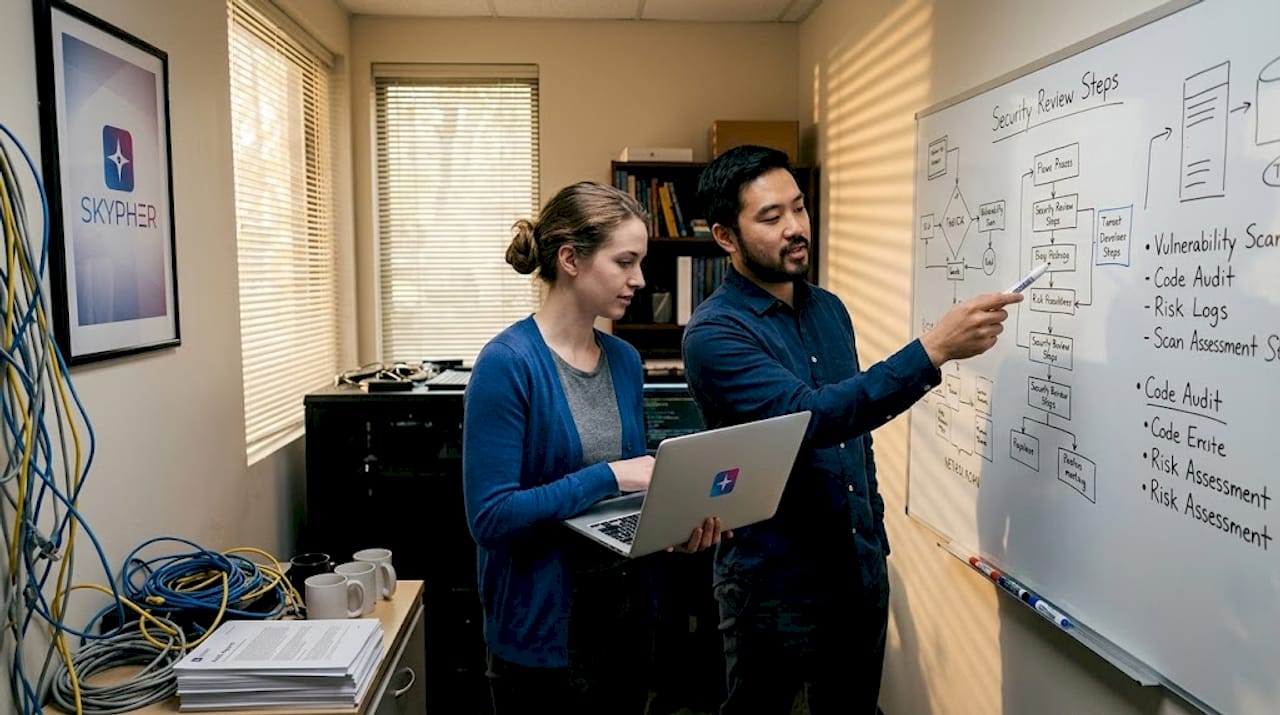
With scope defined and materials in hand, the real examination begins. Breaking the review into distinct phases prevents overwhelm and keeps findings traceable to specific system components.
Here's a structured sequence that works well for medium to large organizations:
- Architecture review: Examine network topology, trust boundaries, authentication flows, and data segmentation. Look for design-level weaknesses before touching any code.
- Code artifact review: Focus on input validation, authentication mechanisms, session management, and data handling. These are the areas where vulnerabilities cluster most frequently.
- Business logic review: Analyze how the application processes transactions, permissions, and user roles. This is where subtle, high-impact flaws hide.
- Process review: Assess operational procedures, change management controls, and incident response readiness.
For the code phase, checklists and automation tools speed up detection of known vulnerability patterns, such as SQL injection, insecure deserialization, and hardcoded credentials. Tools like static analysis scanners catch these at scale. But automation has limits. Edge cases like time-of-check-to-time-of-use (TOCTOU) flaws, where a system state changes between when it is verified and when it is used, require manual attention. So do nuanced business logic errors that only make sense in context.
The NIST Incident Handling Guide makes this tension explicit: hybrid review approaches scale better than purely manual methods, but automation alone risks missing context that changes everything. Lean into AI in security reviews to handle volume, but keep skilled reviewers focused on the logic-heavy areas. For a broader view of where the industry is moving, security automation trends show how leading teams are balancing speed with depth. When structuring each code phase, OWASP code review steps provide a solid baseline checklist.
"Human review is irreplaceable for logic flaws; use automation for scale, never as a substitute."
That principle should anchor your review methodology. Teams that lean fully on automated scanning report fewer critical findings, not because fewer exist, but because their tools aren't designed to see them.
Classify, report, and track findings for remediation
A completed review is only valuable if its findings lead to action. Too many security teams produce thorough reports that sit in a shared drive, unread and unresolved.
Start by classifying every finding using a consistent severity model. A simple but effective framework:
| Severity | Impact | Likelihood | Example |
|---|---|---|---|
| Critical | High | High | Exposed credentials in production |
| High | High | Medium | Missing authentication on sensitive API |
| Medium | Medium | Medium | Insufficient input validation |
| Low | Low | Low | Verbose error messages in staging |
This kind of matrix removes subjectivity from prioritization conversations. When an engineer and a CISO look at the same table, they're working from the same criteria.
Next, tailor your report output to the audience. Technical teams need reproduction steps, affected components, and remediation guidance. Executive stakeholders need risk context, business impact, and a timeline. Producing two versions from the same findings set isn't redundant; it's what gets fixes approved and resourced.
Centralized tracking is non-negotiable. Assign every finding an owner, a due date, and a validation step. Without a tracking system, patches get marked complete before they're verified, and the same vulnerability surfaces in the next review cycle. AI-driven security questionnaires can feed directly into tracking workflows, reducing the manual overhead of logging and updating findings status.
Key practices for remediation tracking:
- Assign a named owner for every finding, not a team
- Set realistic remediation windows based on severity
- Require evidence of fix before closing a finding
- Schedule validation reviews to confirm patches hold
Gartner's research on cybersecurity performance metrics highlights severity-based tracking and KPIs like mean time to patch (MTTP) and patch compliance rates as the clearest indicators of a mature remediation program. Platforms that support efficient security review tracking help teams move from finding to fix without losing context along the way. For classification methodology, OWASP's guidance on tracking findings provides a structured starting point.
Integrate automation and continuous improvement
One-time reviews create one-time visibility. The organizations that build durable security postures treat reviews as a continuous cycle, not a quarterly checkbox.
The shift starts with understanding where manual effort is costing you the most. According to 2025 benchmark data, vendors spend 23 hours per week manually handling security questionnaires. AI reduces that to minutes. That's not a marginal gain; it's a full-time employee's weekly output redirected toward analysis instead of data entry.
Here's how different review approaches compare:
| Method | Speed | Accuracy | Scalability | Best use case |
|---|---|---|---|---|
| Manual | Slow | High for logic flaws | Low | Complex business logic |
| Semi-automated | Moderate | Moderate | Moderate | Mixed environments |
| AI-driven | Fast | High for patterns | High | Questionnaires, known CVEs |
KPIs worth tracking as you scale:
- Mean time to detect (MTTD) and mean time to respond (MTTR)
- Patch compliance rate across severity tiers
- Questionnaire turnaround time per review cycle
- Percentage of findings resolved within SLA
The AI advantages in automation are clearest in high-volume, repeatable tasks. Teams using AI for security questionnaires report not just speed gains, but better consistency across reviewers and fewer escalations due to incomplete answers. For a practical walkthrough of building this into your workflow, the guide on step-by-step secure reviews is worth your time.
For program-level integration, risk-based hybrid approaches connect review cycles to your broader application security program rather than treating them as isolated events.
Pro Tip: Don't try to automate everything at once. Start with the most repetitive questionnaire steps, measure the time saved, then expand automation to cover end-to-end review integration once the ROI is clear to leadership.
Why security review 'checklists' alone aren't enough (and what actually works)
Here's something most security frameworks won't tell you directly: checklists create confidence, but not necessarily security.
The problem with rigid, checklist-driven reviews is that they optimize for coverage, not for risk. A team can check every box on a SOC 2 or ISO 27001 checklist and still miss a critical flaw in how their application processes multi-step financial transactions. Checklists measure whether you looked. They don't measure whether you understood what you saw.
Pure automation has the same blind spot at a different scale. It finds what it's trained to find. Novel attack patterns, subtle privilege escalation paths, and flawed business logic require a reviewer who understands intent, not just syntax.
What actually works, based on real-world experience with complex tech and finance environments, is a hybrid, risk-based framework. OWASP recommends prioritizing risk-based hybrid approaches with baseline reviews for high-risk components and diff-based reviews for incremental changes integrated early into the SDLC. The efficiency-focused best practices that consistently outperform checklist methods share one trait: they allocate human attention based on risk surface, not uniformly across all assets.
Pro Tip: Use your checklist as a floor, not a ceiling. It tells you the minimum to verify. Your risk model tells you where to dig deeper.
Streamline your security reviews with Skypher
If the steps above describe where you want to be but not where you currently are, Skypher closes that gap.

Skypher's security questionnaire automation platform handles the repetitive, time-consuming parts of your review process so your team can focus on analysis that actually requires human judgment. With AI-driven response generation, integrations across 40-plus TPRM platforms, and real-time collaboration tools, Skypher turns a process that once took days into one that takes hours or less. You can also generate structured custom security reports tailored to different stakeholder audiences without rebuilding them from scratch each cycle. Whether you're starting with out-of-the-box templates or building custom workflows, Skypher fits into your existing security stack without a steep ramp-up.
Frequently asked questions
What is the typical order of steps in a security review process?
A complete security review follows this order: define scope and collect documentation, perform architecture and code review, classify findings by severity, produce stakeholder reports, and track remediation to closure. The OWASP Secure Code Review Cheat Sheet outlines this structured sequence as standard practice for tech and finance organizations.
How does automation improve the security review process?
Automation handles high-volume, repeatable tasks like questionnaire responses and known vulnerability scanning at a speed no manual process can match. Benchmark research shows teams that manually process questionnaires spend 23 hours per week on them, while AI-driven tools reduce that to minutes.
Why are manual reviews still important, even with advanced tools?
Automation excels at pattern recognition but cannot evaluate intent or business logic context. The NIST guidance on hybrid methods confirms that manual review value lies specifically in catching the nuanced, context-dependent flaws that automated tools are not built to detect.
What key metrics should I track in my security review process?
Focus on mean time to detect (MTTD), mean time to respond (MTTR), patch compliance rate by severity tier, and questionnaire completion time per cycle. Gartner's cybersecurity benchmarks identify MTTP and patch compliance as the most actionable KPIs for measuring security review program maturity.