

TL;DR:
- Penetration testing involves authorized simulated cyberattacks to identify security weaknesses before malicious actors exploit them.
- It follows a structured methodology from planning and reconnaissance to reporting, balancing automated tools with manual analysis.
Penetration testing is the authorized practice of simulating cyberattacks against a system to identify exploitable security weaknesses before malicious actors find them. Known formally as a penetration test or pentest, this discipline follows a structured methodology that separates it from ad hoc vulnerability scanning. Regular, methodical pen testing delivers a 155% ROI, with the average cost of a data breach in 2025 reaching $4.5 million. That math makes a compelling case for every security team. This guide walks you through how to perform penetration testing end to end, covering prerequisites, each execution phase, common pitfalls, and a 90-day skill-building roadmap aligned with 2026 standards.
What do you need before starting pen testing?
Before you run a single scan, you need a solid technical foundation and a properly configured environment. Skipping this step is the fastest way to produce unreliable results or, worse, cause unintended damage to a production system.
Core knowledge requirements
Networking fundamentals are non-negotiable. You need a working understanding of TCP/IP, DNS resolution, HTTP/HTTPS request flows, and common port behaviors. Without this, you cannot interpret scan output or understand why a particular attack path works. Linux command-line proficiency is equally critical, since most pentesting tools run natively on Linux distributions like Kali Linux. Basic bash scripting lets you automate repetitive tasks and chain tool outputs together.
Essential tools overview
The table below covers the tools you will use most frequently across different phases of a penetration test.
| Tool | Primary Use | Phase |
|---|---|---|
| Nmap | Network discovery and port scanning | Reconnaissance and scanning |
| Burp Suite | Web application interception and analysis | Scanning and exploitation |
| Metasploit Framework | Exploit development and execution | Exploitation and post-exploitation |
| Nessus | Automated vulnerability scanning | Scanning and enumeration |
| sqlmap | Automated SQL injection detection | Exploitation |
| Amass | Subdomain enumeration and OSINT | Passive reconnaissance |
| Shodan | Internet-connected device discovery | Passive reconnaissance |
| Wireshark | Packet capture and protocol analysis | Reconnaissance and analysis |
Environment setup
Run all testing inside isolated virtual machines, never directly from your host OS. Kali Linux is the standard starting point because it ships with most of these tools pre-installed. Build a dedicated lab using platforms like Hack The Box, TryHackMe, or a self-hosted network of intentionally vulnerable VMs such as Metasploitable. This gives you a legal, controlled environment to practice without risk.

Pro Tip: Always obtain explicit written authorization before testing any system you do not personally own. Unauthorized testing is illegal and can result in criminal charges regardless of intent.
What are the step-by-step phases of a penetration test?
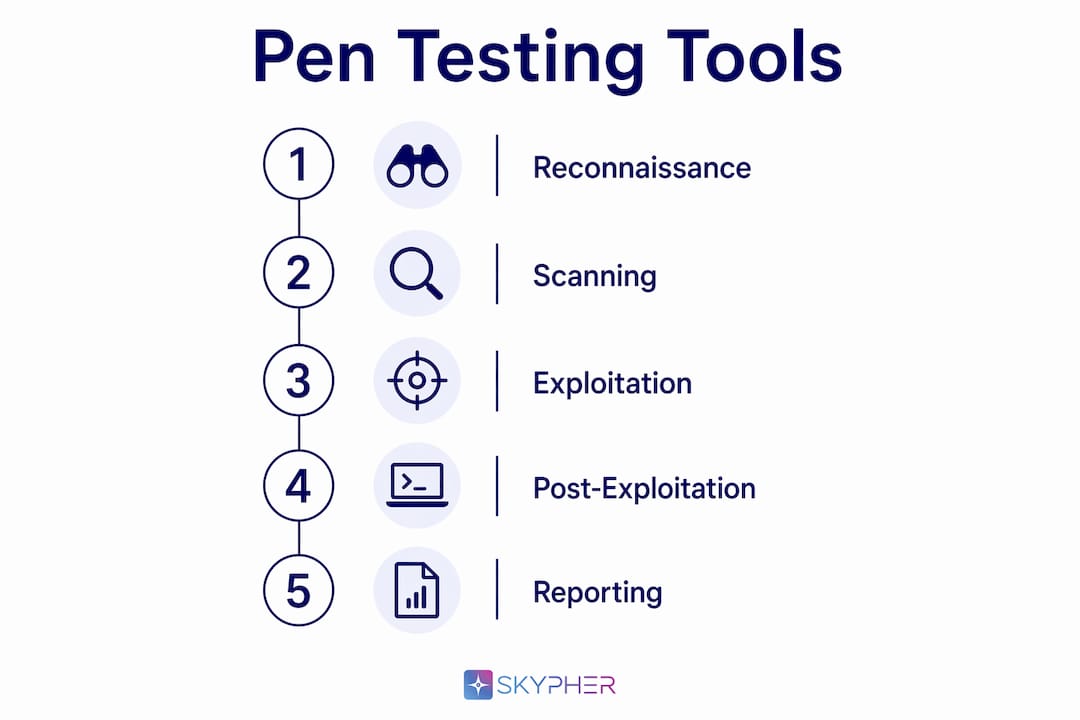
The Penetration Testing Execution Standard (PTES) defines a thorough engagement across seven phases, from pre-engagement through reporting. The framework below maps directly to PTES and reflects current 2026 industry practice.
-
Planning and scoping. Define the target systems, testing boundaries, and rules of engagement in writing. Establish what is in scope, what is explicitly out of scope, and the testing window. This document becomes your legal protection and your operational guide. Skipping pre-engagement scoping leads to scope creep, legal disputes, and accidental service outages.
-
Reconnaissance. Gather information about the target without triggering alerts. Passive reconnaissance uses public sources: WHOIS records, DNS lookups, LinkedIn profiles, and Shodan queries. Active reconnaissance involves direct interaction with the target, such as DNS zone transfers or web crawling. Amass is the go-to tool for subdomain enumeration at this stage.
-
Scanning and enumeration. Use Nmap to map open ports, identify running services, and fingerprint operating systems. Follow up with Nessus or OpenVAS for automated vulnerability detection across the discovered attack surface. Automated scanners provide breadth, while manual testing adds depth and accuracy. Never rely on scanner output alone. Manual analysis catches logic flaws, misconfigurations, and chained vulnerabilities that automated tools consistently miss.
-
Exploitation. Validate discovered vulnerabilities with controlled attacks. Metasploit is the standard framework for this phase, offering a library of tested exploits mapped to CVEs. The goal is proof of exploitability, not maximum damage. Document every successful exploit with screenshots, command output, and timestamps before moving on.
-
Post-exploitation. Once inside, assess the real-world impact. This includes privilege escalation, lateral movement across the network, and identifying what sensitive data is accessible. The objective is to demonstrate the full blast radius of a successful breach, not just the initial foothold.
-
Reporting. Translate technical findings into business language. Assign CVSS scores to each vulnerability, but go further by mapping each finding to its business impact. A critical CVSS score on an isolated test system matters far less than a medium-severity finding that exposes customer PII. Include clear remediation steps for every issue.
Pro Tip: Scope definition is the single most important document in any engagement. Revisit it before every testing session to confirm you have not drifted outside agreed boundaries.
What common mistakes do penetration testers make?
Even experienced professionals make predictable errors. Recognizing them in advance is the difference between a clean engagement and a client relationship that ends badly.
-
Poorly defined scope. Vague scope documents create ambiguity about what is authorized. This exposes you to legal risk and makes the final report difficult to defend. Every target IP range, domain, and application must be explicitly listed.
-
Rushing reconnaissance. Testers eager to get to exploitation often spend too little time on information gathering. Missing a forgotten subdomain or an exposed admin panel at this stage means missing the most direct attack path entirely.
-
Overreliance on automated tools. Nessus and similar scanners are starting points, not conclusions. Automated tools generate false positives and miss context-dependent vulnerabilities. Manual validation of every finding is mandatory before it goes into a report.
-
Testing live production without blackout windows. Experienced testers never scan production systems without a pre-engagement checklist that includes agreed maintenance windows. An aggressive Nmap scan or a DoS-adjacent exploit can take down a service and breach your contract.
-
Weak documentation during testing. Failing to capture evidence in real time forces you to reconstruct attack paths from memory. That produces incomplete reports and makes remediation verification nearly impossible.
Pro Tip: Maintain an organized, indexed workspace throughout the engagement. Structure your directories by phase and target, and log every command with its output. This enables rapid replay of attack paths and gives clients clear, auditable evidence.
How do you build penetration testing skills from beginner to expert?
A structured 90-day roadmap covering networking fundamentals, Linux proficiency, and foundational tools is the most efficient path from beginner to functional pentester. Passive learning through videos and reading does not build the muscle memory that real testing requires. Every week below assumes hands-on lab time as the primary activity.
-
Weeks 1 and 2: Networking and protocols. Study TCP/IP, the OSI model, DNS, HTTP, and TLS. Use Wireshark to capture and analyze live traffic on your lab network. Being able to read a packet capture fluently is a skill that pays off in every subsequent phase.
-
Week 3: Linux fundamentals. Practice file system navigation, user permissions, process management, and bash scripting. Write scripts that automate basic tasks like parsing Nmap output or organizing scan results into directories.
-
Week 4: First pentesting tools. Install Kali Linux and run your first Nmap scans against lab targets. Configure Burp Suite as an intercepting proxy and walk through a basic web application test against a deliberately vulnerable app like DVWA or Juice Shop.
-
Weeks 5 through 7: Web vulnerabilities and exploitation. Work through OWASP Top 10 categories hands-on. Practice SQL injection with sqlmap, cross-site scripting manually, and authentication bypass techniques. Begin using Metasploit against Metasploitable targets to understand the exploit-payload-session workflow.
-
Weeks 8 through 10: Privilege escalation and CTFs. Study Linux and Windows privilege escalation techniques using platforms like Hack The Box and TryHackMe. Capture the Flag challenges force you to think like an attacker under time pressure, which accelerates pattern recognition faster than structured labs alone.
-
Week 11 and beyond: Bug bounty and certification prep. Engage with HackerOne or Bugcrowd bug bounty programs to test real-world targets legally. Pursue the Offensive Security Certified Professional (OSCP) certification if you want a credential that signals hands-on competency to employers. Check cybersecurity compliance tips for guidance on how pentesting frequency aligns with compliance requirements in regulated industries.
The security review best practices for 2026 recommend at least annual penetration testing as a baseline, with quarterly tests for organizations in high-threat sectors like finance and healthcare. Building your skills to meet that cadence is a career-defining investment.
Key takeaways
Penetration testing requires written authorization, a phased methodology from scoping through reporting, and a deliberate balance of automated tools and manual analysis to produce findings that drive real security improvements.
| Point | Details |
|---|---|
| Authorization is mandatory | Always obtain explicit written permission before testing any system to avoid criminal liability. |
| Phased methodology matters | Follow PTES phases from planning through reporting to produce consistent, defensible results. |
| Balance automation with manual work | Automated scanners find breadth; manual testing finds depth and context-dependent vulnerabilities. |
| Prioritize by business impact | Rank findings by real-world risk to the organization, not just CVSS score alone. |
| Documentation drives reporting | Index all evidence during testing to support clear, auditable reports and remediation verification. |
Why the best pen testers think like attackers, not auditors
Most professionals who struggle with penetration testing are not struggling with tools. They are struggling with mindset. The tools are learnable in weeks. The attacker decision logic takes years to internalize, and it is the actual differentiator between a junior tester who generates a list of CVEs and a senior tester who maps a realistic kill chain.
Effective penetration testers mimic attacker decision logic, prioritizing business impact over simply running automated tools. What that means in practice is asking, at every step, what would a motivated adversary do next with this access? Not "what does this scanner flag?" but "what does this finding enable?" That shift changes how you chain vulnerabilities, how you write reports, and how clients perceive your value.
The most critical skill separating novice and senior testers is prioritizing vulnerabilities by business impact rather than technical severity alone. Exposing a path to customer PII through a medium-severity misconfiguration outranks a critical RCE on a sandboxed test server every time. Clients do not pay for CVSS scores. They pay for clarity about what actually puts their business at risk.
I have also seen testers damage client trust not through technical errors but through poor communication. Showing up with a 40-page report full of scanner output and no executive summary is a failure of professional judgment. The technical detail belongs in appendices. The business narrative belongs at the front. That discipline is what turns a competent tester into a trusted advisor.
— Gaspard
How Skypher helps you close the loop after a pentest
After a penetration test, the real work begins: translating findings into evidence for compliance reviews, vendor assessments, and security questionnaires. That process is where most teams lose time.

Skypher's security questionnaire automation platform uses AI to map your security posture directly to questionnaire responses, pulling from the same evidence base your pentest produced. Instead of manually re-answering the same questions across dozens of vendor reviews, Skypher handles it in under a minute. The platform integrates with over 40 third-party risk management platforms, including OneTrust and ServiceNow, and connects with Slack, Confluence, and SharePoint for real-time collaboration. For teams that run regular penetration tests and need to communicate findings to stakeholders fast, Skypher removes the bottleneck between testing and compliance. Learn more about how communicating vulnerability impact to stakeholders can be handled more efficiently.
FAQ
What is penetration testing in simple terms?
Penetration testing is the authorized simulation of a cyberattack against a system to identify exploitable vulnerabilities before real attackers do. It follows a structured methodology from scoping through reporting.
How often should organizations perform penetration tests?
Industry standards recommend at least annual testing, with quarterly tests for organizations in high-threat sectors like finance, healthcare, and critical infrastructure.
What is the difference between a vulnerability scan and a pen test?
A vulnerability scan uses automated tools to identify known weaknesses across a system. A penetration test goes further by actively exploiting those weaknesses to validate their real-world impact and assess the full attack chain.
Do I need a certification to do pen testing professionally?
No certification is legally required, but the OSCP from Offensive Security is widely recognized as the benchmark for hands-on competency. It demonstrates practical exploitation skills rather than just theoretical knowledge.
What tools do professional penetration testers use most?
The core toolkit includes Nmap for network scanning, Burp Suite for web application testing, Metasploit for exploitation, Nessus for vulnerability scanning, and Amass for reconnaissance. Most professionals run these on Kali Linux.