

TL;DR:
- RFP AI automates proposal workflows by using governed knowledge bases to generate drafts and route review tasks. It significantly reduces response times and increases consistency in proposals. Proper governance, knowledge base maintenance, and human judgment remain essential for effective implementation.
RFP AI is the integration of artificial intelligence into the request-for-proposal process to automate draft generation, match questions to a governed knowledge base, and support structured evaluation workflows. The term "RFP AI" is widely used in procurement and sales circles, though the formal industry concept is AI-assisted proposal automation, which covers everything from automated RFP responses to AI-driven vendor selection. For tech and finance teams managing dozens of proposals per quarter, this distinction matters. The difference between a generic AI writing tool and a purpose-built RFP AI system is the governed knowledge base, the review routing, and the compliance controls built into the workflow. Multi-step AI workflow agents now handle question deduplication, source citation, and multi-format output as standard functions, not premium add-ons.
How does RFP AI automate and improve the proposal response workflow?
RFP AI transforms proposal response from a manual, document-heavy task into a semi-automated workflow with defined review gates. The core process follows a predictable sequence: the system ingests the incoming RFP, matches each question against a governed knowledge base, generates a draft answer with source citations, routes flagged items to subject matter experts, and produces output in the required format.
The knowledge base is the engine. It contains past responses, approved pricing language, compliance statements, and technical documentation. When a new RFP arrives, the AI searches this base for the closest matching prior answer, generates a draft, and attaches the source reference. This means your team reviews a pre-populated document rather than writing from scratch.
AI agents execute multi-step workflows including question deduplication, which removes redundant questions before they reach reviewers. That single function alone cuts reviewer workload on large RFPs with 150-plus questions. Multi-format output means the system can export directly into Excel, Word, or portal-specific templates without manual reformatting.
- Question matching: AI maps each incoming question to the closest approved answer in the knowledge base.
- Draft generation: The system writes a contextual response using matched content and flags low-confidence answers.
- Reviewer routing: Questions below a confidence threshold go to the relevant SME automatically.
- Deduplication: Repeated or near-identical questions are consolidated before review.
- Multi-format output: Final responses export in the format the buyer requires.
Pro Tip: Treat your knowledge base as a living document, not a static archive. Set expiry flags on answers older than 12 months and require SME sign-off before those answers go back into active rotation. The most common failure in AI RFP drafting is a confident but stale answer that was accurate two years ago but no longer reflects your current product or compliance posture.
What are the technical and governance considerations when implementing RFP AI?
Setting up RFP AI correctly requires more than connecting a tool to your document library. Governance controls determine whether the system produces trustworthy outputs or confidently wrong ones.
The setup sequence for most enterprise platforms follows a clear path:
- Enable AI settings at the admin level. Most platforms require a super admin to activate the RFP agent and configure data access permissions before any knowledge source is connected.
- Add and structure knowledge sources. Upload approved files, link folders from connected storage, and tag content by product line, region, or compliance framework. HubSpot's Breeze AI RFP agent requires this step before the agent can generate any draft.
- Configure data access restrictions. Limit which knowledge sources the AI can query based on the user's role. A sales engineer should not pull from a restricted legal repository without approval.
- Set up review routing rules. Define which question categories trigger automatic SME escalation and which the AI can answer autonomously.
- Monitor credit and usage. Platforms that charge per run require usage tracking to avoid unexpected costs at scale. Credit consumption and admin configuration are operational constraints, not afterthoughts.
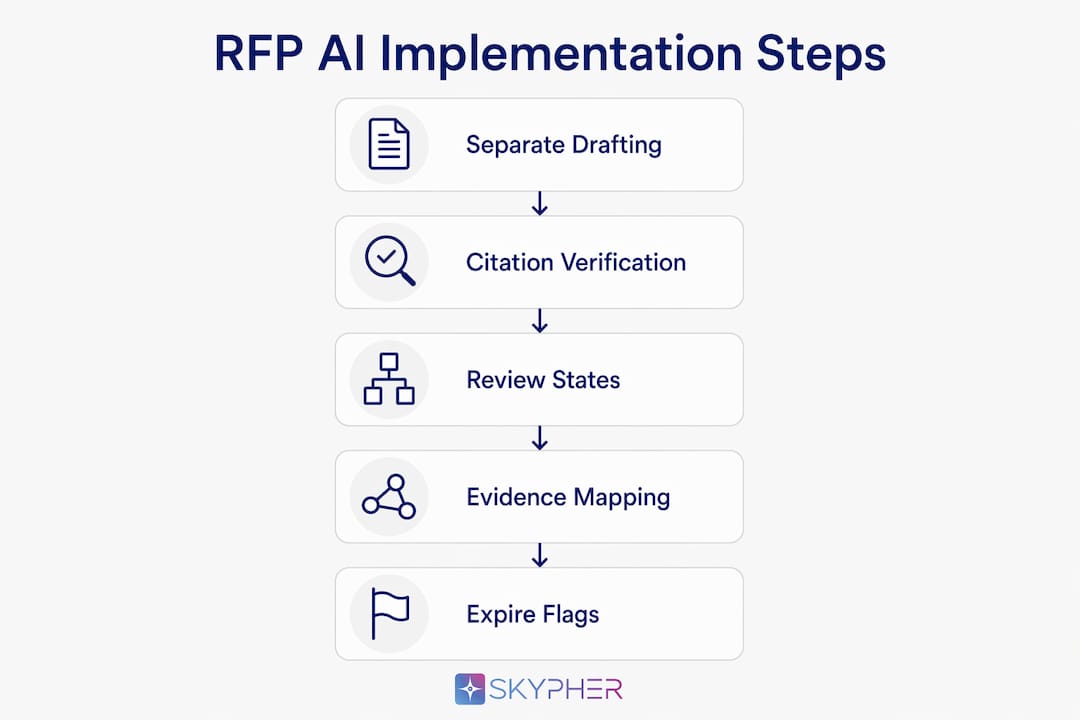
The most important governance principle is separating draft generation from citation verification. Splitting drafting and fact-verification tasks prevents hallucination by ensuring every claim in the draft traces back to a verified source before the document leaves the system. Treat these as two distinct workflow steps, not one combined output.
Pro Tip: Build your knowledge base architecture with review states and evidence mapping from day one. A knowledge base without expiry logic and source traceability is a liability, not an asset. Every answer should carry a "last verified" date and a named owner.
How does AI support RFP evaluation and supplier comparison for faster procurement decisions?
AI-driven vendor selection changes how procurement teams score and compare supplier responses. Instead of manually reading through hundreds of pages, evaluators work from structured scorecards that the AI populates based on predefined criteria.

AI-powered evaluation workflows analyze supplier responses, apply weighted scoring models, identify compliance gaps, and flag risk areas before human reviewers see the document. This means evaluators spend their time on judgment calls, not data extraction.
The table below shows the core elements of an AI evaluation workflow and what each one delivers:
| Evaluation element | What AI does | Benefit to procurement teams |
|---|---|---|
| Weighted scoring | Applies numeric weights to each criterion automatically | Consistent scores across all suppliers |
| Compliance gap detection | Flags missing or non-compliant answers | Reduces risk of awarding to a non-compliant vendor |
| Side-by-side comparison | Aligns supplier answers to the same question in one view | Faster comparative review |
| Risk identification | Highlights ambiguous or high-risk language | Supports legal and compliance review |
| Evaluator collaboration | Routes sections to specific reviewers with comments | Reduces back-and-forth email chains |
The critical nuance here is that AI prepares the scorecard. It does not make the award decision. Procurement experts recommend retaining human strategic control over final vendor selection, using AI as a consistency and preparation tool rather than a decision engine. This matters especially in regulated industries where award decisions require documented human accountability.
For AI advantages in risk management within finance and tech, the value is in surfacing risks early, not eliminating the need for expert review.
What practical benefits and efficiency gains do businesses realize using RFP AI?
The efficiency case for AI in the RFP process is concrete and measurable. RFP auto-fill agents handle approximately 80% of repeated questionnaire items, reducing what was once a multi-hour effort to a 45-minute review pass. The remaining 20% of questions, those requiring new information or judgment, go to human SMEs.
That shift changes the role of proposal managers and sales engineers. Instead of drafting answers, they review and approve them. Instead of formatting documents, they focus on differentiation: the sections where your firm's specific capabilities, case studies, and pricing strategy actually win deals.
The practical benefits break down across four areas:
- Time savings: Auto-fill on standard questions cuts response time from days to hours for most mid-size RFPs.
- Consistency: Every answer pulls from the same approved knowledge base, eliminating version control problems across teams.
- Accuracy: Source citations in every draft answer make it easy to verify claims before submission.
- Scalability: Teams can respond to more RFPs per quarter without adding headcount, because the AI handles the repetitive volume.
For RFP automation in security reviews, the scalability benefit is especially significant. Security questionnaires often repeat the same 50 to 100 questions across different buyers, making them ideal candidates for high auto-fill rates.
Pro Tip: Monitor your auto-fill rate by question category, not just overall. If your AI fills 95% of general IT questions but only 40% of data residency questions, that gap tells you exactly where your knowledge base needs new content. Scale automation thoughtfully by category, not all at once.
Key Takeaways
RFP AI delivers the most value when governed knowledge bases, structured review workflows, and clear separation between draft generation and citation verification work together.
| Point | Details |
|---|---|
| Governed knowledge base is foundational | Build it with expiry flags, source traceability, and SME ownership from day one. |
| Auto-fill handles 80% of standard questions | Reserve human review for the 20% that require judgment or new information. |
| Separate drafting from verification | Run citation checks as a distinct step to prevent confident but inaccurate outputs. |
| AI scores but humans decide | Use AI evaluation for consistency and gap detection; retain human control over award decisions. |
| Monitor by category, not just overall | Track auto-fill rates per question type to identify knowledge base gaps and prioritize updates. |
The governance trap most teams fall into with RFP AI
The teams I see get the most out of RFP AI are not the ones with the most sophisticated tools. They are the ones who treated their knowledge base as a product, not a folder.
The common failure mode is this: a team connects their shared drive to an AI agent, runs a few successful proposals, and then stops maintaining the knowledge base. Six months later, the AI is confidently generating answers based on outdated pricing, deprecated features, or compliance certifications that have since lapsed. Nobody catches it until a buyer flags an inconsistency during due diligence.
The fix is not more AI. It is governance. Assign ownership of every knowledge base section to a named person. Set quarterly review cycles. Flag any answer that references a specific version, date, or certification for mandatory SME sign-off before it goes back into active rotation.
The other trap is conflating AI-assisted evaluation with AI-driven decisions. I have seen procurement teams in finance use AI scoring to justify award decisions without documenting the human review layer. In regulated environments, that is a compliance risk. AI gives you a consistent, well-structured scorecard. The strategic judgment, the final call, and the documented rationale still belong to your team.
The teams that get this right treat AI as a first-pass analyst, not a decision-maker. They use it to surface information faster, catch gaps earlier, and free up expert time for the work that actually requires expertise. That framing, AI as analyst rather than authority, is what separates successful deployments from expensive disappointments.
— Gaspard
How Skypher handles AI-powered questionnaire and RFP automation
Security questionnaires and RFPs share the same core challenge: high volume, repetitive questions, and serious consequences for inaccurate answers.

Skypher's AI Questionnaire Automation Tool is built specifically for this problem. The platform parses every format with proprietary AI models, connects to over 40 third-party risk management platforms including OneTrust and ServiceNow, and can answer 200 questions in under one minute. Integrations with Slack, Microsoft Teams, Confluence, Google Drive, and SharePoint mean your team works inside the tools they already use. For tech and finance teams managing frequent security reviews alongside standard RFP cycles, Skypher provides the traceability, multilingual support, and enterprise-grade collaboration that generic AI writing tools cannot match. Learn more about how AI transforms compliance for security questionnaire workflows.
FAQ
What is RFP AI?
RFP AI refers to artificial intelligence systems that automate proposal and request-for-proposal workflows by matching questions to a governed knowledge base, generating draft responses, and routing items for human review. The formal industry term is AI-assisted proposal automation.
How much time does RFP AI actually save?
Auto-fill agents handle around 80% of repeated questions, reducing a multi-hour drafting effort to a 45-minute review pass for most standard RFPs.
What governance controls does RFP AI require?
Effective governance requires restricting data access by role, setting expiry logic on knowledge base content, and running citation verification as a separate step from draft generation. HubSpot's RFP agent setup illustrates these controls at the platform level.
Can AI replace human judgment in RFP evaluation?
No. AI-assisted evaluation supports consistency and gap detection through structured scoring, but final vendor selection requires documented human accountability, especially in regulated industries.
What makes security questionnaire automation different from general RFP AI?
Security questionnaires follow stricter compliance frameworks and repeat the same questions across many buyers, making them ideal for high auto-fill rates. Platforms like Skypher specialize in this use case with format parsing, essential RFP questions for tech firms, and integrations built for security review workflows.