

TL;DR:
- The SIG questionnaire is a standardized tool used by security professionals to assess vendor cybersecurity, privacy, and operational resilience across 19 domains. Different versions, such as SIG Core and SIG Lite, are suited for critical or lower-risk vendors, with a SaaS platform streamlining management and version control. However, SIG responses are self-reported, becoming outdated quickly, emphasizing the need for continuous monitoring and proper integration into risk programs.
The SIG questionnaire is a standardized third-party risk assessment tool developed by Shared Assessments that security and compliance professionals use to evaluate vendor cybersecurity posture, privacy practices, and operational resilience. Originally created by a consortium of financial institutions to replace the chaos of one-off vendor due diligence forms, it has become the dominant sig assessment form across enterprise risk programs. This guide covers every version, the SIG Evolution SaaS platform, the tool's real limitations, and how to integrate SIG data with continuous monitoring so your vendor risk program holds up under scrutiny.
What is a SIG questionnaire and what does it cover?
The SIG questionnaire is a buyer-provided artifact that vendors complete to describe their cybersecurity controls, privacy practices, business continuity plans, and compliance posture. Shared Assessments publishes and maintains the standard, which means every organization using SIG is working from the same baseline framework. That standardization is the tool's greatest strength: it removes the need to build custom sig survey questions from scratch and gives vendors a familiar format they can respond to efficiently.
The SIG covers 19 risk domains in its full version, including access control, cloud hosting, incident management, data privacy, and third-party oversight. Each domain maps to widely recognized frameworks like NIST CSF, ISO 27001, and SOC 2, which is why compliance teams often describe it as a NIST questionnaire proxy for vendor assessments. Mapping to NIST SP 800-53 controls, for example, allows security teams to cross-reference SIG responses against their own internal control libraries without manual translation work.
What makes SIG distinct from a generic sig evaluation template is its scope. A typical internal security checklist might cover 50 to 80 questions. The SIG Core reaches up to 1,400 questions across those 19 domains, giving procurement and security teams a genuinely detailed picture of a vendor's control environment before a contract is signed.
What are the different SIG versions and when should you use each?
SIG Core and SIG Lite serve fundamentally different purposes, and choosing the wrong version for a vendor tier is one of the most common inefficiencies in third-party risk programs. The table below maps each version to its appropriate use case.
| Version | Question volume | Typical use case |
|---|---|---|
| SIG Core | ~1,400 questions across 19 domains | Critical vendors with access to sensitive data or core infrastructure |
| SIG Lite | ~125 to 150 questions | Tier 2 or Tier 3 vendors, initial screening, lower-risk relationships |
| Custom/Modular | Variable | Targeted assessments for specific domains (e.g., cloud or privacy only) |
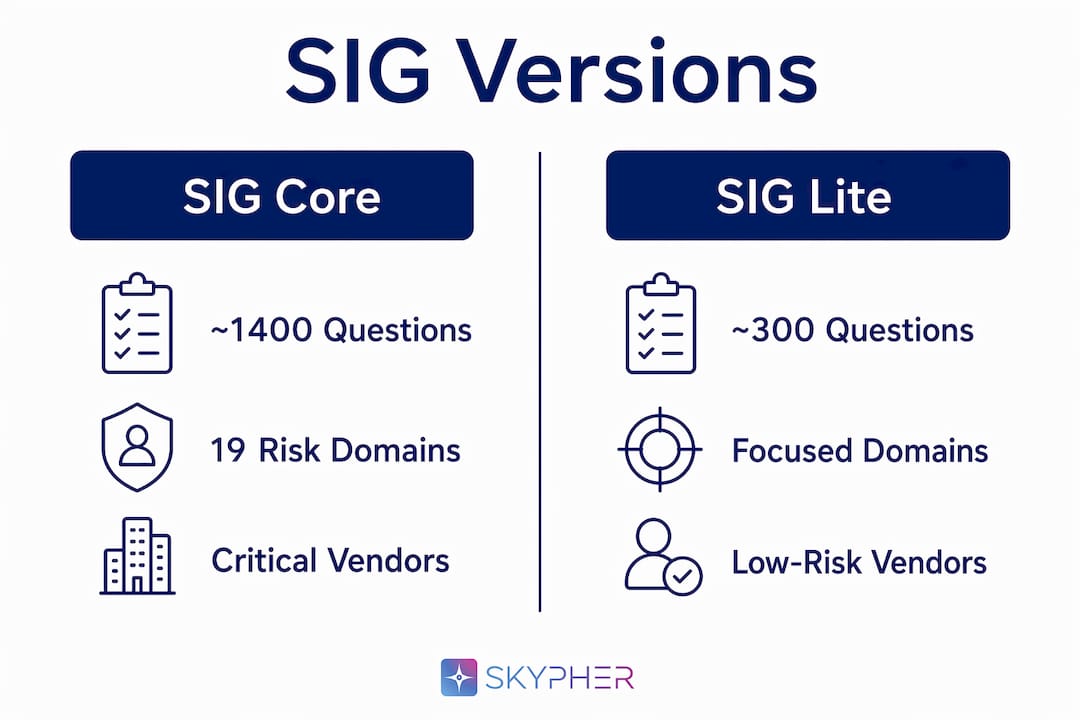
SIG Core is the right tool when a vendor processes personal data, operates inside your network perimeter, or supports a business-critical function. The depth of coverage across domains like physical security, encryption, and supply chain risk justifies the response burden for both parties. SIG Lite works for lower-risk vendors where a full assessment would consume more resources than the relationship warrants.
The modular approach is worth noting for mature programs. You can scope a SIG assessment to specific domains, such as cloud hosting controls or data privacy, when you already have baseline information on a vendor and only need to update one risk area. This keeps the sig assessment form relevant without forcing vendors to re-answer questions that haven't changed.
Pro Tip: Match questionnaire version to vendor criticality tier before sending. A Tier 1 vendor running payroll or storing health records should always receive SIG Core. Sending SIG Lite to that vendor is a compliance gap waiting to surface in an audit.
How does the SIG Evolution platform improve questionnaire management?
SIG Evolution, or SIG EV, is a web-based SaaS platform from Shared Assessments that replaces the spreadsheet and email distribution model most teams still rely on. The practical difference is significant: instead of tracking 40 vendor responses across shared drives and inboxes, your team manages everything from a centralized dashboard with built-in grading and validation workflows.

The platform's version control capability is where it earns its keep for compliance teams. SIG EV includes a Version Delta workbook that tracks which questions have been updated, retired, or added between annual releases. Without this tool, a vendor's response from last year may reference controls that no longer align with the current question set, creating silent discrepancies that only surface during an audit or incident review.
Key features that distinguish SIG EV from manual management include:
- Centralized creation and distribution of questionnaires with role-based access for reviewers and approvers
- Automated grading workflows that flag incomplete or inconsistent responses before they reach your risk team
- Version Delta tracking to maintain alignment between buyer questionnaire versions and vendor responses
- Collaboration tools that allow procurement, security, and legal teams to annotate and escalate responses within the platform
- Audit trail documentation that supports regulatory reporting and internal governance reviews
Managing SIG version deltas and question retirements is an operational challenge that grows with program scale. A team managing 200 vendor relationships across two annual SIG releases faces thousands of question-level changes without a systematic tracking tool. SIG EV directly addresses this by making version alignment a platform function rather than a manual reconciliation task.
What are the real limitations of SIG questionnaires?
The SIG questionnaire's most significant structural limitation is that it is self-reported and periodic. Responses become stale between annual or biannual fills, and a vendor's risk profile can shift materially in the months between assessments. A vendor that passes a SIG assessment in January may face a ransomware incident, a key personnel departure, or a supply chain disruption by June. None of that appears in the questionnaire record.
Financial health risk is poorly captured by the SIG process. Section S of the SIG includes process questions about financial controls, but it does not surface current financial condition indicators like cash flow stress, missed payments, or credit deterioration. A vendor can answer every financial governance question correctly while quietly approaching insolvency. That gap has caused real vendor failures in enterprise risk programs that relied exclusively on questionnaire data.
The self-reported nature of SIG responses also creates a verification problem. Vendors complete the sig survey questions themselves, which means the accuracy of the data depends entirely on the vendor's honesty and their own understanding of their control environment. Without evidence requests or third-party attestation, a SIG response is a declaration, not a proof. Many programs address this by requiring supporting documentation for high-risk domains, but that adds review burden and is rarely applied consistently across all vendors.
Pro Tip: Use SIG responses to set initial vendor risk tiers, then layer in continuous financial and operational monitoring for real-time signals. The questionnaire tells you what a vendor says about their controls. Continuous monitoring tells you what is actually happening.
How to integrate SIG questionnaires into your TPRM program
Using SIG responses to assign vendor risk tiers is the most direct way to operationalize questionnaire data inside a third-party risk management program. The tier assignment then drives monitoring frequency, contract terms, and escalation thresholds. Here is a practical workflow for integrating SIG into your TPRM program:
- Tier vendors before sending the questionnaire. Use contract value, data access scope, and operational dependency to assign Tier 1, 2, or 3 before selecting the SIG version. This prevents over-assessing low-risk vendors and under-assessing critical ones.
- Send the appropriate SIG version. Tier 1 vendors receive SIG Core. Tier 2 vendors receive SIG Lite or a scoped modular version. Tier 3 vendors may receive a simplified internal form or skip the SIG entirely.
- Review responses against control baselines. Map SIG domain scores to your internal control framework, whether that is NIST CSF, ISO 27001, or a custom standard. Flag domains scoring below threshold for follow-up.
- Weight financial and operational risk sections for escalation. Responses in domains covering business continuity, financial controls, and supply chain should trigger deeper review when they reveal gaps, since these areas correlate most directly with vendor failure scenarios.
- Pair SIG data with continuous financial monitoring. Real-time signals like payment behavior, public credit data, and news monitoring fill the visibility gap between annual questionnaire cycles. This combination gives you both the depth of a structured assessment and the currency of live data.
- Schedule reassessment cadences by tier. Tier 1 vendors should complete a full SIG annually. Tier 2 vendors can follow an 18-month cycle. Continuous monitoring data should inform whether to accelerate that cadence for any specific vendor.
Connecting your third-party vendor risk assessment process to a documented workflow also makes audit preparation significantly faster. When regulators or internal auditors ask for evidence of vendor oversight, a structured SIG-based program with documented tier assignments and follow-up actions is far easier to defend than a collection of spreadsheets.
Key takeaways
A SIG questionnaire program only delivers reliable risk intelligence when it combines structured assessment data with continuous monitoring and a tiered vendor approach.
| Point | Details |
|---|---|
| SIG versions serve different tiers | Use SIG Core for critical vendors and SIG Lite for lower-risk or initial screening engagements. |
| SIG EV replaces manual tracking | Shared Assessments' SaaS platform centralizes distribution, grading, and version control at scale. |
| Self-reported data has a shelf life | SIG responses go stale between cycles; continuous monitoring fills the gap between annual assessments. |
| Financial risk is a blind spot | SIG Section S covers process questions but misses real-time financial distress signals entirely. |
| Tier first, then assess | Assigning vendor risk tiers before selecting a SIG version prevents wasted effort and coverage gaps. |
Why I think most teams are using SIG questionnaires wrong
After working through dozens of vendor risk programs, the pattern I see most often is this: teams treat the SIG as a checkbox exercise rather than a risk signal generator. They send the questionnaire, collect the response, file it, and move on. The vendor gets a green status. The program looks complete. And then a vendor fails in a way the SIG never would have caught.
The SIG questionnaire is genuinely one of the best-designed vendor risk assessment tools available. The 19-domain structure, the NIST and ISO alignment, the standardization across industries. These are real advantages. But the tool is only as good as the program around it. A SIG response without a follow-up evidence request for high-risk domains is a declaration of intent, not a control verification. A SIG program without continuous monitoring is a snapshot being used as a movie.
The teams that get the most value from SIG are the ones that treat it as the starting point for a risk conversation, not the end of one. They use the domain scores to prioritize which vendors need deeper scrutiny. They flag financial and operational risk sections for cross-functional review with procurement and finance. They build escalation triggers into their workflows so that a weak response in business continuity doesn't just get filed. It gets acted on.
The other thing I'd push back on is the instinct to customize SIG into something unrecognizable. I've seen organizations strip out entire domains to reduce vendor burden, then wonder why their assessments don't surface the risks they care about. The standardization is the point. If you need a lighter touch, use SIG Lite. If you need a targeted review, use a modular scope. But don't gut the framework and call it a SIG assessment.
— Gaspard
How Skypher helps you handle SIG questionnaires faster
Security teams responding to SIG questionnaires face a real time problem. A SIG Core assessment with up to 1,400 questions is not something you answer in an afternoon, especially when responses need to be accurate, consistent, and defensible.

Skypher's AI questionnaire automation tool is built specifically for this workflow. It parses SIG questionnaires in any format, pulls answers from your existing documentation and knowledge base, and can complete 200 questions in under a minute using AI models trained on security and compliance content. The platform integrates with over 40 TPRM portals including OneTrust and ServiceNow, and connects directly with Slack, Microsoft Teams, Confluence, and SharePoint so your team can collaborate on responses without switching tools. For organizations managing multiple product lines or legal entities, Skypher supports complex enterprise setups with multilingual response capabilities. If SIG questionnaire response time is a bottleneck in your vendor onboarding or sales cycle, Skypher removes it.
FAQ
What is a SIG questionnaire?
A SIG questionnaire is a standardized vendor risk assessment form developed by Shared Assessments that covers cybersecurity, privacy, business continuity, and compliance across 19 risk domains. Buyers send it to vendors to evaluate third-party risk before and during a business relationship.
What is the difference between SIG Core and SIG Lite?
SIG Core contains up to 1,400 questions and is used for critical vendors with access to sensitive data, while SIG Lite contains roughly 125 to 150 questions and is designed for lower-risk vendors or initial screening. Choosing between them depends on the vendor's risk tier and data access scope.
How often should vendors complete a SIG questionnaire?
Most programs require Tier 1 vendors to complete a full SIG annually and Tier 2 vendors on an 18-month cycle. Because SIG responses go stale between cycles, continuous monitoring should supplement the questionnaire cadence for critical vendors.
Does the SIG questionnaire cover financial risk?
The SIG includes process questions about financial controls in Section S, but it does not capture real-time financial health indicators like cash flow stress or credit deterioration. Separate continuous financial monitoring is required to close that gap.
How does SIG relate to NIST frameworks?
SIG domains map to NIST CSF and NIST SP 800-53 controls, which is why compliance teams often use it as a NIST questionnaire proxy for vendor assessments. This alignment allows security teams to cross-reference vendor responses against their own NIST-based control libraries without manual translation.