

TL;DR:
- SOC 2 is a formal attestation report from a CPA firm that proves a company's controls meet AICPA Trust Criteria. Most enterprise buyers prefer a Type 2 report, which shows controls operated effectively over 6 to 12 months. Proper preparation includes a readiness assessment, clear system scope, and continuous control operation to avoid costly audit surprises.
SOC 2 certification is the industry term for a formal attestation engagement where a licensed CPA firm evaluates a service organization's controls against the American Institute of Certified Public Accountants (AICPA) Trust Services Criteria. The correct term is "SOC 2 attestation report," not a certificate, because no official SOC 2 certificate exists. The report is valid for 12 months and requires annual renewal. For tech and finance businesses selling to enterprise buyers, this report is the primary proof that your systems protect customer data effectively.
What is SOC 2 certification and how does it work?
SOC 2 is structured around five Trust Services Criteria developed by the AICPA. Security is the only mandatory criterion. The remaining four — availability, processing integrity, confidentiality, and privacy — are optional and selected based on the commitments your organization makes to clients.
| Trust Services Criterion | What it covers | Mandatory? |
|---|---|---|
| Security | Protection against unauthorized access | Yes |
| Availability | System uptime and performance commitments | No |
| Processing integrity | Complete, accurate, timely processing | No |
| Confidentiality | Protection of confidential information | No |
| Privacy | Collection and use of personal information | No |
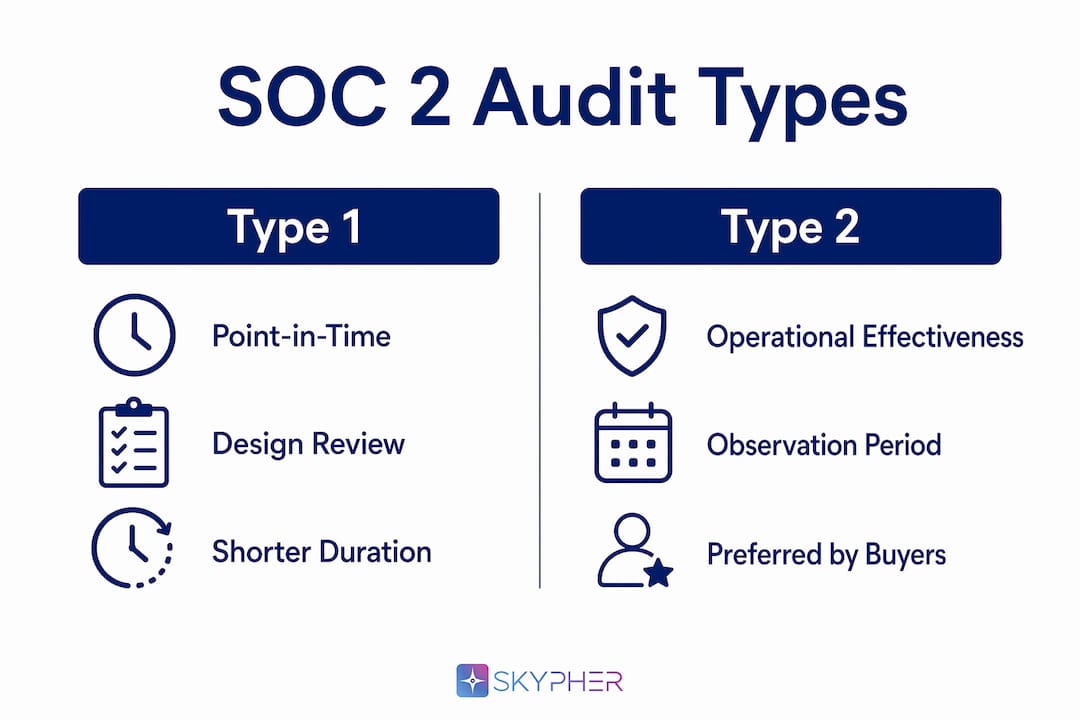
SOC 2 audits come in two types. A Type 1 report is a point-in-time review that confirms your controls are designed correctly as of a specific date. A Type 2 report evaluates whether those controls actually operated effectively over an observation period, typically 6 months for a first audit and 12 months for subsequent ones.
Enterprise buyers strongly prefer SOC 2 Type 2 reports because they prove sustained control operation, not just a snapshot design review. A Type 1 report is useful as a stepping stone when you need to show progress quickly, but it rarely satisfies a mature procurement team's requirements. Most SaaS companies in competitive markets pursue Type 2 within 12–18 months of starting their compliance program.
Pro Tip: Start with a Type 1 audit only if a specific client deal requires it immediately. Otherwise, invest your time and budget directly in a Type 2 program from the start.
How do businesses prepare for a SOC 2 audit?
Preparation is where most organizations either succeed or waste significant time and money. A structured approach prevents costly surprises mid-audit.
-
Conduct a readiness assessment. A readiness assessment maps your current controls against the Trust Services Criteria you plan to cover. Skipping this step leads to expensive surprises and can delay your final report by months. Treat it as a required investment, not an optional preliminary.
-
Define your system scope. Scope determines which systems, infrastructure components, and data flows fall under audit review. Narrow scope reduces cost and complexity. Broad scope increases coverage but raises audit fees significantly.
-
Build your system description. The System Description is the backbone of your SOC 2 report. It documents your services, infrastructure, data flows, and third-party dependencies in enough detail for the auditor to evaluate your environment accurately.
-
Operate controls continuously. Auditors collect evidence samples across the entire observation period. Controls that only exist on paper, or that were activated weeks before the audit, will produce gaps in evidence. Operational discipline throughout the observation period is what separates clean reports from qualified ones.
-
Document incident response exercises. If no real security incidents occur during the observation period, auditors still expect documented tabletop exercises to confirm your incident response process functions. Schedule these exercises early and keep written records.
The most common mistake organizations make is treating SOC 2 as a documentation project. Controls must be embedded in daily workflows, not assembled at audit time. Evidence collected late or inconsistently across the observation period risks a qualified opinion, which signals to clients that your controls had gaps.
Pro Tip: Assign a dedicated internal owner for each control area before the observation period begins. That person collects evidence monthly, not in a last-minute sprint before the auditor arrives.

What does a SOC 2 audit cost?
SOC 2 audit fees vary widely based on organizational size, the number of Trust Services Criteria covered, and environment complexity. Audit fees range from $40,000 to $300,000 or more for large, multi-product organizations with complex infrastructure.
These figures cover only the auditor's fees. Readiness assessments, consulting support, and internal staff time add to the total investment. Organizations that skip readiness work often spend more correcting problems mid-audit than they would have spent on preparation.
Several factors drive cost higher:
- Number of Trust Services Criteria. Each additional criterion adds controls to test and evidence to review.
- Environment complexity. Multi-cloud environments, numerous third-party integrations, and multiple product lines all increase auditor hours.
- Observation period length. A 12-month Type 2 observation period requires more evidence samples than a 6-month period.
- Organization size. Larger teams mean more user access reviews, more systems to test, and more policies to evaluate.
- Remediation needs. Organizations that enter the audit with control gaps pay for auditor time spent reviewing remediation evidence.
For SOC 2 compliance costs at the lower end of the range, organizations typically have a narrow scope, cover only the Security criterion, and operate in a single-cloud environment with a small team. A Type 1 audit generally costs less than a Type 2 audit because it requires no observation period evidence collection.
How does SOC 2 compare to ISO 27001?
SOC 2 and ISO 27001 solve similar problems but operate under different frameworks and serve different markets. Understanding the distinction helps you decide which to pursue first, or whether you need both.
| Factor | SOC 2 | ISO 27001 |
|---|---|---|
| Issuing body | AICPA (licensed CPA firm) | Accredited certification body |
| Output | Attestation report | Certificate |
| Primary market | North American B2B buyers | Global, especially Europe and APAC |
| Validity period | 12 months | 3 years (with annual surveillance audits) |
| Control scope | Trust Services Criteria | ISO/IEC 27001 Annex A controls |
SOC 2 and ISO 27001 share substantial control overlap in areas like access management, risk assessment, and incident response. The documentation approaches and audit methodologies differ, but organizations that build strong controls for one framework find the other significantly easier to achieve.
The strategic choice depends on your client base. If your buyers are primarily US-based enterprise tech or finance companies, SOC 2 is the expected standard. If you sell into European or APAC markets, ISO 27001 carries more weight. Many mid-market SaaS companies pursue SOC 2 first and add ISO 27001 as they expand internationally. Both frameworks together signal a mature security program to any buyer, anywhere.
Key Takeaways
SOC 2 is a formal attestation report, not a certification badge, and enterprise buyers in tech and finance treat it as a non-negotiable proof of control effectiveness.
| Point | Details |
|---|---|
| Attestation, not certification | SOC 2 produces a report from a licensed CPA firm, valid for 12 months, not a certificate. |
| Type 2 is the enterprise standard | Enterprise buyers prefer Type 2 reports covering 6–12 months of observed control operation. |
| Readiness assessment is required | Skipping a readiness assessment risks costly mid-audit surprises and delayed reports. |
| Costs vary widely | Audit fees range from $40,000 to $300,000+ depending on scope, size, and environment complexity. |
| SOC 2 vs ISO 27001 | SOC 2 targets North American buyers; ISO 27001 serves global markets, especially Europe and APAC. |
What most guides get wrong about SOC 2 compliance
The framing of SOC 2 as a "certification" is the single most persistent misconception in B2B tech. I have watched organizations spend months preparing a documentation library, pass their audit, and then hand clients a report they cannot explain. The report is not a badge. It is a disclosure document. A qualified opinion in that report tells clients exactly where your controls fell short.
The organizations that get the most value from SOC 2 treat it as an operational discipline exercise, not a compliance checkbox. They build access reviews, change management logs, and incident response exercises into their regular workflows before the observation period starts. The audit then captures what they already do, rather than what they scrambled to document.
The second misconception is that SOC 2 is purely a security exercise. It is also a sales tool. Enterprise buyers require the report to reduce procurement risk, and a clean Type 2 report shortens sales cycles measurably. Treating compliance as a revenue enabler changes how your team prioritizes the work.
My honest advice: start your readiness assessment at least six months before you plan to begin the observation period. Use that time to fix gaps, not to document controls that do not yet exist. The audit will reflect the reality of your operations, and so will the report your clients read.
— Gaspard
How Skypher supports your compliance and client trust workflows
Completing a SOC 2 audit generates a significant volume of security questionnaires from prospective clients who want to verify your controls before signing contracts. Skypher's security questionnaire automation platform answers even 200 questions in under a minute, pulling from your verified compliance documentation with AI-powered accuracy.

Skypher integrates with over 40 third-party risk management platforms, including OneTrust and ServiceNow, and connects directly with Slack, Microsoft Teams, Confluence, and Google Drive. Its Trust Center platform lets you share your SOC 2 report and security posture with clients transparently, reducing back-and-forth during procurement. For organizations managing multiple products or entities, Skypher supports complex enterprise setups with multilingual capability and real-time collaboration built in.
FAQ
What is SOC 2 certification exactly?
SOC 2 certification is the common term for a SOC 2 attestation report issued by a licensed CPA firm under AICPA standards. No official certificate exists; the deliverable is a detailed report evaluating your controls against the Trust Services Criteria.
What is the difference between SOC 2 Type 1 and Type 2?
A Type 1 report reviews whether controls are designed correctly at a single point in time. A Type 2 report evaluates whether those controls operated effectively over an observation period of 6–12 months, which enterprise buyers require.
How long does a SOC 2 audit take?
A Type 1 audit typically takes 8–16 weeks from start to report. A Type 2 audit takes approximately 6–9 months in total, including the observation period and auditor review.
What does a SOC 2 audit cost?
SOC 2 audit fees range from $40,000 to $300,000 or more, depending on organization size, the number of Trust Services Criteria covered, and environment complexity. Readiness and consulting fees are additional.
Is SOC 2 required for SaaS companies?
SOC 2 is not legally mandated, but it is effectively required in B2B tech sales because enterprise buyers in North America demand the report as a condition of procurement. Without it, closing deals with large clients becomes significantly harder.