

A SOC application means preparing for and submitting evidence in a SOC audit engagement, scoped against the AICPA Trust Services Criteria. The immediate next step is choosing between a Type 1 or Type 2 report and starting evidence collection right away, since that decision drives every deadline after it. We'll walk through the phases, the evidence auditors actually want, and where a platform like Skypher fits into the process.
TL;DR:
- Defining a clear system boundary and choosing the appropriate Type 1 or Type 2 report early prevents delays during fieldwork.
- Collecting recurring, timestamped evidence in structured folders reduces gaps and speeds up auditor review cycles.
- An observation window of three to six months is required for Type 2 audits, which can extend the timeline to six to nine months if not planned properly.
- Choosing an experienced, industry-aware auditor with clear pricing and sample expectations minimizes fieldwork delays.
- Implementing continuous monitoring practices with automation tools helps catch lapses before auditors do and maintains audit readiness.
Table of Contents
- Your 2-Week Checklist to Start the SOC Application Process
- The SOC Audit Phases and What Each One Delivers
- What Auditors Actually Want in Your PBC Evidence List
- Choosing an Auditor Without Losing Weeks to the Wrong Fit
- Keeping Your Observation Window Clean With Continuous Monitoring
- The Findings That Force a SOC Audit Restart
- SOC 3 and Other Report Types Worth Knowing
- The Standards Behind Every SOC Report
- What Happens After the Report Lands on Your Desk
- Who Actually Benefits From SOC Certification
- Rethinking SOC Readiness as a Cadence, Not a Sprint
- Speed Up Evidence Collection and Questionnaire Response With Skypher
- Sources
Your 2-Week Checklist to Start the SOC Application Process
Most delays we see in SOC applications trace back to the first two weeks, not the last two. Teams jump into remediation before they've scoped the system boundary, and they pay for it during fieldwork. Here's the sequence we recommend instead:
- Define your system boundary. List the critical assets, data flows, and third-party services in scope before you touch a single control.
- Pick Type 1 or Type 2. Base this on what your buyers actually need and how much runway you have (more on that below).
- Map controls to the Trust Services Criteria. Assign a named owner to each control category so accountability doesn't get lost in a shared spreadsheet.
- Turn on automated capture for high-value evidence. MFA logs, access reviews, and vulnerability scans are the artifacts auditors ask for most, so automate their collection first.
- Set a recurring evidence triage cadence. A two-week cycle, one week to flag what's due and one for owners to upload it, keeps the evidence pipeline moving without last-minute scrambles.
Get these five right and the rest of the SOC application process becomes a matter of execution, not improvisation.
The SOC Audit Phases and What Each One Delivers
A SOC audit runs through five distinct phases, and each one produces a specific deliverable that feeds the next. Understanding this sequence matters more than most teams realize, because skipping ahead (starting remediation before scoping, for instance) is exactly what pushes timelines out by months.
Scoping and the engagement letter typically take 2 to 4 weeks. This is where you and your auditor agree on which Trust Services Criteria apply and finalize the system description. Readiness assessment follows, usually running 4 to 12 weeks depending on how mature your control environment already is, and it produces a gap map covering 60 to 100 control points along with a remediation plan.
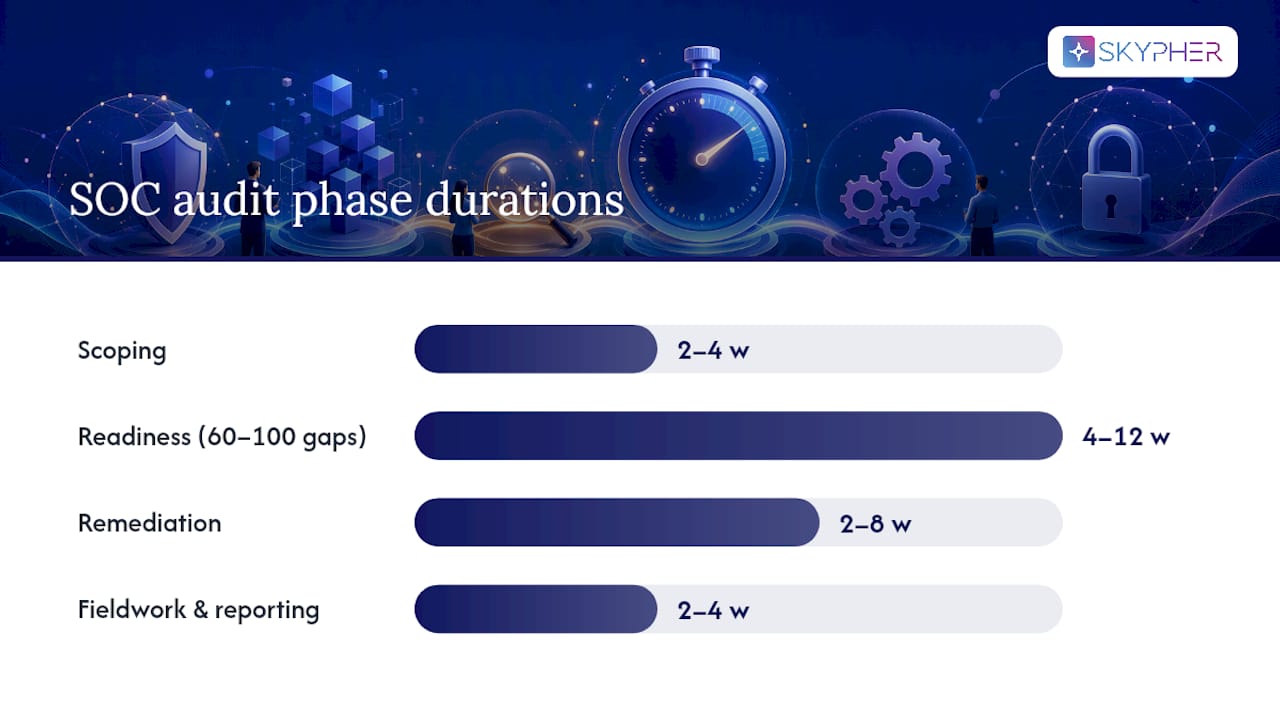
Remediation itself takes another 2 to 8 weeks. Each gap gets an owner and a clear definition of done, whether that's implementing MFA everywhere or documenting a change management policy that already exists informally.
Here's where Type 1 and Type 2 diverge sharply:
| Phase | Type 1 | Type 2 |
|---|---|---|
| Scoping | 2–4 weeks | 2–4 weeks |
| Readiness | 4–12 weeks | 4–12 weeks |
| Remediation | 2–8 weeks | 2–8 weeks |
| Observation window | Not required | 3–6 months |
| Fieldwork & reporting | 2–4 weeks | 2–4 weeks |
Type 1 skips the observation window entirely, since it only tests whether controls are designed correctly at a single point in time. Type 2 requires that 3 to 6 month observation period to prove controls operated effectively over time, which is why a first Type 2 audit often takes 6 to 9 months end to end. Fieldwork and reporting close out both paths in 2 to 4 weeks, assuming your team responds to auditor requests promptly.
What Auditors Actually Want in Your PBC Evidence List
The prepared-by-client (PBC) list is where good intentions meet reality. A typical PBC list contains 80 to 200 or more items, and auditors expect every one of them mapped cleanly back to a specific control, not dumped into a shared folder with vague file names.
Pro Tip: Structure each PBC folder around three pillars: the policy that governs the control, evidence the control actually ran, and the technical configuration proving it. If you can't produce all three for a given control, that's a gap worth fixing before fieldwork starts, not during it.
The three-pillar structure looks like this in practice:
- Policy evidence: a written access control policy, approved and dated, showing who's responsible for what.
- Operational evidence: access review exports showing quarterly reviews actually happened, not just that a policy says they should.
- Technical evidence: timestamped vulnerability scan reports, change tickets with visible approval chains, and configuration exports from the systems themselves.
Software supply chain evidence deserves particular attention here. SBOMs and scanner provenance records are becoming a standard auditor request for SaaS engineering teams, and they're painful to reconstruct after the fact if you haven't been generating them continuously.
One habit we'd push back on hard: relying on screenshots as primary evidence. A screenshot proves a screen existed at one moment; it doesn't prove a control operated consistently across your observation window. Auditors know this, and they'll ask for the underlying signed log, CSV export, or timestamped report behind it anyway. Skip the intermediate step and organize the real artifact from day one, with a short description of what it proves and when it was generated.
Choosing an Auditor Without Losing Weeks to the Wrong Fit
Not every CPA firm that offers SOC audits is a good fit for a fast-moving tech or finance organization, and picking the wrong one shows up as delays during fieldwork, not before you sign the engagement letter.
Look for a firm with an active CPA license, a clean AICPA peer review record, genuine SOC 2 experience (not just SOC 1 experience relabeled), and familiarity with your industry's specific risk profile. Pricing models vary widely between firms, so ask upfront whether you're paying a flat fee or a rate tied to sample volume.
Once you've narrowed the field, the operational steps matter as much as the credentials:
- Send RFPs to at least three firms and compare turnaround estimates side by side.
- Ask to review a redacted sample report before signing anything.
- Agree on sample sizes and portal access in writing, not verbally on a kickoff call.
Pro Tip: Auditors typically pull 15 to 25 samples per control during fieldwork. Ask your auditor for that number before fieldwork starts so you know exactly how deep your evidence needs to go for each control category.
The engagement letter should spell out scope, the exact observation window dates, and a communication cadence. During fieldwork itself, assign one internal audit coordinator, triage every auditor request within 24 to 48 hours, and hold a weekly status call so nothing sits unanswered for a week.
Keeping Your Observation Window Clean With Continuous Monitoring
The single biggest threat to a SOC Type 2 timeline isn't a missing policy. It's a control that ran fine for four months and then quietly lapsed in month five because nobody was watching. Continuous control monitoring exists specifically to catch that lapse before your auditor does, and organizations that treat audit readiness as an ongoing discipline rather than a seasonal sprint avoid the gaps that force an observation restart.
Practical automation patterns worth building now:
- Scheduled vulnerability and configuration scans that run on a fixed cadence, not manually before each auditor check-in.
- Automated access-review workflows that generate their own evidence trail as they run.
- SBOM generation tied to your build pipeline, so supply chain evidence exists continuously rather than being reconstructed under deadline pressure.
- Evidence tagging and timestamping at the point of creation, not after the fact when memory of context has faded.
When evaluating a platform to support this, four things separate a genuinely useful tool from a checkbox purchase:
| Evaluation criteria | What to look for |
|---|---|
| Connectors | Direct integrations with your existing TPRM and ticketing tools |
| Export formats | Auditor-friendly exports (CSV, signed logs) over raw screenshots |
| Confidence scoring | Transparent flags on AI-generated answers needing human review |
| Multi-entity support | Ability to manage separate products or subsidiaries under one system |
A questionnaire automation tool fits into this picture as one example of what to look for: it parses multiple document formats, connects to many third-party risk management platforms, offers AI-assisted answers with confidence scoring, and integrates into collaboration platforms so evidence requests don't get lost in email threads. A customizable Trust Center then lets you share your compliance posture with prospects without reopening your PBC folder for every sales conversation.
The Findings That Force a SOC Audit Restart
Certain findings show up again and again, and they're almost always preventable with earlier planning rather than better excuses during fieldwork.
- Inconsistent evidence across the observation period. A control that ran once in month one and never again isn't operating; it's a one-off. Auditors will flag this immediately, so build recurring cadence into every control from day one.
- Design versus operating effectiveness mismatches. A policy that exists on paper but isn't enforced in practice is worse than no policy at all, because it signals the gap wasn't caught internally.
- Supply chain evidence gaps. Missing SBOM or scanner provenance records force auditors to ask follow-up questions that eat into your fieldwork timeline.
- Slow responses to supplemental requests. This is the single most avoidable delay. Designate a triage owner with a 24 to 48 hour SLA, as recommended in day-by-day fieldwork walkthroughs, and stick to it.
When a gap does surface mid-observation, the fastest recovery pattern assigns a clear owner, implements a short-term fix immediately, and documents retrospective evidence covering the gap period. In genuinely limited cases, a bridge letter from your auditor can cover the interim, though it's not a substitute for closing the underlying gap.
SOC 3 and Other Report Types Worth Knowing
Type 1 and Type 2 cover the depth of testing, but SOC reports also come in different formats depending on who's going to read them. A SOC 2 report, whether Type 1 or Type 2, is a detailed document meant for a restricted audience: your existing customers, prospects under NDA, and auditors who need the granular control descriptions and test results.
SOC 3, by contrast, is a general-use report built for public distribution. It covers the same Trust Services Criteria at a high level but strips out the sensitive control details, which makes it safe to post on a website or hand to any prospect without a legal review first. Most organizations that complete a SOC 2 Type 2 audit generate a SOC 3 as a marketing-friendly companion, not as a replacement.
There's also SOC 1, which focuses specifically on internal controls over financial reporting rather than security, availability, or confidentiality. It matters mainly for organizations whose services touch a customer's financial statements, think payroll processors or fund administrators, and it follows a separate framework from SOC 2 even though the audit mechanics look similar.
For most tech and finance companies fielding security questionnaires from enterprise buyers, SOC 2 Type 2 is the report that actually moves deals forward. SOC 3 supplements it for public trust signaling, and SOC 1 only enters the conversation when financial reporting controls are genuinely part of what you deliver to customers.
The Standards Behind Every SOC Report
Every SOC report rests on a specific auditing standard, and knowing which one applies helps you understand why your auditor asks the questions they do. In the United States, SOC engagements follow SSAE 18 (Statement on Standards for Attestation Engagements No. 18), issued by the AICPA's Auditing Standards Board. SSAE 18 governs how CPA firms plan, execute, and report on attestation engagements, including the sampling approaches and documentation requirements that shape your fieldwork experience.
Internationally, the equivalent standard is ISAE 3402 (International Standard on Assurance Engagements 3402), issued by the International Auditing and Assurance Standards Board. If your organization operates across US and international markets, or your auditor has an international practice, you may see engagements structured to satisfy both standards simultaneously, which avoids the cost of running two separate audits for functionally overlapping requirements.
The Trust Services Criteria themselves, security, availability, processing integrity, confidentiality, and privacy, sit underneath both standards as the actual content being tested. Most first-time SOC applications scope only the Security criterion, then expand to Availability or Confidentiality in later cycles as buyer requirements grow more specific. Knowing this distinction matters when a buyer's security team asks which standard your report follows: SSAE 18 versus ISAE 3402 describes the audit framework, while the Trust Services Criteria describe what was actually tested.
What Happens After the Report Lands on Your Desk
Getting the report is the beginning of the maintenance phase, not the end of the project. Most SOC 2 reports carry findings or exceptions even in a clean engagement, and how you respond to those matters to buyers reading the report just as much as the findings themselves.
Start by categorizing every exception by severity and root cause. A single missed access review is a process gap; a control that was never implemented is a design gap, and it needs a different remediation approach entirely. Draft a management response for each exception, since auditors include these directly in the final report, and a thoughtful, specific response reads far better to a security reviewer than a vague promise to "improve monitoring."
From there, the real work is sustaining what you just proved. Convert your one-time remediation fixes into permanent process changes: if you built an automated access review workflow to pass this audit, keep it running rather than reverting to manual quarterly checks. Schedule your next audit's observation window to start with minimal gap between reports, since a lapse in coverage between SOC periods raises questions buyers will notice.
Most organizations also formalize a quarterly internal control review at this stage, checking that the controls tested in the last audit are still operating as designed. This catches drift early, before it becomes a finding in your next report, and it turns what used to be an annual scramble into a steady, manageable cadence.
Who Actually Benefits From SOC Certification
A SOC report earns its cost by doing different work for different audiences, and it helps to think about who's actually reading it before you decide how much to invest in the process.
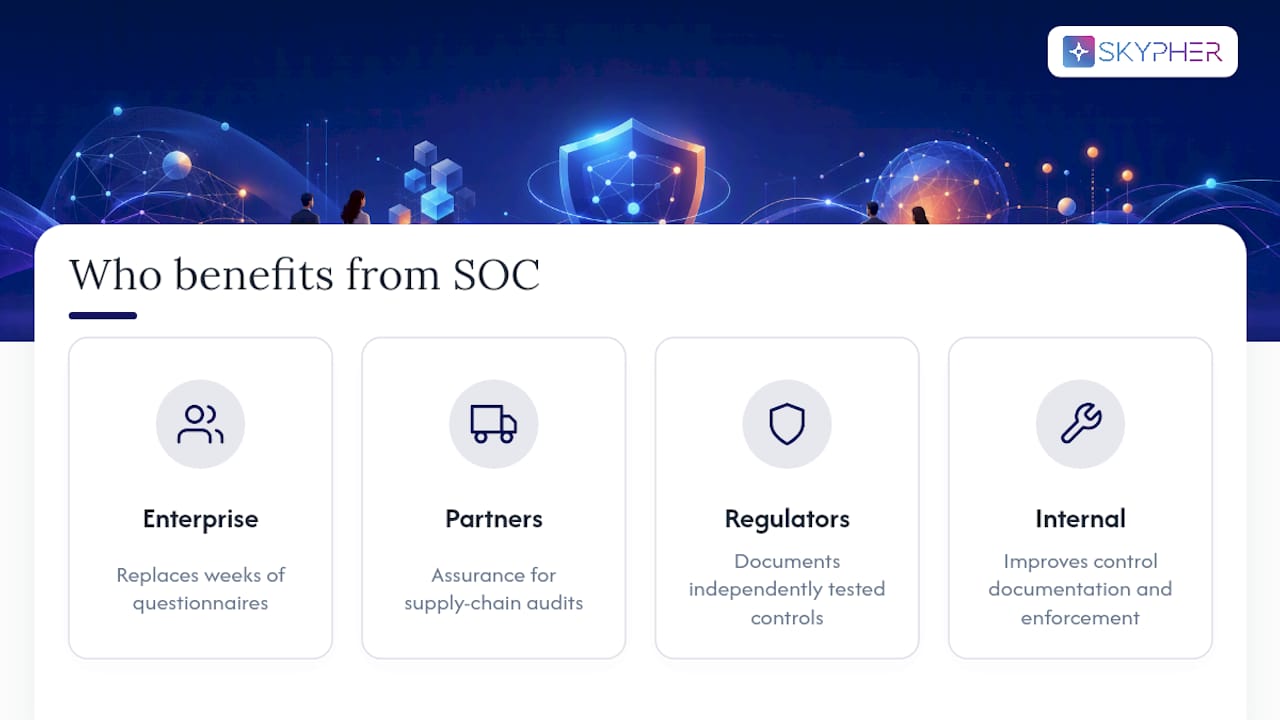
For enterprise clients, a SOC 2 Type 2 report replaces weeks of custom security questionnaires with a single document that answers most of their due diligence questions upfront. This is the most direct commercial benefit: sales cycles shorten because security review, often the longest step in enterprise procurement, gets compressed into a report review instead of a back-and-forth interrogation.
For partners and vendors further down your supply chain, the report provides assurance without requiring them to conduct their own audit of your environment. This matters increasingly as supply chain risk becomes a bigger part of every buyer's own compliance obligations; your SOC report effectively becomes evidence in their audit too.
For regulators and industry bodies, particularly in finance, a SOC report demonstrates a documented, independently tested control environment that satisfies portions of broader regulatory expectations, even when it isn't the regulatory requirement itself. It won't replace sector-specific compliance obligations, but it builds a credible foundation that regulators and examiners recognize.
Internally, the process itself often delivers as much value as the certificate. Teams that go through readiness assessment and remediation typically end up with better documented, more consistently enforced controls than they had before the audit started, independent of whether a single customer ever asks to see the report.
Rethinking SOC Readiness as a Cadence, Not a Sprint
Most organizations treat SOC audits like a fire drill: panic for three months, pass, then forget about it until next year's deadline looms. That approach works, technically, but it wastes the one advantage a mature control environment actually gives you, predictability.
We'd argue the two-week evidence triage cycle is the most underrated piece of this entire process. It's not glamorous, and it doesn't show up in any auditor's checklist, but it's the mechanism that turns evidence collection from a quarterly emergency into a background task. Prioritize buyer-facing controls first, access management, MFA, change management, and supply chain provenance, because those are the areas enterprise security reviewers scrutinize hardest regardless of what your auditor samples.
Automation earns its place here by giving back the time your team would otherwise spend chasing screenshots. Use that time to fix real gaps instead.
— Gaspard
Speed Up Evidence Collection and Questionnaire Response With Skypher
Preparing a SOC application involves two parallel workloads that most teams underestimate: gathering audit evidence and answering the flood of security questionnaires that enterprise buyers send during the same sales cycles your audit is running through. Skypher is built for the second workload, and it takes real pressure off the first by keeping your evidence library and questionnaire answers in sync.

The AI questionnaire automation tool parses whatever format a buyer sends, pulls from a centralized knowledge base you build once, and drafts answers with confidence scoring so your team reviews rather than rewrites from scratch. The automated review cycles and duplicate detection feature catches repeated questions across different buyers' questionnaires, so your team stops answering the same access control question for the fifth time this quarter. Pair that with a Trust Center built from your SOC report and supporting artifacts, and you can hand qualified prospects self-service access to your compliance posture instead of routing every request through your already-stretched compliance team.
If your SOC application timeline overlaps with a heavy questionnaire season, and for most mid-size and enterprise sellers it does, book a demo to see how the connectors and export formats fit your existing evidence workflow.
Sources
- SOC 2 Audit Process Step by Step (2026 Guide)
- SOC 2 Compliance Roadmap: From Gap Assessment to Audit-Ready
- The SOC 2 Audit Process: Timeline, Steps, and What to Expect | GRCTrail Blog
- What to Expect During Your SOC 2 Audit: A Day-by-Day Walkthrough | SecurityDocs