

TL;DR:
- Manual SOC processes cause analysts to be overwhelmed by alerts and alert fatigue. Implementing phased automation with proper foundation, workflows, and measurements improves detection, response, and analyst satisfaction. Rushing automation without trust, quality data, or standardization risks creating ineffective, brittle systems that hinder security outcomes.
Security teams running on manual processes are losing ground fast. The average SOC analyst now faces hundreds of alerts per shift, and alert fatigue is real: SOC automation can cut analyst triage workload by about 70%, yet most organizations are still handling enrichment, correlation, and initial triage by hand. If you're a security analyst or compliance officer trying to figure out where automation fits in your operations — and how to actually implement it without breaking things — this guide covers the full picture, from prerequisites to metrics that prove it's working.
Table of Contents
- Key takeaways
- What SOC automation actually requires before you start
- How to implement SOC automation step by step
- Common mistakes that derail SOC automation projects
- Verifying success and measuring outcomes
- My honest take on where SOC automation stands
- Cut your questionnaire workload while you build your SOC automation
- FAQ
Key takeaways
| Point | Details |
|---|---|
| Start with prerequisites | Centralize telemetry and document workflows before touching any automation tooling. |
| Phase your rollout | A three-phase approach over 12 months reduces risk and builds analyst trust in the system. |
| Avoid over-automation | Human approval gates on sensitive actions prevent brittle systems and compliance failures. |
| Measure workflow coverage | Track automation by task execution, not just alert volume, to get accurate ROI data. |
| Questionnaire automation matters | A maintained "golden answers" library tied to versioned evidence dramatically speeds up security reviews. |
What SOC automation actually requires before you start
Most teams jump straight to deploying a SOAR platform and wonder why playbooks fail within weeks. The real work happens before any automation runs. Getting this foundation right is the difference between SOC automation that scales and automation that creates more cleanup than it prevents.
The core technology stack
SOC automation is built on four layers working together: a SIEM for centralized log collection and correlation, a SOAR platform for orchestration and playbook execution, threat intelligence feeds that provide external context, and increasingly, AI agents that handle decision logic at speed. None of these work well in isolation. Your SOAR is only as useful as the data your SIEM surfaces, and your SIEM is only as reliable as the collection and normalization happening upstream.
Consistent tool taxonomy is one of the most overlooked prerequisites. If your endpoint team calls an event a "process injection" and your network team labels the same behavior a "lateral movement indicator," your playbooks will branch incorrectly or fail to fire at all. Before you automate anything, align your team on a shared vocabulary across every data source.
What to document and measure before day one
You need three things locked down before turning on any automation:
- Documented workflows for every process you plan to automate, including decision points, escalation paths, and who approves what
- Integrated data sources with clean, normalized feeds from endpoints, network, cloud, identity, and email
- Baseline KPIs covering Mean Time to Detect (MTTD), Mean Time to Respond (MTTR), false positive rates, and current analyst triage time per alert
| Prerequisite | Why it matters | Risk if skipped |
|---|---|---|
| Centralized telemetry | Single source of truth for playbooks | Playbooks fire on incomplete data |
| Documented playbooks | Automation needs explicit logic | Inconsistent or broken workflows |
| Baseline KPIs | Measures ROI post-implementation | No way to prove value or course-correct |
| Standardized taxonomy | Consistent enrichment and routing | Misrouted alerts and analyst confusion |
For compliance officers, this stage also means building your "golden answers" library: a centralized evidence map tied to controls and versioned evidence that feeds security questionnaire responses automatically. Updating one authoritative source keeps answers consistent across every questionnaire your team touches.

Pro Tip: Run a two-week manual log of every repeated task your analysts perform. Anything that appears more than three times per week with no decision variance is an immediate automation candidate.
How to implement SOC automation step by step
Phased rollout over 12 months is the approach that actually works: foundation, augmentation, acceleration. Teams that try to automate everything at once typically end up reverting because analysts don't trust the output and leadership can't explain what the system decided.
Phase 1: Foundation (months 1 through 3)
- Centralize all telemetry into your SIEM, resolving normalization conflicts before moving forward.
- Document every manual playbook your analysts currently use, including edge cases and escalation criteria.
- Establish baseline metrics for MTTD, MTTR, and false positive rate. You cannot improve what you have not measured.
- Audit your data quality. Partial automation of isolated SOC stages leads to poor outcomes if upstream data is inconsistent. Fix it before automating on top of it.
Phase 2: Augmentation (months 4 through 8)
- Automate alert enrichment. Pull in threat intel, asset context, user history, and geolocation automatically on every alert. Analysts should never be manually looking up a hash or IP address.
- Deploy conditional triage playbooks. Use SOAR to route alerts based on severity, asset criticality, and threat type. Configurable automation logic at the step level lets you automate the easy calls while routing the ambiguous ones to humans.
- Automate low-risk containment actions. Blocking a known-malicious IP or quarantining an endpoint based on a high-confidence indicator can happen without a human in the loop, but only after you have validated confidence thresholds through several weeks of shadowed operation.
Phase 3: Acceleration (months 9 through 12)
- Expand autonomous workflows to cover higher-complexity scenarios, using data from phases one and two to calibrate confidence thresholds.
- Introduce human-in-the-loop approval gates for sensitive actions: disabling user accounts, modifying firewall rules, or any action affecting business-critical systems.
- Automate questionnaire workflows with human validation steps before final submission. This applies the same phased logic to compliance tasks, where accuracy matters as much as speed.
Revisit your playbooks every 30 days in the first year. Threats evolve, data sources change, and analyst feedback will surface gaps you did not anticipate at design time.
Pro Tip: Shadow your automation for two weeks before enabling auto-execute. Run the playbook logic in observe-only mode and compare its decisions against what your analysts would have done. Close any gaps before going live.
Common mistakes that derail SOC automation projects
The failure modes in SOC automation are predictable, which means they are avoidable. Here is what actually goes wrong and how to address it before it costs you.
Over-automating before trust is established. Teams that automate everything on day one often discover that playbooks fire on stale or partial data, causing containment actions that affect production systems. Rollback mechanisms for automated actions are not optional. Every automated response that touches business operations needs an explicit reversal path.
Ignoring data quality upstream. Automation does not fix bad data. It executes on it at speed, which means errors multiply instead of getting caught by a human. If your log normalization is inconsistent, your automated enrichment will be wrong, and your playbook logic will branch incorrectly. Fix the pipes before you build the automation.
Skipping taxonomy standardization. Without consistent labels and definitions, playbooks become ungovernable. Six months after deployment, nobody can explain why a specific playbook fires under certain conditions because the triggering logic was built on inconsistently labeled events.
Automation amplifies the quality of your processes. If your processes are well-defined and your data is clean, automation delivers dramatic efficiency gains. If they are not, automation surfaces every flaw at machine speed.
Misaligning automation levels with risk tolerance. Not every action warrants full automation. High-confidence, low-impact actions (blocking a known-bad IP) can safely be automated. Low-confidence or high-impact actions (disabling a service account for a critical application) should require human approval regardless of how mature your automation is.
Pro Tip: Build a confidence-to-impact matrix before designing any playbook. Map every automated action on two axes: confidence in the detection and business impact of the response. Only actions scoring high confidence and low impact should run fully automated on day one.
- Create a rollback path for every automated containment action before enabling auto-execute
- Review false positive rates weekly for the first three months and adjust thresholds accordingly
- Collect analyst feedback through structured retrospectives, not just anecdotal comments
- Never automate an action your team cannot explain and defend in a compliance audit
Verifying success and measuring outcomes
Knowing whether your SOC automation is actually working requires more than a dashboard showing alerts processed. Teams that measure this correctly track workflow execution coverage alongside alert volume.
Tracking automation by task execution rather than just alerts processed is a meaningful distinction. An alert that gets auto-enriched but still requires 20 minutes of manual investigation because the enrichment missed key context is not a win. You want to measure how much of the total workflow ran autonomously end to end.
| Metric | What it measures | Target (mature SOC) |
|---|---|---|
| MTTD reduction | Speed of threat detection | 30 to 40% improvement |
| MTTR reduction | Speed of incident containment | 45 to 55% improvement |
| Analyst triage time | Time per alert after automation | 70% reduction |
| False positive rate | Quality of automated decisions | Trending down quarter over quarter |
| Automation coverage | Percentage of workflows fully automated | 60 to 80% for routine tasks |
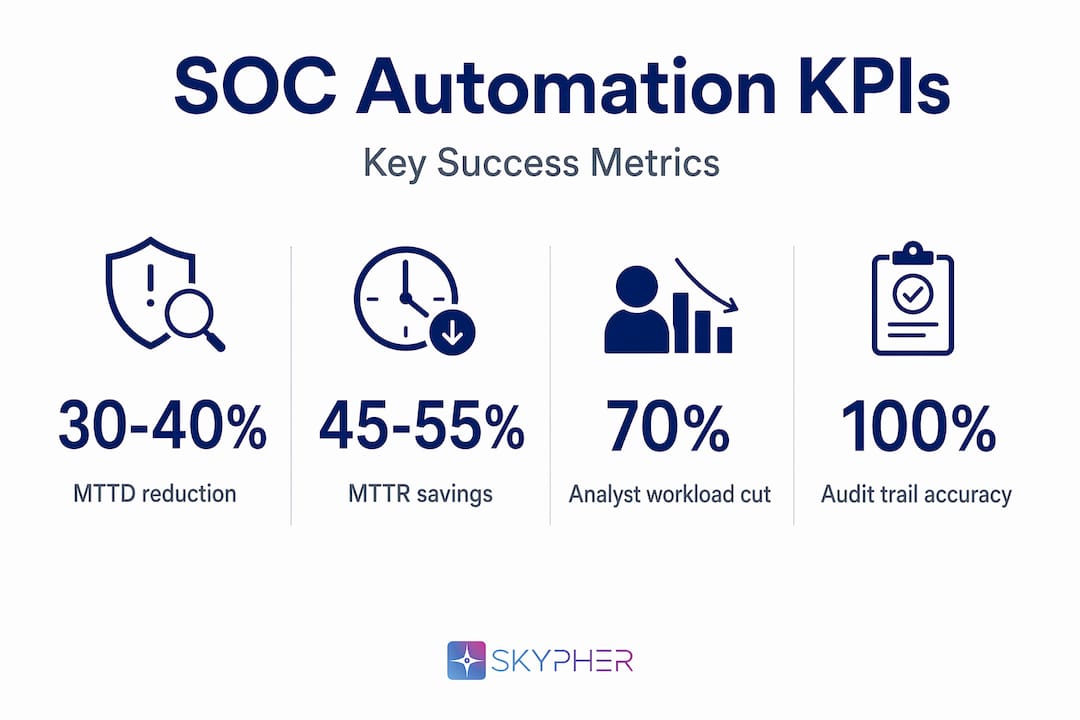
Beyond the numbers, track analyst satisfaction and retention. When automated systems handle 70% of repetitive investigation tasks, analysts shift toward threat hunting, purple team exercises, and engineering work. Experienced analysts who feel like they're doing meaningful work stay longer. That is a measurable operational benefit that rarely appears in ROI calculations.
For compliance officers, audit trails generated by automated workflows are a direct benefit. Every automated action is logged, timestamped, and attributable, which simplifies evidence collection for SOC 2, ISO 27001, and similar frameworks considerably.
Regular review cycles at 30, 60, and 90 days should revisit your golden answers library for questionnaires, refresh threat intelligence integrations, and incorporate playbook changes based on the most recent analyst retrospectives.
My honest take on where SOC automation stands
I have seen teams go into SOC automation expecting a system that runs itself in six months. That is not how it works, and the organizations that approach it that way end up with brittle playbooks, frustrated analysts, and automation they are afraid to expand.
What I have learned is that the value of SOC automation is not in removing humans from the loop. It is in removing humans from the wrong parts of the loop. Tier-1 triage on a known-malicious IP address does not require analyst judgment. Deciding whether to disable the VP of Finance's account at 2 AM absolutely does. The best implementations I have seen draw that line deliberately and revisit it as confidence in the system grows.
The harder truth is that incremental automation with human oversight consistently outperforms aggressive automation on every metric that matters: analyst trust, governance clarity, and incident outcomes. Teams that rush to full autonomy often see their analysts working around the system rather than with it, which is worse than no automation at all.
The emerging trend I am watching closely is agentic AI, where autonomous platforms handle multi-step threat investigation with human approval for sensitive actions. That is genuinely powerful when the governance structure is right. But governance has to come first. Build the culture before you build the capability.
The teams doing this well are not the ones with the most automation. They are the ones who treat automation as an evolving practice, keep analysts involved in playbook design, and measure outcomes honestly. That mindset is the real differentiator.
— Gaspard
Cut your questionnaire workload while you build your SOC automation
Security questionnaire responses are one of the most time-consuming manual tasks that SOC and compliance teams face, and they are a natural fit for the same automation logic you are applying to your operations.

Skypher's AI-powered questionnaire automation gives security and compliance teams a purpose-built tool to respond to vendor assessments, customer due diligence requests, and compliance reviews at a fraction of the usual time. The platform maintains a versioned knowledge base tied directly to your controls, so every answer is consistent and auditable. Skypher also offers automated review cycles and duplicate detection to cut repetitive work on recurring questionnaires. If you are building out your security automation practices this year, questionnaire automation is the fastest place to see measurable time savings.
FAQ
What is SOC automation?
SOC automation refers to using technology such as SOAR platforms, AI agents, and SIEM integrations to handle repetitive security operations tasks like alert triage, enrichment, and incident response automatically. It frees analysts to focus on complex threats that require human judgment.
How long does it take to implement SOC automation?
A phased implementation over 12 months is the standard approach: three months for foundation work, five months for augmentation, and four months for acceleration into more autonomous workflows. Rushing the timeline increases the risk of brittle playbooks and analyst distrust.
What metrics prove SOC automation is working?
The most reliable indicators are MTTD reduction (target 30 to 40%), MTTR reduction (target 45 to 55%), and analyst triage time per alert. Track automation coverage by workflow execution rather than alert volume to get an accurate picture of operational impact.
What is the biggest risk in SOC automation?
Over-automating before building analyst trust and data quality standards is the most common failure mode. Automated responses that fire on incomplete or inconsistent data can affect business operations and are difficult to reverse without pre-built rollback mechanisms.
How does questionnaire automation fit into SOC automation?
Security questionnaire automation applies the same principles: a centralized, versioned knowledge base replaces manual lookup and drafting, and human validation gates catch errors before responses go out. It reduces compliance team workload the same way playbooks reduce analyst workload on routine alerts.