

TL;DR:
- Vanta automates security compliance and GRC workflows for regulated industries, reducing audit time from months to weeks. It connects to various systems, runs continuous tests, and uses AI to streamline policy drafting and risk management. The platform's broad framework support and real-time monitoring improve efficiency but require thorough initial setup and clear control ownership.
Vanta is defined as a trust management platform that automates security compliance and governance, risk, and compliance (GRC) workflows for organizations in regulated industries. The vanta company serves over 15,000 customers and cuts audit preparation time from nearly a year down to weeks. Founded in 2018 and valued at $4.15 billion as of 2026, Vanta has grown from a SOC 2 automation tool into a full GRC platform with more than 1,000 employees. For tech and finance teams facing mounting regulatory pressure, understanding what Vanta does and how it works is the first step toward choosing the right compliance path.
How does the Vanta company automate security compliance?
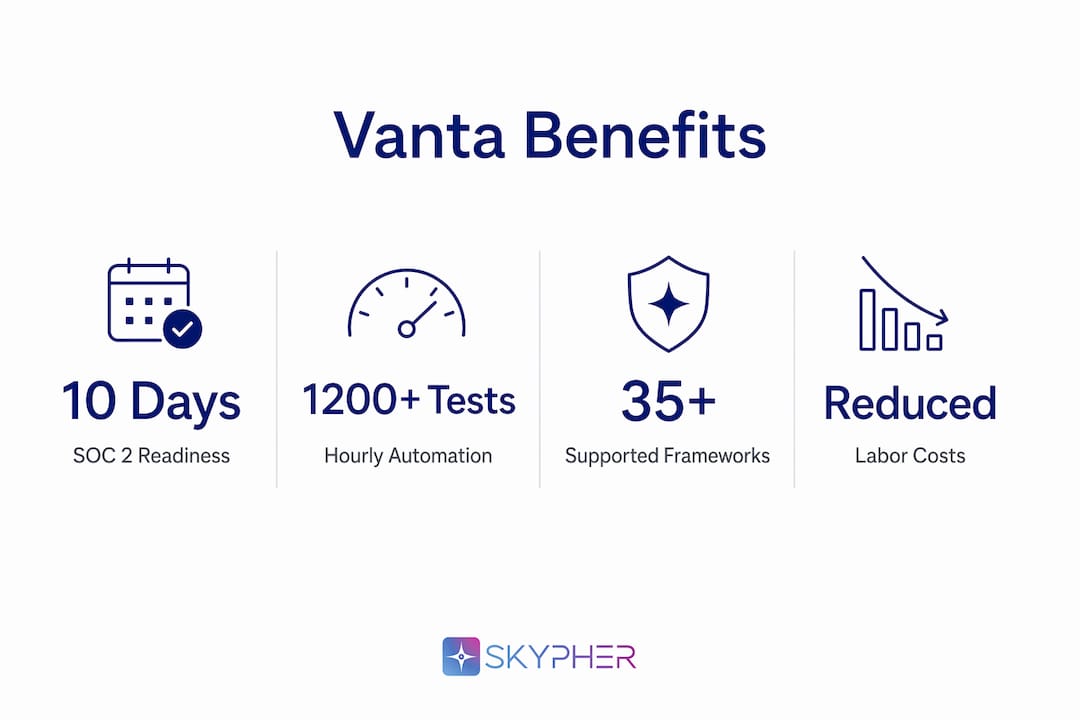
Vanta replaces manual, spreadsheet-based compliance with continuous, automated monitoring. The platform connects directly to an organization's existing cloud services, HR tools, code repositories, and identity providers. Once connected, it runs over 1,200 automated tests every hour across more than 400 integrations. That volume of testing would be impossible for any compliance team to replicate manually.
The core mechanism works in four stages:
- Connect your infrastructure. Vanta links to cloud providers like AWS, Google Cloud, and Azure, as well as HR platforms, endpoint management tools, and version control systems. Each connection feeds live data into the compliance dashboard.
- Map controls to frameworks. The platform maps your existing technical controls to the specific requirements of your target compliance framework, whether that is SOC 2, ISO 27001, or another standard.
- Run continuous tests. Vanta's automated hourly tests check for misconfigurations, access control gaps, and policy violations in real time. Failures surface immediately rather than at the end of a quarterly review.
- Collect and organize evidence. Vanta automatically gathers the evidence auditors require, storing it in a structured format that auditors can access directly through a shared portal.
The AI agent layer sits on top of this infrastructure. It can draft compliance policies, pre-fill security questionnaires, and flag potential risks before they become audit findings. This shifts compliance work from reactive firefighting to proactive management.
Pro Tip: Connect Vanta to your identity provider on day one. Access control is the most common audit failure point, and early integration gives you the longest data history for auditors to review.

What compliance frameworks does Vanta support?
Vanta supports more than 35 compliance frameworks, covering security, privacy, and risk standards across industries. That breadth matters because tech and finance organizations rarely operate under a single regulation. A fintech company might need SOC 2 for enterprise customers, PCI DSS for payment processing, and GDPR for European users, all at the same time.
The frameworks Vanta covers include:
- SOC 2 Type I and Type II for SaaS and cloud service providers
- HIPAA for health data handling in digital health and insurtech
- ISO 27001 for internationally recognized information security management
- PCI DSS for organizations that process, store, or transmit payment card data
- GDPR for data privacy compliance with European regulations
- FedRAMP for cloud providers serving US federal agencies
- NIST CSF and additional risk frameworks for enterprise GRC programs
Vanta has evolved beyond its original SOC 2 niche into a platform that handles multi-framework GRC at scale. That evolution is significant for finance firms, which often face layered regulatory requirements from bodies like the SEC, FINRA, and state-level regulators simultaneously. A single platform that maps controls across frameworks eliminates the duplication of effort that comes from managing each regulation in isolation.
The continuous trust management model Vanta promotes is also a direct response to enterprise procurement demands. Large customers now routinely require real-time compliance evidence before signing contracts, not just an annual audit report. Vanta's always-on monitoring gives vendors the live documentation those customers expect.
What business benefits does Vanta deliver?
The most direct benefit is speed. Vanta helps organizations achieve SOC 2 Type I readiness in as little as ten days for startups with clean infrastructure. For more complex organizations, the platform still cuts audit preparation from months or a full year down to weeks. That time saving translates directly into faster sales cycles, since enterprise deals often stall waiting for security review completion.
Continuous monitoring also reduces the labor cost of compliance. Without automation, compliance teams spend significant time manually collecting screenshots, pulling access logs, and chasing down policy sign-offs. Vanta handles that evidence collection automatically, freeing security and engineering staff for higher-value work. The AI-powered workflow features extend this further by pre-completing questionnaires and drafting policy documents that teams then review rather than write from scratch.
Pro Tip: Use Vanta's vendor risk management module early. Third-party risk is one of the fastest-growing audit focus areas, and having documented vendor assessments before your audit begins removes a common last-minute scramble.
Risk visibility improves as well. Because Vanta monitors controls continuously rather than at a single point in time, security teams see control failures the day they occur. A misconfigured S3 bucket or an off-boarded employee who still has system access appears in the dashboard within hours, not at the next quarterly review. That real-time visibility supports a stronger security posture and gives leadership accurate data for board-level risk reporting.
For startups growing into regulated markets, Vanta also provides a credibility signal. Displaying a live Trust Center with current compliance status tells enterprise prospects that security is managed systematically, not reactively. That signal shortens procurement conversations and reduces the volume of inbound security questionnaires teams must answer manually.
What challenges should organizations expect when implementing Vanta?
Vanta's automation is powerful, but it depends entirely on the quality of the initial setup. Achieving full automation benefits requires significant upfront configuration to map organizational controls to the platform's framework requirements. Organizations with fragmented infrastructure or undocumented processes will spend more time in this phase than those with clean, well-documented environments.
The key implementation challenges include:
- Integration coverage gaps. Vanta's 400+ integrations cover most major cloud and SaaS tools, but organizations running legacy on-premises systems or niche industry software may find gaps. Those gaps require manual evidence collection, which partially offsets the automation benefit.
- Control ownership ambiguity. Vanta surfaces control failures, but someone must own the remediation. Without clear internal ownership assigned to each control, alerts pile up without resolution.
- Data quality dependencies. The platform's tests are only as accurate as the data flowing in from connected systems. Misconfigured integrations or stale data sources produce false positives that erode team trust in the dashboard.
- Mindset shift required. Teams accustomed to point-in-time compliance cycles, where compliance is a project rather than an ongoing state, often struggle with the continuous model. Compliance becomes an operational function, not an annual event.
Experienced users view Vanta not just as an automation tool but as a GRC platform requiring ongoing governance and management. The platform handles the monitoring and evidence collection, but human judgment remains necessary for interpreting risk, making remediation decisions, and communicating with auditors. Organizations that treat Vanta as a set-and-forget solution typically underperform those that assign dedicated compliance ownership alongside the tool.
The shift from annual audits to continuous compliance also changes how teams interact with auditors. Auditors increasingly expect to access live evidence portals rather than receive static document packages. Training your audit team and your external auditors on the new workflow is a practical step that many organizations overlook during implementation.
Key Takeaways
Vanta automates continuous security compliance across more than 35 frameworks, cutting audit preparation from months to weeks for tech and finance organizations.
| Point | Details |
|---|---|
| Continuous monitoring replaces audits | Vanta runs 1,200+ automated tests hourly, catching control failures in real time rather than at year-end. |
| Broad framework coverage | Support for SOC 2, HIPAA, ISO 27001, PCI DSS, GDPR, and FedRAMP serves multi-regulated tech and finance firms. |
| Speed to compliance | Startups can reach SOC 2 Type I readiness in as little as ten days with clean infrastructure. |
| Setup effort is real | Full automation benefits require thorough initial configuration and clear internal control ownership. |
| Human governance still matters | Vanta handles evidence collection, but risk decisions and auditor communication require dedicated human oversight. |
Vanta's real impact on compliance, from where I sit
I've watched compliance go from a once-a-year scramble to a board-level priority over the past decade. Vanta sits at the center of that shift, and I think its most underappreciated feature is not the automation itself but the cultural change it forces.
When a control failure appears in a live dashboard the same day it occurs, the conversation inside an organization changes. Security stops being the compliance team's problem and becomes an engineering and operations problem too. That accountability shift is worth more than any single automated test.
That said, I've seen organizations buy Vanta and then underinvest in the configuration phase. They connect a handful of integrations, declare victory, and wonder why their audit still takes months. The platform's value scales directly with how thoroughly you map your controls and how clearly you assign ownership. Treat the first 90 days as a compliance architecture project, not a software deployment.
The GRC platform evolution Vanta has pursued also matters for CISOs thinking long-term. A tool that started as a SOC 2 shortcut now handles multi-framework risk management at enterprise scale. For finance firms navigating overlapping SEC, FINRA, and state-level requirements, that breadth is genuinely useful. The question is not whether Vanta can handle the complexity. The question is whether your team is ready to govern the platform well enough to realize that potential.
— Gaspard
How Skypher complements your Vanta compliance program
Organizations using Vanta to manage continuous compliance still face one persistent bottleneck: incoming security questionnaires from customers and prospects. Vanta monitors your controls, but it does not answer the hundreds of questions that enterprise buyers send before signing a contract.

Skypher's Trust Center platform lets you share your live compliance posture directly with prospects, reducing inbound questionnaire volume from the start. For the questionnaires that do arrive, Skypher's AI-powered recommendation engine pulls answers from your existing documentation and past responses, completing even 200-question reviews in under a minute. Skypher integrates with Slack, Microsoft Teams, Confluence, Google Drive, and SharePoint, so your compliance data stays connected across the tools your team already uses. Together with Vanta's automated monitoring, Skypher closes the loop between internal compliance management and external trust communication.
FAQ
What does the Vanta company do?
Vanta automates security compliance and GRC workflows through continuous monitoring, automated evidence collection, and AI-assisted policy management. The platform serves over 15,000 customers across tech, finance, and other regulated industries.
How many compliance frameworks does Vanta support?
Vanta supports more than 35 frameworks, including SOC 2, HIPAA, ISO 27001, PCI DSS, GDPR, and FedRAMP. That coverage makes it practical for organizations operating under multiple regulatory requirements simultaneously.
How long does it take to get SOC 2 certified using Vanta?
Startups with clean infrastructure can reach SOC 2 Type I readiness in as little as ten days using Vanta. Larger organizations with more complex environments typically complete the process in weeks rather than months.
What is Vanta's valuation and company size?
Vanta is privately held with a valuation of $4.15 billion as of 2026 and employs over 1,000 people. The company was founded in 2018 and is headquartered in San Francisco.
What are the main limitations of Vanta's automation?
Vanta's automation depends on thorough initial configuration and broad integration coverage. Organizations with legacy systems or undocumented controls will still require manual evidence collection for gaps the platform cannot reach automatically.