

A Request for Information (RFI) is a structured, preliminary document buyers issue to gather information about vendor capabilities and available market solutions before any formal bidding begins. It is a research tool, not a sales pitch or a contract commitment.
Use an RFI when:
- You are entering a new sourcing category and need to understand what solutions exist
- You want to shortlist vendors before writing detailed requirements
- You are testing market pricing models or capability tiers, not locking in a price
Skip the RFI when you already know your requirements and just need firm quotes. That's an RFQ conversation. Procurement teams use RFIs to shape sourcing strategy; construction teams use them mid-project to clarify drawings and specs. Both share the same core purpose: get information before committing to anything.
Key Takeaways
An effective RFI succeeds by asking specific, comparable questions early enough to shape a realistic RFP, while treating vendor responses as research rather than commitments.
| Point | Details |
|---|---|
| RFI is preliminary research | It gathers vendor capability information before any formal solicitation or contract obligation exists. |
| RFI precedes RFP and RFQ | Move to an RFP only once requirements are specific enough to write a testable scope. |
| Construction RFIs affect schedule | Clarification answers on drawings or specs can convert into formal change orders. |
| Confidentiality terms need stating | Specify how responses will be used and who inside your organization will see them. |
| Automation eases repetitive review | Tools like Skypher's Questionnaire Automation Tool centralize answers and speed evaluation. |
Table of Contents
- What Is a RFI and Why Do Procurement Teams Use It?
- How Does an RFI Differ From an RFP, RFQ, and RFT?
- What Goes Into an RFI? A Practical Template Outline
- How to Write and Run an Effective RFI
- RFIs in Construction Versus General Procurement
- Common Mistakes and Red Flags in RFIs
- Buyer and Supplier Checklists for RFIs
- Examples of RFI Responses and How to Evaluate Them
- Legal Considerations and Confidentiality in RFIs
- How to Follow Up After Receiving RFI Responses
- Impact of RFIs on Supplier Relationships and Negotiation Strategies
- A Practitioner's Note on Balancing Structure and Engagement
- When Automation Can Take Over the Repetitive Parts of RFI Work
- Primary Sources and Further Reading
- Frequently Asked Questions
- Sources
What Is a RFI and Why Do Procurement Teams Use It?
An RFI functions as structured market research. Instead of guessing which vendors can meet your needs, you ask a broad set of qualified suppliers to describe their capabilities, delivery models, and general approach. The GSA describes RFIs as an early-stage tool agencies use to understand what's available and explore possible solutions before writing a formal solicitation. It's not yet a contract opportunity for either side.
That distinction changes how buyers should draft one. An RFI's job is to reduce ambiguity before you invest in the far more expensive work of writing a Request for Proposal. Ask capability questions too late, after you've already committed to a technical approach, and you end up rewriting requirements mid-cycle. Ask them during the RFI stage, and your eventual RFP arrives already scoped correctly.
Common uses include mapping vendor capabilities in an unfamiliar category, scoping a brand-new procurement line (say, moving from on-premises software to a SaaS model), or identifying which solution architectures even exist for a given problem. In formal public-sector processes, FAR Part 15 treats RFIs explicitly as market-research instruments, separate from the rules governing actual contract award.
How Does an RFI Differ From an RFP, RFQ, and RFT?
The four documents sit on a spectrum from "tell me what's out there" to "give me your firm price." Confusing them wastes supplier time and produces useless responses. An RFI asks for capability information; an RFP asks for a detailed proposed solution; an RFQ or RFT asks for a price against fixed specifications.
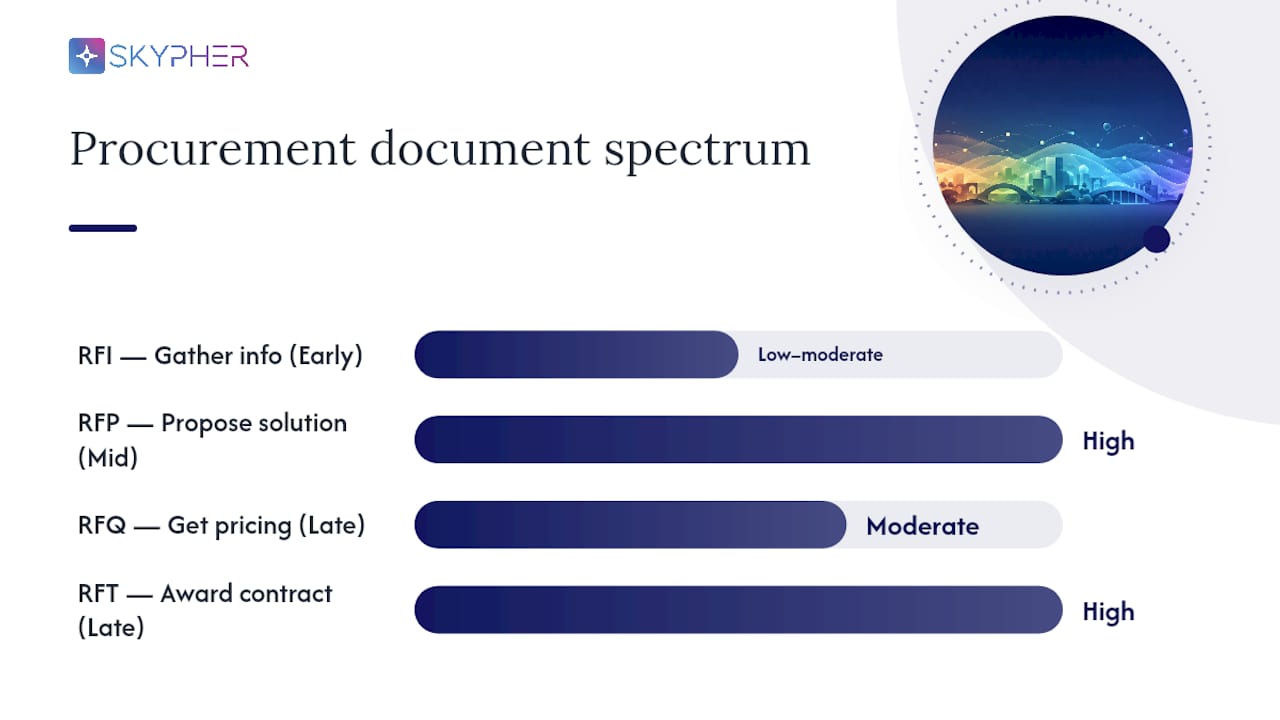
| Document | Procurement stage | Detail required from respondents | Primary objective | What the buyer expects |
|---|---|---|---|---|
| RFI | Early discovery | Low to moderate | Gather information | Capability overview, general approach |
| RFP | Mid cycle | High | Propose a solution | Detailed methodology, team, references |
| RFQ | Late cycle | Moderate, price-focused | Get pricing | Firm quotes against fixed specs |
| RFT | Late cycle | High, formal | Award a contract | Binding tender against strict terms |
The trigger for moving from RFI to RFP is simple: once you can write specific, testable requirements, you're ready. If RFI responses reveal three viable technical approaches, write the RFP around the one that best fits your constraints, not a generic blend of all three.
Before issuing an RFP, revisit your RFI notes. Confirm your shortlist reflects actual demonstrated capability, not just who replied fastest, and remove any vendor whose RFI answers raised unresolved compliance flags.
What Goes Into an RFI? A Practical Template Outline
A well-structured RFI follows a predictable shape. Missing sections are the most common reason responses come back inconsistent and hard to compare.
- Background: a short paragraph on your organization and the problem you're trying to solve
- Objectives: what you hope to learn from this RFI, stated plainly
- Submission instructions: format, page limits, deadline, and where to send responses
- Capability questions: what the vendor can actually do, at what scale
- Security and compliance questions: certifications, frameworks like the NIST Cybersecurity Framework, data handling practices
- Experience and references: comparable projects, client names, tenure in the category
- Commercial posture: general pricing model (subscription, fixed fee, usage-based) without asking for a firm quote
- Optional attachments: sample deliverables, architecture diagrams, case studies
Open RFIs, distributed publicly or to a broad supplier list, work well for market scoping in unfamiliar categories. Closed RFIs, sent to a pre-qualified group, work better when you already know the likely players and want faster, more targeted answers. Match your question specificity to the RFI type: open RFIs should ask broader questions to avoid excluding viable vendors; closed RFIs can go deeper since you already trust the respondents' baseline fit.
How to Write and Run an Effective RFI
Running an RFI well is a five-step process, and skipping steps is where most delays start.
- Define your objectives. Write down exactly what decision this RFI will inform. If you can't state the decision, you're not ready to draft questions.
- Draft your questions. Pull from the template above. Keep questions specific enough to compare answers side by side, phrased in plain language.
- Choose open or closed distribution. Decide whether you're casting wide or targeting known vendors, and set your list before publishing.
- Distribute and collect responses. Give suppliers a defined window, Harvard's guide to drafting RFIs recommends being explicit about response structure so vendors don't waste time guessing your format.
- Evaluate and decide. Score responses against your objectives and decide whether to proceed to an RFP, request follow-up information, or close the process.
Commercial RFIs typically run two to four weeks from distribution to response deadline. Public-sector RFIs often run longer, sometimes 30 to 60 days, to accommodate broader vendor outreach.
A simple scoring rubric works better than an elaborate one at this stage. Try weighting technical capability at 40%, security and compliance at 25%, relevant experience at 25%, and commercial fit at 10%. Vendors scoring above your threshold move into your RFP shortlist; the rest get a polite decline.
Pro Tip: Score RFI responses in a shared spreadsheet with your evaluation team before any single reviewer forms an opinion out loud. Anchoring bias sinks more shortlists than bad vendor answers do.
RFIs in Construction Versus General Procurement
The same document format solves very different problems depending on context.
- Construction RFI: issued mid-project to clarify a drawing, specification, or site condition that doesn't match reality on the ground. A contractor might ask whether a beam detail on page 14 conflicts with a mechanical run shown on page 22. Procore's guide to construction RFIs notes that the answer can alter project scope and, when it does, gets formalized as a change order affecting cost and schedule.
- General procurement RFI: issued pre-contract to understand what vendors exist and what they can do, shaping the market before a formal solicitation goes out.
A procurement example: a finance company evaluating cloud infrastructure providers issues an RFI to map which vendors support its compliance requirements before writing detailed RFP specs. A construction example: a general contractor issues an RFI to the structural engineer asking for clarification on rebar spacing, and the resulting answer triggers a formal change order.
Common Mistakes and Red Flags in RFIs
Most RFI value gets lost in predictable ways, on both sides of the table.
- Buyer mistake: writing overly broad questions that produce unusable, incomparable answers
- Buyer mistake: asking for firm pricing at the RFI stage, which confuses vendors about what's actually being solicited
- Buyer mistake: omitting evaluation criteria or confidentiality terms, leaving suppliers guessing how they'll be judged
- Supplier mistake: treating an RFI like an RFP and producing an expensive, over-engineered proposal nobody asked for
- Supplier mistake: withholding practical clarifications out of fear of revealing pricing strategy
- Red flag: a buyer who won't specify a timeline or next step, suggesting the RFI process itself is disorganized
Buyer and Supplier Checklists for RFIs
Before you send or answer an RFI, run through a short list.
Buyer checklist:
- State the objective in one sentence
- Mark mandatory fields clearly
- Specify the response format (page limit, file type)
- Include a confidentiality notice covering how responses will be used
- Set a firm timeline with a response deadline
- Define your scoring model before responses arrive
Supplier checklist:
- Read every instruction before drafting a response
- Answer concisely, matching the requested format
- Include concrete evidence: certifications, references, comparable deployments
- Flag any assumptions made when a question is ambiguous
- Ask clarifying questions early rather than guessing
Three example buyer questions that produce comparable answers: "Describe your standard implementation timeline for a deployment of our stated scale." "List certifications currently held that are relevant to data security." "Provide two references from clients in a comparable industry or project size."
Examples of RFI Responses and How to Evaluate Them
A strong RFI response answers the question asked, in the format requested, with evidence attached. A vendor asked about implementation timeline who responds with "typically 6 to 10 weeks depending on integration complexity, based on our last 12 deployments" gives you something to score. A vendor who responds with "we move fast and deliver quality" gives you nothing comparable.
Weak responses share a pattern: vague capability claims without specifics, marketing language standing in for evidence, and missing references. Strong responses include named comparable projects, specific certifications rather than "industry-standard security," and direct answers to yes/no questions instead of deflection.
Evaluate responses in two passes. First, a completeness pass: did the vendor answer every question, in the requested format, within the deadline? Incomplete responses often signal how a vendor will handle a real contract's administrative requirements. Second, a substance pass: score each answer against your rubric, weighting technical fit, security posture, relevant experience, and commercial approach.
Watch for responses that are technically accurate but strategically evasive, a vendor who lists certifications without specifying scope, or claims experience "in your industry" without naming a single client. Cross-reference references directly rather than taking a vendor's summary at face value; a five-minute call with a named reference often reveals more than the entire written response.
Keep a simple record of why each vendor advanced or didn't. That record becomes valuable later if a passed-over vendor asks for feedback, and it protects your process if anyone questions how the shortlist was built.
Legal Considerations and Confidentiality in RFIs
An RFI is not a binding solicitation, and that distinction matters legally. Under FAR Part 15, federal RFIs are explicitly market-research tools, not contract opportunities, meaning the government isn't obligated to award anything based on responses received. The same principle generally holds in commercial procurement: issuing an RFI creates no obligation to proceed to a contract, and responding to one creates no entitlement to future work.
That said, confidentiality still matters on both sides. Buyers routinely receive proprietary vendor information, pricing models, technical architectures, sometimes competitive intelligence a vendor wouldn't share publicly. State clearly in the RFI document how responses will be used, who inside your organization will see them, and whether you intend to share information across your evaluation team or with other departments.
Suppliers, in turn, should be cautious about how much proprietary detail they disclose at this stage. The GSA is explicit that vendors should treat an RFI as market research, not an opportunity requiring a full-priced proposal, and that guidance cuts both ways: don't demand proprietary pricing models from suppliers you haven't committed to working with, and don't hand over your entire technical playbook to a buyer who hasn't committed to a process.
If your RFI touches sensitive data categories, health information, financial records, government data, consider a mutual non-disclosure agreement before distribution rather than relying on a confidentiality clause buried in the document itself. It's a small extra step that prevents a much larger dispute later.
How to Follow Up After Receiving RFI Responses
Silence after an RFI deadline is the single most common complaint vendors raise about buyer-side process, and it damages your reputation in the market faster than almost anything else. Once responses are in and scored, follow up within a defined window, ideally two weeks, regardless of outcome.
For vendors advancing to the next stage, communicate clearly what happens next: are they moving to an RFP, a follow-up call, or a shortlist announcement? Give a realistic timeline rather than a vague "we'll be in touch."
For vendors not advancing, a brief, specific decline is worth the five minutes it takes to write. "Your response didn't demonstrate experience at our required deployment scale" is more useful, and more respectful, than silence. Vendors remember how they were treated during an RFI, and that memory shapes whether they bother responding to your next one.
If a response raised questions your rubric didn't anticipate, don't hesitate to send a short follow-up request for clarification before making a final call. This is common practice and doesn't obligate you to proceed with that vendor. It simply improves the quality of the decision you're about to make.
Document your follow-up communications the same way you documented your scoring. If your organization runs RFIs regularly, this history becomes a reference point for how consistently you treat vendors across cycles, which matters more than most buyers realize when it comes to who bothers responding next time.
Impact of RFIs on Supplier Relationships and Negotiation Strategies
An RFI is often the first real interaction a vendor has with your organization, and first impressions compound. A clear, well-run RFI signals to the market that you're a buyer worth investing serious effort in. A sloppy one, vague questions, no timeline, no feedback, signals the opposite, and your best potential vendors may quietly deprioritize your next solicitation.

RFIs also shape negotiation leverage well before pricing conversations start. A buyer who used the RFI stage to genuinely understand market capability enters RFP and contract negotiations knowing what's realistic to ask for. A buyer who skipped that step often finds themselves negotiating against inflated vendor claims with no independent basis for comparison.
There's a two-way dynamic worth noting here: vendors sometimes use RFI responses to flag gaps in a buyer's stated requirements or suggest alternative approaches the buyer hadn't considered. Treat that input seriously rather than dismissing it as sales positioning. A vendor who points out that your stated requirement is technically outdated, or more expensive to achieve than a simpler alternative, is often giving you free consulting.
Over multiple sourcing cycles, buyers who run consistent, respectful RFI processes build a reservoir of goodwill that shows up as better pricing, faster response times, and more candid answers from vendors who've learned they're dealing with a serious counterpart. That reputation takes years to build and very little to damage.
A Practitioner's Note on Balancing Structure and Engagement
Standardize your RFI template, but leave room for vendors to surprise you. The most useful responses often come from questions phrased loosely enough that a vendor can show you something you didn't know to ask about.
One habit worth building: feed RFI results directly into your project or sourcing calendar the same week you finish scoring, before institutional memory of the nuance fades.
When Automation Can Take Over the Repetitive Parts of RFI Work
Running RFIs at scale, especially if your organization also handles inbound security questionnaires from customers, means answering the same categories of questions over and over, often pulled from scattered documents and past responses. Automation reduces that manual copying, centralizes past answers in one searchable place, and preserves institutional memory that otherwise walks out the door when a team member leaves.

Skypher's Questionnaire Automation Tool applies that same logic to the inbound side of vendor and security assessments: faster turnaround on repetitive questions, consistent phrasing across responses, and a searchable knowledge base your team builds once and reuses indefinitely. For procurement and security teams fielding their own RFIs, RFPs, or security reviews from customers and partners, a Trust Center makes it possible to share your compliance posture proactively, cutting down the back-and-forth that slows vendor evaluation on both sides. If your team is buried in repetitive questionnaire work, explore the Trust Center platform and see whether a short demo makes sense for your process.
Primary Sources and Further Reading
- GSA's guide to RFIs, RFQs, and RFPs for federal contracting terminology and market-research rules
- Acquisition for the formal regulatory framing of RFIs in federal procurement
- TechTarget's RFI definition for a concise vendor-capability framing of the term
- Procore's contractor guide to construction RFIs for project-level clarification workflows
- Wikipedia's overview of Request for Information for general background across industries
Consult your organization's own procurement policy or public agency guidance for jurisdiction-specific rules before running a formal RFI process.
Frequently Asked Questions
What is a RFI in simple terms? A Request for Information is a document buyers send to vendors to gather details about their capabilities and available solutions before starting a formal bidding process. It's a research step, not a purchase commitment.
What is the difference between an RFI and an RFP? An RFI asks vendors to describe general capabilities; an RFP asks for a detailed, specific proposal against defined requirements. Buyers typically issue an RFI first, then narrow to an RFP once they know what they need.
How to create an RFI that gets useful responses? Define your objective in one sentence, draft specific questions tied to that objective, choose your distribution list, set a clear deadline and response format, then score answers against a rubric you built before responses arrived.
How long should an RFI response window be? Commercial RFIs typically run two to four weeks. Public-sector RFIs often run longer, sometimes 30 to 60 days, to accommodate broader outreach.
Are RFI responses legally binding? No. An RFI is a market-research tool under frameworks like FAR Part 15, and responding to one obligates neither party to proceed to a contract.
What types of RFIs exist? Open RFIs go to a broad or public vendor pool for wide market scoping. Closed RFIs go to a pre-qualified shortlist for faster, more targeted answers.
Sources
- Understand common federal contracting terms: RFIs, RFQs, and RFPs | GSA
- Acquisition
- Request for information - Wikipedia