

TL;DR:
- Most attack pathways involve compromised credentials, yet organizations often treat access management as a back-office function. Effective access control enforces real-time decisions based on continuous policies, reducing identity sprawl and privilege creep. Implementing principles like least privilege, just-in-time access, and ongoing reviews enhances security and minimizes insider and external risks.
66% of attack pathways involve compromised credentials, yet most security teams still treat access management as a back-office function rather than a frontline defense. What is access management, exactly, and why does getting it wrong cost organizations so much? The answer sits at the intersection of authentication, authorization, and ongoing governance. This guide cuts through the confusion between access management, identity management, and IAM as a whole, and delivers the principles, tools, and practices you need to build a security posture that actually holds.
Table of Contents
- Key Takeaways
- What is access management and what does it do
- Common risks and challenges in access management
- Principles and best practices for access control
- Technologies enabling modern access management
- Implementing access management in your organization
- My honest take on where most organizations go wrong
- How Skypher supports your access governance workflows
- FAQ
Key Takeaways
| Point | Details |
|---|---|
| Access management is the enforcement layer | It controls who gets in, when, and to what, sitting at the point of access rather than in policy documents. |
| IAM and access management are not the same | IAM governs the full identity lifecycle; access management executes the rules at the moment of access. |
| Identity sprawl is the biggest hidden risk | Permissions accumulate silently during a user's tenure, creating overprovisioned accounts that attackers exploit. |
| Least privilege is non-negotiable | Restricting users to only the permissions they need is the single most effective way to limit breach impact. |
| Access management must be continuous | Static, one-time configurations degrade quickly. Regular audits and dynamic controls keep your controls aligned with reality. |
What is access management and what does it do
Access management is the enforcement layer of your identity and access management (IAM) framework. While IAM covers the full lifecycle of a digital identity, from creation to deprovisioning, access management executes enforcement at the exact point a user requests a resource. Think of IAM as the rulebook and access management as the referee making calls in real time.
The access management definition breaks down into three core functions:
- Authentication: Verifying that a user is who they claim to be, through passwords, MFA, biometrics, or hardware tokens.
- Authorization: Determining what that verified user is permitted to do once inside, based on roles, policies, and context.
- Audit logging: Recording access events so that your team can reconstruct what happened, when, and by whom.
These three functions, authentication, authorization, and audit logging, work together to form a complete control loop. Authentication without authorization is just a locked front door with no rooms inside. Authorization without audit logging is a system you cannot trust after an incident.
Access management is not a product you buy and deploy once. It is a set of decisions, policies, and controls you run continuously against a constantly changing environment.
It also helps to distinguish access management from Privileged Access Management (PAM). PAM is a subset focused specifically on high-risk accounts: administrators, service accounts, and anyone with elevated system permissions. Access management governs all users; PAM governs the most dangerous ones.
Common risks and challenges in access management
The biggest risk in access management rarely comes from sophisticated external attacks. It comes from inside your own provisioning processes, specifically from the permissions that accumulate quietly over time.
Overprovisioned access is a major vulnerability that organizations consistently underestimate. A developer joins a project and gets access to a production database. The project ends, but the access remains. They switch teams and pick up new permissions. Three years later, that account holds access to a dozen systems it has no business touching. This is called privilege creep, and it is how identity sprawl quietly undermines security posture across entire organizations.

The data reinforces how serious this problem is. Only 44% of organizations report high confidence in their ability to prevent identity-based security incidents. That means more than half of organizations are flying with limited visibility into who actually has access to what.
Pro Tip: Schedule quarterly access reviews for every privileged account and at minimum annual reviews for all standard accounts. Most organizations do neither consistently, and that gap is where overprovisioning lives.
The user provisioning lifecycle's middle stage, the years between onboarding and offboarding, is the riskiest phase because role changes and project assignments pile up without triggering formal reviews. Your offboarding process may be solid, but if no one is auditing permissions during tenure, you are solving the wrong problem. Standing privileges, persistent access that exists whether or not the user currently needs it, create an always-open attack surface that a stolen credential can exploit instantly.
Principles and best practices for access control
Building effective access management starts with a set of foundational access control principles, not technology purchases. The tools only work well when the principles are already in place.
- Apply the Principle of Least Privilege (PoLP) everywhere. Every user, service account, and application should hold only the permissions necessary to perform its function. Nothing more. This limits lateral movement if credentials are compromised.
- Adopt just-in-time (JIT) access for privileged operations. Instead of granting standing privileges, issue time-limited access that expires automatically after a task is complete. This directly addresses the standing privilege problem.
- Require approval workflows for sensitive access. Approval-based and time-limited controls add a human checkpoint before privileged access is granted, creating an audit trail and reducing automated misuse.
- Run continuous access reviews, not annual checkboxes. Access control decisions should be dynamic and adapt to role changes, context shifts, and evolving threat data. Static reviews are already stale by the time they are completed.
- Enforce separation of duties. No single user should hold the access needed to complete a high-risk action from start to finish without a second set of eyes. This is a core governance requirement in regulated industries.
Pro Tip: When implementing PoLP, start with your highest-risk systems: production environments, financial data, and customer PII. Trying to enforce least privilege everywhere simultaneously is a recipe for operational disruption.
These principles tie directly to the importance of access management as a security discipline. Organizations that treat access as a configuration task rather than an ongoing practice consistently end up with the identity sprawl problem described above. Access management best practices require both policy discipline and the tooling to execute consistently at scale. For more on structuring ongoing governance, Skypher's security review guidance covers practical approaches for 2026 environments.
Technologies enabling modern access management
Understanding how access management works in practice means knowing the protocols and tools that make policies real. The technology stack has evolved considerably, and the gap between organizations running legacy setups and those using modern controls is now a measurable security risk.
Core protocols and authentication methods
Common protocols in use today include Kerberos for internal network authentication, OAuth 2.0 for delegated API access, and FIDO2 standards for phishing-resistant passwordless login. Multi-factor authentication (MFA) sits across all of these as a baseline control. If you are not enforcing MFA on every external-facing system by 2026, that is your first priority.
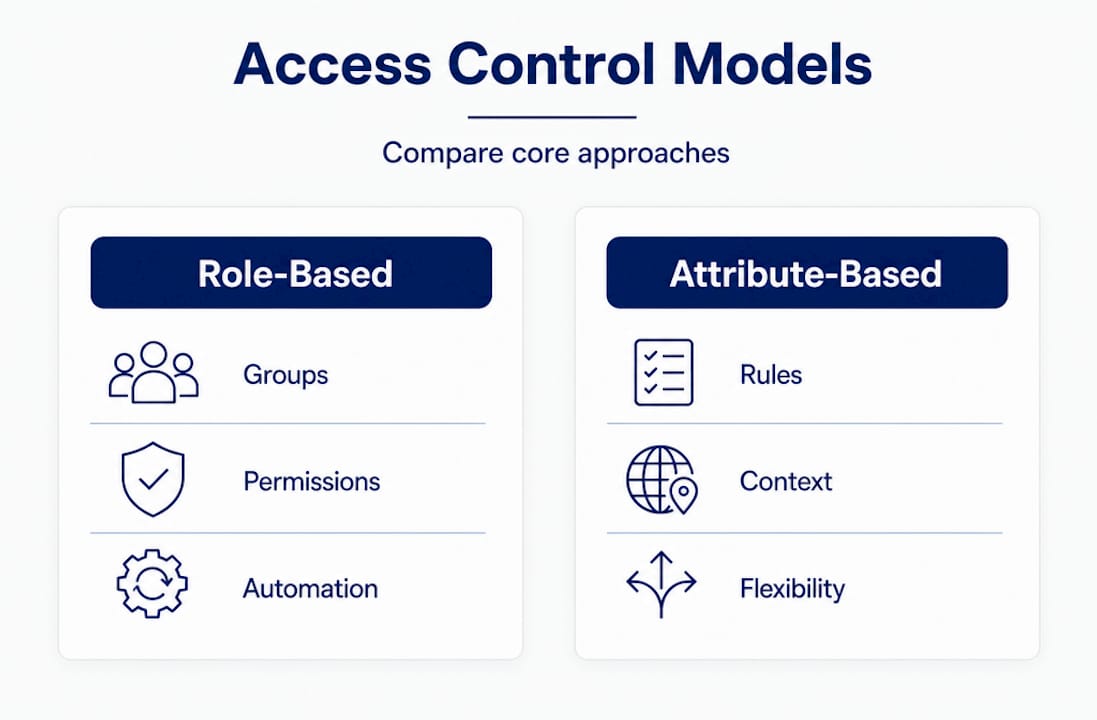
Access control models
| Model | How it works | Best for |
|---|---|---|
| Role-Based Access Control (RBAC) | Permissions assigned to roles, users assigned to roles | Most standard enterprise environments |
| Attribute-Based Access Control (ABAC) | Permissions based on user, resource, and environmental attributes | Complex, context-sensitive access decisions |
| Dynamic Access Control | Real-time, policy-driven decisions using multiple data signals | Zero trust architectures |
PAM tools and emerging trends
Modern PAM tools now implement time-limited, approval-based access that automatically rotates and revokes credentials after use. This eliminates the static shared-password problem that has plagued infrastructure teams for years.
Beyond PAM, two trends are reshaping the field:
- AI-driven access controls that flag anomalous access patterns in real time, catching behavioral deviations that static rules miss entirely.
- Zero standing privilege (ZSP) architectures, where no user or service account holds persistent access. Every session is provisioned on demand and revoked on completion.
These approaches represent the practical future of what access management does at scale.
Implementing access management in your organization
Knowing the principles is one thing. Putting them into operation across a real organization, with legacy systems, cloud migrations, and hundreds of users at various stages of their lifecycle, is where the real complexity lives.
A structured implementation follows this sequence:
- Inventory your current access state. You cannot govern what you cannot see. Start by mapping every account, role, and permission across your key systems. Most organizations are surprised by what they find.
- Define role structures before assigning access. Build your RBAC model around business functions, not individual requests. Ad hoc permission grants are how sprawl starts.
- Automate provisioning and deprovisioning. Manual processes fail at scale. Connect your HR system to your identity provider so that role changes and departures trigger automatic access adjustments.
- Build continuous monitoring into your workflow. Integrate access governance practices into your regular security operations, not just your annual compliance review.
- Address legacy systems explicitly. Cloud-native tools support modern protocols, but legacy systems often require custom connectors or compensating controls. Document these gaps and treat them as active risk items.
Pro Tip: When migrating access management controls to the cloud, resist the temptation to lift-and-shift your existing permission structures. A cloud migration is the best opportunity you will get to rebuild roles with least privilege from scratch.
Integrating access management with your broader IT security management framework is also non-negotiable. Access management controls that operate as isolated tools, disconnected from your SIEM, incident response workflows, or change management processes, will always have blind spots.
My honest take on where most organizations go wrong
I have spent years looking at how security teams approach access management, and the pattern I see most often is this: organizations invest heavily in their entry and exit processes, solid onboarding checklists, thorough offboarding procedures, and then completely ignore what happens in between.
The hardest part of access management is not the technology. It is the organizational discipline required to treat permissions as living data that needs active maintenance. Most teams do not have bandwidth for that, and so permissions accumulate, roles drift from their original design, and nobody notices until an audit or an incident forces the issue.
What I have found actually works is shifting the framing. Stop thinking of access reviews as a compliance obligation and start treating them as threat intelligence. When you review access and find a developer with admin rights to a production database they have not touched in 18 months, that is not a paperwork problem. That is a standing attack vector you just closed.
The move toward just-in-time access and approval-based workflows is the most meaningful shift I have seen in this space in years. It removes the assumption that standing privilege is acceptable and forces every high-risk session to be justified in the moment. Organizations that have adopted this model report a dramatically cleaner access footprint within the first year.
The uncomfortable truth is that access management is not static. It degrades the moment you stop actively managing it. The teams that treat it as an ongoing operational discipline, not a project with a completion date, are the ones whose access posture actually holds up under scrutiny.
— Gaspard
How Skypher supports your access governance workflows
Effective access management generates a significant volume of documentation: controls evidence, audit logs, permission matrices, and compliance records. When a vendor, partner, or enterprise customer sends a security questionnaire, that documentation needs to be surfaced quickly and accurately.

Skypher's security questionnaire automation tool pulls from your existing knowledge base to answer access-related questions in minutes, not days. Whether you are responding to questions about MFA enforcement, privilege access controls, or user provisioning processes, Skypher's AI maps your actual controls to incoming questionnaire formats with precision. The platform integrates with over 40 third-party risk management systems and connects directly with Slack, ServiceNow, and your document repositories, so your team spends less time assembling evidence and more time improving the controls that evidence describes. For organizations that need to demonstrate their security posture externally, Skypher's Trust Center platform provides a centralized, always-current view of your compliance and access governance state.
FAQ
What is the access management definition?
Access management is the set of processes, policies, and technologies that control who can access specific systems, data, and resources, verifying identity at the point of access through authentication and enforcing permissions through authorization.
How does access management differ from identity management?
Identity management governs the full lifecycle of a digital identity, including creation, maintenance, and deletion. Access management executes enforcement at the moment of access, determining what an authenticated identity is actually permitted to do.
What are the biggest access management risks?
The most common risks are overprovisioned accounts from privilege creep, standing privileges that create persistent attack surfaces, and inadequate access reviews that allow permissions to accumulate undetected over time.
What does the Principle of Least Privilege mean in practice?
PoLP means every user, application, and service account holds only the minimum permissions required to perform its specific function, nothing more. This limits how far an attacker can move if any one account is compromised.
What is just-in-time access and why does it matter?
Just-in-time access grants temporary, time-limited permissions for specific tasks and automatically revokes them upon completion. It eliminates standing privileges, which are one of the most exploited vulnerabilities in enterprise environments.