

TL;DR:
- A proof of concept (POC) is a small-scale test that confirms the technical feasibility of an idea or technology before significant resource investment. It helps identify risks early, build stakeholder confidence, and provides clear go/no-go decisions, especially in software involving new APIs or AI integrations. Properly defining success criteria, limiting scope, and treating POCs as disposable assets are essential for effective validation and avoiding costly project failures.
A proof of concept is a small-scale demonstration designed to confirm whether an idea, technology, or method is technically feasible before you commit significant resources to it. In software development and project management, the POC sits at the earliest decision gate: it answers "can this actually be built?" before your team writes a single line of production code. Organizations like Atlassian and Asana have published detailed frameworks around POC execution precisely because the cost of skipping this step is so high. Get the POC right, and every subsequent phase of your project starts from a position of evidence rather than assumption.
What is proof of concept, and why does it matter?
A proof of concept, often abbreviated as POC, is defined as a focused test that validates whether a proposed solution is technically achievable under real conditions. It does not need to be polished, scalable, or user-ready. Its only job is to answer a specific feasibility question with enough evidence to support a go or no-go decision.
The importance of proof of concept in product development comes down to risk reduction. Before a team invests months of engineering time, a POC surfaces technical blockers, integration failures, or performance gaps that would otherwise appear late in the project when they are far more expensive to fix. A POC completed in two weeks that reveals a fundamental constraint has saved the organization from a six-month dead end.
POCs are especially critical in software projects involving new APIs, machine learning models, or third-party integrations. If your product depends on a vendor's data pipeline performing at a certain speed, you need to test that assumption before building your architecture around it. Skipping the POC in these scenarios is not a time-saver. It is a risk transfer to a later, costlier stage.
What are the primary benefits of running a POC?
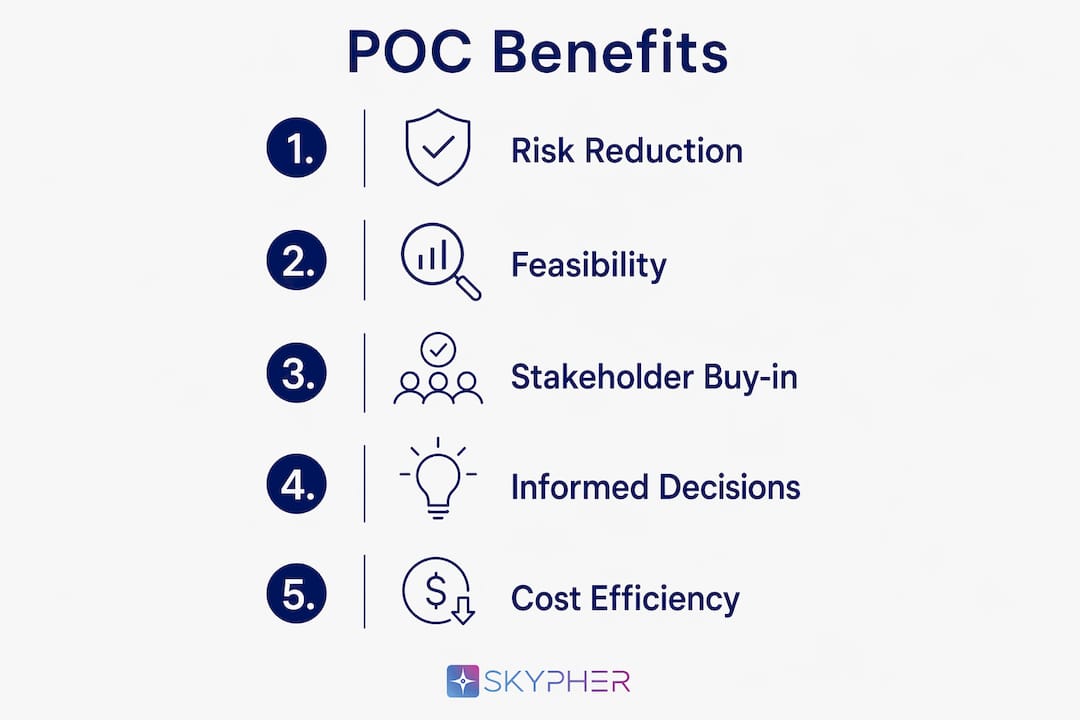
The benefits of proof of concept extend well beyond technical validation. A well-executed POC serves four distinct purposes that collectively reduce project failure rates.
- Risk identification: A POC forces your team to confront the hardest technical questions first. If the core mechanism does not work at small scale, it will not work at full scale either.
- Stakeholder confidence: Presenting concrete evidence of feasibility to investors, executives, or clients is far more persuasive than a slide deck. A POC gives decision-makers something tangible to evaluate.
- Resource protection: Validating feasibility early prevents teams from spending months building a product that cannot deliver on its core promise. The cost of a POC is almost always a fraction of the cost of a failed full-scale build.
- Decision clarity: A POC produces a binary outcome. Either the approach works and the project proceeds, or it does not and the team pivots. That clarity is the most underrated output of the entire exercise.
Pro Tip: Define your success criteria in writing before you begin the POC. A vague question produces a vague answer. Write down exactly what "success" looks like, including specific performance thresholds or integration requirements, so your results are unambiguous.
The go/no-go decision that a POC enables is its most strategically valuable output. Teams that skip this step often find themselves months into development before discovering a fundamental flaw, at which point the political and financial cost of stopping is enormous.
How does proof of concept differ from a prototype and an MVP?
This is one of the most common points of confusion in product development, and mixing up these concepts leads directly to wasted resources and technical debt. Each stage has a distinct purpose, scope, and audience.

| Stage | Primary question | Audience | Output |
|---|---|---|---|
| Proof of concept | Can this be built? | Internal team, technical leads | Feasibility evidence |
| Prototype | How will this look and work? | Designers, UX researchers, stakeholders | Visual or interactive model |
| MVP (minimum viable product) | Will users pay for this? | Real end users | Functional, shippable product |
A POC is internal and disposable. A prototype is a design artifact. An MVP is a product. Treating a POC as a prototype means you are spending design resources on something that should only answer a technical question. Treating a prototype as an MVP means you are shipping something that was never tested with real users at scale.
Confusing POCs with prototypes is particularly costly in software projects because developers often feel pressure to "clean up" POC code and ship it. That path creates technical debt almost immediately. POC code is written for speed and learning, not for maintainability. Atlassian's guidance is explicit on this point: a POC is a throw-away asset, and treating it otherwise undermines the entire purpose of the exercise.
Pro Tip: When presenting POC results to stakeholders, explicitly label the output as "feasibility evidence only." This prevents the common organizational pressure to ship POC code directly to production.
The timeline differences are also significant. A POC typically runs one to four weeks. A prototype may take four to eight weeks depending on fidelity. An MVP can take three to six months. Knowing which stage you are in keeps your team focused on the right deliverable.
What are the steps to create an effective proof of concept?
Creating a POC that produces genuinely useful results requires discipline around scope and measurement. The steps to develop a proof of concept follow a clear sequence.
- Define the core feasibility question. Write one sentence that captures exactly what the POC must prove. For example: "Can our system process 10,000 concurrent API requests from ServiceNow with under 200ms latency?" Vague questions produce vague results.
- Set measurable success criteria. Clarity upfront is what separates a useful POC from an open-ended experiment. Attach numbers, thresholds, or binary pass/fail conditions to every objective.
- Limit the scope aggressively. A POC is not a mini-project. Strip out everything that does not directly test the feasibility question. No UI polish, no error handling beyond the minimum, no documentation beyond what the team needs to understand the results.
- Identify and allocate resources. Assign the engineers with the deepest relevant expertise. A POC run by junior developers on a new technology stack will produce unreliable results. Allocate dedicated time, not leftover capacity.
- Execute the test. Build only what is necessary to answer the feasibility question. Use real data or realistic synthetic data where possible. Simulated conditions that do not reflect production reality will give you false confidence.
- Document outcomes against your criteria. Record what worked, what did not, and what the results imply for the full project. This documentation is the deliverable. The code is not.
For software compliance and security-related POCs, you can also reference IT compliance documentation guidance to structure your outcome documentation in a way that satisfies audit requirements from the start.
What are common pitfalls when running a POC in software projects?
Even experienced teams make predictable mistakes when running POCs. Recognizing these patterns in advance is the difference between a POC that informs your roadmap and one that wastes three weeks.
- Undefined success metrics: Starting a POC without written success criteria is the single most common failure mode. Without them, teams debate results indefinitely and the POC produces no decision.
- Scope creep: POCs attract feature requests. Stakeholders see early results and immediately ask "can it also do X?" Resist this. Every addition to scope dilutes the POC's focus and extends its timeline without improving its core output.
- Reusing POC code in production: Trying to reuse POC code creates technical debt that compounds over time. POC code is written fast and dirty by design. It is not architected for scale, security, or maintainability.
- Treating a failed POC as a failure: A POC that proves an approach does not work is a strategic advantage. It enables a fast no-go decision that prevents a costly full-scale failure. The real failure is spending six months on a product before discovering the same thing.
- Running only one POC per project: Modular POCs at multiple stages of development reduce risk incrementally as project complexity increases. A single POC at the start does not protect you from new technical risks that emerge mid-project.
Pro Tip: Schedule a post-POC review meeting before you begin the POC itself. Knowing that results will be formally reviewed by the team creates accountability for documentation quality and prevents results from being quietly shelved when they are inconvenient.
For teams working on risk management with automation, integrating POC findings into your broader risk framework ensures that technical evidence from the POC directly informs your project governance decisions.
Key takeaways
A proof of concept succeeds when it answers one specific feasibility question with measurable evidence, not when it produces impressive-looking code.
| Point | Details |
|---|---|
| POC definition | A POC validates technical feasibility at small scale before full investment begins. |
| POC vs prototype vs MVP | Each stage answers a different question; mixing them wastes resources and creates debt. |
| Success criteria first | Write measurable pass/fail criteria before starting or the results will not drive decisions. |
| Failed POC is still valuable | A no-go result from a POC prevents a far more expensive full-scale failure. |
| POCs are disposable | Never ship POC code to production; it is built for speed and learning, not for scale. |
Why I think most teams misuse the POC entirely
Most teams I have seen treat the POC as a formality. They run it after the architecture decision has already been made, use it to confirm what they already believe, and then feel pressure to ship the code because "we already built it." That is not a proof of concept. That is confirmation bias with a deadline.
The real value of a POC is its willingness to kill a project. When you define success criteria honestly and the POC fails to meet them, you have done something genuinely difficult: you have produced evidence that contradicts the direction the organization wants to go. That takes courage to act on, and most teams do not. They adjust the criteria, extend the timeline, or quietly move forward anyway.
The teams that use POCs well treat them as adversarial tests. They are trying to break the idea, not confirm it. In agile environments, this mindset translates directly into sprint zero activities where the hardest technical assumptions are tested before the backlog is built. I have seen this approach save months of engineering time on projects involving new cloud infrastructure, AI model integrations, and third-party API dependencies.
The other misuse I see constantly is scope inflation. A POC that tries to answer five questions answers none of them well. One question, one test, one decision. That discipline is harder than it sounds, especially when stakeholders are excited about the idea and want to see more. Your job is to protect the POC's integrity, not to impress anyone.
— Gaspard
How Skypher supports POC and risk workflows for software teams

Security questionnaires are one of the most time-consuming bottlenecks in the POC and vendor evaluation phase of software projects. When your team is assessing a new technology or third-party integration, security reviews can stall the process by weeks. Skypher's AI questionnaire automation eliminates that bottleneck by completing security reviews in minutes rather than days, with integrations across more than 40 third-party risk management platforms including OneTrust and ServiceNow. For software and project management teams running POCs that involve vendor assessments or compliance checks, Skypher compresses the security review timeline so your technical evaluation stays on schedule. You can also explore Skypher's AI recommendation engine to see how AI-driven responses support faster, more accurate risk decisions during the POC phase.
FAQ
What is the proof of concept definition in software development?
A proof of concept in software development is a focused, short-duration test that validates whether a specific technical approach or feature is feasible before full-scale development begins. It produces evidence for a go/no-go decision rather than a shippable product.
How long does a proof of concept typically take?
Most POCs in software projects run between one and four weeks, depending on the complexity of the feasibility question being tested. Longer timelines usually indicate scope creep rather than genuine technical complexity.
What is a pilot project, and how does it differ from a POC?
A pilot project is a limited real-world deployment of a solution to test operational performance with actual users, while a POC tests only technical feasibility in a controlled environment. Pilots come after POCs and involve real end users; POCs are internal and disposable.
Can a proof of concept fail and still be considered successful?
Yes. A POC that proves an approach is not feasible is a success because it prevents a far more expensive full-scale failure. Failing fast at the POC stage is a deliberate risk management strategy, not a setback.
What are the most important proof of concept examples in tech?
Common POC examples in tech include testing whether a machine learning model can classify data at the required accuracy, validating that a third-party API can handle the expected request volume, and confirming that a new database architecture meets latency requirements. Each of these tests one specific technical assumption before the broader system is built around it.