

TL;DR:
- Stakeholder alignment is the process of ensuring key individuals share a common understanding of project goals, scope, and success criteria. It results from ongoing engagement and management efforts, not a single event, and requires continuous maintenance throughout the project lifecycle. Tools like stakeholder mapping, structured workshops, and feedback loops help sustain alignment in complex, evolving environments.
Stakeholder alignment is defined as the process of bringing all key individuals and groups to a shared understanding of project goals, scope, and success criteria. It goes beyond sending status updates or holding kickoff meetings. HelloPM defines alignment as moving stakeholders from passive recipients of information to active partners who own the same objectives. For business leaders and project managers, this distinction matters because misaligned stakeholders derail timelines, inflate budgets, and fracture team trust long before a project reaches its final phase. Frameworks like PMBOK, Scrum Alliance practices, and Harvard's Program on Negotiation all treat alignment as a foundational leadership competency, not an optional communication exercise.
What is stakeholder alignment vs. engagement vs. management?
These three terms get used interchangeably in most organizations. They are not the same thing, and confusing them leads to real project failures.
Stakeholder engagement is the ongoing process of building relationships and trust with the people who influence or are affected by your work. Scrum Alliance describes engagement as the human element that enables collaboration. It covers listening sessions, one-on-ones, feedback surveys, and regular check-ins. Engagement is the how of working with people.
Stakeholder management is the structured process of identifying stakeholders, documenting their interests and influence, and planning how to communicate with them. PMBOK treats management as the formal architecture: stakeholder registers, communication plans, and responsibility matrices. Management is the system that organizes your approach.
Stakeholder alignment is the outcome you are trying to reach. Harvard Business School Online clarifies that engagement infuses the human connection that strengthens formal management structures. Alignment is what happens when both engagement and management work together: every key party understands the problem, agrees on the goal, and knows what success looks like.
| Concept | Focus | Primary Goal | Key Output |
|---|---|---|---|
| Stakeholder Engagement | Relationship building | Trust and open communication | Collaborative culture |
| Stakeholder Management | Identification and planning | Structured communication | Stakeholder register, communication plan |
| Stakeholder Alignment | Shared understanding | Unified direction and commitment | Agreed goals, scope, and success metrics |
One critical nuance: alignment does not require identical agreement from every party. reStruggle's PM guide explains that stakeholders do not need to agree on every detail. They need to share understanding of the problem, the goals, and the rationale behind key decisions. That distinction prevents fractured collaboration when trade-offs arise later.
How to align stakeholders: strategies that actually work
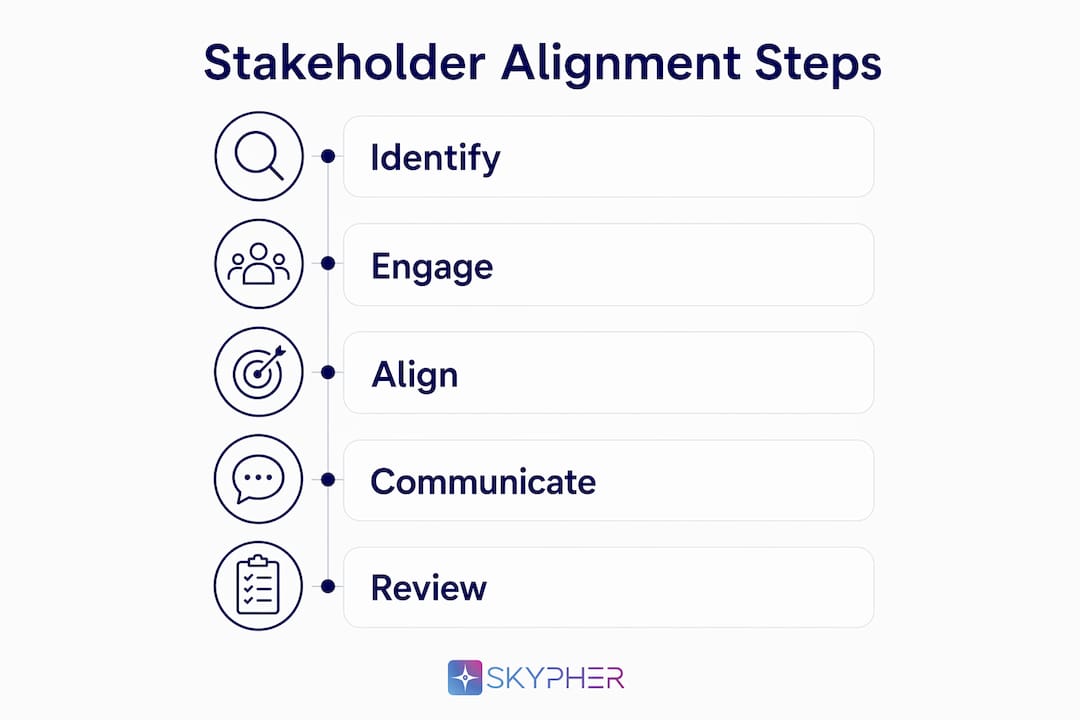
Building stakeholder alignment is not a single meeting or a signed charter. It is a repeatable set of practices applied throughout the life of a project.
-
Map your stakeholders before you plan anything. Use an interest-influence matrix to categorize stakeholders by how much they care about the outcome and how much power they hold. This visual tool, recommended by Harvard Law's Program on Negotiation, prevents the common mistake of over-communicating with low-influence parties while under-communicating with decision-makers.
-
Build and maintain a living stakeholder register. Ongoing stakeholder identification must happen before planning and continue throughout execution. A static list created at kickoff becomes outdated within weeks. Update it whenever scope changes, new sponsors join, or organizational priorities shift.
-
Run structured alignment workshops early. Bring key stakeholders together to define success criteria in their own words. Facilitated workshops surface hidden assumptions before they become conflicts. Ask each group to describe what a successful outcome looks like. You will often find three different answers in the same room.
-
Replace one-way updates with two-way feedback loops. Status reports and dashboards inform but do not guarantee alignment. Schedule regular sessions where stakeholders can raise concerns, flag changing priorities, and confirm their understanding. This is where real alignment gets built and maintained.
-
Sequence your alignment conversations correctly. Many misalignment failures come from poor sequencing in projects. Starting alignment conversations without a clear destination picture leads every stakeholder to fill in the gaps with their own assumptions. Define the destination first, then align on the path.
Pro Tip: Use a simple one-page alignment summary after every major stakeholder session. List the agreed goal, the top three success metrics, and any open questions. Circulate it within 24 hours. This single habit catches misalignment before it compounds.
For teams working across time zones or organizational boundaries, real-time collaboration tools significantly reduce the lag between misalignment occurring and being corrected.

Why ongoing alignment matters throughout the project lifecycle
The most common mistake project managers make is treating alignment as a one-time event at project kickoff. Harvard Law's Joel Cutcher-Gershenfeld describes alignment as a continual process where many parties must repeatedly orient to both shared and separate interests. That framing changes everything about how you plan your communication calendar.
Project contexts shift constantly. Sponsors change roles. Budgets get cut. Regulatory requirements evolve. Each of these events can quietly move a stakeholder's priorities without anyone noticing until a decision gets blocked or reversed. Misaligned expectations are one of the leading causes of project delays, cost overruns, and team conflict.
"Alignment must be treated as a living process, not a signed document. The moment you stop actively maintaining it, drift begins." — reStruggle, The PM's Complete Guide to Stakeholder Alignment
Governance structures that embed ongoing alignment practices outperform those that rely on initial agreements. Specific practices that sustain alignment over time include:
- Monthly stakeholder reviews that revisit goals, scope changes, and updated success metrics
- Change impact assessments shared with all key stakeholders before decisions are finalized
- Escalation protocols that surface misalignment to leadership before it stalls execution
- Updated stakeholder registers reviewed at every project phase gate
Constantly updating stakeholder analysis throughout a project is not administrative overhead. It is the mechanism that keeps your team moving in the same direction when the environment changes around them.
What tools and frameworks support stakeholder alignment?
Concrete tools make the difference between alignment that exists on paper and alignment that holds under pressure.
Stakeholder mapping matrices are the starting point. Plot each stakeholder on a two-axis grid: interest on one axis, influence on the other. The result tells you who to engage deeply, who to keep informed, and who to monitor. This format works in construction, software development, healthcare, and finance because the underlying logic is universal.
Heat maps and interest-intersection diagrams go one level deeper. Harvard's Program on Negotiation recommends these tools for multiparty ecosystems where interests overlap in complex ways. A heat map shows where stakeholder priorities cluster and where they conflict, giving you a visual guide for where to focus alignment energy first.
Communication plans tied to alignment goals are more effective than generic update schedules. A strong communication plan specifies who receives what information, in what format, at what frequency, and with what feedback mechanism attached. Without the feedback mechanism, the plan produces engagement but not alignment.
The table below outlines a practical alignment framework you can adapt for your next project:
| Tool | Best Used For | Key Output |
|---|---|---|
| Interest-influence matrix | Initial stakeholder mapping | Prioritized engagement list |
| Alignment workshop | Early goal definition | Shared success criteria document |
| Living stakeholder register | Ongoing lifecycle management | Updated stakeholder profiles |
| Heat map | Multiparty conflict identification | Visual interest-overlap analysis |
| Two-way feedback loop | Continuous alignment maintenance | Confirmed understanding and open issues log |
Pro Tip: In compliance-heavy industries like tech and finance, your stakeholder alignment work often intersects with third-party risk management processes. Map external vendors and auditors into your stakeholder register from day one. Their expectations shape your project constraints as much as any internal sponsor.
For teams managing security compliance frameworks, stakeholder alignment tools help coordinate across legal, IT, and executive teams who each hold different pieces of the compliance picture.
Key takeaways
Stakeholder alignment requires continuous, structured effort across the full project lifecycle, not a single kickoff agreement.
| Point | Details |
|---|---|
| Alignment is an outcome, not a process | Engagement and management are the inputs; shared understanding is the result you are building toward. |
| Agreement and alignment differ | Stakeholders need shared understanding of goals and rationale, not identical opinions on every decision. |
| Alignment must be maintained continuously | Shifting priorities and scope changes make one-time alignment obsolete within weeks of project start. |
| Sequencing matters | Define the destination clearly before starting alignment conversations to prevent competing assumptions. |
| Tools make alignment visible | Matrices, heat maps, and living stakeholder registers turn abstract alignment into trackable, manageable work. |
The part most leaders skip
I have worked with project teams across industries, and the pattern I see most often is this: leaders invest heavily in the kickoff alignment session, declare success when everyone nods in the room, and then never revisit it. Six weeks later, the project is stalled because two sponsors have quietly developed different definitions of "done."
The uncomfortable truth about stakeholder alignment is that it requires emotional intelligence as much as process discipline. You can have the best stakeholder register in the world and still miss the fact that a key executive has mentally deprioritized your project because of a budget conversation you were not in the room for. Formal tools catch structural misalignment. Relationships catch the rest.
What I have found actually works is treating alignment check-ins as diagnostic conversations, not status updates. Ask stakeholders what has changed in their world since the last meeting. Ask what would make them less confident in the project right now. Those questions surface the real misalignment before it becomes a blocker.
Alignment is also a leadership signal. When you consistently bring stakeholders back to shared goals and success criteria, you build a reputation as someone who keeps complex initiatives on track. That reputation opens doors that formal authority alone cannot.
Do not wait for misalignment to become visible. By the time it shows up as a missed deadline or a rejected deliverable, it has already cost you weeks of momentum.
— Gaspard
How Skypher supports stakeholder alignment in compliance projects
Alignment across security and compliance projects is especially hard because the stakeholders span legal, IT, procurement, and executive teams, each with different information needs and timelines.

Skypher's AI Security Questionnaire Automation tool removes one of the biggest friction points in compliance alignment: the back-and-forth of manual security reviews. When your team can answer 200 questions in under a minute with consistent, accurate responses, every stakeholder from the CISO to the sales lead works from the same verified information. Skypher's Trust Center platform gives internal and external stakeholders a single source of truth for your compliance posture, cutting the confusion that derails cross-functional alignment. For tech and finance teams managing complex vendor relationships, that transparency is not a nice-to-have. It is what keeps projects moving.
FAQ
What is the stakeholder alignment definition?
Stakeholder alignment is the state in which all key individuals and groups share a common understanding of project goals, scope, and success criteria. It is the outcome produced by effective stakeholder engagement and management working together.
How does stakeholder alignment differ from stakeholder engagement?
Stakeholder engagement is the ongoing process of building relationships and trust. Stakeholder alignment is the outcome of that process: shared understanding and unified commitment to the same objectives.
How do you achieve stakeholder alignment in a project?
Achieving alignment requires mapping stakeholders by interest and influence, running structured workshops to define shared success criteria, and maintaining two-way feedback loops throughout the project lifecycle rather than relying on a single kickoff agreement.
Why do projects lose stakeholder alignment after kickoff?
Priorities shift, scope evolves, and stakeholder roles change over time. Without continuous reviews and updated stakeholder registers, initial alignment erodes as each party fills information gaps with their own assumptions.
Does stakeholder alignment require everyone to agree on everything?
No. Alignment requires shared understanding of the problem, goals, and decision rationale. Stakeholders can hold different opinions on approach while still being aligned on what success looks like and why it matters.