

TL;DR:
- Governance provides accountability, structures, and oversight essential for effective compliance.
- Frameworks like OCEG and COSO integrate governance with risk and compliance for better performance.
- Strong governance enables proactive compliance, reducing risks and enhancing regulatory performance.
Governance failures are quietly responsible for some of the most damaging compliance breakdowns in modern tech and finance. Not missing policies. Not undertrained staff. Governance. When accountability is blurry, escalation paths are undefined, and executives operate without real oversight, even the most sophisticated compliance programs collapse under pressure. Governance failures are the real root cause of major financial crime and regulatory lapses. This guide breaks down exactly what effective governance looks like, which frameworks support it, where it most often breaks down in tech and finance settings, and how compliance leaders can turn it into a measurable competitive advantage.
Table of Contents
- Why governance is the backbone of compliance
- Modern GRC frameworks: OCEG and COSO explained
- Key governance challenges: Edge cases in tech and finance
- Turning governance into a compliance advantage: Practical steps
- Why governance is your best compliance investment
- Unlock seamless compliance with governance-focused tools
- Frequently asked questions
Key Takeaways
| Point | Details |
|---|---|
| Governance is essential | Strong governance sets the foundation for effective compliance and reduces regulatory risk. |
| Frameworks boost integration | OCEG and COSO frameworks help unify governance, risk, and compliance strategies. |
| Edge cases test resilience | AI, data quality, and IP protection expose weaknesses in traditional governance. |
| Make compliance proactive | Practical steps and technology empower teams to stay ahead of emerging risks. |
Why governance is the backbone of compliance
Governance is not a document. It is not a policy manual sitting on a shared drive. In the compliance context, governance refers to the structures, authorities, and accountability mechanisms that determine how decisions get made, how risk is reported, and how compliance functions operate independently of the business units they oversee.
"Governance establishes accountability, oversight, and structures ensuring compliance functions are independent and adequately resourced." That independence is not optional. It is the foundation that allows compliance officers to escalate issues without fear, flag concerns to boards without interference, and build programs that actually change behavior.
When governance is weak, the failures are predictable. Compliance teams report to business heads who have conflicting incentives. Risk appetite is communicated informally rather than defined in board-approved documentation. Escalation paths are assumed rather than documented. And when something goes wrong, no one owns the outcome because no one was formally assigned to.
Boards and executive leadership carry specific and non-delegable governance responsibilities. The board must approve the organization's overall risk tolerance, ensure the compliance function is independent and funded, and receive regular reporting on compliance performance. The Chief Compliance Officer, or CCO, must have direct access to the board, not just the CEO. Without that structural independence, the compliance function becomes reactive at best and ceremonial at worst.
Exploring compliance frameworks for tech organizations reveals how regulatory bodies are increasingly scrutinizing governance structures themselves, not just compliance outcomes. Regulators want to see that oversight exists at every level.
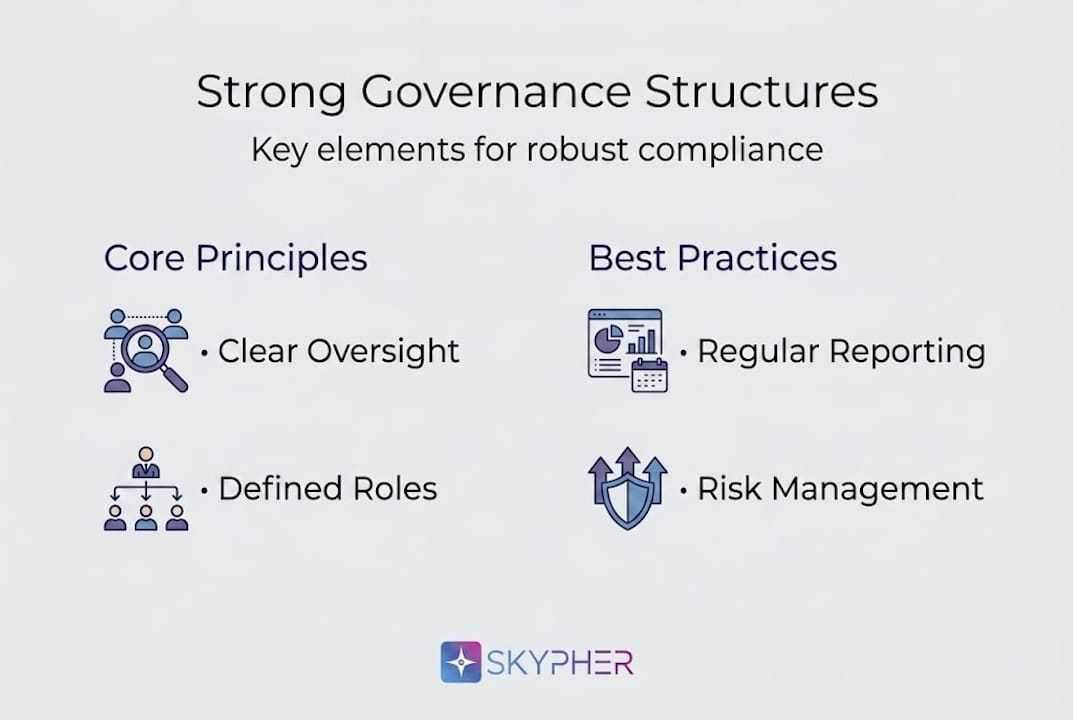
Here are the governance practices that consistently separate high-performing compliance programs from struggling ones:
- Define and document reporting lines for the CCO and all compliance staff, separate from business unit management
- Establish a compliance committee with board-level representation and a formal meeting cadence
- Set written escalation thresholds so staff know exactly when to raise an issue and to whom
- Approve risk appetite statements at the board level and cascade them into business unit KPIs
- Conduct independent compliance reviews on a scheduled basis, separate from internal audit
- Ensure adequate resourcing, including budget, staffing, and technology, for the compliance function
Organizations that invest in understanding the GRC tool benefits also find that governance becomes easier to manage when it is systematized rather than informal. Technology enforces consistency where culture alone cannot.
Modern GRC frameworks: OCEG and COSO explained
With governance's importance established, let's look at the frameworks that shape effective compliance programs. GRC stands for Governance, Risk, and Compliance, and it is both a discipline and a set of structured methodologies that help organizations integrate those three functions rather than treating them as separate silos.
The two most widely adopted GRC frameworks in tech and finance are the OCEG Capability Model and the COSO Enterprise Risk Management framework. Key GRC methodologies like the OCEG Capability Model and COSO ERM integrate governance with risk and compliance for principled performance, meaning decisions are made based on clearly defined principles rather than ad hoc judgment. These models do not just describe best practices. They provide implementation architectures that organizations can map their existing processes against.
| Dimension | OCEG capability model | COSO ERM framework |
|---|---|---|
| Primary focus | Principled performance across GRC | Enterprise risk management tied to strategy |
| Governance emphasis | Strong: structures, roles, culture | Moderate: board oversight and tone at top |
| Risk integration | Integrated with compliance and ethics | Deep integration with strategic planning |
| Compliance coverage | Explicit compliance component | Embedded within risk response framework |
| Best suited for | Organizations wanting unified GRC | Organizations prioritizing risk-strategy alignment |
| Maturity measurement | Capability model tiers | Risk maturity levels |
Both frameworks share a critical insight: you cannot run compliance effectively if risk management and governance operate in separate departments with separate reporting lines. The value of either model is the integration, not the individual components.
To evaluate which framework fits your organization, work through this process:
- Assess your current governance structure. Map who owns compliance decisions, where escalation paths lead, and whether the board receives regular compliance reporting.
- Identify your regulatory priorities. Organizations under heavy financial regulation often find COSO's risk-strategy alignment more immediately applicable. Tech firms dealing with privacy and data regulations may find OCEG's unified GRC model more flexible.
- Run a gap analysis. Compare your existing processes against the chosen framework's capability areas. Note where accountability is unclear, where monitoring is absent, and where reporting is inconsistent.
- Prioritize gaps by risk impact. Not all gaps are equal. Focus first on those that create regulatory exposure or limit the compliance function's independence.
- Develop a phased implementation roadmap. Trying to implement an entire GRC framework at once almost always fails. Sequence changes so each phase builds on the last.
Pro Tip: Before choosing between OCEG and COSO, take one department and map its current compliance processes against both frameworks simultaneously. The gaps that show up in both are your highest-priority governance improvements, regardless of which model you ultimately adopt.
For broader context on applying these models, OCEG GRC resources provide detailed standards documentation that compliance teams can use directly in gap analysis exercises. Reviewing GRC governance insights in practice helps ground theoretical frameworks in operational reality.
Key governance challenges: Edge cases in tech and finance
Understanding the frameworks, it's crucial to recognize where governance most often breaks down in real-world tech and finance settings. The predictable failures, blurry ownership and weak escalation paths, are well documented. The less discussed ones are where sophisticated organizations actually get hurt.
Misaligned incentives at the business unit level are a structural governance problem that no policy can fix on its own. When revenue targets and compliance requirements compete, and there is no governance mechanism to adjudicate that conflict, business units win almost every time. The compliance team learns about the problem after the fact, if at all. Financial crime thrives on these governance gaps, including misaligned incentives and fragmented ownership structures that let risk accumulate without visibility.
Fragmented ownership structures are particularly common in large tech organizations that have grown through acquisitions. When three separate entities each claim partial ownership of a compliance obligation, the practical result is that no one owns it. This is not a training problem. It is a governance design problem that requires explicit ownership assignment at the executive level.

AI governance represents the sharpest edge case right now. AI systems make decisions at speeds and scales that traditional compliance monitoring cannot track. AI requires runtime proof over paperwork, meaning documentary compliance after the fact is simply not sufficient when the system has already made thousands of consequential decisions. Compliance teams need real-time monitoring embedded into AI pipelines, not quarterly reviews.
The data quality and IP protection challenges in this environment are significant. According to recent research, 65% of organizations struggle with data quality issues that directly affect compliance, while 77% cite IP protection as a top compliance challenge. Those numbers reflect how deeply technical infrastructure problems have become governance problems.
Reviewing information security policy guidance helps organizations understand the structural controls needed to address these issues before they become regulatory findings.
| Governance gap | Associated risk | Common trigger |
|---|---|---|
| Fragmented ownership | Unowned compliance obligations | M&A activity, rapid growth |
| Misaligned incentives | Business pressure overrides compliance | Revenue-tied management bonuses |
| No AI runtime monitoring | Undetected algorithmic bias or fraud | AI deployment without controls |
| Weak data governance | Inaccurate compliance reporting | Poor data lineage documentation |
| Undefined escalation paths | Delayed breach notification | Informal communication culture |
Understanding how AI compliance strategies work in practice and how AI security questionnaires are reshaping vendor due diligence gives compliance leaders a clearer picture of where governance investment is most urgent right now.
Here are the warning signs that your governance structure has edge case vulnerabilities:
- Multiple teams describe themselves as "responsible" for the same compliance obligation with no single decision-maker
- AI or automated decision systems are deployed without real-time compliance monitoring controls
- Compliance findings are consistently discovered by external auditors before internal teams
- Data quality issues appear repeatedly in audit findings without a defined remediation owner
Turning governance into a compliance advantage: Practical steps
With the challenges in mind, here are proven approaches for making governance a true compliance accelerator. The organizations that consistently perform well on regulatory examinations and audits are not doing something magical. They have built governance structures that make compliance the path of least resistance.
Step 1: Establish independent compliance oversight. The CCO must report directly to the board or audit committee, not the CEO alone. This single structural change has more impact than almost any policy update. C-level independence and board escalation are foundational for converting governance into a proactive compliance advantage.
Step 2: Quantify and document risk appetite. Verbal risk appetite is not risk appetite. The board must approve a written statement that translates organizational risk tolerance into specific, measurable thresholds. Those thresholds must cascade into business unit targets.
Step 3: Build structured reporting cycles. Compliance reporting should happen on a defined schedule with standardized metrics. Committee effectiveness, incident counts, remediation rates, and regulatory finding trends should all be tracked and trended over time. Measuring GRC maturity through committee activity, compliance spending benchmarks, and incident reduction gives leadership the data they need to make resource decisions.
Step 4: Integrate RegTech and AI monitoring tools. Manual monitoring cannot scale with the complexity of modern compliance environments. Automated tools that continuously scan for anomalies, flag control failures in real time, and generate audit-ready documentation reduce both risk and workload. Understanding the full automation benefits for compliance functions helps justify technology investment to leadership.
Step 5: Build cross-functional governance teams. The compliance function cannot govern by itself. Risk, legal, technology, and business operations all need defined roles in the governance structure. Cross-industry compliance approaches consistently show that cross-functional ownership of controls reduces gaps and improves response times when issues arise.
Pro Tip: Stand up a cross-functional compliance working group that meets monthly, with rotating ownership of control reviews. This keeps governance active rather than episodic and builds institutional knowledge across departments instead of concentrating it in a single team.
Your governance maturity checklist should confirm:
- Written CCO reporting line to board or audit committee
- Board-approved, quantified risk appetite statement
- Documented escalation thresholds with named owners
- Technology integration for real-time compliance monitoring
- Scheduled compliance committee meetings with formal minutes
- Cross-functional control ownership assignments
- Annual governance effectiveness review
Understanding the GRC tool advantages that modern platforms offer makes it easier to build governance structures that are systematic and scalable rather than dependent on individual effort.
Why governance is your best compliance investment
Here is something most compliance guides will not tell you directly: checklists do not protect organizations. Governance does.
We have seen teams spend enormous resources building out policy libraries, training programs, and control catalogs, only to have a single regulatory examination expose fundamental governance gaps that invalidate all of it. When the board cannot demonstrate active oversight, when escalation paths do not exist in practice, when the CCO has no structural independence, the documentation becomes irrelevant.
The organizations that outperform consistently on regulatory and audit outcomes are not the ones with the thickest policy manuals. They are the ones where governance is designed into the operating model, not bolted on after the fact. Compliance stops being reactive firefighting when governance gives it the authority and resources to operate proactively.
The contrarian view worth considering: fixing governance first, before updating any policy, before deploying any new technology, is the highest-leverage investment a compliance leader can make in 2026. Everything else builds on that foundation. Without it, every other initiative is fragile.
Think of governance as an enabler, not overhead. When authority is clear, when reporting lines are defined, and when boards are actively engaged, compliance teams spend their time on real risk rather than organizational politics. That is a measurable advantage in any regulatory environment. Reviewing compliance framework strategies with this mindset reframes how you prioritize your roadmap.
Unlock seamless compliance with governance-focused tools
Governance structures are only as effective as the workflows that support them. When compliance teams spend hours manually compiling board reports, chasing down questionnaire responses, or trying to maintain a consistent knowledge base across scattered systems, governance suffers.

Skypher's security questionnaire automation platform was built for exactly this environment. It integrates with over 40 TPRM platforms, connects directly with Slack, Microsoft Teams, Confluence, SharePoint, and more, and uses AI-powered document vectorization to give your compliance team instant, accurate answers. Automated review cycles keep your responses current without manual tracking. The trust center platform gives boards and external stakeholders real-time visibility into your security posture. Request a demo today and see how governance-focused automation can reduce your compliance overhead significantly.
Frequently asked questions
What is the most important function of governance in compliance?
The most important function is establishing accountability, oversight, and structures so compliance teams can operate independently, with clear escalation paths and adequate resources, without interference from business units.
How do OCEG and COSO frameworks support compliance programs?
OCEG and COSO provide structured models for integrating governance with risk and compliance, ensuring boards align strategies with regulatory objectives through principled, measurable performance standards.
What are common governance pitfalls in tech and finance compliance?
The most frequent pitfalls include fragmented ownership, misaligned incentives, and the absence of real-time controls for AI systems, all of which create compliance vulnerabilities that regulatory examinations expose quickly.
How can organizations measure governance and compliance maturity?
Maturity is best measured through committee effectiveness scores, compliance spending against benchmarks, and incident reduction trends tracked over time, as outlined in OCEG GRC standards for principled performance.