

Cyber security monitoring is the continuous observation, collection, and analysis of digital activity across your networks, endpoints, applications, and cloud environments to detect threats before they cause damage. Every organization running connected systems needs it. The IBM Cost of Data Breach Report puts the global average breach cost in the millions of dollars, and the gap between organizations with mature monitoring programs and those without is where most of that financial exposure lives. Without continuous visibility, your team is responding to incidents after the fact rather than catching them in progress.
Effective monitoring programs accomplish several core objectives:
- Detect anomalies and indicators of compromise across all digital assets in real time
- Provide the audit-ready log data required by frameworks like HIPAA and PCI-DSS
- Feed incident response workflows with the context analysts need to act quickly
- Validate that security controls are actually working, not just deployed
- Support cybersecurity risk management by aligning visibility with business priorities
The NIST Risk Management Framework treats continuous monitoring as the seventh and final step in its process, the one that validates every control decision made in the preceding six steps. That framing matters: monitoring is not a bolt-on activity. It is the mechanism that keeps your entire security posture honest over time.
What tools and components power a cyber security monitoring system?
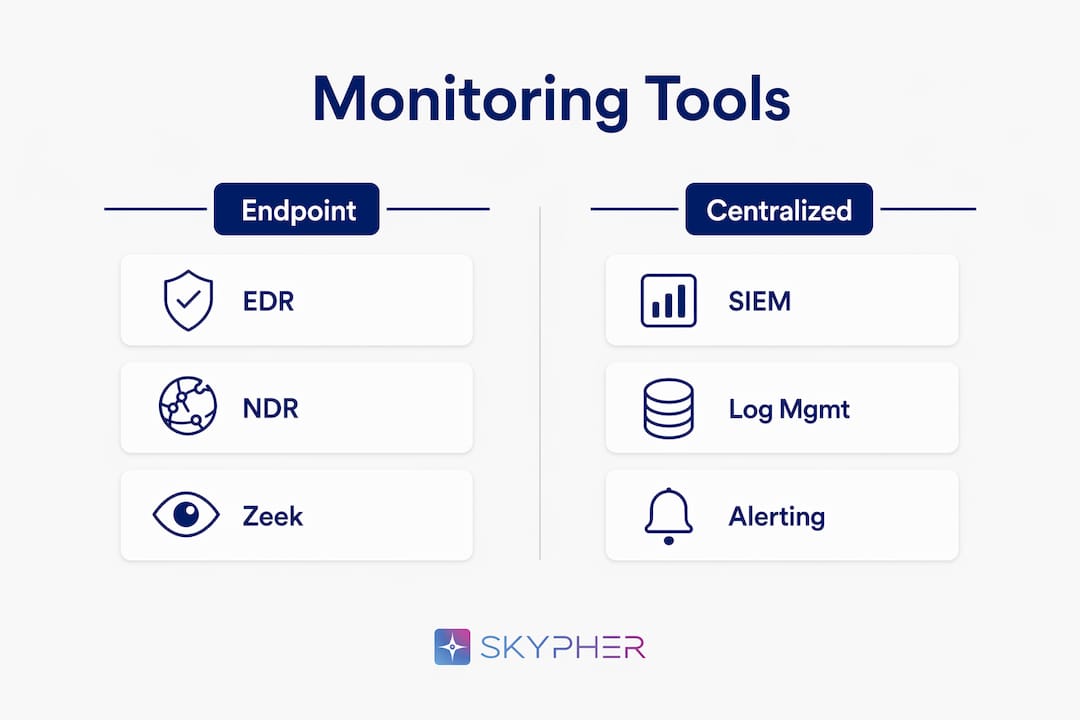
No single product gives you complete visibility. A mature monitoring architecture layers several specialized technologies, each covering a different part of your environment, and routes their outputs into a centralized platform where analysts can correlate signals across sources.
Core components every program needs:
- SIEM (Security Information and Event Management): Centralizes log ingestion from across the environment, applies correlation rules, and surfaces alerts. SIEM is the analytical hub where raw events become actionable findings.
- IDS (Intrusion Detection System): Passively monitors traffic or host activity for known attack signatures and behavioral anomalies, then generates alerts. It observes but does not block.
- IPS (Intrusion Prevention System): Extends IDS by sitting inline in the traffic path, allowing it to block or drop malicious packets in real time rather than just alerting.
- EDR (Endpoint Detection and Response): Deploys agents on individual devices to capture process execution, file changes, registry modifications, and network connections. EDR excels at detecting post-compromise activity that perimeter tools miss.
- NDR (Network Detection and Response): Analyzes east-west and north-south traffic at the network layer, using behavioral models to identify lateral movement and command-and-control communication.
- Log management: Collects, normalizes, and retains raw log data from every source. Platforms like Datadog retain security signals for up to 15 months, enabling threat hunting well beyond the initial alert window.
- Zeek: An open-source network security monitoring tool with over 10,000 active deployments worldwide, tracking more than 3,000 network event types and generating 70+ default log files. Zeek captures high-fidelity transaction logs ideal for SIEM integration and manual forensic review.
| Tool | Primary function | Monitoring scope |
|---|---|---|
| SIEM | Log correlation and alerting | Organization-wide |
| IDS | Signature and anomaly detection | Network and host |
| IPS | Inline threat blocking | Network perimeter |
| EDR | Endpoint telemetry and response | Individual devices |
| NDR | Network behavioral analysis | Internal and perimeter traffic |
| Zeek | Deep packet inspection and logging | Network traffic |
| Log management | Retention and search | All data sources |
Effective monitoring requires integrating SIEM, EDR, and NDR together to produce a correlated view rather than relying on any one tool alone. Each technology has blind spots the others fill.

What are the different types of security monitoring your organization needs?
Monitoring is not one thing. Your environment spans multiple attack surfaces, and each one demands a different approach. Here is how the major categories break down:
- Network security monitoring: Analyzes traffic flows, packet data, and protocol behavior to detect intrusions, lateral movement, and data exfiltration. Tools like Zeek and NDR platforms sit at the core of this layer, capturing the fine-grained traffic detail that signature-based IDS systems often miss.
- Endpoint monitoring: Tracks activity at the device level, including process execution, file system changes, and user logon events. EDR tools provide the telemetry here, and they are particularly effective at catching attackers who have already bypassed the perimeter.
- Application and API monitoring: Observes runtime behavior within applications, flagging unexpected API calls, privilege escalations, and injection attempts. This layer is critical for organizations running web-facing services or microservices architectures.
- Cloud and SaaS monitoring: Watches for misconfigurations, unauthorized access, and policy violations across cloud infrastructure and third-party SaaS platforms. Cloud-native security posture management tools feed into SIEM for centralized correlation.
- Identity and access monitoring: Tracks authentication events, privilege use, and access patterns to detect credential abuse and insider threats. Unusual login times, geographic anomalies, and excessive privilege requests are the signals this layer surfaces.
Each category generates its own telemetry. The value comes from combining them. An alert that looks like noise in isolation, say, a single failed login, becomes a high-confidence indicator when correlated with a concurrent spike in outbound traffic from the same endpoint.

How do you implement cyber security monitoring step by step?
Building a monitoring program from scratch, or maturing an existing one, follows a logical sequence. Skipping steps early tends to create alert noise problems and coverage gaps that are expensive to fix later.
-
Identify and categorize your assets. You cannot monitor what you do not know exists. Start with a complete inventory of systems, applications, data stores, and cloud resources, then classify them by sensitivity and business criticality. The NIST RMF's Categorize step provides a structured method for this, tying asset classification to impact analysis.
-
Align monitoring objectives with enterprise risk management. NIST emphasizes that cybersecurity monitoring should integrate with your broader Enterprise Risk Management program so that visibility priorities reflect actual business objectives, not just technical preferences.
-
Select and deploy a layered tool architecture. Based on your asset inventory and risk profile, deploy SIEM, EDR, and NDR as the core stack. Add Zeek or similar network monitoring tools for deep packet visibility. Place sensors strategically to cover both perimeter and internal traffic.
-
Establish baseline behavior models. Before tuning alert rules, let your tools observe normal activity for a defined period. Baselines for user behavior, network traffic volumes, and application call patterns give your detection rules something meaningful to deviate from.
-
Configure data collection and log pipelines. Route logs from every source, including cloud platforms, endpoints, applications, and identity providers, into your SIEM. Standardize log formats and timestamps to enable accurate correlation.
-
Tune detection rules and reduce false positives. Raw out-of-the-box rules generate too much noise. Adjust thresholds based on your environment's baselines, suppress known-good activity, and prioritize high-fidelity indicators. Alert fatigue is one of the most common reasons monitoring programs fail, and it is almost always a tuning problem.
-
Integrate with incident response workflows. Connect your monitoring platform to a SOAR (Security Orchestration, Automation, and Response) system so that high-confidence alerts trigger automated responses such as device isolation or IP blocking without waiting for manual analyst action.
-
Establish log retention policies. Define retention periods that satisfy both operational needs and regulatory requirements. Fifteen months of signal retention, as Datadog now supports, allows historical threat hunting that short retention windows make impossible.
-
Iterate based on feedback loops. Detection results should feed back into your data collection strategy. If a recent incident revealed a blind spot, update your sensor placement and collection rules. This circular refinement is what separates mature programs from static ones.
Pro Tip: Automate your first-response actions for the highest-confidence alert categories. Device isolation, account suspension, and firewall rule updates triggered by SOAR reduce dwell time for fast-moving threats like ransomware, where every minute of manual delay costs containment.
Best practices that make security monitoring actually work
Deploying tools is the easy part. Getting consistent, high-quality detection from them requires deliberate operational discipline. These practices separate programs that catch threats from those that generate noise.
- Tune continuously, not once. Your environment changes constantly. New applications, cloud services, and user behaviors shift what "normal" looks like. Revisit detection thresholds quarterly at minimum, and after any significant infrastructure change.
- Layer your monitoring sources. Combine network traffic logs, endpoint telemetry, and user activity data for correlation. High-fidelity detection depends on cross-referencing signals from multiple sources, not relying on any single feed.
- Retain logs long enough for threat hunting. Many attacks have dwell times measured in weeks or months. Short retention windows mean you cannot reconstruct the full attack chain. Aim for retention policies that cover your regulatory requirements and then some.
- Use AI and machine learning for behavioral anomaly detection. Rule-based detection catches known patterns. Behavioral models catch deviations from baseline, which is where novel attacks and insider threats tend to appear. AI-driven monitoring continuously refines its models as new data arrives.
- Invest in analyst training alongside automation. Automated systems handle volume; trained analysts handle ambiguity. The two are complementary, not interchangeable. Analysts who understand attacker tactics interpret alerts in context, catching the cases where automation alone would miss the significance.
- Audit your monitoring configuration for compliance. Continuous monitoring verifies compliance with HIPAA, PCI-DSS, and similar frameworks by maintaining audit-ready logs and demonstrating that controls are operating as intended. Schedule regular configuration audits to confirm your tools are actually capturing what your compliance posture requires.
- Document your detection coverage map. Know which attack techniques from the MITRE ATT&CK framework your current tooling covers and which it does not. Gaps in coverage are risks you can quantify and prioritize.
Pro Tip: Balance automated alerting with scheduled human-led threat hunting sessions. Automated rules catch what you have already defined; threat hunting finds what you have not yet thought to look for. Even a few hours of structured hunting per week surfaces threats that sit below alert thresholds.
Research-backed insights shaping security monitoring in 2026
The financial stakes of inadequate monitoring are well-documented. The IBM Cost of Data Breach Report consistently shows that breach costs average millions of dollars globally, with organizations lacking real-time detection programs paying significantly more than those with mature monitoring in place. That gap reflects the difference between catching an intrusion early and discovering it after weeks of undetected access.
Zeek's growth tells a parallel story about the open-source monitoring ecosystem. With 10,000+ deployments worldwide tracking over 3,000 network event types, it has become a foundational data source for security teams that need deep network visibility without the cost of proprietary solutions. Its 70+ default log files feed directly into SIEM platforms, giving analysts the raw material for both real-time alerting and retrospective investigation.
The shift toward extended log retention reflects a broader maturation in how organizations think about threat hunting. Extended retention windows mean that a threat discovered today can be traced back through historical activity, revealing the full scope of an intrusion that a shorter window would have obscured.
Industry analysis consistently reinforces that no single tool provides sufficient coverage. The integration of SIEM, EDR, and NDR into a unified architecture is now the accepted standard for organizations that want correlated visibility rather than isolated alerts from disconnected tools. NIST's guidance on integrating cybersecurity within Enterprise Risk Management adds the organizational dimension: monitoring programs that align with business objectives get the executive support and resource allocation they need to stay effective over time.
Key research findings for 2026:
- Breach costs average millions of dollars globally, with real-time monitoring directly reducing financial exposure
- Zeek's extensive active deployments confirm open-source network monitoring as a production-grade option
- Extended retention periods enable threat hunting that short windows make structurally impossible
- Layered SIEM, EDR, and NDR architectures are widely recognized as more effective than single-tool approaches in detection coverage
- NIST's RMF positions continuous monitoring as the validation mechanism for all upstream security control decisions
- AI-driven behavioral models are closing the detection gap for novel attacks that signature-based rules miss
How Skypher fits into your security monitoring program

Cyber security monitoring generates a continuous stream of evidence about your security posture. That evidence has a second life: it powers the security questionnaires, vendor assessments, and compliance reviews that your organization faces from customers, partners, and auditors. The problem most security teams run into is that translating monitoring data into questionnaire responses is slow, manual, and inconsistent.
Skypher's AI-powered questionnaire automation connects your existing security knowledge base directly to the response process. When a customer sends a 200-question security review, Skypher's models parse every format, pull from your documented controls and monitoring configurations, and generate accurate draft responses in under a minute. The platform integrates with over 40 third-party risk management portals, including OneTrust and ServiceNow, and connects to your existing documentation in Confluence, Notion, Google Drive, OneDrive, and SharePoint.
For security teams that have invested in mature monitoring programs, Skypher turns that investment into a competitive asset. Your monitoring architecture, your log retention policies, your SIEM and EDR configurations: all of it becomes evidence you can surface quickly and consistently when prospects and partners ask. That is how monitoring and compliance work together rather than in parallel silos.
Key Takeaways
Effective cyber security monitoring requires a layered architecture combining SIEM, EDR, NDR, and network tools like Zeek, governed by NIST's Risk Management Framework and integrated with automated incident response.
| Point | Details |
|---|---|
| Layered tools are required | SIEM, EDR, and NDR must work together; no single tool provides sufficient coverage. |
| NIST RMF anchors the program | Continuous monitoring is the seventh RMF step, validating every upstream control decision. |
| Zeek scales open-source monitoring | With 10,000+ deployments and 3,000+ event types tracked, Zeek is production-grade for network visibility. |
| Long retention enables hunting | Platforms retaining signals for up to 15 months allow historical investigation that short windows prevent. |
| Alert tuning prevents program failure | Filtering for high-fidelity indicators reduces alert fatigue, the most common reason monitoring programs underperform. |