

TL;DR:
- Integrating security tools into a centralized architecture is essential for effective incident response and avoiding operational silos. Hub-and-spoke models scale better than point-to-point connections and are best for enterprises with more than five tools. Continuous automation of discovery, monitoring, and compliance ensures maintained security and streamlined workflows.
Enterprise security tool stack integration is the process of connecting disparate security technologies into a unified system that enables centralized control, automated data sharing, and coordinated incident response. Without it, security teams operate in silos, chasing alerts across unconnected platforms while attackers move faster than any manual process can track. The average enterprise SaaS platform connects to over 42 third-party applications, creating blind spots that no single tool can close alone. Effective enterprise security tool stack integration is not optional for enterprises managing real risk. It is the operational foundation that determines whether your security program scales or collapses under its own weight.
What are the core components and architecture models for security tool stack integration?
The architecture you choose for connecting your security tools determines everything downstream, from maintenance cost to incident response speed. Three models dominate enterprise deployments: point-to-point, hub-and-spoke, and API gateway.
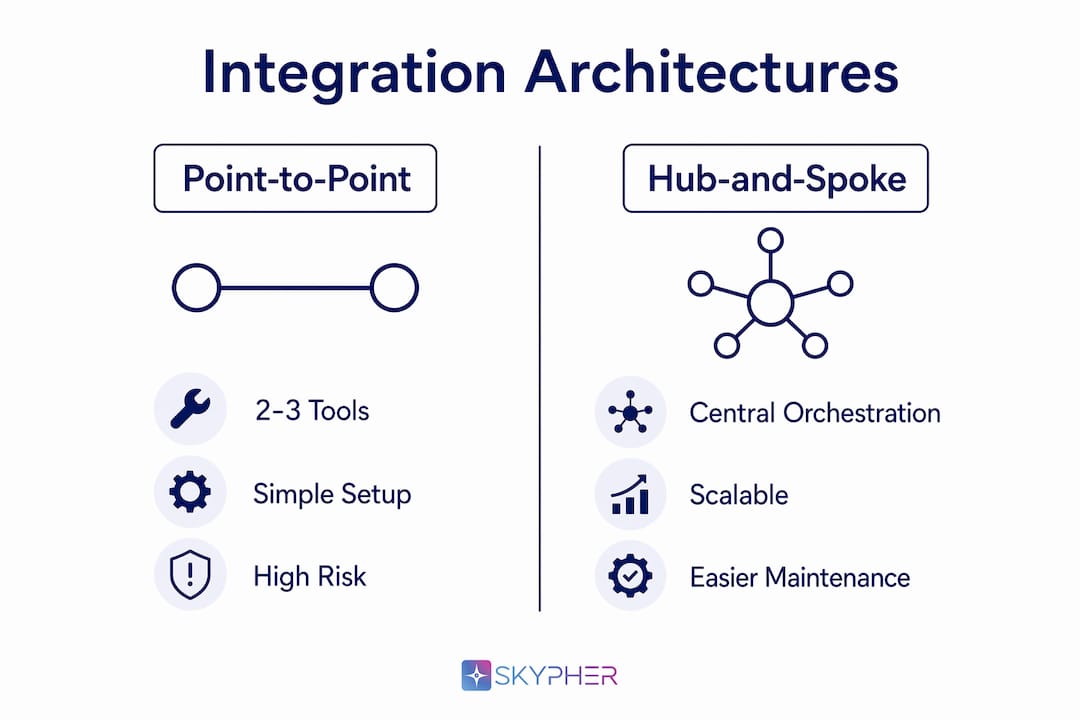
Point-to-point integration connects each tool directly to every other tool it needs to communicate with. This works for two or three tools. At ten tools, you have 45 potential connections to maintain. At twenty tools, that number exceeds 190. The complexity becomes unmanageable fast.
Hub-and-spoke architecture routes all tool communication through a central orchestration layer, such as a SOAR platform or an API gateway. Each tool connects to the hub once. The hub handles routing, transformation, and logic. This model scales without adding proportional maintenance overhead.
| Architecture | Best for | Main risk |
|---|---|---|
| Point-to-point | 2–3 tools, simple environments | Unsustainable at scale |
| Hub-and-spoke | 5+ tools, SOC environments | Hub becomes single point of failure |
| API gateway | Cloud-native, microservices stacks | Requires strong API governance |
The core components every integration layer needs are APIs with documented schemas, centralized authentication management, data connectors that normalize formats across tools, and an orchestration engine that triggers automated workflows. AWS Security Hub Extended addresses this by forcing all findings into the standardized OCSF format, which eliminates the translation overhead that slows most multi-tool environments.
Pro Tip: Never build point-to-point connections between more than three tools. The moment you add a fourth tool, redesign around a central orchestration layer. Retrofitting hub-and-spoke onto a spaghetti architecture costs three times more than building it right the first time.
Which security tools should be integrated and how do they complement each other?
The tools that deliver the most value when integrated are the ones that share context. A firewall that cannot talk to your SIEM is just a gate. A SIEM that cannot push alerts to your SOAR is just a log archive. Integration is what turns individual tools into a functioning system.
The core categories worth connecting in any enterprise security stack include:
- SIEM platforms (Splunk, Microsoft Sentinel): aggregate and correlate logs from across the environment
- EDR solutions (CrowdStrike Falcon, SentinelOne): provide endpoint telemetry and automated containment
- SOAR platforms (Palo Alto XSOAR, Splunk SOAR): orchestrate response workflows across tools
- Threat intelligence platforms (Recorded Future, MISP): supply external context on adversary tactics and indicators
- MFA and identity tools (Okta, Microsoft Entra ID): enforce access controls that feed into behavioral analytics
- Secure code review tools: embed security analysis directly into CI/CD pipelines
The integration between threat intelligence and SIEM or EDR is where the clearest efficiency gains appear. Layering threat intelligence into existing tools reduces manual investigation time and accelerates incident response decisions. Analysts stop chasing low-confidence alerts and focus on indicators with verified external context.
Secure code review tools deserve special attention. Traditional SAST tools carry a 91% false positive rate, which means developers spend most of their time dismissing noise rather than fixing real vulnerabilities. Integrating modern secure code review tools directly into CI/CD pipelines cuts that noise and produces scan results in minutes rather than hours. The fix cycle shortens, and security stops being a bottleneck at the end of the development process.
How to manage security risks and compliance when integrating third-party tools?
Every integration point is an attack surface. OAuth tokens, API keys, and webhooks each represent a credential that can be stolen, misconfigured, or forgotten. The risk compounds fast when you consider that manual audits capture only 60–70% of active SaaS integrations. The integrations you cannot see are the ones attackers find first.
Continuous automated discovery is the only reliable answer. Manual quarterly audits miss integrations created between review cycles. Automated discovery tools scan OAuth grants, API key usage, and webhook registrations in real time, flagging new connections the moment they appear.
For enterprises in finance, healthcare, or defense, the architecture of the integration layer itself must pass strict security reviews. Zero-storage, pass-through proxy architectures process data in memory without writing it to disk. This design eliminates the data-at-rest risk that most enterprise security reviews flag immediately. Sync-and-store architectures that cache sensitive data are the fastest way to fail a vendor security assessment.
Pro Tip: When a prospect's security team asks how your integration handles data, "we process it in memory and never store it" is the answer that moves deals forward. Build that architecture before you need it, not after a deal stalls.
Governance practices that actually work in enterprise environments include:
- Maintain a live registry of all active integration credentials, their owners, and their expiration dates
- Enforce least-privilege scopes on every OAuth grant and API key
- Set automated alerts for behavioral anomalies, such as an integration suddenly pulling ten times its normal data volume
- Require security questionnaire completion for every new third-party integration before it reaches production
- Review and rotate credentials on a defined schedule, not just when a breach occurs
Security questionnaire automation platforms accelerate this last point significantly. AI-powered platforms auto-fill 80–90% of questionnaire content, cutting response time from weeks to hours. That speed matters when a new integration vendor needs approval before a product launch deadline.
What are the practical steps to implement an integrated security tool stack?
Implementation fails most often at the preparation stage. Teams skip the audit, assume they know what tools they have, and discover six months later that three legacy integrations are still running with admin-level API keys and no owner.
Step 1: Audit your existing tools and integration points
Map every tool in your current stack. Document what each tool connects to, what credentials it uses, and who owns the relationship. This audit is the baseline everything else builds on.

Step 2: Select tools with strong API and documentation support
A tool with a poorly documented API will cost your team weeks of reverse engineering. Prioritize vendors who publish OpenAPI specs, maintain changelogs, and offer sandbox environments for integration testing. Consolidating vendor relationships also reduces procurement complexity, a point AWS Security Hub Extended reinforces by centralizing support channels alongside technical integration.
Step 3: Build a centralized control plane
Your control plane handles authentication, authorization, logging, and filtering for all integration traffic. SecOps teams that shift conversations from "no" to "how to operate safely" do so by building this layer first. It gives them visibility and control without blocking the integrations the business needs.
Step 4: Automate maintenance and health monitoring
Integrations break. APIs change versions. Credentials expire. Automated health checks that run continuously catch these failures before they create gaps in your detection coverage. Set up alerting for failed API calls, authentication errors, and data volume anomalies.
Step 5: Integrate compliance workflows
Security questionnaire automation belongs in your integration stack, not in a separate process. Platforms with native integrations with compliance tools like Vanta and AI-powered confidence scoring reduce the manual burden of proving your security posture to customers and partners. The top questionnaire automation features now include real-time collaboration, format-agnostic parsing, and AI-driven answer suggestions that cut response time to under an hour.
| Implementation phase | Key action | Success metric |
|---|---|---|
| Audit | Map all tools and credentials | 100% of integrations documented |
| Architecture | Deploy hub-and-spoke orchestration | Single control plane active |
| Governance | Automate credential rotation | Zero expired credentials in registry |
| Monitoring | Continuous integration health checks | Failures detected within minutes |
| Compliance | Automate security questionnaire responses | Response time under 24 hours |
Pro Tip: AI security automation tools now cut questionnaire response times by up to 90%. If your team still handles security reviews manually, that time is being spent on work a machine can do faster and more consistently. Redirect that capacity toward actual threat analysis.
Key takeaways
Effective enterprise security tool stack integration requires centralized architecture, continuous monitoring, and automated compliance workflows working together as a single system.
| Point | Details |
|---|---|
| Choose hub-and-spoke architecture | Point-to-point connections become unmanageable beyond three tools; centralize through a SOAR or API gateway. |
| Automate integration discovery | Manual audits miss 30–40% of active connections; continuous automated scanning closes that gap. |
| Build zero-storage proxy layers | Pass-through architectures that avoid disk writes pass enterprise security reviews in regulated industries. |
| Integrate threat intelligence into SIEM and EDR | Contextual enrichment reduces manual investigation and speeds response decisions. |
| Automate security questionnaire responses | AI platforms auto-fill up to 90% of answers, cutting review cycles from weeks to hours. |
Why integration is an operational transformation, not a technical project
I have watched security teams spend months selecting the right SIEM, only to leave it disconnected from their EDR for another year because "integration is next quarter's project." That delay is where breaches live. The tools were never the problem. The gap between them was.
The most important shift I have seen in mature security programs is treating integration as an ongoing operational discipline, not a one-time deployment. The teams that get this right assign ownership to every integration point, review that registry quarterly, and treat a broken API connection with the same urgency as a failed firewall rule. They also stop trying to build everything in-house. The SaaS security ecosystem for enterprise environments has matured to the point where pre-built connectors, standardized formats like OCSF, and AI-assisted workflows handle most of the heavy lifting.
The emerging challenge is not connecting more tools. It is keeping the integrations you already have clean, monitored, and compliant as your vendor list grows. That requires automation at the governance layer, not just the detection layer. Teams that invest there stop reacting to integration failures and start preventing them.
— Gaspard
How Skypher fits into your enterprise security stack
Security questionnaire automation is one of the most overlooked integration workflows in enterprise security programs. Every new vendor, partner, or customer triggers a review cycle that can stall deals and drain analyst time.

Skypher's AI-powered platform auto-fills security questionnaires with high accuracy, connects to over 40 third-party risk management platforms including OneTrust and ServiceNow, and integrates directly with Slack, Microsoft Teams, Confluence, and SharePoint. Teams answer even 200 questions in under a minute. Skypher's Trust Center gives prospects and customers a live view of your compliance posture, reducing back-and-forth on every deal. For security teams that need to prove their integration stack meets enterprise standards without spending weeks on paperwork, Skypher's questionnaire automation tool handles the compliance layer so your analysts can focus on actual threats.
FAQ
What is enterprise security tool stack integration?
Enterprise security tool stack integration is the process of connecting security tools such as SIEM, EDR, SOAR, and threat intelligence platforms into a unified system with centralized control and automated data sharing. The goal is to eliminate operational silos and accelerate incident response.
What architecture works best for integrating enterprise security tools?
Hub-and-spoke architecture, using a central orchestration layer like a SOAR platform or API gateway, is the most manageable model for enterprises with five or more security tools. Point-to-point connections become unsustainable as tool count grows.
How do you manage compliance when integrating third-party security tools?
Continuous automated discovery of OAuth tokens, API keys, and webhooks is required, since manual audits capture only 60–70% of active integrations. Zero-storage, pass-through proxy architectures also help enterprises pass strict security reviews in regulated industries.
How does security questionnaire automation fit into tool stack integration?
Security questionnaire automation platforms integrate with compliance tools and knowledge bases to auto-fill up to 90% of questionnaire content, cutting response cycles from weeks to hours. This makes them a practical component of any enterprise security governance workflow.
What is the biggest mistake enterprises make when integrating security tools?
The most common mistake is building point-to-point connections between tools without a central orchestration layer. This creates a fragile, high-maintenance architecture that breaks under scale and leaves integration gaps that attackers can exploit.