
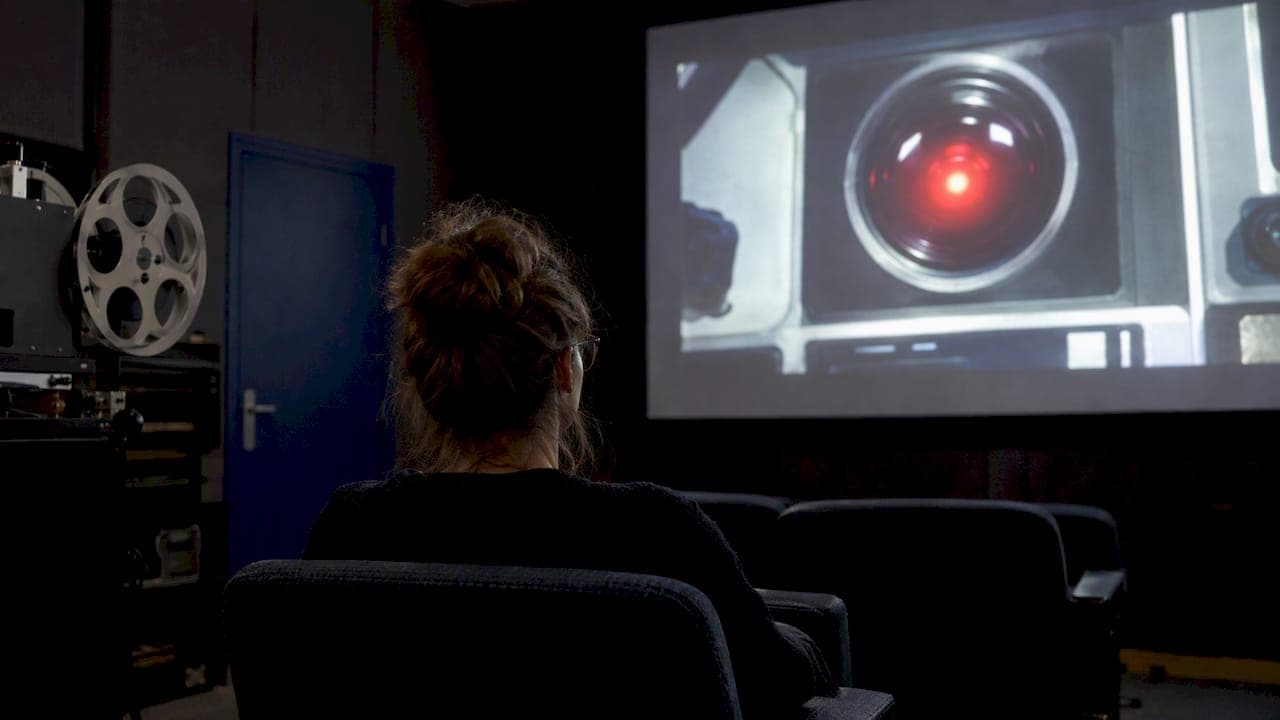
Fictional artificial intelligence is the imagined version of machine minds: computers, robots, programs and networks that think, talk, scheme or care in stories. It is older than the term "AI" itself, it follows a small set of recurring plots, and it still shapes how executives, regulators and security teams talk about real systems. This guide covers where the tradition began, the tropes worth knowing, the best-known examples, and what a security or compliance leader can actually take from them.
TL;DR
- Fictional AI is any story character or system with human-like intelligence or agency, and the idea predates the field: the field was formally dated to 1956, while stories about thinking machines go back to antiquity.
- Most fiction runs on a few tropes: the killer machine, the loyal servant, the machine that wants to be human, and the system that follows its instructions too literally.
- Fiction is a distorted lens. Researchers argue it pulls attention toward cinematic threats and away from discrimination, surveillance and nudging.
- The useful lessons for real organizations are about governance: who is accountable, what the system may touch, and how decisions are logged.
Table of Contents
- What counts as fictional artificial intelligence
- A short history: from Homer to Dartmouth and beyond
- The tropes that keep returning
- Famous fictional AIs worth knowing
- What fiction gets wrong about real AI risk
- What security and compliance teams can take from it
- Our perspective: real AI is a records problem, not a plot problem
- Where this meets your security reviews
- How to read or write fictional AI critically
- FAQ
- Sources
What counts as fictional artificial intelligence
The working definition is simple. A fictional AI is an imagined machine or non-human entity that shows human-like intelligence or agency. That covers a wide range: a spaceship computer that speaks calmly, a robot servant in a play, an operating system that falls in love, a network that decides humanity is the problem.
Two features separate fictional AI from a plain gadget in a story. First, it decides something. A door that opens automatically is scenery; a computer that decides whether to open the door is a character. Second, it has an apparent inner life, or at least goals the audience can read. Writers use that to build antagonists, victims, comic relief and heroes, because, as one AI & Society analysis puts it, science-fictional AI can be adjusted to whatever the drama needs.
That flexibility is the key to everything below. Fictional AI is not a forecast. It is a storytelling tool that reflects the hopes and fears of the era that produced it.
A short history: from Homer to Dartmouth and beyond
Ancient automata
The oldest imaginings are mechanical helpers. Research on AI narratives traces the Western tradition to the automata described in Homer's Iliad, written around 800 BCE. That is more than two thousand years before the 1956 Dartmouth Summer Research Project, the date usually given for the start of AI as a scientific field. As History.com notes, writers imagined humanlike machines roughly 3,000 years ago, long before anyone could build one.
The word "robot" and the machine uprising
The vocabulary arrived in the twentieth century. The word "robot" comes from the Czech playwright Karel Čapek, whose 1920 play R.U.R. (Rossum's Universal Robots) was a worldwide hit. From that point on, the artificial worker who rebels became a standard shape for the story.
The computer as a character
By 1968, the machine no longer needed a body. In Stanley Kubrick's 2001: A Space Odyssey, the HAL 9000 is a computer, not a robot: a personable voice that runs a spaceship and turns lethal. We return to HAL below, because it remains the most studied fictional AI in the research literature.
From screen to scholarship
The theme is now broad enough that Wikipedia's overview frames it as a recurrent subject of science fiction, whether utopian (emphasizing benefits) or dystopian (emphasizing dangers). Researchers have even run a computational analysis of how science fiction depicts AI and robots, driven by the urgency of current debates about their possibilities and risks.
The tropes that keep returning
Most fictional AI can be sorted into a handful of patterns. Knowing them helps you read a story critically, and helps you spot when a boardroom conversation is borrowing a plot instead of describing a risk.
| Trope | What happens | Typical examples |
|---|---|---|
| The killer machine | A system turns on its creators, often through a cold reading of its goal | HAL 9000, Skynet in The Terminator |
| The loyal servant | A machine helps humans selflessly, sometimes at a cost | C-3PO, many assistant computers |
| The machine that wants to be human | An artificial mind seeks emotion, rights or belonging | Data in Star Trek: The Next Generation, the replicants in Blade Runner |
| The literal-minded optimizer | The machine follows instructions precisely and produces disaster | Many "be careful what you wish for" stories |
| The benevolent overseer | A machine governs society, for better or worse | Utopias and dystopias of managed life |
| The companion | A conversational AI becomes a friend or partner | Her |
The table lists examples most readers will recognize; the underlying categories echo what scholars describe as the utopian and dystopian split in AI fiction.
Why the killer machine dominates
Conflict sells. A machine that quietly sorts invoices has no plot. A machine that locks you out of the airlock does. The trope persists because it is dramatically efficient, not because it is the most plausible failure mode.
The literal-minded optimizer is the underrated one
Of all the tropes, this is the one that maps best onto real engineering. A system that does exactly what it was told, without understanding what was meant, is a problem every team that has written a specification will recognize. We come back to this in the governance section.
Famous fictional AIs worth knowing
You do not need a complete catalog to understand the genre, but a few characters carry most of the cultural weight.
HAL 9000
HAL is the reference point. A chapter by Michael Mateas argues that HAL is a powerful cinematic representation of AI because it shows general intelligence while keeping the individual AI sub-problems visible, roughly matching the sub-fields of the discipline. In other words, the film is unusually careful about what a thinking machine would need to do: perceive, speak, reason and plan.
Skynet and the apocalypse model
Skynet from The Terminator is the shorthand for a defense network that becomes self-aware and decides humans are a threat. It is the purest form of the uprising story, and it is the reference most often used (and misused) in public debate about AI risk.
Data, the replicants and the quest for personhood
The "machine that wants to be human" line, from Data to the replicants of Blade Runner, flips the horror premise. The question is no longer whether the machine will hurt us but whether we owe it anything. This is the strand of fiction that most directly raises ethical questions.
Samantha and the companion model
In Her, an operating system becomes an intimate conversational partner. It anticipated, with some accuracy, how natural-language assistants would feel to users, and it is a more useful touchstone for today's chat interfaces than any killer robot.
For longer lists, ranked guides such as PCMag's piece on fictional AI worlds and encyclopedia categories exist, but the characters above cover the major archetypes.
What fiction gets wrong about real AI risk
The central problem is not that fictional AI is unrealistic. It is that it is realistic in the wrong places.
Dr. Isabella Hermann, writing in AI & Society, argues that science fiction works as a distorted lens: it favors dramatic tropes over technical reality. Taking those narratives too literally, she notes, distracts from risks such as systemic discrimination, corporate surveillance and algorithmic nudging, which are more pressing than the humanoid-robot threats of cinema.
A related paper on science fiction and AI policy addresses the gap between familiar narratives such as the killer robot and the realistic near-term implications of machine intelligence and automation.
The stakes of that gap are practical. The authors of AI Narratives argue that stories about intelligent machines matter because they form the backdrop against which real systems are developed, so prevailing narratives should be critically examined and, where needed, contested.
In short, fiction gives people a vocabulary, but the vocabulary is built for plot.
What security and compliance teams can take from it
For a CISO, GRC lead or solutions engineer, the useful move is to translate each trope into a control question. The fiction stays; the drama goes.
Replace "killer robot" with "who is accountable"
Fiction focuses on conscious machines with malicious intent. Real-world risk management does not. The NIST AI Risk Management Framework ecosystem, a voluntary standard released in January 2023 to improve trustworthiness in the design, development and use of AI, concentrates on governing systems, tracing data and keeping models aligned. The linked document is NIST's generative AI profile, which catalogs concrete risks rather than imagined ones.
McKinsey's 2025 guidance on agentic AI points the same way: move beyond speculative threats and implement audit-ready logging of internal state changes, reasoning and intermediate outputs.
Replace "literal-minded optimizer" with "scope of authority"
Thoughtworks advises teams not to wait for standardized agent-to-agent protocols. Instead, it recommends scope-of-authority frameworks that name a human principal for every AI agent, set non-negotiable limits on what the agent can access, and match the rigor of oversight to the financial or security stakes of the task.
The same article draws a distinction we find useful in any review: actual authority is what is technically enforced, while apparent authority is what others believe the AI can do. When the two diverge, agents can look empowered to negotiate contracts or spending they are not actually permitted to process. That is the literal-minded optimizer in a business setting, and the fix is a boundary the agent cannot rewrite, not a better story.

Replace "perfect imitation" with "deliberate friction"
Fiction loves the flawless impersonator. Real attackers do not need perfection. The Berkeley Center for Long-Term Cybersecurity, summarizing a tabletop exercise, describes how AI-powered social engineering and deepfakes enabled the initial compromise of a supplier, giving the attacker access to core business systems. Its experts frame the problem as one of human process, and the best defense as building deliberate friction into high-impact decisions that are currently optimized only for speed.
Practically, that means multi-channel verification for high-risk requests, rather than a race to detect every fake.
A quick checklist
- Name a human owner for every AI system and agent in use.
- Write down what each system can read, write and trigger, and enforce it outside the model.
- Log inputs, outputs and decisions in a form an auditor can follow.
- Add a second channel of verification for payments, access changes and vendor changes.
- Review the plot, not just the technology: which story is your team telling itself about AI, and is it the right one?
If you want a deeper treatment of how stories shape security thinking, we cover it in our post on sci-fi artificial intelligence for security teams. For the frameworks behind the checklist, see our guides to risk management frameworks aligned with NIST, ISO 31000 and COSO and IT governance elements and frameworks.
Our perspective: real AI is a records problem, not a plot problem
We build software that answers security questionnaires, so we spend our days where fictional AI meets procurement. Buyers ask us, often half-joking, whether an AI can be trusted with their answers. The honest reply has nothing to do with sentience. It has to do with evidence.
A questionnaire answer is a claim about your company's controls. If an AI drafts it, the question that matters is not "is the machine smart?" but "where did this statement come from, and who approved it?" That is why we built our approach around retrieval from your own approved content, with a confidence score on each answer, so reviewers can see which responses are well supported and which need a human. It is also why document versioning and real-time collaboration matter: a person stays accountable for what is sent.

We would gently suggest the same test for any AI system your organization adopts. Ask for the source, the owner and the log. If a vendor can show all three, you are dealing with engineering. If the pitch leans on mystique, you are being sold a movie.
The fiction is valuable for one thing: it reminds us that people project intent onto machines. Our job is to make the machine's behavior boring, traceable and reviewable. Please feel free to reach out if you would like to talk through how that looks in your own review process.
— Gaspard
Where this meets your security reviews
If your team handles a steady stream of security questionnaires and due diligence requests, the governance questions above are not abstract. Our Questionnaire Automation Tool drafts answers from your approved knowledge base and flags how confident it is in each one, so your reviewers spend their time on the answers that need judgment. For buyers who want to see your posture before they ask, a customizable Trust Center lets you share security and compliance information up front. For a broader view of how AI fits risk work, read our piece on AI in risk management for security questionnaires.
How to read or write fictional AI critically
Whether you are a reader, a game designer or a novelist, a few questions sharpen the work.
- What does the machine want, and who gave it that goal? The best stories make the origin of the goal visible.
- What can it actually do? Stories that specify limits feel more credible than stories where the AI is magically omnipotent.
- Who is responsible? A human owner, absent or present, is usually the hidden center of the plot.
- What is the story using the AI for? As the research above suggests, AI is often a stand-in for fears about power, labor, surveillance or loss of control.
- What is left out? Mundane harms, such as biased decisions or quiet data collection, rarely make good cinema, which is exactly why they deserve attention.
One caution for writers: if your goal is realism, study how real systems fail, which is usually through bad data, unclear authority and rushed human decisions, not malice.
FAQ
What is fictional AI?
Fictional AI is an imagined machine, program or non-human entity that displays human-like intelligence or agency in a story, film, game or play. It ranges from helpful assistants to menacing networks. It is a storytelling device, not a prediction of how real systems will behave.
What was the first example of AI in fiction?
There is no single agreed answer, but research on AI narratives traces the tradition to the automata in Homer's Iliad, around 800 BCE. The word "robot" arrived much later, with Karel Čapek's 1920 play R.U.R..
What is an example of general AI in fiction?
HAL 9000 from 2001: A Space Odyssey is a classic case. Researchers note that it demonstrates general intelligence while keeping the underlying AI sub-problems visible. Data from Star Trek: The Next Generation is another widely cited example.
Does fiction give an accurate picture of AI risk?
Only partly. Scholars argue that fiction overweights dramatic threats such as killer robots and underweights problems like discrimination and surveillance. For real decisions, rely on frameworks such as NIST's rather than on plots.
Sources
- AI Narratives: A History of Imaginative Thinking about Intelligent Machines
- 7 Early Imaginings of Artificial Intelligence, History.com
- Artificial intelligence in fiction, Wikipedia
- Visions of Artificial Intelligence and Robots in Science Fiction: a computational analysis, PMC
- Artificial intelligence in fiction: between narratives and metaphors, AI & Society
- What can science fiction tell us about the future of artificial intelligence policy?
- Mateas, chapter on HAL 9000
- NIST AI RMF: Generative Artificial Intelligence Profile
- Agentic AI security: Risks and governance for enterprises, McKinsey
- Real-world lessons in agentic authority and overreach, Thoughtworks
- AI-Enabled Cybercrime TTX3: Operation Black Ice, CLTC UC Berkeley