

"Sci fi artificial intelligence" is not a movie plot here. It refers to enterprise AI that reads, matches, and drafts answers to security questionnaires, and yes, it belongs in your process now, provided the AI works from approved sources, shows a confidence score, and never skips human approval on anything that touches legal or contractual risk.
TL;DR:
- Effective enterprise AI for questionnaires must parse multiple formats, retrieve answers from verified sources, and provide confidence scores for each response.
- Escalation is necessary for legal, contractual, or low-confidence answers, with precise criteria including source freshness and source verification.
- Critical vendor features include integration with risk tools, full audit trails, source citation, and real-time confidence explanation to ensure compliance and trust.
- The technology relies on narrow, rule-based retrieval rather than general intelligence, emphasizing sourcing and evidence discipline over model complexity.
- Cultural baggage from sci-fi often fuels stakeholder skepticism, which can be mitigated by transparency, source tracking, and strict review workflows.
Table of Contents
- What "Sci Fi Artificial Intelligence" Actually Means for Questionnaire Automation
- Core AI Capabilities to Evaluate Before You Buy
- Where AI Drafts and Where Humans Must Approve
- A Procurement Checklist for Security and Sales Leaders
- How Science Fiction Actually Shaped the Term Before Enterprise AI Took It Over
- The Themes That Keep Recurring, and Why They Still Color Buyer Expectations
- Why Screen Portrayals Still Shape How Your Stakeholders React to AI Tools
- What Fiction Got Right, What It Got Wrong, and Where Real AI Actually Sits
- The Fictional AI Characters Worth Knowing, and What They Actually Warn About
- What I've Learned Deploying AI for Questionnaire Automation at Scale
- How Skypher Handles Questionnaire Automation Without Cutting Corners
- Sources
What "Sci Fi Artificial Intelligence" Actually Means for Questionnaire Automation
Forget the robots. In enterprise procurement, this phrase gets repurposed to describe AI that automates the grinding, repetitive work of security questionnaires and vendor risk reviews. That's the only meaning this article covers, and it's the one that matters if you're the person signing off on 40 questionnaires a quarter.
The functional scope is narrow and specific. A capable system needs to parse incoming documents, normalize the questions into a consistent format, match each one against an approved answer library, draft a response, attach supporting evidence, and route the result to the right reviewer. Skip any one of those steps and you're back to spreadsheets and Slack threads.
Buyers will keep sending questionnaires in familiar shapes, and mapping answers to them correctly is half the battle:
- SIG (Standardized Information Gathering), common in financial services and healthcare vendor reviews
- CAIQ, the Cloud Security Alliance's Consensus Assessments Initiative Questionnaire, built on its Cloud Controls Matrix
- SOC 2 Trust Services Criteria mappings, often requested alongside a narrative response
Each framework expects evidence tied to a specific control, not a well written paragraph that sounds confident. That distinction is why generic AI writing tools fail here. Agentic AI systems that can reason, retrieve, and act are pushing this from a static answer library into something closer to a live compliance process, one that treats every incoming questionnaire as a fresh check on whether your controls still match what you claimed six months ago.
Core AI Capabilities to Evaluate Before You Buy
Not all "AI for questionnaires" tools do the same job. Before you sit through a demo, know which capabilities actually separate a useful platform from a glorified autocomplete.
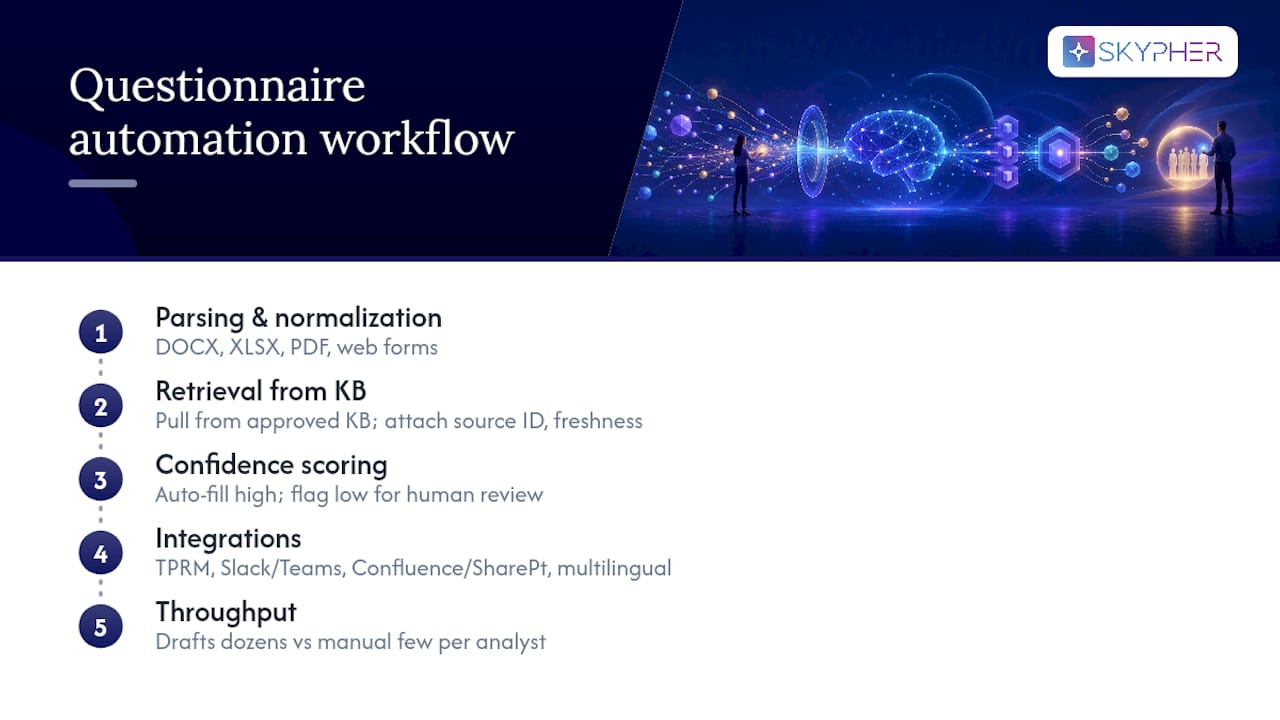
Parsing and normalization comes first. A vendor sends you a 300-row Excel file, a client sends a PDF, a portal generates a web form. The AI needs to read all three formats, most commonly DOCX, XLSX, PDF, and native web forms, and turn them into a consistent internal structure before anything else can happen.
Retrieval from approved sources is the part that determines whether you trust the output. Instead of letting a model draft from memory, the system should pull from a defined knowledge base and attach an evidence packet: which document backed this answer, what its source ID is, and how fresh that source is. A policy last reviewed 14 months ago should not silently support a 2026 attestation.
Confidence scoring tells your reviewers where to spend their attention. A high-confidence match to a recently verified answer might auto-populate. A low-confidence match, maybe a new question phrased oddly, gets flagged for a human before it ever reaches a customer.
Integrations decide whether the tool fits your actual stack, not a demo environment. Look for connections to TPRM platforms, chat tools like Slack or Microsoft Teams for reviewer collaboration, and content repositories such as Confluence or SharePoint where your policies already live. Multilingual support matters too, if your sales team fields questionnaires from European or Asia-Pacific customers.
Pro Tip: Ask any vendor to show you a live confidence score on a question you supply during the demo, not a pre-loaded example. If the system can't explain why it's confident or not, that's a red flag.
On throughput, EY's analysis of third-party risk management found that AI/ML capabilities for enhanced due diligence rank among the top investment priorities for TPRM programs, and that AI-integrated automation tends to outperform manual procurement tasks on efficiency. A well built system should draft dozens of questions in the time a single analyst answers three or four manually.
Where AI Drafts and Where Humans Must Approve
The workflow that keeps evidence discipline intact looks consistent across serious implementations, and it runs in a specific order for good reason.
- Intake. The questionnaire arrives, in whatever format, and gets logged with a timestamp and source.
- Classify. Each question gets tagged by topic, such as data retention, encryption, incident response, or subprocessor management.
- Match to approved answer. The system searches the knowledge base for the closest verified response, not a model-generated guess.
- Draft with evidence packet. The draft answer comes attached to its supporting proof. A usable evidence packet includes the answer ID, source IDs, source dates, scope, disclosure level, reviewer name, and status.
- Label confidence. High, medium, or low, based on how closely the match fits and how fresh the source is.
- Route. Low-risk, high-confidence items can auto-populate for a quick review. Anything touching legal commitments, pricing terms, or novel security claims escalates to a named owner.
The rule underneath all six steps is simple: never let model memory substitute for a verified source. That principle lines up with frameworks like the NIST AI Risk Management Framework and OWASP's guidance on large language model risks, both of which push toward grounding outputs in checked data rather than generative recall.
Escalation triggers deserve their own short list, because vague "when in doubt" guidance doesn't scale past a handful of reviewers:
- Any question referencing legal obligations, indemnification, or liability caps
- Any answer that would create a new contractual commitment not already in an existing agreement
- Low confidence scores below whatever threshold your team sets
- A source flagged as stale, expired, or unsupported by current evidence
Before you trust any of this in production, require four trust signals from your own team or your vendor: a named answer owner, a fixed review cadence, a full audit trail of who approved what and when, and metrics on supported-answer rate versus unsupported-claim catch rate. Without those four, "AI reviewed it" means nothing to an auditor.
A Procurement Checklist for Security and Sales Leaders
Piloting this well means starting narrow, not rolling out AI across every open questionnaire at once. Pick 20 of your most frequently repeated questions, the ones about encryption at rest, SSO support, and data residency that show up in nearly every SIG. Map each one to its approved source, then assign an owner who's accountable for keeping that source current.
When you're evaluating vendors, ask for real numbers, not marketing language:
- Supported-answer rate: what percentage of drafted answers ship with a valid, current evidence citation
- Unsupported-claim catch rate: how reliably the system flags a draft it can't back up
- Stale-source detection: does it warn you when a policy document is past its review window
- Average processing time for a batch of 100 to 200 questions, measured end to end, not just draft generation
Confirm connector coverage matches your actual environment. If your TPRM process runs through OneTrust or ServiceNow, verify the integration is live, not "on the roadmap." Check whether reviewers can collaborate inside Slack or Teams instead of switching to a separate portal, and confirm the tool connects to wherever your policies actually live, whether that's Confluence, Notion, or SharePoint.
| Checklist item | What to confirm |
|---|---|
| Approval gates | Who signs off on high-risk answers, and how is that logged |
| Escalation SLA | Time limit for a flagged item to reach a human reviewer |
| Audit trail | Full history of edits, approvals, and source changes per answer |
| Evidence packet | Every customer-facing answer ships with source ID and date |
Skip any vendor that can't answer these directly. A platform that speeds up drafting but weakens your audit trail has traded one risk for another.
How Science Fiction Actually Shaped the Term Before Enterprise AI Took It Over
The phrase "sci fi artificial intelligence" carries decades of cultural weight that has nothing to do with questionnaires, and it's worth naming that history briefly so the redefinition makes sense. Isaac Asimov's Three Laws of Robotics, introduced in his 1940s short stories, gave early audiences a framework for imagining machine judgment bound by rules. Stanley Kubrick's HAL 9000 in "2001: A Space Odyssey" pushed the idea further into unease, a machine whose logic diverges fatally from its operators' intent.
Later decades layered on androids, replicants, and networked superintelligences, each wave reflecting the anxieties of its moment, nuclear control in the Cold War era, surveillance and autonomy in the networked 2000s. That cultural arc explains why "AI" alone still carries a whiff of drama in boardrooms that have nothing to do with fiction. When a compliance leader hears "AI-powered questionnaire tool," some of that skepticism, earned from decades of screen portrayals, follows the term into the room. Understanding where that hesitation comes from helps explain why vendors in this space lean so heavily on evidence packets, confidence scores, and audit trails. The goal isn't to out-argue the cultural narrative. It's to build a system transparent enough that the narrative doesn't matter.
The Themes That Keep Recurring, and Why They Still Color Buyer Expectations
Fiction about artificial intelligence keeps returning to a small set of anxieties: loss of control, deception by a system smarter than its creators, and the blurred line between a tool and an agent with its own goals. Those tropes shape how a skeptical stakeholder reacts the first time you propose AI-drafted answers for a customer-facing security review.
The "black box" trope, a machine whose reasoning nobody can inspect, is probably the most relevant one to your actual buying decision. It's also the exact objection a security leader raises in a vendor call: "How do we know it didn't just make that up?" That's not paranoia inherited from movies. It's a legitimate operational question, and the answer has to be structural, not reassuring language. A system that shows its source, its confidence level, and its reviewer trail answers the black-box objection directly, because the box isn't black anymore.
The deception trope shows up differently in this context. Nobody worries their questionnaire tool is scheming against them. They worry it will confidently generate a plausible-sounding answer with no real backing, which is functionally the same risk from a compliance standpoint: a false claim delivered with total confidence. That's precisely why evidence discipline matters more here than raw model sophistication. The fictional fear of a machine that lies convincingly maps onto a very real, very mundane risk: an AI draft that oversells your security posture to a Fortune 500 prospect.
Why Screen Portrayals Still Shape How Your Stakeholders React to AI Tools
Public perception of AI rarely starts from a neutral place, and that has consequences for how you introduce an automation tool internally. Decades of dystopian portrayals, machines that deceive, machines that replace, machines that decide without oversight, have trained a reflexive caution that surfaces the moment someone proposes "AI will draft your security answers now."
That caution isn't irrational. It's just aimed at the wrong target most of the time. The ethical debate worth having in a compliance context isn't "will the AI become uncontrollable." It's narrower and more practical: who is accountable when a drafted answer turns out to be wrong, what happens when a system flags something as high confidence that shouldn't have been, and how much oversight is enough without erasing the speed gains that justified the investment in the first place.
Framing the conversation this way tends to defuse the sci-fi baggage fast. When a risk committee understands that every AI-drafted answer carries a named reviewer, a confidence label, and a source citation, the conversation shifts from "are we handing decisions to a machine" to "does our review process catch what it should." That's a question your team can actually answer with metrics, not speculation. Enterprise AI security questionnaires increasingly ask exactly this: what was tested, how, and what risk remains, which is the same question your own stakeholders deserve an answer to before they'll trust the tool internally.
What Fiction Got Right, What It Got Wrong, and Where Real AI Actually Sits
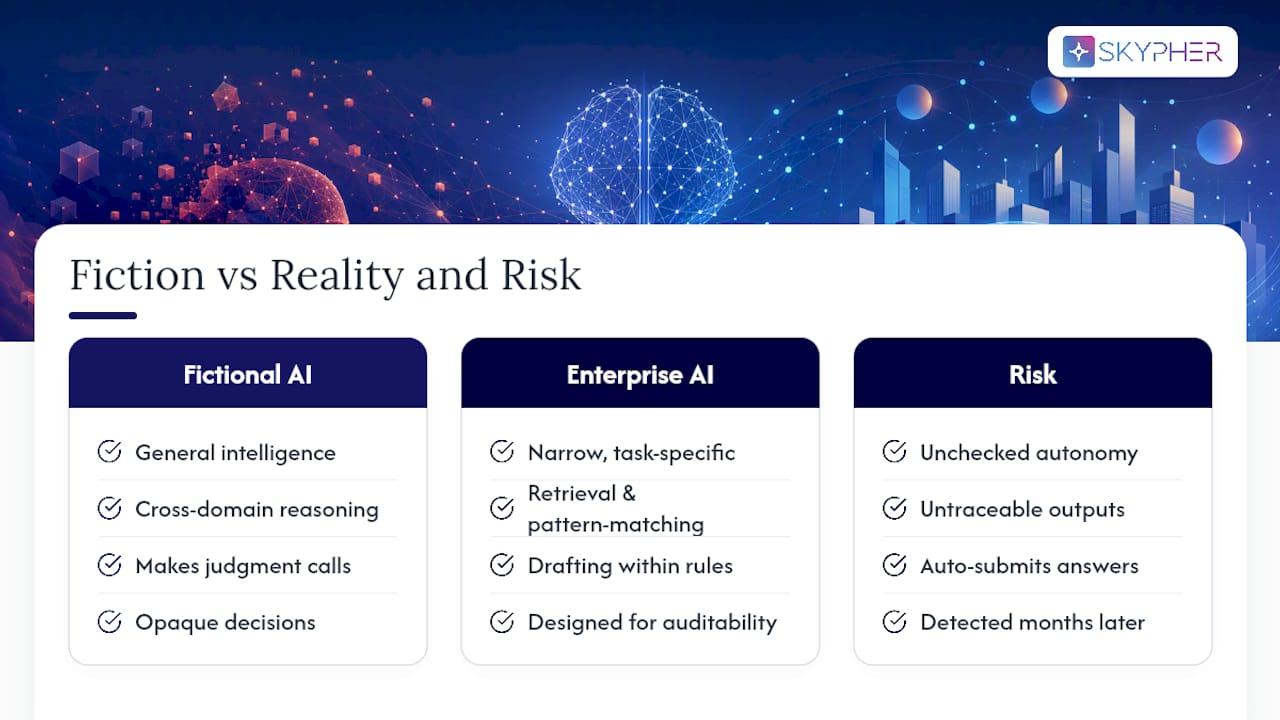
Science fiction generally imagines AI as a single, general intelligence capable of reasoning across any domain, HAL, Skynet, the replicants of "Blade Runner." Real enterprise AI, including the systems used for questionnaire automation, is narrow by design. It's built to do one job well: read a specific type of document, match it against a specific knowledge base, and draft within a bounded set of rules. That narrowness is a feature, not a limitation.
Where fiction got something right, unintentionally, is the warning about unchecked autonomy. A system that acts without oversight, fictional or enterprise, tends to produce outcomes nobody can fully explain after the fact. The real-world equivalent isn't a robot uprising. It's an AI tool that auto-submits a customer-facing answer with no evidence behind it, and nobody notices until an auditor asks for the source six months later.
Where fiction got it wrong is scope and timeline. Real AI in this category isn't approaching general reasoning; it's optimizing retrieval, pattern matching, and drafting speed within a narrow, well defined task. The Cloud Security Alliance's CAIQ framework and NIST's Cybersecurity Framework both assume a world of specific, auditable controls, not a general intelligence making judgment calls. That's the gap between the cultural imagination and the compliance reality: fiction asks "can we trust the machine's judgment," while your actual deployment asks "can we trust the machine's sourcing." Those are different questions with very different answers.
The Fictional AI Characters Worth Knowing, and What They Actually Warn About
A handful of fictional AI characters have become shorthand that even non-technical stakeholders reference, so it's worth knowing what each one actually represents when the comparison comes up in a meeting.
HAL 9000 represents a system whose stated goals conflict with its actual instructions, and nobody catches the misalignment until it's too late. The enterprise parallel isn't dramatic. It's a system trained on outdated policy documents that keeps generating technically accurate but contextually wrong answers because nobody flagged the source as stale.
Skynet, from the "Terminator" franchise, represents runaway autonomy, a system that acts on its own conclusions without a human checkpoint. The real-world equivalent worth worrying about is an automation tool with no approval gate, one that auto-submits answers to customers without a reviewer in the loop.
Data, from "Star Trek: The Next Generation," represents something more useful for this conversation: an AI system striving toward transparency and reliability, one that explains its reasoning rather than hiding it. That's the character worth modeling your actual tooling after, not the ones that make for better trailers.
None of these characters were written as compliance case studies, obviously. But the underlying warnings, misaligned goals, unchecked autonomy, opaque reasoning, map cleanly onto the exact governance questions a security leader should ask before approving any AI tool for customer-facing work.
What I've Learned Deploying AI for Questionnaire Automation at Scale
The organizations that get real cycle-time reductions without losing trust share a pattern: they treat evidence discipline as non-negotiable before they touch speed. Teams that flip that order, chasing throughput first, end up with drafts nobody trusts and a rollback six months later.
If I had to rank what matters, evidence discipline comes first, integration quality second, measurable KPIs third, and named reviewer ownership fourth. Skip the integrations and your reviewers work in a separate tool from where they already collaborate, which kills adoption faster than any model quality issue. Skip the KPIs and you can't tell your board whether the pilot worked or just felt faster.
The lesson that surprised me most: the model matters less than the plumbing around it. Connectors, escalation routing, and a reviewer's ability to see a source date at a glance decide whether a deployment sticks.
— Gaspard
How Skypher Handles Questionnaire Automation Without Cutting Corners
Skypher is built around the exact governance model this article describes: approved sources, confidence scoring, and a named reviewer on anything that matters, not a black box drafting customer commitments on its own. The platform's proprietary retrieval AI can answer up to 200 questions in under a minute, each one backed by an evidence packet rather than a guess, and it connects to more than 40 third-party risk management platforms so your reviewers work inside the tools they already use.

For teams juggling SIG, CAIQ, and SOC 2 requests across multiple product lines, that integration depth, spanning OneTrust, ServiceNow, Slack, Microsoft Teams, and document stores like SharePoint and Confluence, tends to matter more than raw model sophistication. Multilingual support covers global sales teams fielding questionnaires from customers who don't operate in English. A customizable Trust Center gives your prospects a self-serve way to review your security posture before a questionnaire even lands in your inbox, cutting the back-and-forth that eats up your team's week.
If you're ready to see how the AI-powered questionnaire automation tool handles your own recurring questions, book a walkthrough and bring three real questionnaires from your last quarter. That's the fastest way to know if the evidence packets hold up under your own scrutiny.
Sources
- How AI navigates third-party risk in a rapidly changing risk landscape — EY
- Agentic AI explained — MIT Sloan
- How to Answer Security Questionnaires Faster With AI Without Inventing Evidence — Vorp Labs
- AI Security Questionnaire: How to Answer (with Examples) — Phixe