

A risk management framework is a structured, repeatable system of policies, processes, and practices that helps an organization identify, assess, and treat the risks that threaten its objectives. Its primary value is governance: it turns risk decisions from ad hoc guesswork into a consistent, documented discipline. Standards like NIST SP 800-37-overview) and ISO 31000 give leaders a proven scaffold, and platforms like Skypher help scale the evidence work underneath it.
TL;DR:
- Organizations should clearly define risk scope and criteria before identifying risks to ensure consistent evaluation and decision-making.
- Embedding a risk owner with authority is critical for transforming a static risk register into actionable management; without this, progress stalls.
- Continuous monitoring involving key risk indicators and trigger events like security incidents or vendor changes is essential for maintaining an effective RMF.
- Automating evidence collection through tools like questionnaire automation reduces manual effort and improves consistency during audits.
- Practitioners blending standards like NIST, ISO 31000, and COSO often achieve stronger stakeholder trust and better alignment of risk with strategic objectives.
Table of Contents
- What Does a Risk Management Framework Actually Do?
- How Does the Risk Management Process Actually Work?
- NIST, ISO 31000, or COSO: Which Standard Fits Your Needs?
- What Are the Real Benefits of a Risk Management Framework?
- How Do You Build a Risk Management Framework From Scratch?
- How Do You Monitor an RMF After It's Live?
- Where Does Automation Fit Into RMF Evidence Collection?
- What Does RMF Application Look Like in Real Organizations?
- What Goes Wrong When Organizations Implement an RMF?
- What Should Leaders Prioritize First?
- If You're Scaling Evidence Collection, Here's a Faster Path
- Where to Read More on Risk Frameworks
- Sources
What Does a Risk Management Framework Actually Do?
An RMF is not a single document or a one-time checklist. It's a structured, repeatable system, built from policies, processes, and defined practices, that organizations use so risk decisions don't depend on whoever happens to be in the room that day.
The definition that matters most comes from ISO 31000, which frames risk as "the effect of uncertainty on objectives." That phrasing is deliberate. A risk that doesn't threaten a specific business objective is really just a worry, not a risk worth formally tracking. Framing risk this way forces every assessment to answer a concrete question: what goal does this jeopardize, and by how much?
A working RMF typically includes:
- A governance structure that assigns accountability for risk decisions
- Documented risk criteria (appetite and tolerance thresholds)
- A repeatable process for identifying, analyzing, and treating risks
- Defined roles connecting risk owners to executive oversight
- Mechanisms for monitoring and reporting risk status over time
Done well, an RMF embeds itself into how the organization already makes decisions rather than sitting beside them as a compliance exercise.
How Does the Risk Management Process Actually Work?
Strip away the branding differences between standards, and most risk management frameworks run on the same cyclical process. NIST and ISO 31000 both describe the same core sequence: establish context, identify, analyze, evaluate, treat, and monitor, with two activities running continuously alongside every step.
- Establish scope and context. Define what's in scope, what success looks like, and your risk criteria before anyone touches a spreadsheet. Skip this and every later judgment call becomes subjective.
- Identify risks. Catalog what could threaten defined objectives. The output here is a living risk register, not a one-time list.
- Analyze risks. Estimate likelihood and impact for each entry. This is where a risk assessment matrix earns its keep, sorting noise from what actually deserves attention.
- Evaluate risks. Compare analyzed risk against your stated tolerance. Some risks clear the bar and get accepted; others don't.
- Treat risks. Assign an owner, a treatment plan (mitigate, transfer, avoid, or accept), and a deadline. Untreated risks with no owner are the single most common reason RMFs stall.
- Monitor and review. Track treatment progress and watch for new risks emerging from changed conditions.
Two activities never stop: communication and consultation with stakeholders, and ongoing monitoring and review. Mature programs treat these as parallel processes running the whole time, not tasks to knock out at the end.
Pro Tip: Build a re-assessment trigger list before you need it, things like a new vendor integration, a regulatory change, or a security incident, so the team knows exactly when to loop back to step one instead of waiting for the annual review.
NIST, ISO 31000, or COSO: Which Standard Fits Your Needs?
The three most-cited frameworks solve overlapping but distinct problems, and most enterprises end up blending them rather than picking just one.
- NIST SP 800-37 focuses on system-level security controls and the authorization lifecycle. It's built for organizations that need to formally categorize systems, select controls, and maintain near real-time continuous monitoring, making it the natural fit for regulated tech environments.
- ISO 31000:2018 is process and principle first. It defines the framework and the risk criteria that everything else runs on, and it works at the whole-organization level rather than just IT systems, per the ISO practical guide.
- COSO ERM ties risk directly to strategy and board-level performance reporting, organizing itself around governance, strategy, performance, review, and information flows.
If your organization needs airtight system authorization, lean NIST. If you're building an enterprise-wide risk culture from scratch, ISO 31000 gives you the scaffolding. If the board wants risk tied explicitly to strategic performance, COSO speaks that language natively.
What Are the Real Benefits of a Risk Management Framework?
The payoff isn't abstract. Organizations that practice strategic risk management report stronger stakeholder confidence and measurably better business outcomes than those that treat risk as a compliance afterthought.
Organizations with mature, strategically integrated risk practices consistently outperform peers on stakeholder trust and business resilience metrics, according to research summarized by Harvard Business School Online.
A functioning RMF speeds up decisions because leaders aren't relitigating the same risk questions every quarter. It reduces financial exposure by catching problems before they become losses. Most importantly, it lets leadership take calculated risks deliberately instead of avoiding them out of uncertainty, which is where real value creation happens.
How Do You Build a Risk Management Framework From Scratch?
Implementation succeeds or fails on a handful of early decisions, long before anyone builds a dashboard.
Start by defining scope, context, and explicit risk criteria. Without documented appetite and tolerance thresholds, every risk evaluation becomes a matter of opinion. Practitioner guidance consistently flags this as the step organizations skip, and it's the one that causes the most rework later.
From there:
- Name a risk executive function with real authority to accept, reject, or escalate risk decisions
- Assign risk owners for every category, not just IT or compliance owns everything by default
- Translate abstract policies into operational controls with clear triggers and documented owners
- Build the risk register and assessment matrix templates before your first formal review
- Set a review cadence (a regular review cadence is common) and stick to it even when nothing seems urgent
- Pilot the framework on one business unit before rolling it out company-wide
Pro Tip: Naming a specific person as risk owner, not a team or department, is the single change that most reliably converts a risk register from a static document into actual action.
Organizations building this out for the first time in a technology context often benefit from a dedicated IT risk management framework approach, since system-level risks carry their own scoping questions.
How Do You Monitor an RMF After It's Live?
An RMF that isn't monitored decays fast. The standards agree on this: continuous monitoring isn't a phase, it's a permanent parallel process running beside everything else.
Useful key risk indicators (KRIs) include control failure rates, time-to-remediate for open findings, and the percentage of risks reassessed within your stated cadence. Pair those with key performance indicators like average time to close a security questionnaire or audit cycle.
Trigger points for an off-cycle review should include:
- A security incident or near-miss
- A significant technology or vendor change
- New regulatory requirements affecting your sector
- Material shifts in business strategy or market conditions
Automation and system integrations increasingly carry the load here, pulling evidence and control status into dashboards closer to real time rather than waiting for a regular manual pull. That shift matters most for organizations tracking dozens of controls across multiple business units, where manual monitoring workflows simply can't keep pace.
Where Does Automation Fit Into RMF Evidence Collection?
Every RMF eventually runs into the same bottleneck: proving controls exist. Auditors, customers, and regulators all want evidence, and collecting it manually across spreadsheets and email threads introduces inconsistency that undermines the framework itself.
For organizations fielding high volumes of security questionnaires, integrating questionnaire automation with the RMF's evidence and control mapping measurably reduces audit-cycle time and improves consistency across responses. Skypher's Questionnaire Automation Tool connects to more than 40 third-party risk management platforms, including tools like OneTrust and ServiceNow, so control evidence flows where it's needed instead of getting retyped for every request. Real-time collaboration through Slack and MS Teams keeps risk owners and reviewers working from the same source of truth, and a customizable Trust Center lets you share your compliance posture with customers without a fresh document every time. None of this replaces the framework, but it removes the manual drag that quietly erodes it.

What Does RMF Application Look Like in Real Organizations?
The theory of an RMF is straightforward. What it looks like in practice depends heavily on where the organization sits.
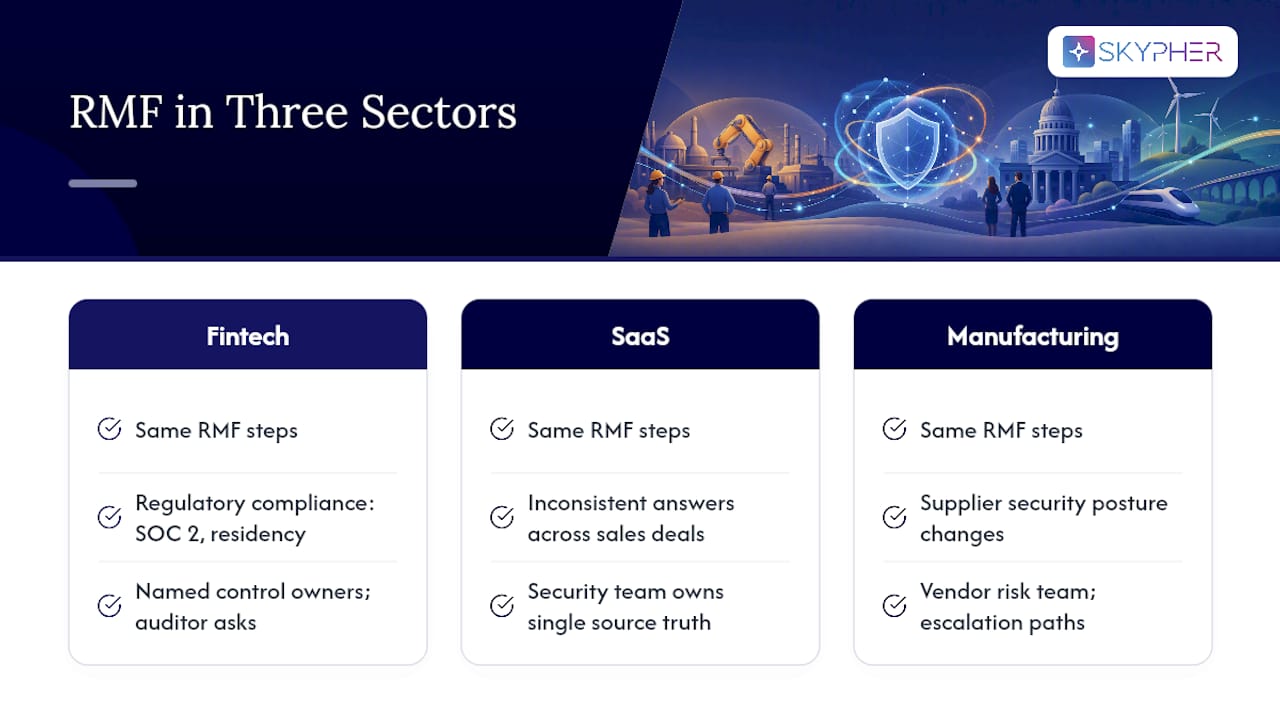
A mid-sized fintech handling a regulatory audit typically maps its ISO 31000 process directly onto specific compliance requirements: SOC 2 evidence, data residency controls, vendor risk assessments. The risk register isn't abstract; every line item ties to a named control and a named owner, because the auditor will ask who's accountable for each one.
A SaaS company scaling customer trust reviews faces a different pressure. Enterprise prospects send security questionnaires that ask nearly identical questions in different formats, and the security team's real risk exposure is inconsistent answers across deals, not just missing controls. Their RMF work centers on standardizing responses and maintaining a single source of truth so answers don't drift between one questionnaire and the next.
A manufacturing firm managing third-party supply chain risk uses its RMF to formalize vendor onboarding: risk criteria for new suppliers, ongoing monitoring of critical vendors, and escalation paths when a supplier's own security posture changes. This overlaps heavily with third-party risk management practices, since supplier risk rarely fits neatly inside a single framework category.
Across all three, the pattern holds: the framework's steps stay constant, but what counts as a critical risk, and who owns treating it, shifts entirely based on the business.
What Goes Wrong When Organizations Implement an RMF?
Most RMF failures trace back to a small set of recurring mistakes, not a flaw in the framework itself.
The most common pitfall is treating risk management as a security silo rather than embedding it into how the business actually makes decisions. When the RMF lives entirely inside IT or compliance, it produces reports nobody outside those teams reads, and risk data never reaches the people making strategic calls. COSO's guidance on integrating risk with strategy exists specifically to counter this pattern.
A second pitfall is skipping or rushing the scoping step. Teams eager to show progress jump straight to identifying risks without agreeing on risk criteria first, which means every subsequent evaluation gets argued from scratch because there's no shared baseline for "how much risk is too much."
Ownership gaps cause a third failure mode. A risk register full of entries with no named owner is a wish list, not a management tool. Plans stall because nobody has both the authority and the accountability to act.
Finally, many programs treat the framework as a project with an end date rather than a continuous cycle. Once the initial rollout is "done," monitoring quietly stops, and the framework drifts out of sync with a business that keeps changing underneath it. The fix isn't more documentation. It's discipline: revisit criteria, reassign owners as roles shift, and keep the review cadence even when nothing feels urgent.
What Should Leaders Prioritize First?
If you're starting or fixing an RMF, three moves matter more than the rest: get an executive sponsor who can actually enforce decisions, write down risk criteria before you assess a single risk, and automate evidence collection early so your program scales with the business instead of against it.
The mantra worth keeping on a sticky note: a framework only works when someone specific owns each risk and answers for it.
— Gaspard
If You're Scaling Evidence Collection, Here's a Faster Path
Skypher gives risk and security teams a way to cut the manual grind out of RMF evidence work, without touching how your framework itself is structured. If your team is buried in questionnaire responses and evidence requests instead of actual risk analysis, that's the bottleneck worth fixing first.

The Questionnaire Automation Tool answers security questionnaires in any format using your existing control documentation, and it connects to more than 40 platforms so evidence moves instead of getting retyped. The AI-powered recommendation engine keeps answers consistent across every questionnaire your team touches, and easy import and export workflows mean evidence doesn't get stuck in one format. This is an adjacent tool, not a replacement for your RMF itself. Worth checking when you evaluate it: integration depth with your existing TPRM platforms, enterprise support availability, and whether your team can run it without a lengthy onboarding cycle. If evidence collection is slowing down your audits, see how the Trust Center works and book a walkthrough with the team.
Where to Read More on Risk Frameworks
For primary references: NIST's RMF overview, ISO 31000 guidance, COSO's ERM framework, and cloud security best practices for monitoring-specific guidance.
Sources
- ISO 31000:2018 — Risk management — A practical guide (preview) | ISO
- Risk management | HBS Online blog