

TL;DR:
- ISO 27001 has become essential for building ongoing, risk-managed security programs that improve security posture.
- Automation of evidence management and questionnaires is critical for maintaining continuous compliance at scale.
- Most organizations benefit from dual certification with ISO 27001 and SOC 2 for global operational trust.
Most security and compliance professionals assume ISO frameworks are just expensive certification exercises designed to appease enterprise procurement teams. They're wrong. With over 70,000 organizations certified globally in 2023 alone and a 20% year-over-year growth rate, ISO 27001 has become the backbone of serious information security programs. Research shows that 73% of certified organizations report improved security posture, and 40% see a meaningful reduction in security incidents within two years. This article breaks down the real mechanics of ISO frameworks, explains how they compare to alternatives like SOC 2, and shows you exactly where automation changes the game.
Table of Contents
- What are ISO frameworks? Scope, purpose, and critical benefits
- Anatomy of ISO 27001: Clauses, Annex A controls, and certification
- ISO 27001 vs. SOC 2: Choosing the right standard for global operations
- Automating ISO compliance: From static registers to dynamic workflows
- Our perspective: Why ISO frameworks are more about operational trust than checklists
- How Skypher helps automate ISO frameworks and unlocks scale
- Frequently asked questions
Key Takeaways
| Point | Details |
|---|---|
| ISO 27001’s global relevance | ISO 27001 is the leading framework for automating security and managing compliance in large organizations. |
| Automation is essential | Manual registers and static evidence are high-risk—dynamic, automated workflows solve real audit challenges. |
| Dual certification value | ISO 27001 and SOC 2 together cover global and US-specific security needs for modern tech and finance firms. |
| Controls map to risk | ISO 27001’s structure requires organizations to link controls to risks and evidence for true audit readiness. |
What are ISO frameworks? Scope, purpose, and critical benefits
ISO frameworks are internationally recognized standards that define how organizations should approach specific domains of governance, quality, or security. Within the security and compliance space, ISO 27001 sits at the top as the primary framework for building, implementing, maintaining, and continuously improving an Information Security Management System, or ISMS.
An ISMS is not simply a set of policies or a list of security tools. It is a structured, auditable system that integrates people, processes, and technology into a repeatable risk management approach. Think of it as a living operating model for security, one that forces your organization to ask hard questions: What are our information assets? What threats face them? What controls do we have in place, and are those controls actually working?
This distinction matters enormously for security leaders in tech and finance. A tech company managing customer payment data has a very different risk profile than a regional bank running core banking infrastructure. ISO 27001's risk-based design means both organizations can implement the same framework while arriving at entirely different sets of active controls, all determined by their specific context and threat landscape.
The practical benefits go far beyond the certification plaque on the wall:
- Improved security posture: Systematic risk identification closes gaps you didn't know existed
- Audit readiness: Documented evidence and controlled processes mean fewer surprises during reviews
- Client and partner trust: Enterprise customers increasingly require ISO 27001 as a baseline before signing contracts
- Regulatory alignment: The framework maps naturally to GDPR, DORA, and other major regulatory requirements
- Reduced incidents: Organizations that treat the ISMS as operational see 40% fewer security incidents within two years of certification
"ISO 27001 is not a compliance checkbox. It is a management system standard. The difference is that management systems are designed to improve over time, not stay static."
Understanding the ISO 27001 impact on real organizations requires looking beyond certification counts. The framework's value is cumulative. Each surveillance audit, each risk review cycle, and each control update builds institutional knowledge that compounds over time. Organizations that grasp core ISMS concepts early get ahead of this curve and avoid the expensive rework that comes from treating ISMS as a one-time project.
Anatomy of ISO 27001: Clauses, Annex A controls, and certification
With that foundational context in place, let's dissect how ISO 27001's structure maps to practical security management for your team.
ISO 27001 is built on two core pillars: the main clauses and Annex A. The main clauses, numbered 4 through 10, cover governance requirements. Each clause addresses a specific aspect of managing an ISMS:
- Clause 4: Context of the organization — Define internal and external issues, interested parties, and the scope of your ISMS
- Clause 5: Leadership — Establish executive commitment, roles, responsibilities, and a top-level information security policy
- Clause 6: Planning — Conduct risk assessments, define risk treatment plans, and set measurable security objectives
- Clause 7: Support — Manage resources, competence, awareness, communication, and documented information
- Clause 8: Operation — Execute the risk treatment plan and manage operational security processes
- Clause 9: Performance evaluation — Monitor, measure, audit, and review ISMS effectiveness
- Clause 10: Improvement — Address nonconformities and drive continual improvement
Annex A is where things get operationally specific. It lists 93 controls organized across four categories: organizational, people, physical, and technological. These controls range from identity access management and cryptography to supplier relationships and incident response. Not every control is mandatory. Organizations apply controls based on their risk treatment decisions, and any excluded control must be formally justified in a document called the Statement of Applicability.
| Phase | Typical timeline | Key activities |
|---|---|---|
| Gap assessment | 4-8 weeks | Identify current state vs. ISO requirements |
| ISMS design | 6-12 weeks | Build policies, risk register, control framework |
| Implementation | 8-16 weeks | Deploy controls, train staff, collect evidence |
| Internal audit | 2-4 weeks | Test effectiveness before external audit |
| Stage 1 audit | 1-2 weeks | Certification body reviews documentation |
| Stage 2 audit | 1-2 weeks | Certification body tests implementation |
| Ongoing | Annual | Surveillance audits, continual improvement |
For medium to large organizations, expect the full journey from kickoff to certification to take 6 to 12 months and require an audit investment of $15,000 to $50,000, depending on scope and certifying body. The certificate itself is valid for three years, with annual surveillance audits required to maintain it.

Pro Tip: Don't wait for your external auditor to find gaps in your evidence trail. Build an internal audit calendar that runs quarterly, focusing on the highest-risk Annex A controls. This keeps your evidence current and your team audit-ready year-round.
Working with experienced ISO 27001 consulting partners during the design phase significantly reduces the rework that happens when organizations discover their control documentation doesn't meet auditor expectations. This is one of the most common and costly mistakes teams make during their first certification cycle.
ISO 27001 vs. SOC 2: Choosing the right standard for global operations
Having covered the ISO structure in detail, the next logical question is how ISO 27001 stacks up against SOC 2, particularly for organizations operating across multiple geographies and regulatory regimes.
Both frameworks aim to demonstrate strong security controls, but they approach that goal from fundamentally different angles. Understanding this distinction is critical for tech and finance organizations making long-term compliance stack decisions.
| Dimension | ISO 27001 | SOC 2 |
|---|---|---|
| Origin and recognition | International (ISO/IEC), globally accepted | US-focused (AICPA), strong in North America |
| Output | Certification (3-year cycle) | Point-in-time audit report |
| Approach | Risk-based ISMS management system | Trust service criteria assessment |
| Regulatory alignment | GDPR, DORA, PSD2, NYDFS, NIS2 | US SaaS, enterprise procurement |
| Scope | Organization-wide or defined ISMS scope | Specific systems or service boundaries |
| Ongoing requirement | Annual surveillance, continual improvement | Annual re-attestation |
ISO 27001 complements major regulatory regimes like DORA, PSD2, GDPR, and NYDFS because it provides the structured ISMS governance that those regulations require. For fintech companies serving European markets, ISO 27001 is often the preferred starting point, and there is a 65 to 75% control overlap with SOC 2, meaning dual certification doesn't require double the work.
SOC 2, on the other hand, dominates the US SaaS procurement landscape. Enterprise buyers in North America frequently require a SOC 2 Type II report as a minimum security signal before entering into vendor contracts. The key difference is that SOC 2 produces a snapshot rather than an ongoing certification, which creates ongoing questions for sophisticated buyers about what has changed since the report was issued.
When should you pursue both? The answer is almost always yes for global tech or finance organizations:
- Your enterprise sales cycles touch both US and international accounts
- You operate in regulated industries where GDPR or DORA creates mandatory governance requirements
- Your clients operate in sectors where ISO 27001 is a contractual baseline, such as banking, healthcare, or defense
- You are scaling rapidly and need a framework that grows with your organization
Understanding the ISO 27001 vs SOC 2 decision is particularly important for SaaS companies that are scaling internationally, since the cost of dual certification is manageable when controls are designed with both frameworks in mind from the start.
"Choosing between ISO 27001 and SOC 2 is often a false dilemma. The smarter question is: how do we design a control environment that satisfies both efficiently?"
Automating ISO compliance: From static registers to dynamic workflows
After understanding the certification and controls landscape, the real operational challenge becomes clear: how do you make ongoing ISO compliance scalable without building a dedicated team of people whose entire job is maintaining spreadsheets?
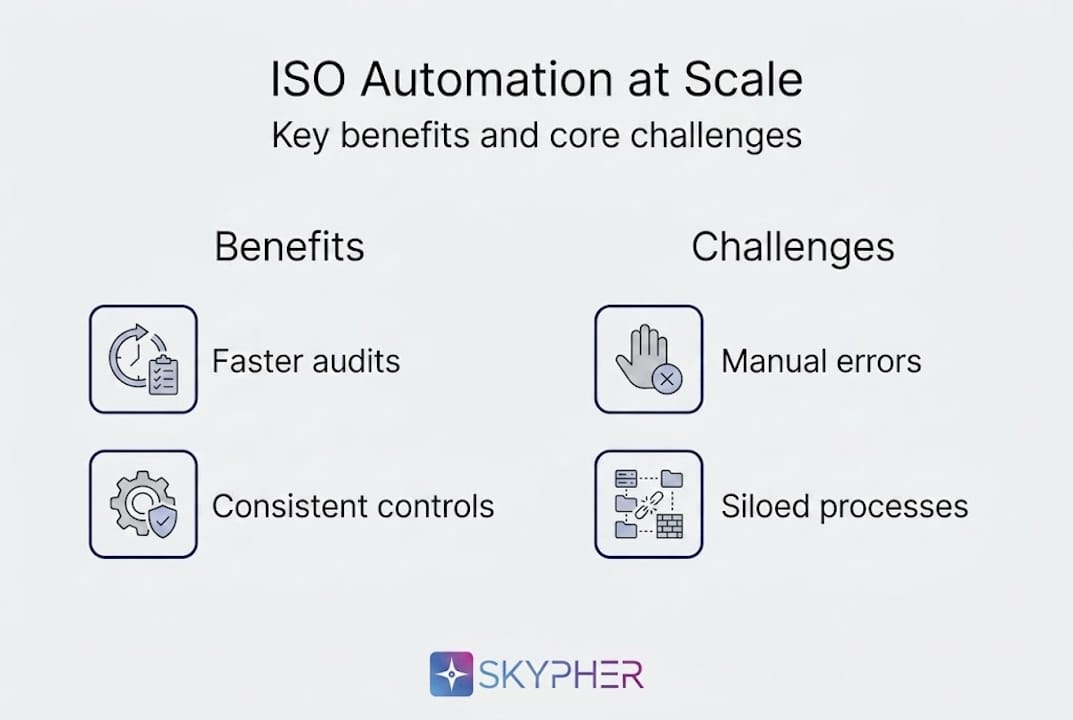
This is where most organizations run into serious problems. The initial certification effort is intense but finite. The post-certification reality is a continuous cycle of risk reviews, evidence collection, control testing, and questionnaire responses. Without automation, this cycle becomes a major operational burden.
The core problem with manual ISO compliance is what auditors call a broken "golden thread." Under Clause 8.3, risk treatment execution requires a clear, traceable link from identified risks through to your Statement of Applicability, specific controls, and the evidence that proves those controls work. Static spreadsheets and disconnected document repositories break this chain constantly. Controls get updated without corresponding evidence. Risk registers fall out of sync with actual control states. Auditors find gaps that weren't visible internally.
Ongoing evidence management and post-certification maintenance are consistently cited as the hardest challenges organizations face after achieving ISO 27001 certification. The certification gets you through the door. Staying compliant is the real test.
A practical approach to automating your ISO compliance workflow looks like this:
- Centralize your knowledge base: Connect your policy documents, control evidence, and risk register to a single platform that supports document ingestion from sources like Confluence, SharePoint, and Google Drive
- Map controls to evidence dynamically: Use automation to link specific controls to the evidence documents that support them, so updates flow through automatically rather than requiring manual reconciliation
- Automate questionnaire responses: When clients or auditors send security questionnaires, use AI-powered tools to pull accurate, current answers directly from your ISMS documentation
- Build a workflow for control testing: Schedule automated reminders, evidence collection prompts, and review approvals so nothing slips between audit cycles
- Track changes in real time: Any update to a policy, a control, or a risk assessment should propagate immediately to dependent documents and questionnaire libraries
Pro Tip: The highest-value automation investment for most ISO-certified organizations is not the initial setup but the ongoing questionnaire response workflow. Security questionnaires from clients, prospects, and third-party risk managers come constantly after certification. Automating this single workflow alone can reclaim dozens of hours per month for your security team.
The security automation approaches that work best in enterprise settings treat the ISMS not as a documentation repository but as a live data source. When your controls and evidence are structured and machine-readable, every questionnaire becomes an opportunity to demonstrate your security posture rather than create a bottleneck.
Our perspective: Why ISO frameworks are more about operational trust than checklists
The security industry has a habit of reducing ISO 27001 to a compliance exercise. Get the certificate, frame it, and move on. This mindset explains why so many organizations struggle after certification. They achieved a point-in-time result rather than a continuous operational capability.
The organizations we see getting genuine value from ISO 27001 treat the ISMS as a trust communication tool. When a major bank asks your team 200 security questions before signing a contract, the answer isn't the questionnaire response. The answer is the evidence-backed, auditable system that lets you respond accurately in minutes rather than weeks. That speed and accuracy are what actually build trust with enterprise buyers.
Automation is what makes this possible at scale. Without it, the "golden thread" from risk to control to evidence exists only in theory. With it, your ISMS becomes a dynamic, queryable source of truth. The failed audits we consistently see aren't caused by technical security failures. They are caused by static documentation that stopped reflecting reality months before the auditor walked in.
ISO frameworks are the language of operational trust. Treat them that way.
How Skypher helps automate ISO frameworks and unlocks scale
For teams ready to reduce compliance headaches and accelerate security-driven growth, here's how Skypher addresses the next-generation ISO automation challenge.

Skypher's security questionnaire automation platform is built for exactly the kind of dynamic, evidence-linked ISO workflows described in this article. The platform ingests your existing policies and control documentation from Confluence, SharePoint, Google Drive, and more, then applies AI-powered vectorization to make every document queryable. Its AI recommendation engine delivers accurate, context-aware answers to even 200-question security reviews in under a minute. With flexible import and export workflows, Skypher fits directly into your existing TPRM stack, connecting to over 30 online portals and integrating with Slack, Microsoft Teams, and ServiceNow. Multilingual support and multi-entity handling make it a natural fit for global tech and finance organizations scaling their ISO-aligned programs.
Frequently asked questions
Which ISO framework is most relevant for automating security questionnaires?
ISO 27001 is the primary framework for information security management and aligns most directly with automation for security questionnaires, since it creates a structured, evidence-linked control environment that feeds directly into questionnaire responses.
How long does ISO 27001 certification typically take for a medium or large organization?
Most medium to large organizations complete certification in 6 to 12 months, followed by annual surveillance audits throughout the three-year certificate cycle.
What risks come with manual ISO evidence registers?
Static registers frequently fail audits because they break the traceable link between risks, controls, and supporting evidence that auditors require under Clause 8.3 of ISO 27001.
Is ISO 27001 or SOC 2 better for global SaaS and finance companies?
Most global organizations benefit from pursuing both. ISO 27001 is preferred internationally and in EU markets, while SOC 2 remains the dominant standard in US enterprise procurement, and the 65 to 75% control overlap makes dual certification more efficient than it looks.
What's the biggest challenge after ISO certification?
Evidence management and maintaining compliance posture between annual surveillance audits are consistently the hardest post-certification challenges, which is why automation of evidence collection and questionnaire workflows delivers such high ongoing value.