

For most mid-to-large U.S. organizations, the strongest starting point is a three-layer combination: use the NIST Risk Management Framework (SP 800-37 Rev. 2) as your program backbone, adopt NIST CSF 2.0 for outcome-based prioritization and executive communication, and apply FAIR where monetary estimates are needed to justify investment decisions. This combination covers system-level control governance, enterprise-facing risk communication, and quantitative business-case support without requiring three separate programs.
The rationale is practical: RMF gives you a repeatable, auditable lifecycle with defined roles and authorization artifacts. CSF 2.0 translates those artifacts into a language boards and ERM committees understand. FAIR fills the gap both leave open — dollar-denominated risk estimates that make budget conversations defensible.
- NIST RMF (SP 800-37 Rev. 2): Program backbone; mandatory for federal systems, strongly recommended for regulated industries.
- NIST CSF 2.0: Outcome taxonomy; works for any organization size and maps directly to RMF control families.
- FAIR: Quantitative layer; apply selectively where a monetary loss estimate changes a decision.
- ISO 31000 / ISO/IEC 27005: Preferred when your organization already operates within ISO-centric governance or has significant international obligations.
- ISACA Risk IT / COBIT: Best fit when IT governance and audit alignment are the primary drivers, particularly in finance and heavily regulated sectors.
If your organization is a smaller enterprise without federal obligations or a mature GRC function, CSF 2.0 alone is a faster, lower-overhead entry point. ISO-centric organizations with existing ISO 9001 or ISO 27001 programs will find ISO 31000 and ISO/IEC 27005 a more natural fit than RMF.
Pro Tip: Before selecting any framework, confirm whether your organization has a named risk executive with authority to approve residual risk. Without that role filled, even the best-designed program stalls at the authorization step.
Key Takeaways
The strongest IT risk programs combine NIST RMF as the control governance backbone, CSF 2.0 as the outcome-based communication layer, and FAIR for monetary risk estimates where executive decisions require dollar-denominated inputs.
| Point | Details |
|---|---|
| Start with RMF + CSF 2.0 | Use RMF for system-level control governance and CSF 2.0 profiles for board-level risk communication. |
| Add FAIR selectively | Apply FAIR only where a monetary loss estimate changes a specific authorization or investment decision. |
| Assign roles before frameworks | Name a risk executive and Authorizing Official before selecting or implementing any framework. |
| Integrate IT risk into ERM | Use NIST SP 800-221A (ICT ROF) to translate IT risk register outputs into enterprise risk reporting inputs. |
| Automate evidence collection early | Skypher's questionnaire automation reduces assessment cycle time and supports continuous monitoring at scale. |
Table of Contents
- What is an information technology risk management framework?
- Major IT risk frameworks at a glance
- How do the major frameworks compare across practical dimensions?
- How do you pick the right framework for your organization?
- How to implement your chosen framework: a 90/180/365-day plan
- How to use frameworks together: mapping RMF, CSF, FAIR, and ICT ROF
- What tools and automation patterns support framework implementation?
- What actually works in mid-to-large organizations: a practitioner's view
- Faster evidence collection for control assessments
- Sources
What is an information technology risk management framework?
An IT risk management framework is a repeatable, auditable structure that an organization uses to identify, assess, decide on, and monitor IT-related risks across the system and enterprise lifecycle. The word "repeatable" matters: a one-time risk assessment is not a framework. A framework produces consistent outputs — risk registers, control baselines, authorization packages, and monitoring metrics — that decision-makers can rely on across business cycles and personnel changes.
For IT and cybersecurity managers, the framework serves three distinct functions. First, it improves decision quality by forcing structured analysis before resources are committed. Second, it creates compliance mapping artifacts that satisfy regulators, auditors, and internal audit teams. Third, it gives risk executives and CISOs a common vocabulary to communicate findings to ERM committees and boards without translating technical jargon on the fly.
A well-designed framework should deliver at minimum:
- A risk register that captures identified risks, likelihood, impact, and treatment decisions.
- A control baseline aligned to a recognized catalog (NIST SP 800-53, ISO 27001 Annex A, or equivalent).
- Risk appetite alignment — explicit thresholds that define what residual risk the organization will accept.
- Metrics and KRIs (Key Risk Indicators) that signal when risk posture is drifting outside acceptable bounds.
- Audit-ready artifacts — authorization packages, assessment reports, and evidence repositories.
Treating IT risk governance as a subdomain of enterprise risk, rather than a separate IT function, is what separates programs that earn board-level trust from those that stay siloed in the security team.
Pro Tip: Adopt a single risk taxonomy across IT and ERM from day one. When IT uses "critical" to mean CVSS 9.0+ and ERM uses it to mean revenue impact above a defined threshold, the same vulnerability gets mis-prioritized at the executive level. Align the definitions before you build the register.
Major IT risk frameworks at a glance
NIST RMF (SP 800-37 Rev. 2)
The NIST Risk Management Framework is a system life-cycle process built around seven steps: Prepare, Categorize, Select, Implement, Assess, Authorize, and Monitor. Prepare is the foundational step — it establishes organizational roles, risk tolerance, and common controls before any system-level work begins. Categorize assigns an impact level (Low, Moderate, High) based on confidentiality, integrity, and availability. Select chooses a control baseline from NIST SP 800-53. Implement puts controls in place. Assess evaluates whether controls are working. Authorize is the formal risk acceptance decision by a named Authorizing Official. Monitor keeps the authorization current through continuous assessment.
RMF is best suited to federal agencies, defense contractors, and regulated industries where formal authorization artifacts are required. Adoption effort is significant: you need assigned roles, a system boundary definition, and a functioning continuous monitoring capability before the framework delivers its full value. Privacy integration and supply-chain risk management are built into the current revision, making it one of the most complete system-level frameworks available.
NIST CSF 2.0
CSF 2.0 organizes cybersecurity outcomes into six Functions: Govern, Identify, Protect, Detect, Respond, and Recover. Each Function breaks into Categories and Subcategories — roughly 106 outcome statements in total. Unlike RMF, CSF 2.0 is technology-neutral and does not prescribe specific controls or an authorization process. It tells you what good looks like; RMF tells you how to get there and prove it.
The addition of the Govern Function in version 2.0 is significant. It places cybersecurity risk management explicitly within organizational strategy and supply-chain governance, making CSF profiles useful for board-level reporting in a way earlier versions were not. Any organization — from a 50-person SaaS company to a Fortune 500 — can build a CSF profile and use it to prioritize where to invest next.
NIST SP 800-221A (ICT Risk Outcomes Framework)
SP 800-221A defines an ICT Risk Outcomes Framework (ICT ROF) specifically to bridge the gap between IT/cyber risk programs and enterprise risk management. It provides Functions and Categories that translate ICT risk data into ERM inputs — useful when your CISO needs to report into an ERM committee that speaks in terms of strategic, operational, and financial risk rather than CVEs and control gaps.
FAIR (Factor Analysis of Information Risk)
FAIR is the leading quantitative IT risk framework. Where RMF and CSF produce qualitative or ordinal risk ratings, FAIR produces monetary loss estimates by decomposing risk into frequency and magnitude components. It is not a replacement for RMF or CSF — it is a decision-support layer you apply when a dollar-value estimate changes the outcome of a business decision (a major infrastructure investment, a cyber insurance negotiation, or a board-level risk acceptance). Adoption requires analytical skill and good loss data; it is not a starting point for organizations without a functioning qualitative program.
ISO 31000 and ISO/IEC 27005
ISO 31000 is a principles-based enterprise risk management standard, not an IT-specific framework. It provides a process model (context, assessment, treatment, communication, monitoring) that applies across all risk domains. ISO/IEC 27005 applies that model specifically to information security risk, with guidance on risk identification, analysis, and treatment tailored to IT environments. Together, they are the natural choice for ISO-centric organizations that want their IT risk program to sit cleanly inside an existing ISO governance structure. Regulatory fit is strongest in international and European contexts, though U.S. organizations with ISO 27001 certifications often use 27005 as the assessment methodology behind their ISMS.
ISACA Risk IT / COBIT
ISACA's Risk IT Framework, now integrated with COBIT, positions IT risk within a governance and management model that emphasizes board-level oversight, policy structures, and audit alignment. ISACA's governance model requires that governance, policies, and oversight structures be in place before consistent risk-based decision-making is achievable. It is the preferred framework in financial services, where internal audit and IT governance maturity are already high and where COBIT's process maturity model maps well to regulatory expectations.
When to choose each framework:
- RMF: Federal systems, defense contractors, FISMA compliance, or any organization needing formal authorization artifacts.
- CSF 2.0: Any organization wanting an outcome-based starting point, executive-facing reporting, or a prioritization overlay on top of RMF.
- ICT ROF: Organizations integrating IT risk into a formal ERM program or reporting to an enterprise risk committee.
- FAIR: Where a monetary loss estimate is required for a specific decision — not as a primary program framework.
- ISO 31000 / 27005: ISO-centric governance environments or organizations with significant international operations.
- ISACA / COBIT: Finance, heavily audited industries, or organizations where IT governance maturity and board oversight are the primary drivers.
Pro Tip: Check your key compliance frameworks before selecting. If your organization is subject to FedRAMP, CMMC, or FISMA, RMF is not optional — it is the compliance mechanism, and CSF 2.0 sits on top of it, not instead of it.
How do the major frameworks compare across practical dimensions?
| Dimension | NIST RMF | NIST CSF 2.0 | NIST ICT ROF | FAIR | ISO 31000 / 27005 | ISACA / COBIT |
|---|---|---|---|---|---|---|
| Best for | Federal/regulated systems | Any org size | ERM integration | Quantitative decisions | ISO-centric orgs | Finance/audit-heavy |
| Primary focus | System lifecycle controls | Outcome taxonomy | ERM alignment | Monetary risk estimates | Principles-based ERM | IT governance |
| Scope | Security, privacy, supply chain | Security, supply chain | ICT-to-ERM | Financial impact | Enterprise risk | Governance, audit |
| Level | System and program | Program and enterprise | Enterprise | Decision-specific | Enterprise | Enterprise |
| Adoption effort | High | Low to medium | Medium | High (analytical) | Medium | Medium to high |
| Regulatory fit | FISMA, FedRAMP, CMMC | Broad, sector-neutral | ERM reporting | Supplemental | ISO 27001, international | SOX, finance regs |
| Key outputs | Authorization package, risk register, continuous monitoring plan | CSF profile, gap analysis | ERM-aligned risk register | Monetary loss estimates | Risk treatment plan, ISMS | Governance policies, maturity assessments |
The table reveals a pattern worth noting: no single framework covers all four levels of need simultaneously — system-level control governance, enterprise-facing communication, quantitative decision support, and audit alignment. That is precisely why the RMF + CSF 2.0 combination is so common in practice.
For CISOs and risk executives, the practical trade-off is adoption effort versus coverage. RMF alone gives you the deepest system-level rigor but produces outputs that are difficult to present to a non-technical board. CSF 2.0 alone gives you executive-ready profiles but no formal authorization process. FAIR alone gives you monetary precision but no control governance. The combination resolves all three gaps with manageable overlap.
Pro Tip: When presenting framework options to leadership, map each framework's primary output to a specific stakeholder need — authorization artifacts for auditors, CSF profiles for the board, FAIR estimates for the CFO. Stakeholders approve budgets for programs they can see themselves using.
How do you pick the right framework for your organization?
Work through these questions before committing to a framework or combination:
- Are you subject to federal compliance requirements? If yes to FISMA, FedRAMP, or CMMC, RMF is required — not a choice.
- Do you have a named Authorizing Official and risk executive? Without these roles filled, RMF's authorization step cannot function. Assign them first or consider a fractional risk executive to fill the gap while building internal capacity.
- Does your organization have an ERM function? If yes, ICT ROF is the integration layer you need to avoid running a parallel risk program that never connects to enterprise decisions.
- What is your current risk maturity? Organizations without a functioning risk register or control baseline should start with CSF 2.0 profiles before attempting RMF's full lifecycle.
- Do you need monetary estimates for specific decisions? If a board or CFO requires dollar-denominated risk exposure, add FAIR for those decisions — but only after a qualitative program is running.
- What is your existing governance framework? ISO-centric organizations should extend ISO 31000 / 27005 rather than introduce a parallel NIST structure.
Red flags that signal a framework mismatch:
- Choosing RMF without executive sponsorship or a defined system boundary.
- Adopting CSF 2.0 as the sole framework when federal authorization artifacts are required.
- Running FAIR analyses without underlying loss data or a calibrated analyst.
- Implementing ISACA / COBIT in an organization that lacks board-level IT governance oversight.
Minimum evidence to require before committing:
- A pilot risk register covering at least one critical system, with likelihood and impact ratings applied.
- Roles assigned: risk executive, system owner, and control assessor named and briefed.
- A short list of Key Risk Indicators (KRIs) the organization will track in the first 90 days.
- A gap analysis against the chosen framework's minimum outputs.
Pro Tip: Run a 15-minute stakeholder alignment session using three questions: What decisions does this program need to support? Who approves residual risk? What does "done" look like for our first system? If the room cannot agree on answers, the framework selection is premature — the governance model needs to come first.
How to implement your chosen framework: a 90/180/365-day plan
Implementation is where most programs stall. The cause is almost always the same: organizations try to cover everything at once instead of building a working foundation first.
Roles and responsibilities
Before any milestone work begins, assign these roles explicitly:
- Risk Executive: Owns risk tolerance decisions and approves residual risk at the program level.
- Authorizing Official (AO): Signs the authorization decision for individual systems; must have budget authority.
- System Owner: Accountable for the security and privacy posture of a specific system.
- Control Assessor: Independently evaluates whether controls are implemented and effective.
- Privacy Officer: Ensures privacy risk is integrated into the RMF Categorize and Select steps.
Milestone plan
-
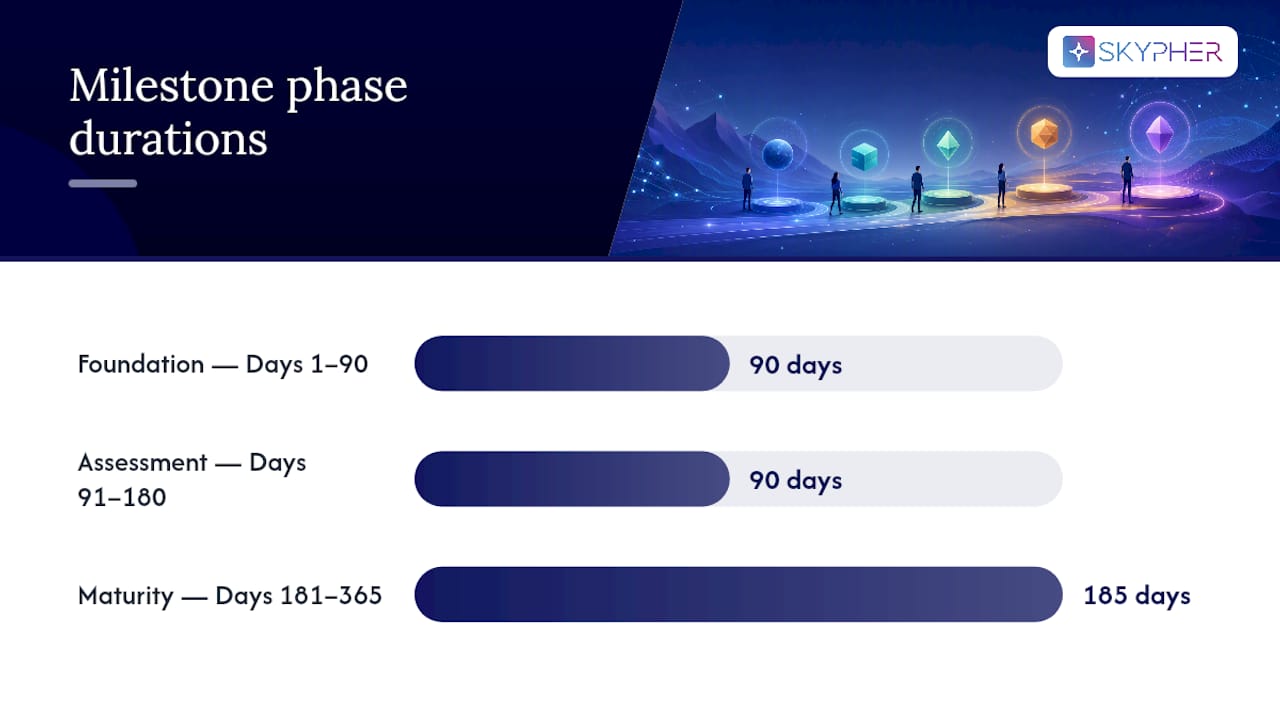
Days 1–90 (Foundation): Define system boundaries, assign roles, complete impact categorization for priority systems, select initial control baselines, and build a pilot risk register. Minimum output: a documented system boundary and a risk register with entries covering one critical system.
-
Days 91–180 (Assessment and Authorization): Implement selected controls, conduct initial control assessments, produce the first authorization package, and establish a continuous monitoring plan. Minimum output: a signed authorization decision (or interim ATO) and a monitoring cadence for high-impact controls.
-
Days 181–365 (Maturity and Integration): Expand coverage to additional systems, integrate risk register outputs into ERM reporting, build CSF profiles for board-level communication, and automate evidence collection for recurring controls. Minimum output: a CSF profile, a KRI dashboard, and at least one ERM-aligned risk report.
Metrics to track framework effectiveness:
- Control coverage rate: Percentage of in-scope systems with a completed control baseline.
- Time-to-authorization: Average days from system boundary definition to signed ATO.
- Mean-time-to-detect (MTTD): Average time to identify a control failure or security event.
- KRI trend rate: Number of KRIs outside acceptable thresholds per quarter.
- Assessment finding closure rate: Percentage of open findings remediated within agreed timelines.
Common pitfalls and how to avoid them:
- Treating Authorize as the finish line. Authorization is a checkpoint, not a destination. Without continuous monitoring, the authorization becomes stale within months and creates compliance debt.
- Missing ERM alignment. A risk register that never feeds into enterprise risk reporting is a compliance artifact, not a decision tool. Map at least three IT risk categories to ERM risk domains from day one.
- Overstretching early controls. Selecting a High-baseline control set for a Moderate-impact system wastes resources and delays authorization. Tailor the baseline to the actual impact level.
- Skipping the Prepare step. Organizations that jump straight to Categorize without establishing organizational risk tolerance and common controls spend months reworking decisions that should have been made upfront.
Pro Tip: Treat your cybersecurity checklist for CISOs as a living document. Review KRIs monthly in the first year and adjust thresholds as you learn what "normal" looks like for your environment.
How to use frameworks together: mapping RMF, CSF, FAIR, and ICT ROF
The most effective programs we see in mid-to-large organizations do not pick one framework and ignore the others. They use an overlay strategy: RMF as the management backbone, with CSF 2.0 and FAIR mapped into it rather than run as separate programs.
Practical mapping patterns:
- CSF profiles to RMF control selection: Build a CSF Current Profile to identify gaps, then use those gaps to prioritize which RMF control families to address first. This prevents the common mistake of selecting a full SP 800-53 baseline and then discovering the organization cannot implement 40% of it.
- FAIR for high-stakes authorization decisions: When an Authorizing Official is weighing whether to accept residual risk on a high-impact system, a FAIR analysis of the top three residual risks converts the qualitative assessment into a monetary range. That range makes the authorization decision defensible to a CFO or board.
- ICT ROF to translate RMF outputs into ERM inputs: Map your RMF risk register fields to ICT ROF Functions and Categories. The ICT Risk Outcomes Framework provides the translation layer so IT risk data flows into enterprise risk reporting without manual re-categorization.
Minimum artifacts for integrated mapping:
- A crosswalk spreadsheet mapping CSF Categories to SP 800-53 control families and your risk register fields.
- Mapping rules that define how RMF impact levels translate to ICT ROF risk categories.
- An ownership matrix that assigns each mapped control or outcome to a named role.
- FAIR loss magnitude fields added to the risk register for systems where monetary estimates are required.
Suggested process flow: CSF gap analysis → RMF control baseline selection → control implementation and assessment → FAIR analysis for residual risk decisions → ICT ROF translation → ERM risk report. This flow produces a single integrated output set rather than three parallel programs generating redundant artifacts.
| Integration Pattern | Input | Output | When to Apply |
|---|---|---|---|
| CSF → RMF | CSF Current Profile gap analysis | Prioritized RMF control baseline | Before Select step; any org using both frameworks |
| RMF → ICT ROF | RMF risk register and assessment findings | ERM-aligned risk categories and metrics | When IT risk must feed enterprise risk reporting |
| RMF + FAIR | Residual risk from assessment | Monetary loss estimate for AO decision | High-impact systems; board or CFO risk decisions |
Pro Tip: Use a GRC risk register integration approach to keep crosswalk data in one place. A spreadsheet works for a pilot; once you cover more than five systems, a GRC platform with native framework mapping becomes worth the investment.
What tools and automation patterns support framework implementation?
Frameworks define what to do. Tools determine whether you can actually do it at scale without burning out your team on manual evidence collection and spreadsheet management.
Core automation patterns to prioritize:
- Questionnaire and evidence automation: Control assessments generate large volumes of evidence requests. Automating the intake, parsing, and response of security questionnaires cuts assessment cycle time significantly and reduces the risk of inconsistent answers across assessors.
- Continuous control monitoring: Integrate your SIEM, CMDB, and vulnerability management tools into a GRC platform so control status updates automatically rather than requiring manual evidence pulls at each assessment cycle.
- KRI dashboards: Connect risk register data to a reporting layer that surfaces KRI trends in real time, so the risk executive sees drift before it becomes a finding.
- Control assessment workflows: Automate the routing of assessment tasks to system owners and control assessors, with evidence upload prompts and deadline tracking built in.
Vendor evaluation checklist — what to ask before buying:
- Does the platform integrate natively with your SIEM, CMDB, and ticketing system (ServiceNow, Jira, or equivalent)?
- What API automation is available for evidence ingestion and control status updates?
- Does the platform support SSO and role-based access for assessors, system owners, and AOs?
- Can it generate authorization package artifacts (SSP, SAR, POA&M) in formats your auditors accept?
- Does it maintain evidence provenance — a traceable record of who submitted what, when, and from which source system?
An example integration flow worth building early: automated questionnaire intake → evidence repository with provenance tracking → control status update in the GRC risk register → authorization package assembly. This flow removes the manual handoffs that slow most assessment cycles and creates an audit trail that satisfies both internal audit and external assessors.
Pro Tip: Apply automation first to questionnaire response and evidence collection. These two tasks consume the most analyst time in recurring assessments and produce the most consistent ROI. Explore automation and smart controls before investing in broader GRC platform features you may not need in year one.
What actually works in mid-to-large organizations: a practitioner's view
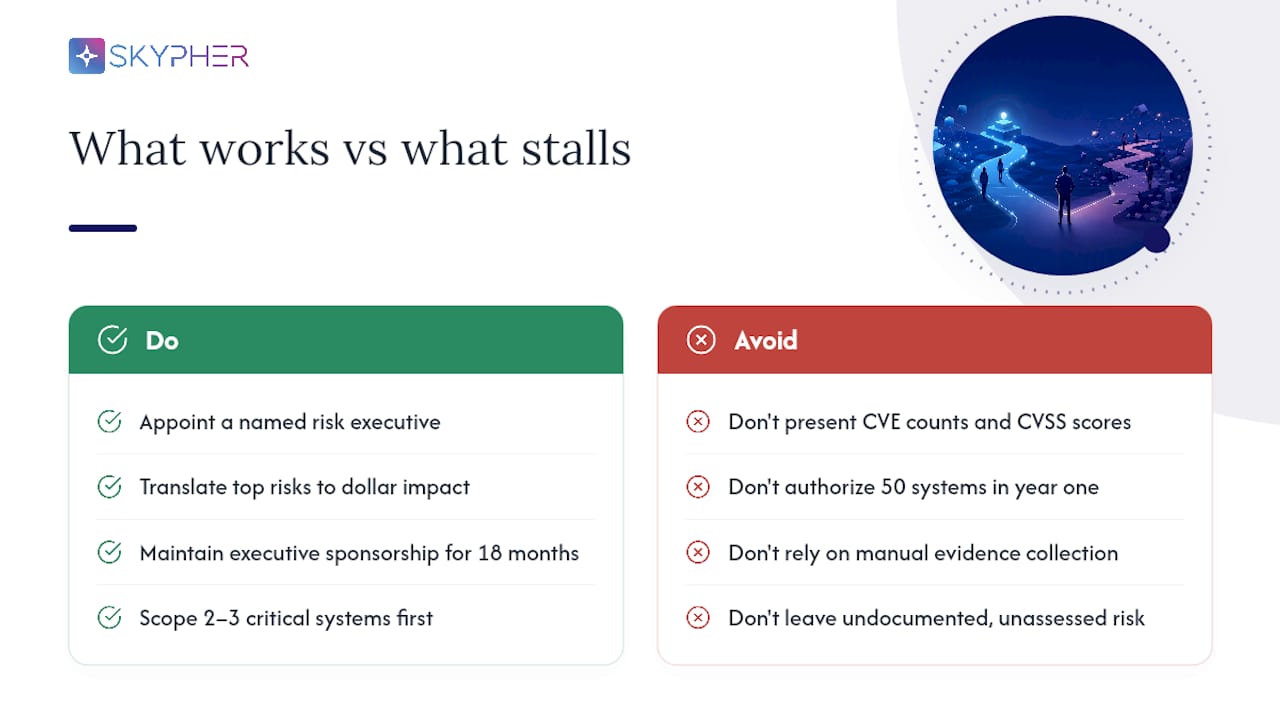
Most IT risk programs fail not because of framework selection errors but because of governance culture gaps. The framework is the easy part. Getting a named risk executive with real authority, converting technical findings into business-impact language, and maintaining executive sponsorship through the first 18 months — those are the hard parts.
Here is what consistently separates programs that mature from those that stall:
Executive sponsorship is non-negotiable. A CISO who presents risk findings in CVE counts and CVSS scores to a board that thinks in revenue and regulatory exposure will lose budget every cycle. The single highest-leverage investment in the first 90 days is translating the top five risks into dollar-denominated impact ranges, even rough FAIR estimates, before the first board presentation.
Scope reduction is a feature, not a failure. Organizations that try to authorize 50 systems in year one typically authorize zero. Picking two or three critical systems, running the full RMF lifecycle on them, and producing clean authorization artifacts is worth more than a half-finished program covering everything. Auditors and boards respond to demonstrated competence on a small scope far better than to ambitious plans with no artifacts.
A single taxonomy across IT and ERM is the governance multiplier. When IT risk categories map directly to enterprise risk domains, the risk executive can walk into an ERM committee meeting and present findings without a translation session. That alignment, more than any framework choice, is what earns IT risk a seat at the enterprise governance table.
Automation over manual evidence assembly, always. Every hour an analyst spends manually collecting screenshots and exporting logs is an hour not spent on risk analysis. The programs that scale are the ones that automate evidence collection early and redirect analyst time toward assessment quality and finding remediation.
The trade-off to accept early: you will not achieve full control coverage in year one, and that is fine. Accepting assessed residual risk with documented compensating controls is a legitimate, defensible posture. What is not acceptable is undocumented, unassessed risk — the kind that lives in systems that were never scoped into the program.
Faster evidence collection for control assessments
Control assessment cycles are where most IT risk programs lose momentum. The evidence collection phase, specifically responding to security questionnaires and assembling authorization artifacts, consumes a disproportionate share of analyst time relative to the analytical value it produces.

Skypher's AI-driven questionnaire automation addresses this directly. The platform can process and respond to 200-question security questionnaires in under a minute, using AI models trained on your organization's existing knowledge base and prior responses. It integrates with over 40 third-party risk management platforms, including OneTrust and ServiceNow, and connects to document repositories like Confluence, Google Drive, and SharePoint so evidence is pulled from authoritative sources rather than assembled manually.
When evaluating any questionnaire automation tool, ask for three proof points: response speed on a standard 200-question RFP, the integration list (SIEM, GRC, ticketing), and evidence provenance — a traceable record showing which source document each answer came from. Those three criteria separate tools that accelerate assessment cycles from those that simply move the manual work to a different step.
Sources
The publications below are the primary references for implementing the frameworks covered in this guide.
- Risk Management Framework for Information Systems and Organizations: A System Life Cycle Approach for Security and Privacy (SP 800-37 Rev. 2)
- NIST Risk Management Framework RMF (CSRC project page)