

No official HIPAA logo exists. The U.S. Department of Health and Human Services and its Office for Civil Rights don't issue, endorse, or certify any HIPAA seal, badge, or logo, so any graphic you've seen claiming otherwise came from a private vendor, a stock library, or a design team, not the government. That doesn't mean you can't display a compliance badge. It means the badge you choose, and how you present it, matters far more than most websites realize.
Here's the quick verdict: for training portals or internal tools, a vendor-supplied badge from a source like HIPAA Compliant Badges | HIPAA Logos works fine, provided you follow its usage terms. For blog posts, editorial content, or marketing materials that aren't making a direct compliance claim, licensed stock art is acceptable. For customer-facing pages where you're actually asserting "we are HIPAA compliant," a static badge alone is the weakest option. We built the Skypher Trust Center precisely because that claim deserves live, checkable evidence.
Whichever route you take, three things are non-negotiable:
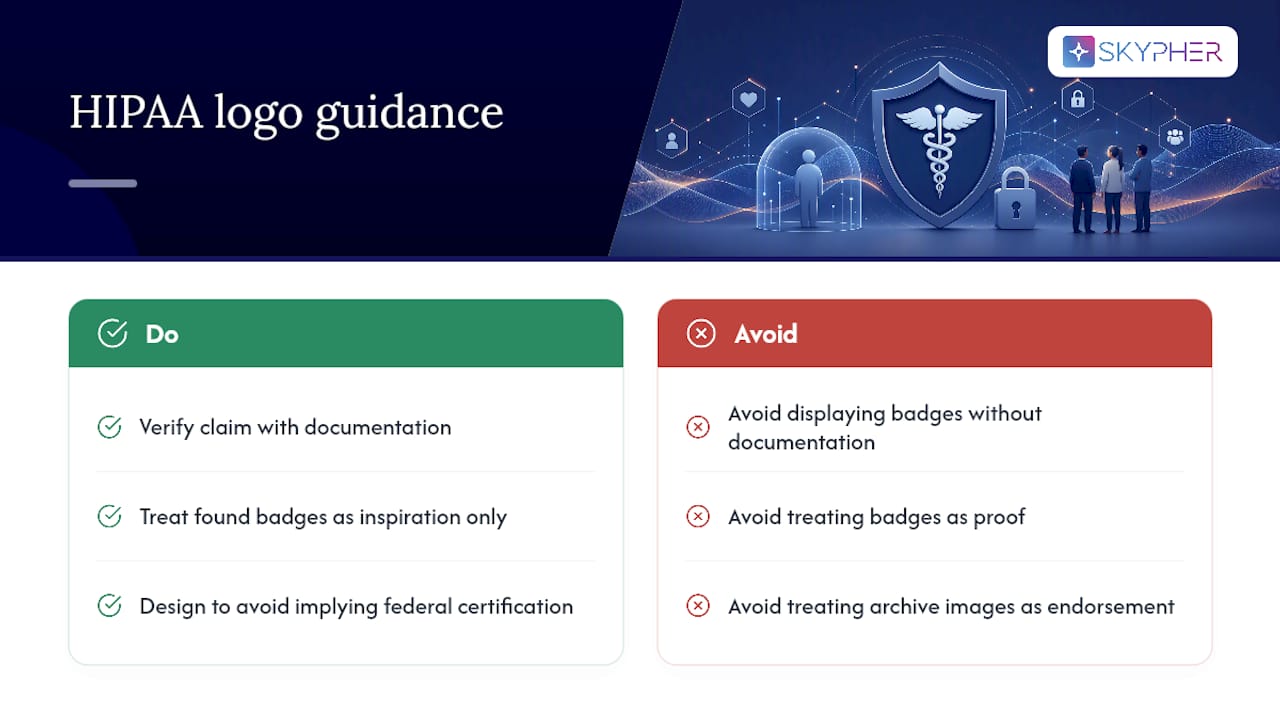
- Never imply HHS or OCR endorsement, directly or through design choices that mimic a federal seal.
- Add a scope statement explaining exactly what your compliance claim covers.
- Link to your privacy or security policy and post a "last reviewed" date next to the badge.
Key Takeaways
A HIPAA logo carries no legal weight on its own. Its value depends entirely on the documentation, scope statement, and review process behind it.
| Point | Details |
|---|---|
| No official logo exists | HHS and OCR don't issue or endorse any HIPAA seal, badge, or certification mark. |
| Match the badge to the use case | Vendor badges suit training portals; stock art suits editorial content; verified evidence suits customer-facing claims. |
| Scope statements are mandatory | State exactly what your compliance claim covers, and link to your privacy or security policy. |
| Keep evidence current | Post a last-reviewed date and update documentation whenever your compliance program changes. |
| Consider verifiable alternatives | The Skypher Trust Center replaces a static badge with live, documented proof of compliance posture. |
Table of Contents
- What Is the HIPAA Logo, and Why Doesn't One Exist?
- Comparing Your Options for a HIPAA Compliant Logo
- How Do You Display a HIPAA Badge Responsibly?
- Where to Find HIPAA Badge Artwork and Which File Formats Work Best
- Does HHS Actually Certify Any HIPAA Compliance Badge?
- Why Most Sites Get Their HIPAA Badge Strategy Backwards
- A Trust Center Says More Than Any Badge Can
- Frequently Asked Questions
- Sources
What Is the HIPAA Logo, and Why Doesn't One Exist?
Search "HIPAA logo" and you'll find dozens of graphics: shields, checkmarks, lock icons, blue and green badges with "HIPAA Compliant" stamped across them. None of them come from the government. The HIPAA Symbol guidance from AccountableHQ confirms what most compliance teams eventually learn the hard way: private organizations created every badge in circulation, and there's no meaning of HIPAA logo beyond whatever the issuing vendor decided to attach to it.
That distinction matters because a badge is a claim, not a credential. Anyone can design a HIPAA compliance logo in an afternoon. What separates a legitimate one from a liability is whether the organization displaying it can actually back up the claim with documentation, and whether the badge's design and placement avoid suggesting federal certification that doesn't exist.
Even government-adjacent archives complicate the picture. NIST hosts an image labeled as a HIPAA-related logo used in conference materials, but that's a visual reference for a presentation, not an endorsement mark. If you're designing a HIPAA logo for your own site, treat every existing graphic you find as inspiration at best, never as proof of legitimacy.
Comparing Your Options for a HIPAA Compliant Logo
Seven realistic paths exist for getting badge artwork onto your site, and they land very differently on trust, cost, and legal exposure.
The Skypher Trust Center leads this list for a reason: it doesn't just display a static image, it publishes the policies, evidence links, and review dates behind the claim. That live documentation is exactly what auditors, enterprise buyers, and privacy-conscious patients now expect, and it's the strongest defense against the "you can't prove it" objection that sinks a lot of badge-only compliance pages.
HIPAATraining.com and HIPAA Journal both offer downloadable badge artwork with real usage conditions attached. Read them. Most require that you maintain an actual compliance program and link to a patient privacy rights resource before you display their graphic, per HIPAA Journal's own guidance.
A custom-designed badge gives you full brand control, but the burden shifts entirely to you. You'll need internal governance to make sure the claim stays accurate as your program evolves. Adobe Stock and iStock are fine for illustrating a blog post about HIPAA compliance logo design, but using licensed stock art to imply your own certification is where legal risk spikes fastest.
- Vendor badges: fast to implement, but usage terms can restrict how and where you display them.
- Stock art: cheap and flexible, but carries zero evidentiary weight if a regulator or customer questions your claim.
- Custom badges: maximum control, minimum built-in credibility unless you pair them with real documentation.
- Trust Center: highest setup effort upfront, strongest ongoing proof.
Pro Tip: Whatever badge you choose, write your scope statement before you pick the artwork. A sentence like "This badge reflects our administrative, physical, and technical safeguards under the HIPAA Security Rule, last reviewed March 2026" does more to reduce legal risk than any logo design decision you'll make.
How Do You Display a HIPAA Badge Responsibly?
A badge sitting alone in your footer is a liability waiting to happen. Here's the sequence we recommend before that image ever goes live:
- Confirm the scope of what you're actually claiming. Are you HIPAA compliant as a covered entity, or acting as a business associate under a signed BAA?
- Gather your supporting evidence: risk assessments, workforce training records, and your current privacy and security policies.
- Write a short scope statement to sit directly beside the badge, not buried three clicks away, and link to your security overview page for full compliance details.
- Link the badge to your privacy policy, security page, or Trust Center.
- List a contact point for privacy or security questions, ideally a dedicated email address rather than a generic contact form.
- Add a last-reviewed date and commit to updating it on a real schedule, not just when someone notices it's stale.
On placement: footers and dedicated trust or security pages work better than hero banners, where a badge can read as a marketing flourish rather than a documented claim. Keep the image responsive using SVG format so it stays crisp on mobile without ballooning page weight.
- Give the badge descriptive alt text, such as "HIPAA compliance scope statement, reviewed March 2026," not just "HIPAA logo."
- Maintain color contrast that meets WCAG standards; a badge that's illegible on mobile undermines the trust it's supposed to build.
- Make sure the link behind the badge actually loads the policy page, not a 404.
Pro Tip: Treat your HIPAA logo usage guidelines the same way you'd treat a financial disclosure. If the claim changes (a new business associate, a new subprocessor, a security incident), update the badge's linked documentation the same week, not at your next annual review.
Where to Find HIPAA Badge Artwork and Which File Formats Work Best
Four realistic sources cover almost every use case. Vendor pages like HIPAATraining.com offer downloadable badges built specifically for covered entities. Adobe Stock and iStock both carry large catalogs of HIPAA-themed icons and illustrations under standard commercial licenses, useful for blog graphics or general awareness content, though licensing a stock illustration confers no compliance verification whatsoever. Custom design and a Trust Center widget round out the list for organizations that want full control.
On formats: use SVG for your badge so it scales cleanly across devices without pixelation, and keep a PNG fallback at roughly 200 to 400 pixels wide for older browsers or email signatures. Build in a responsive variant so the badge doesn't crowd out text on smaller screens.
- Read every license agreement on stock art before you publish it. Most Adobe Stock and iStock licenses prohibit implying endorsement or certification you haven't earned.
- Never modify a badge to resemble a government seal, even loosely. That crosses from questionable into potentially fraudulent territory.
- Keep your source files organized so you can swap the badge quickly if your compliance scope changes.
Pro Tip: Store your badge's SVG source and its supporting documentation in the same folder. When the "last reviewed" date comes up, you'll update both in one sitting instead of hunting for scattered assets.
Does HHS Actually Certify Any HIPAA Compliance Badge?
No. HHS and OCR have never issued a certification program, seal, or logo for HIPAA compliance, a fact confirmed directly on Hhs. Any vendor or badge claiming "federally certified" or "government-approved" is misrepresenting its product.
What actually holds up as evidence? Documented risk assessments, signed Business Associate Agreements, workforce training logs, and independent third-party attestations like SOC 2 or HITRUST. These frameworks don't certify HIPAA compliance directly, but hospitals and health plans evaluating vendors treat them as far more persuasive than a badge alone, according to Primary Record's analysis of HIPAA compliance claims.
Pro Tip: If a prospect or auditor asks for proof, send them a link to your documentation, not a screenshot of your badge. A badge answers "do you claim compliance." Documentation answers "can you prove it."
Why Most Sites Get Their HIPAA Badge Strategy Backwards
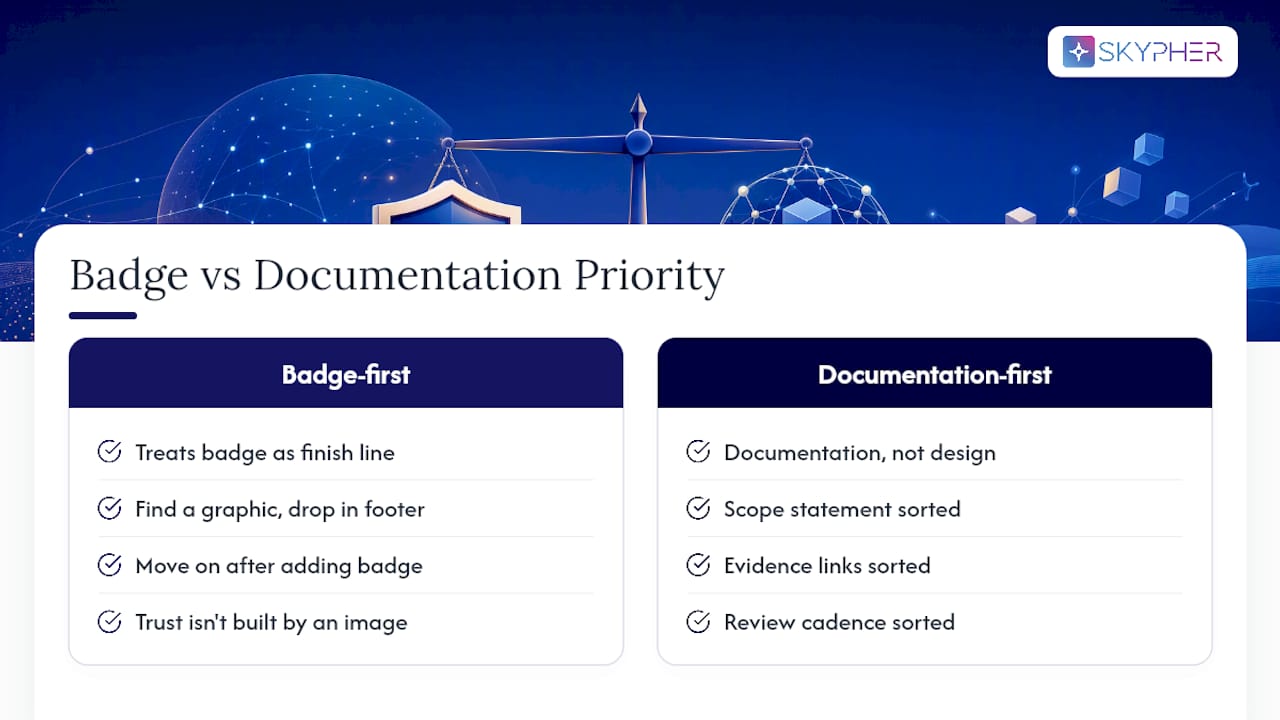
Most organizations treat the badge as the finish line. They find a graphic, drop it in the footer, and move on. That's backwards. The badge should be the smallest, least important piece of your compliance communication, a visual pointer to something substantial, not a substitute for it.
The conventional advice, "just add a HIPAA compliant logo to build trust," misses that trust isn't built by an image. It's built by what's behind the image. A prospect evaluating your platform, or a patient deciding whether to use your portal, is increasingly savvy enough to click through and check. If there's nothing there, the badge actively damages credibility rather than building it.
What should you prioritize first? Documentation, not design. Get your scope statement, your evidence links, and your review cadence sorted before you spend another minute picking a badge color. The organizations that get burned publicly, the ones facing enforcement scrutiny or reputational fallout, almost always failed on substance, not graphics. A HIPAA certification symbol was never going to save them.
A Trust Center Says More Than Any Badge Can
A static badge tells a visitor you claim compliance. A Trust Center shows them. Instead of a single image sitting in your footer, the Skypher Trust Center publishes your actual policies, your last-reviewed date, and a direct contact point for privacy or security questions, all in one customer-facing hub that updates as your program evolves.

This matters most on pages where you're making a direct compliance claim to a customer, a partner, or an enterprise buyer running due diligence, situations where a badge alone invites the question "can you prove it?" Skypher's platform also generates the underlying evidence summaries your Trust Center can link to, drawing on the same security questionnaire automation tools used to answer buyer due diligence requests. If your current badge is doing more marketing work than trust work, start by exploring the Trust Center and seeing what a documented, verifiable compliance page looks like next to yours.
Frequently Asked Questions
Is there an official HIPAA logo I can download? No. HHS and OCR have never created or endorsed a HIPAA logo. Any badge you find online, including from vendors or stock libraries, is a private creation, not a government mark.
Can I get in trouble for using a HIPAA compliant logo on my site? You can face reputational and legal exposure if the badge implies government endorsement or certification you don't have. The fix is a clear scope statement and documented evidence linked directly to the badge.
Where can I legally get HIPAA badge artwork? Vendor pages like HIPAATraining.com and HIPAA Journal offer downloadable badges with usage terms. Adobe Stock and iStock offer licensed illustrations suited to editorial or marketing use, not compliance verification.
What should I use instead of a badge for customer-facing compliance claims? Consider a Trust Center that links your claim to live documentation, including policies, risk assessments, and a last-reviewed date, giving visitors something verifiable rather than a single static image.
Sources
- Hhs
- There Is No Official “HIPAA Compliance Logo.” Here’s What to Look for Instead. - Primary Record
- HIPAA Compliant Badges | HIPAA Logos
- HIPAA Compliance Logo