

The HHS Office for Civil Rights (OCR) is the primary federal enforcer of HIPAA's Privacy and Security Rules; the Centers for Medicare & Medicaid Services (CMS) handles Administrative Simplification; the Department of Justice (DOJ) prosecutes criminal violations; and State Attorneys General can bring parallel civil actions. Enforcement outcomes range from technical assistance and corrective action plans (CAPs) to civil money penalties (CMPs) tiered under the HITECH Act, and, for willful or malicious disclosures, federal criminal prosecution. Understanding where your organization sits on that spectrum, and how to respond effectively, is what separates a case that closes with a corrective action from one that escalates to a formal penalty.
The practical implications for your compliance team come down to three priorities:
- Cooperate early. OCR's enforcement approach emphasizes voluntary compliance; noncooperation is one of the fastest ways to convert a routine inquiry into a full compliance review.
- Document remediation. Pre-existing policies, training records, risk assessments, and business associate agreements (BAAs) are your strongest mitigating evidence.
- Use the 30-day window. When OCR issues an intent-to-penalize notice, you have 30 days to submit evidence that can reduce or eliminate penalties. That window closes fast.
Pro Tip: Before any inquiry arrives, build a single indexed folder containing your most recent risk assessment, training completion logs, BAAs, and breach analyses. Assembling that packet under time pressure is far harder than maintaining it proactively.
Table of Contents
- Which agencies enforce HIPAA and what each one can do
- How does the OCR enforcement process actually work?
- What are the actual HIPAA penalty tiers and criminal sanctions?
- What breach notification requirements apply, and what should you do immediately?
- What do enforcement outcomes actually look like in practice?
- How should you respond when OCR opens an inquiry?
- How automation and documentation tools speed up your investigation response
- Key Takeaways
- The documentation gap is where most organizations actually lose
- Faster evidence collection when an OCR inquiry arrives
- Authoritative sources and further reading
Which agencies enforce HIPAA and what each one can do
Enforcement authority under HIPAA is deliberately distributed across agencies, each with a distinct scope. Knowing which regulator to expect for a given violation type lets you direct your response to the right channel from day one.

| Agency | Rules Enforced | Primary Tools | Criminal Authority |
|---|---|---|---|
| HHS Office for Civil Rights (OCR) | Privacy Rule, Security Rule, Breach Notification Rule | Complaint intake, compliance reviews, CAPs, resolution agreements, CMPs | No — refers to DOJ |
| Centers for Medicare & Medicaid Services (CMS) | Administrative Simplification (transactions, code sets, identifiers) | CMPs under the HIPAA Enforcement Rule | No |
| Department of Justice (DOJ) | Criminal HIPAA provisions | Federal prosecution, fines, imprisonment | Yes |
| State Attorneys General | State consumer-protection laws overlapping HIPAA | Civil suits, state remedies, injunctive relief | Varies by state |
| FTC / Other federal agencies | Consumer-protection overlap (e.g., health data breaches) | Enforcement actions under FTC Act | No |
OCR is the agency most compliance officers will encounter. It handles the full lifecycle of a Privacy or Security Rule complaint: intake, investigation, corrective action negotiation, and, when necessary, CMPs. OCR enforces through complaint investigations, compliance reviews, technical assistance, corrective action plans, resolution agreements, and civil money penalties when voluntary compliance fails.
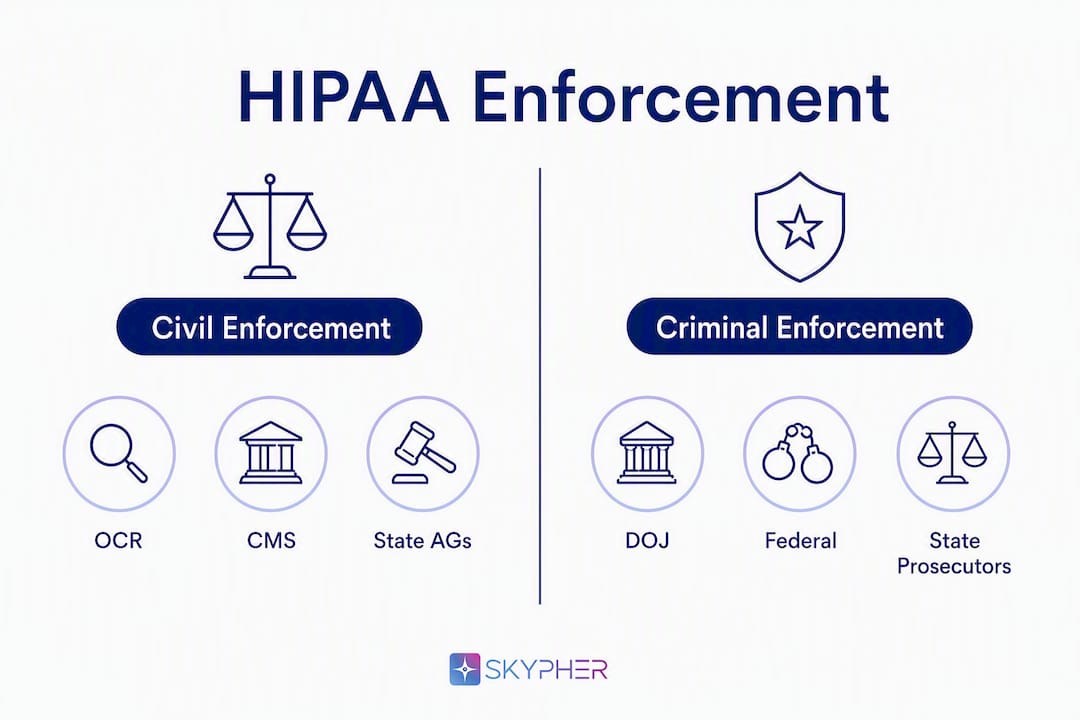
CMS operates separately, focused on the administrative and transactional side of HIPAA. If your organization has issues with electronic transaction standards or code sets, CMS is the relevant regulator, not OCR.
DOJ enters the picture when OCR identifies conduct suggesting criminal intent, such as an employee selling patient records or a covered entity knowingly disclosing PHI for personal gain. OCR does not prosecute; it refers. The DOJ then decides whether to pursue charges.
State Attorneys General gained independent enforcement authority under HITECH. They can bring civil actions on behalf of state residents for Privacy and Security Rule violations, and those actions can run concurrently with federal enforcement. Some states layer additional consumer-protection statutes on top, widening potential exposure.
How does the OCR enforcement process actually work?
The HIPAA Enforcement Rule codified at 45 CFR Part 160 sets out the procedural framework. In practice, OCR moves through a predictable sequence, though the timeline varies significantly based on complexity and cooperation.
Step-by-step: from complaint to resolution
- Intake and initial review. OCR receives a complaint or initiates a compliance review. Many cases close here if the complaint falls outside OCR's jurisdiction or if the covered entity is not subject to HIPAA.
- Case acceptance. OCR accepts the case for investigation and notifies the covered entity or business associate. This notification is your signal to begin evidence preservation immediately.
- Evidence requests. Investigators typically request policies and procedures, training records, risk assessments, BAAs, access logs, breach analyses, and documentation of any remediation already taken. Expect multiple rounds of requests in complex cases.
- Analysis and preliminary findings. OCR reviews the submitted evidence and develops a preliminary assessment of whether a violation occurred and, if so, its severity.
- Resolution attempt. OCR first attempts voluntary resolution. This usually means technical assistance (for minor or first-time issues) or a negotiated CAP requiring specific corrective measures, reporting obligations, and sometimes independent monitoring.
- Civil money penalties or DOJ referral. If voluntary compliance is not achievable, OCR may impose CMPs. When the evidence suggests criminal conduct, OCR refers the case to DOJ for prosecution.
What investigators actually ask for
When OCR sends an evidence request, the documents that appear most consistently include: written HIPAA policies and procedures, workforce training completion records, the most recent Security Rule risk analysis, BAAs with all relevant vendors, system access logs, breach risk assessments, and documentation of any corrective steps already taken. Having these organized and version-controlled before an inquiry arrives shortens your response time from weeks to days.
Statistic callout: OCR enforcement data shows that the majority of investigated cases close with corrective action or technical assistance rather than CMPs, confirming that cooperation and documented remediation are the most effective tools available to a covered entity.
How cooperation changes outcomes
OCR's enforcement model is explicitly cooperative: the agency prefers systemic reform over maximum penalties. Organizations that respond promptly, submit complete documentation, and demonstrate genuine remediation consistently achieve better outcomes than those that delay or provide incomplete responses. Noncooperation, on the other hand, is one of the clearest signals that escalates a case from technical assistance to formal enforcement.

Pro Tip: Map your evidence folder to the six standard OCR request categories (policies, training, risk analysis, BAAs, access logs, breach documentation) and update it quarterly. When a request arrives, you are pulling from a live repository, not rebuilding from scratch.
What are the actual HIPAA penalty tiers and criminal sanctions?
HIPAA penalties operate on two tracks: civil monetary penalties administered by OCR, and criminal sanctions prosecuted by DOJ. The HITECH Act restructured the civil tier system based on culpability, and those tiers remain the framework today.
Civil monetary penalty tiers (HITECH-based)
| Tier | Culpability Standard | Per-Violation Range | Annual Cap (same requirement) |
|---|---|---|---|
| Tier 1 | Did not know (and could not have known) | $50,000 | $50,000 |
| Tier 2 | Reasonable cause (not willful neglect) | $100,000 | $100,000 |
| Tier 3 | Willful neglect, corrected within 30 days | $250,000 | $250,000 |
| Tier 4 | Willful neglect, not corrected | $250,000 | — |
OCR may reduce penalties for reasonable cause or correction within a specified cure period, which is why the 30-day response window carries so much practical weight. The annual caps apply per requirement violated, so an organization with multiple simultaneous violations faces stacked exposure.
Criminal penalties handled by DOJ
Criminal penalties under HIPAA escalate with intent: fines range from $50,000 to $250,000 and prison terms from one to ten years depending on whether the violation involved knowledge, false pretenses, or intent to sell/use PHI for commercial advantage or malicious harm. These are federal felony-level consequences, and DOJ pursues them when OCR's referral documents deliberate conduct.
The distinction between civil and criminal tracks matters operationally:
- OCR handles civil remediation; it cannot imprison anyone.
- DOJ handles prosecution; it does not negotiate CAPs.
- When a case involves both a systemic compliance failure and individual criminal conduct, both tracks can run simultaneously against different parties (the organization under OCR, an employee under DOJ).
- Business associates carry direct HIPAA liability under the 2013 Omnibus Rule, so criminal referrals can target vendor employees as well as covered-entity staff.
What breach notification requirements apply, and what should you do immediately?
The Breach Notification Rule requires covered entities to notify affected individuals, HHS/OCR, and, in some cases, prominent media outlets when unsecured PHI is improperly accessed, used, or disclosed. Not every security incident is a reportable breach; the rule applies when a risk assessment cannot demonstrate a low probability that PHI was compromised.
Core notification timelines
- HHS/OCR (breaches affecting 500+ individuals): — Report via the OCR breach portal within 60 days of discovery; these breaches are posted publicly on what practitioners call the "Wall of Shame."
Immediate post-incident checklist
- Notify required parties — Use the OCR breach portal for HHS reporting; prepare individual notices with required content (description of breach, types of PHI involved, steps individuals should take, what you are doing, and contact information).
What do enforcement outcomes actually look like in practice?
Understanding the realistic distribution of outcomes helps compliance teams calibrate their response strategy. Most cases do not end in headline-grabbing penalties.
OCR categorizes closed cases into several outcome types: resolved after intake and review (no investigation required), technical assistance provided, no violation found after investigation, corrective action obtained, and other resolutions. The majority of cases close before reaching a formal CMP, and most investigations close with technical assistance or corrective actions rather than financial penalties.
Common violation patterns in enforcement cases
The types of violations that most frequently appear in OCR's published resolution agreements follow recognizable patterns:
- Unauthorized disclosures of PHI to unauthorized parties, including impermissible uses by workforce members.
- Lost or stolen devices containing unencrypted PHI, particularly laptops and portable media.
- Missing or inadequate BAAs with vendors who handle PHI on the covered entity's behalf.
- Insufficient risk analysis, where the organization never conducted a thorough, documented assessment of threats to ePHI.
- Inadequate access controls, including failure to terminate access for former employees or implement minimum-necessary standards.
What a corrective action plan typically requires
CAPs negotiated through resolution agreements generally include: updated written policies and procedures, workforce training on the revised policies, a new or revised risk analysis, regular progress reports to OCR (often quarterly for one to three years), and sometimes independent monitoring or audits. The enforcement process is iterative: OCR uses CAPs to produce systemic reform, not just a one-time fix. Organizations under a CAP should treat reporting deadlines as hard compliance obligations, because missing them can reopen enforcement.
Reviewing published resolution agreements before a potential investigation is genuinely useful. They function as a template library: you can see exactly what OCR required of organizations with similar violations and build your remediation plan around those precedents.
How should you respond when OCR opens an inquiry?
Speed, completeness, and cooperation are the three variables you control. Here is a prioritized sequence for compliance teams from first notice through resolution.
- Authenticate the notice — Confirm the communication is genuinely from OCR (official HHS letterhead, verifiable contact information). Fraudulent HIPAA notices exist; verify before taking any action that could expose privileged information.
Pro Tip: Run a tabletop exercise with legal, IT, and compliance at least annually. Simulate receiving an OCR notice, and time how long it takes your team to assemble the standard evidence packet. The gaps that exercise reveals are exactly what you need to fix before a real inquiry arrives.
How automation and documentation tools speed up your investigation response
When an OCR inquiry arrives, the bottleneck is almost never legal strategy. It is evidence assembly: locating the right version of a policy, confirming which employees completed training, pulling BAAs for every relevant vendor, and generating a coherent audit trail under time pressure. Automation addresses that bottleneck directly.
What to automate and why it matters
Centralized evidence repositories with version-controlled documents mean you can produce the current and historical versions of any policy in minutes rather than hours. Automated training completion tracking creates a time-stamped log that satisfies one of OCR's most consistent evidence requests. Automated BAA management, where the system tracks execution status and renewal dates for every vendor, eliminates the scenario where an investigator discovers a missing agreement you did not know was absent.
Security scanning reports and patching logs, when generated automatically and stored in an exportable format, provide objective evidence that your organization actively managed technical safeguards. These artifacts carry more weight than policy documents alone because they demonstrate operational compliance, not just written intent.
For organizations that receive security questionnaires as part of vendor due diligence, questionnaire automation tools can populate investigator requests significantly faster than manual drafting. Skypher's platform, for instance, can answer up to 200 questions in under a minute using AI-assisted responses drawn from a centralized knowledge base, with integrations across Slack, Microsoft Teams, Confluence, Google Drive, and SharePoint. That kind of speed matters when you are working against a 30-day response window.
Caveats worth stating plainly
Automation helps with structured-data audits and LLM-ready schema for evidence assembly and documentation. It does not replace legal counsel, and it does not substitute for substantive remediation. An automated system that generates audit trails for a broken process still documents a broken process. The tools that reduce enforcement risk are the ones that support genuine compliance work: automated compliance reviews that flag gaps before an investigator does, tamper-evident logs that cannot be retroactively altered, and exportable audit trails that hold up under scrutiny.
When evaluating any compliance automation platform, look for: tamper-evident logging, role-based access controls, exportable reports in standard formats, and integrations with your existing document management systems. A platform that checks those boxes reduces both response time and the risk that your evidence package has gaps.
For a deeper look at how HIPAA assessments fit into a proactive compliance program, the linked resource walks through the documentation artifacts that appear most frequently in OCR investigations.
Key Takeaways
The enforcement of HIPAA is distributed across OCR, CMS, DOJ, and State Attorneys General, and the outcome of any investigation depends primarily on how quickly and completely your organization cooperates and documents its remediation.
| Point | Details |
|---|---|
| Know your regulator | OCR handles Privacy and Security Rules; CMS covers Administrative Simplification; DOJ prosecutes criminal violations; State AGs can act in parallel. |
| The 30-day window is critical | Submit mitigating evidence and remediation documentation within 30 days of an OCR intent-to-penalize notice to reduce or eliminate penalties. |
| Most cases close without CMPs | OCR enforcement data shows corrective action and technical assistance are the most common outcomes; CMPs and criminal prosecution apply to willful or malicious conduct. |
| Criminal exposure escalates with intent | DOJ penalties range from $50,000 and one year for knowing violations, $100,000 and five years for false pretenses, up to $250,000 and ten years for commercial or malicious disclosures. |
| Skypher accelerates evidence assembly | Skypher's AI-assisted platform centralizes documentation and can respond to 200 investigator questions in under a minute, shortening response time during OCR reviews. |
The documentation gap is where most organizations actually lose
There is a pattern in how HIPAA enforcement cases unfold that does not get enough attention: the organizations that face the steepest penalties are rarely the ones with the worst underlying violations. They are the ones that cannot prove what they did right.
OCR's cooperative model is genuinely designed to reward good-faith compliance. The agency's own guidance makes clear that it prefers corrective action over maximum penalties, and the enforcement data supports that. The problem is that "good faith" has to be demonstrated with documents, not asserted in a response letter. A covered entity that conducted a thorough risk analysis two years ago but cannot produce it, or that trained its workforce but has no completion records, is functionally in the same position as one that never did either.
This is where the conventional advice, "just cooperate," falls short. Cooperation without documentation is a weak defense. What actually changes outcomes is the combination: cooperate fully and arrive at the table with a complete, organized evidence packet that shows OCR exactly what your program looks like. The organizations that do that consistently achieve corrective action outcomes. The ones that show up with incomplete records, or that delay while they reconstruct documentation, are the ones that end up in multi-year monitoring agreements.
The practical implication is that compliance is a documentation discipline as much as a technical one. Running tabletop exercises, maintaining live evidence repositories, and automating the artifacts that investigators consistently request are not just efficiency measures. They are the difference between a case that closes in months and one that runs for years.
Faster evidence collection when an OCR inquiry arrives
When your team receives an OCR notice, the first 72 hours determine whether you respond from a position of strength or scramble to reconstruct records. Skypher's platform is built for exactly that moment: a centralized knowledge base that stores your policies, BAAs, training logs, and risk assessments in one place, with AI-assisted response capabilities that can populate investigator questionnaires in under a minute.

The platform integrates with Confluence, Google Drive, SharePoint, OneDrive, Slack, and Microsoft Teams, so your evidence lives where your team already works. It connects to over 40 third-party risk management platforms, and its AI recommendation engine draws on your own documentation to generate accurate, consistent responses rather than generic templates. Skypher is not a substitute for legal counsel, and the platform makes that clear: automation handles evidence assembly and questionnaire response; your attorneys handle legal strategy.
For compliance teams that need to move faster during investigations without adding headcount, Skypher's Trust Center and security questionnaire automation tool are a practical starting point. Request a demo to see how quickly your team could assemble a complete OCR evidence packet.
Authoritative sources and further reading
The resources below are primary-source materials from HHS, CMS, and the Federal Register. We recommend bookmarking these for direct reference during any enforcement action, and consulting qualified legal counsel for case-specific guidance.
- HIPAA Enforcement | HHS.gov — OCR's primary enforcement page, including the complaint process flowchart and links to resolution agreements.
- Enforcement Data | HHS.gov — Cumulative enforcement statistics, case outcome categories, and annual enforcement results.
- Enforcement Results by Year | HHS.gov — Year-by-year breakdown of OCR case outcomes, useful for benchmarking your risk profile.
- Enforcement Results by State | HHS.gov — State-level enforcement data from April 2003 through December 2021, showing investigated, corrective action, and no-violation rates by jurisdiction.
- Resolution Agreements and Corrective Action Plans | HHS.gov — Full text of published resolution agreements; the most useful template library for anticipating remediation requirements.
- The HIPAA Enforcement Rule | HHS.gov — The codified procedural framework at 45 CFR Part 160, covering investigations, CMPs, and hearings.
- Summary of the HIPAA Privacy Rule | HHS.gov — Penalty mitigation factors, including reasonable cause and cure-period corrections.
- CMS Administrative Simplification Enforcement — CMS enforcement procedures and CMPs for Administrative Simplification violations.
- Business Associates Factsheet | HHS.gov — Direct liability provisions for business associates under the 2013 Omnibus Rule.
This article provides general information about HIPAA enforcement mechanisms and is not legal advice. Confirm current rules, penalty amounts, and procedural requirements with HHS/OCR directly or with qualified legal counsel before making compliance decisions.