

TL;DR:
- Drata HIPAA automates continuous monitoring of safeguards and policy compliance for organizations handling protected health information.
- However, a human-led Security Risk Analysis and designated privacy officers are essential, as software cannot replace these foundational tasks.
Drata HIPAA is a compliance automation platform that continuously monitors technical and administrative safeguards to simplify HIPAA obligations for organizations handling protected health information (PHI). Drata integrated HIPAA support in late 2021, mapping the Privacy Rule, Security Rule, and Breach Notification Rule into automated control workflows. The platform collects evidence, tracks policy status, and monitors configurations across your technology stack without manual intervention. For compliance officers and technology teams, that means fewer spreadsheets, faster audit responses, and a clearer picture of where gaps exist.
What HIPAA compliance requirements does Drata support and automate?
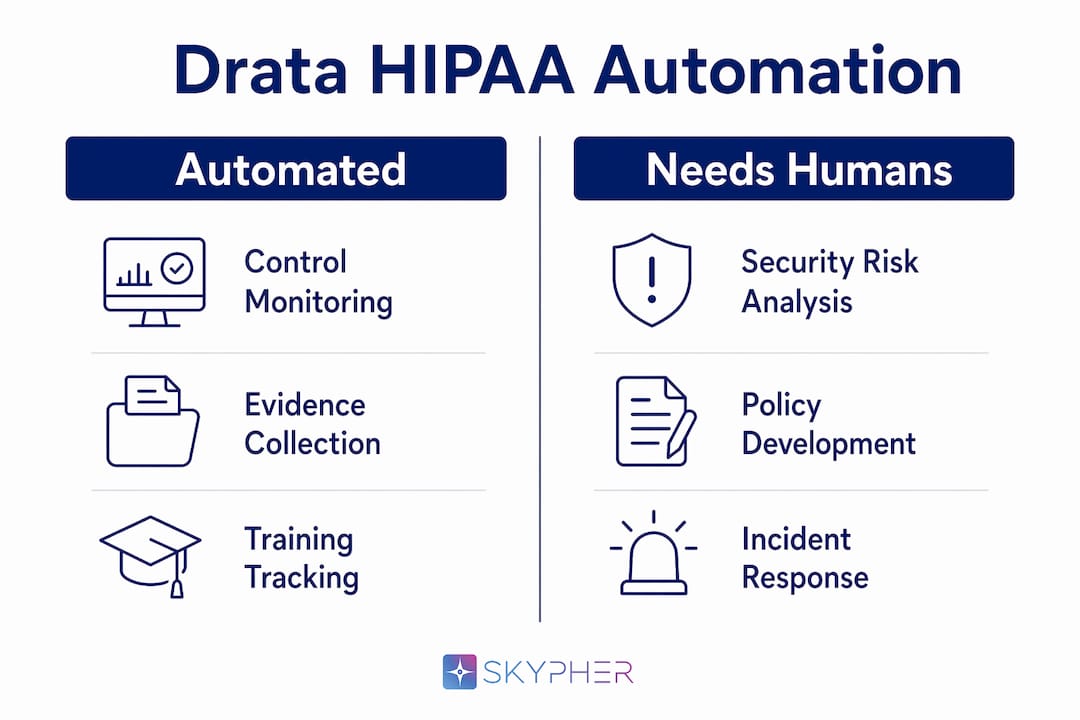
Drata automates the operational layer of HIPAA compliance. It maps administrative, physical, and technical safeguards to specific controls, then continuously tests whether those controls are active and configured correctly.
The platform covers a wide range of HIPAA obligations out of the box:
- Policy templates and versioning. Drata provides pre-built HIPAA policy templates, including Business Associate Agreement (BAA) templates. Policy and evidence management is centralized with timestamped audit trails, satisfying HIPAA's six-year documentation requirement.
- Workforce training tracking. Embedded HIPAA training modules automatically record completion status and timestamps, linking records to individual personnel files for audit evidence.
- Continuous control monitoring. Drata tests configurations like multi-factor authentication (MFA), encryption at rest and in transit, and access logging in real time. Failures surface as alerts, not surprises during an audit.
- Vendor risk and BAA management. BAA status is tracked across all vendors handling PHI, with centralized workflows to collect and store signed agreements.
- Breach Notification support. Audit trails and incident workflows document the timeline and scope of potential breaches, giving you the evidence OCR expects when investigating a Breach Notification Rule violation.
Pro Tip: Sign your BAA with Drata on day one. Because Drata accesses your environment to collect evidence, it may encounter PHI during that process. A signed BAA is a legal requirement before any data collection begins.
The result is a compliance dashboard that shows your HIPAA control status at any moment. That visibility is what makes Drata genuinely useful for audit readiness, not just documentation storage.
What Drata does not cover and why human expertise still matters
No official HIPAA certification exists from the government or any third party. HHS confirms there is no formal certification for HIPAA compliance. Drata does not certify your organization as HIPAA compliant. It automates the monitoring of controls, but several critical compliance tasks require human judgment and cannot be delegated to software.
The most consequential gap is the Security Risk Analysis. Under 45 CFR 164.308, the Risk Analysis is the foundational document OCR requests first in any investigation. Drata cannot conduct or replace this analysis. It requires an organization-specific assessment of threats, vulnerabilities, and the likelihood of harm to ePHI. A generic checklist does not satisfy OCR's expectations.
The following tasks require human-led execution:
- Security Risk Analysis (45 CFR 164.308(a)(1)(ii)(A)). A tailored, documented assessment of all ePHI your organization creates, receives, maintains, or transmits. This must reflect your specific environment, not a template.
- Vendor BAA review. Drata tracks BAA status, but a qualified privacy or legal professional must review the terms of each agreement for adequacy and enforceability.
- Incident response planning. Drata logs incidents, but your team must design, test, and own the response procedures that govern what happens when a breach occurs.
- Designated privacy and security officers. HIPAA requires named individuals responsible for the compliance program. Software cannot fulfill this role.
- Physical safeguard assessments. Facility access controls, workstation policies, and device disposal procedures require on-site evaluation that no platform can automate.
Pro Tip: Treat Drata as your compliance monitoring layer, not your compliance program. Build the program first with a qualified HIPAA professional, then use Drata to automate the ongoing evidence collection that program requires.
Healthcare breach costs averaged $7.42 million per incident in 2025, according to IBM's Cost of a Data Breach Report. That figure reflects what happens when organizations treat automation as a substitute for a real compliance program rather than a tool within one. You can read more about building a thorough foundation in this guide to HIPAA risk assessments for technology companies.
How does Drata integrate with existing technology stacks?
Drata's core value is its ability to connect with the systems your organization already uses and pull compliance evidence automatically. Drata connects with cloud infrastructure, HRIS platforms, identity providers, endpoint management tools, and ticketing systems to run real-time control checks.
The integrations that matter most for HIPAA include:
- Cloud providers (AWS, Azure, GCP). Drata tests encryption settings, access policies, and logging configurations directly within your cloud environment.
- Identity providers (Okta, Azure AD). MFA enforcement and access control policies are checked continuously, not just at audit time.
- HRIS platforms. Employee onboarding and offboarding trigger automatic access reviews, reducing the risk of orphaned accounts with access to ePHI.
- Endpoint management tools. Device encryption and patch status are monitored and flagged when they fall out of compliance.
The centralized evidence library is one of Drata's most practical features. Every test result, policy acknowledgment, and training completion is stored with timestamps and exportable in audit-ready formats. When OCR or a business partner requests documentation, you can produce it in hours rather than weeks.
| Capability | What Drata automates | What requires human action |
|---|---|---|
| Control monitoring | Continuous automated testing | Reviewing and remediating failures |
| Policy management | Versioning, storage, distribution | Drafting, legal review, approval |
| Workforce training | Delivery and completion tracking | Program design and content quality |
| Vendor BAA management | Status tracking and reminders | Contract review and negotiation |
| Risk Analysis | None | Full human-led assessment required |

One underappreciated benefit for technology companies is the ability to layer HIPAA controls on top of an existing SOC 2 program. Many controls overlap, so organizations already pursuing SOC 2 Type II can map HIPAA requirements to controls they are already monitoring. That reduces duplicated effort significantly. For a deeper look at how this plays out in practice, the guide on automating compliance in 2026 covers the operational benefits for tech and finance firms.
Which organizations benefit most from Drata HIPAA automation?
Drata is best suited for organizations with software products that handle ePHI, particularly SaaS companies that already have or are pursuing SOC 2 compliance. The platform's technical control focus and integration depth deliver the most value when your compliance needs span multiple frameworks.
| Organization type | Drata fit | Better alternative |
|---|---|---|
| SaaS company with ePHI and SOC 2 needs | Strong fit | Not applicable |
| Health tech startup building toward audit | Good fit with HIPAA expertise added | Fractional privacy officer to lead program |
| Small medical practice, no SOC 2 | Poor fit | Specialized HIPAA consultant or simpler tool |
| Enterprise with mature HIPAA program | Strong fit for automation layer | Not applicable |
| Mid-size covered entity, limited IT staff | Moderate fit | Managed HIPAA service provider |
SaaS companies with SOC 2 compliance needs benefit most from Drata's overlapping controls management. Small healthcare practices without SOC 2 requirements often find the platform's enterprise pricing and technical complexity exceed what their compliance program actually needs.
The cost consideration is real. Drata's pricing is not publicly listed, but the platform targets mid-size to enterprise organizations. A small medical practice with five employees and no cloud infrastructure may spend more on Drata than the compliance risk justifies. For those organizations, a fractional privacy officer or a purpose-built HIPAA compliance tool is a more proportionate investment.
Pro Tip: If your organization handles ePHI and is already building toward SOC 2, add HIPAA to your Drata framework from the start. Retrofitting compliance frameworks after the fact costs significantly more time and effort than mapping them together initially.
Platforms like WithinBounds.ai offer governance and compliance tools that can complement a Drata-based program, particularly for organizations that need ready-to-use policy libraries and workforce training resources alongside their technical control monitoring.
Key Takeaways
Drata automates HIPAA control monitoring and evidence collection effectively, but a human-led Security Risk Analysis and designated compliance officers remain legally required and cannot be replaced by any software platform.
| Point | Details |
|---|---|
| Drata automates the operational layer | It monitors controls, tracks training, and manages BAAs continuously across your tech stack. |
| No HIPAA certification exists | HHS confirms there is no official certification; Drata supports compliance but does not certify it. |
| Risk Analysis requires human expertise | OCR's first audit request is the Risk Analysis under 45 CFR 164.308, which software cannot produce. |
| SaaS companies get the most value | Organizations with SOC 2 overlap benefit most; small practices may find the cost disproportionate. |
| Sign the BAA with Drata on day one | Drata accesses your environment during evidence collection, making a signed BAA a legal prerequisite. |
The part most compliance teams get wrong
My honest take on Drata for HIPAA is this: the platform is genuinely excellent at what it does, and most teams use it wrong.
The common mistake is deploying Drata before completing a Security Risk Analysis. Teams see the compliance dashboard, assume the green checkmarks mean they are covered, and skip the foundational work OCR actually cares about. That is a dangerous misread. Drata monitors whether your MFA is enforced. It cannot tell you whether you have identified every system in your environment that stores or transmits ePHI. Those are different questions, and only one of them requires a human.
The organizations that get the most out of Drata are the ones that treat it as a force multiplier, not a starting point. They complete the Risk Analysis first, designate their privacy and security officers, design their incident response procedures, and then layer Drata on top to automate the recurring evidence collection that would otherwise consume hours of staff time every month.
Physical safeguards are the other area I see teams neglect. Drata's strength is in technical controls. Workstation policies, facility access logs, and device disposal procedures require someone to physically walk through your environment. No dashboard replaces that.
The 2026 enforcement environment makes this more urgent, not less. OCR has signaled continued focus on Risk Analysis documentation and breach response adequacy. Automation tools reduce compliance overhead, but they do not reduce regulatory exposure if the foundational program is missing.
— Gaspard
Skypher and Drata: a stronger compliance workflow
When your HIPAA compliance program is running on Drata, vendor security questionnaires become the next bottleneck. Every new business associate, cloud vendor, or technology partner sends a questionnaire that your team has to answer manually, pulling time away from actual compliance work.

Skypher's AI questionnaire automation connects directly to your existing security documentation and answers vendor questionnaires in minutes, not days. The platform integrates with over 40 third-party risk management platforms and supports real-time collaboration across your compliance and security teams. For organizations running HIPAA programs on Drata, Skypher reduces the manual effort of responding to business associate due diligence requests, keeping your team focused on the compliance work that actually requires human judgment. You can also explore Skypher's smart security knowledge base to centralize your compliance documentation and accelerate every future review.
FAQ
What does Drata do for HIPAA compliance?
Drata automates evidence collection and continuous monitoring of HIPAA administrative, physical, and technical safeguards, including policy management, workforce training tracking, BAA management, and control testing across cloud and identity systems.
Does Drata certify HIPAA compliance?
No. HHS confirms no official HIPAA certification exists from any government body or third party. Drata supports operational compliance monitoring but does not certify your organization as HIPAA compliant.
What is the Security Risk Analysis and why can't Drata do it?
The Security Risk Analysis, required under 45 CFR 164.308, is a tailored assessment of threats and vulnerabilities to your specific ePHI environment. OCR requests it first in any investigation, and it requires human judgment that no automation platform can replicate.
Which organizations benefit most from using Drata for HIPAA?
SaaS companies handling ePHI that also need SOC 2 compliance benefit most, since many controls overlap. Small healthcare practices without SOC 2 requirements often find Drata's complexity and pricing disproportionate to their needs.
How much does a healthcare data breach cost in 2025?
Healthcare breach costs averaged $7.42 million per incident in 2025, according to IBM's Cost of a Data Breach Report. That figure underscores why a complete HIPAA program, not just automated monitoring, is a financial necessity.