

TL;DR:
- Automating security questionnaires can reduce workload by up to 92% and speed responses 10 to 18 times.
- Different questionnaire types target specific areas like broad risk, cloud security, or financial compliance, requiring tailored responses.
- Effective preparation, centralized evidence libraries, and combining automation with human oversight ensure accurate and credible responses.
Security questionnaires are eating your team's calendar. A single vendor review can consume 12 to 18 hours of manual effort, and when you're managing dozens of requests per quarter, that adds up to a serious operational drag. For compliance officers and risk teams in tech and finance, the stakes go beyond lost time. Delayed responses stall sales cycles, frustrate prospective clients, and expose your organization to reputational risk. The good news is that automation tools and structured processes can reduce that workload by up to 92% and accelerate response times 10 to 18 times faster. This guide walks you through every stage, from understanding questionnaire types to deploying automation and handling edge cases, so your team can respond faster, more accurately, and with far less friction.
Table of Contents
- Understand key compliance questionnaire types and requirements
- Prepping your response library and workflow
- How to automate and accelerate the questionnaire process
- Dealing with edge cases, high-risk items, and quality control
- What most teams get wrong about compliance questionnaires
- Ready to automate your compliance questionnaire workflow?
- Frequently asked questions
Key Takeaways
| Point | Details |
|---|---|
| Prep is essential | A central evidence library and standardized workflow greatly reduce manual compliance work. |
| Automate for speed | Leading tools enable 80-96% auto-fill, cutting hours and accelerating sales cycles. |
| Human review required | AI handles the bulk, but complex or risky questions demand expert oversight. |
| Trust packages matter | Providing certifications upfront can help deflect most questionnaire requests, saving time and effort. |
Understand key compliance questionnaire types and requirements
Before you can streamline anything, you need to know exactly what you're dealing with. Not all compliance questionnaires are created equal, and treating them as interchangeable is one of the fastest ways to waste time and create rework.
The most common formats you'll encounter include:
- SIG Core and SIG Lite (Standardized Information Gathering): Broad vendor risk assessments covering 18 risk domains. SIG Core is exhaustive (often 800+ questions), while SIG Lite is a shorter version for lower-risk vendors.
- CAIQ (Consensus Assessments Initiative Questionnaire): Designed specifically for cloud service providers, aligned to the CSA Cloud Controls Matrix.
- VSAQ (Vendor Security Assessment Questionnaire): A Google-originated format focused on web application and infrastructure security.
- Wolfsberg FCCQ: Used in financial services for AML and KYC due diligence, covering financial crime compliance across correspondent banking and payment relationships.
| Questionnaire | Primary use case | Typical length | Key domains |
|---|---|---|---|
| SIG Core | Broad vendor risk | 800+ questions | 18 risk domains |
| SIG Lite | Lower-risk vendors | ~130 questions | Condensed domains |
| CAIQ | Cloud providers | ~261 questions | CSA CCM controls |
| VSAQ | Web/app security | Variable | Infrastructure, app security |
| Wolfsberg FCCQ | Finance/AML/KYC | ~200 questions | Financial crime compliance |
For a deeper look at when to use each format, the SIG vs. CAIQ comparison breaks down the tradeoffs clearly. Finance organizations dealing with correspondent banking relationships should layer in the Wolfsberg FCCQ on top of their standard vendor review process.
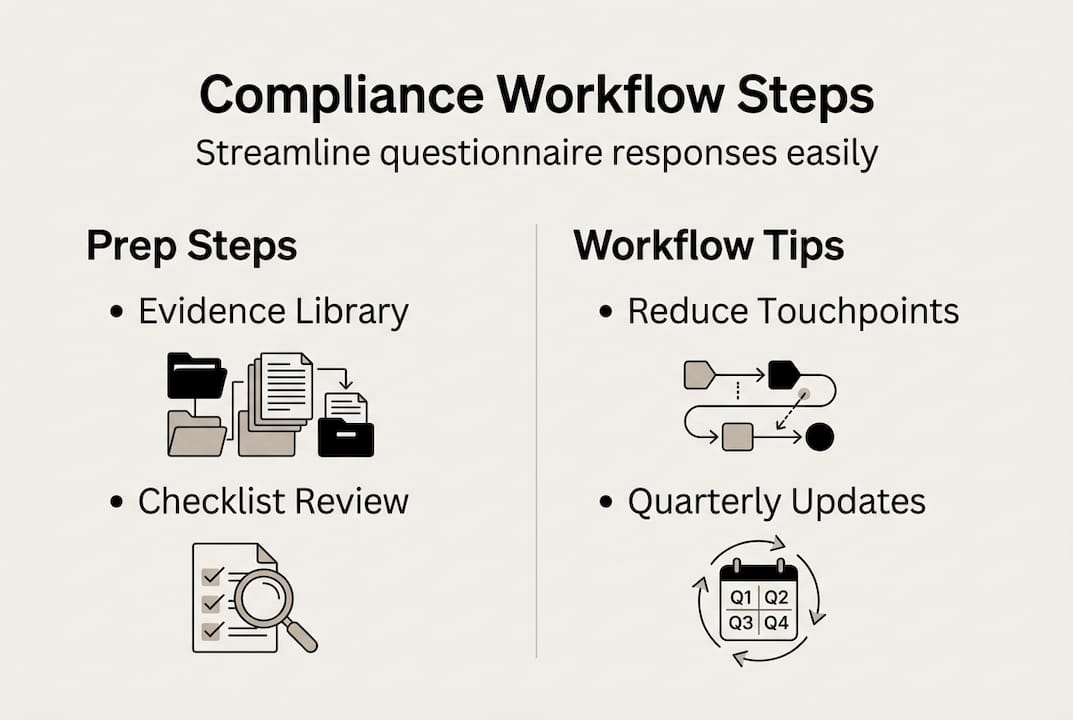
Before you even open a questionnaire, you need a preparation checklist. This means having your SOC 2 or ISO 27001 certificates current, your security policies documented and version-controlled, and a trust package assembled with your most frequently requested evidence. Understanding automating questionnaire basics early helps teams avoid scrambling for documents mid-response.
Pro Tip: Build a centralized evidence library mapped to question domains (access control, incident response, encryption, etc.) so any team member can pull the right artifact without hunting through shared drives.
Prepping your response library and workflow
With a grasp of what to expect, the next step is setting up the right documentation and workflow to reduce manual work. A well-structured library is the difference between a 2-hour response and a 2-day one.
Here's how to build it effectively:
- Centralize all policy documents in one location. This includes your information security policy, business continuity plan, incident response plan, and any relevant certifications.
- Map evidence to frameworks. Organize artifacts by SIG domains, NIST CSF categories, or ISO 27001 controls so they're easy to retrieve during triage.
- Define your intake and triage process. Who receives incoming questionnaires? Who triages complexity and urgency? Who are the subject matter experts (SMEs) for legal, cloud infrastructure, and data privacy?
- Set escalation thresholds. Not every question needs a security engineer. Define which question types go straight to your library versus which ones require SME input.
- Build a trust center. A proactive, self-serve portal where prospects can access your security posture reduces inbound questionnaire volume significantly.
For high-volume response management, medium to large organizations in tech and finance should prioritize centralized libraries combined with AI automation rather than relying on spreadsheets or shared docs.
| Approach | Setup effort | Scalability | Accuracy risk | Best for |
|---|---|---|---|---|
| Manual spreadsheets | Low | Poor | High | Small teams, low volume |
| Dedicated automation tools | Medium | Excellent | Low | Mid to large orgs |
| Trust centers | Medium | Excellent | Very low | High-volume deflection |
For practical workflow streamlining tips, the key is reducing the number of touchpoints per questionnaire. Every handoff is a delay. The response process best practices framework recommends defining no more than three escalation tiers to keep things moving.

Pro Tip: Review and update your evidence library every quarter. Stale certifications or outdated policy versions are a leading cause of vendor pushback and rework, and they can undermine trust at a critical point in a sales cycle.
How to automate and accelerate the questionnaire process
Once your library and workflow are ready, you can deploy automation to radically boost efficiency. The process looks straightforward once it's set up, but the sequencing matters.
Step-by-step automation workflow:
- Intake and parsing. Upload the questionnaire in any format (Excel, Word, PDF, portal-based). AI parses and normalizes the questions.
- AI evidence matching. The system searches your library and maps the best available response to each question, achieving 80 to 96% auto-fill accuracy.
- SME review for outliers. Questions flagged as low-confidence or high-risk route to the appropriate expert for manual input.
- Trust center deflection. For recurring or standard requests, direct prospects to your trust center before a full questionnaire is even submitted. This alone can deflect 75% of requests before they enter your queue.
- Packaging and delivery. Export completed responses in the required format and deliver through the client's preferred channel.
Leading platforms including OneTrust, Responsive, Skypher, and SecurityScorecard can reduce manual workloads by 83 to 92% and process questionnaires 10 to 18 times faster than manual methods. For teams looking to understand the full efficiency picture, this automation efficiency breakdown is worth reviewing.
When to still escalate to manual review:
- Client-specific controls not covered in your standard library
- Questions involving legal liability, data residency, or regulatory jurisdiction
- Atypical security architectures or multi-entity setups
- Any item where the AI confidence score falls below your defined threshold
For a detailed walkthrough of building this process end to end, the streamline questionnaires guide covers the setup in practical terms.
Dealing with edge cases, high-risk items, and quality control
Automation covers the bulk, but robust compliance also means preparing for unique or risky situations where automation cannot replace expert oversight. This is where many teams get overconfident and make costly mistakes.
84% of questionnaires received by organizations are custom or in-house formats. Even with AI accuracy rates between 91 and 96%, that remaining margin matters enormously when the questions involve financial crime controls, data sovereignty, or contractual obligations.
Important: Responses must be factual and evidence-backed. Avoid vague or marketing-style language like "industry-leading security" without supporting documentation. Auditors and procurement teams will push back, and it damages credibility at exactly the wrong moment.
For finance organizations specifically, failing to properly address AML and CTF controls in Wolfsberg FCCQ responses carries serious consequences. Regulatory fines exceeding $2.7 billion have been levied against institutions with weak financial crime compliance programs. That's not a theoretical risk.
Top failure points to watch for:
- Outdated certifications or expired policy documents in your library
- Responses that don't map to the specific control domain being asked about
- Missing rationale for compensating controls when a standard control isn't in place
- No trust package provided upfront, forcing a full questionnaire when it wasn't necessary
- Escalating too late, leaving SMEs with insufficient time for thorough review
For teams building out their quality control process, streamlined response strategies and faster automation insights both offer practical checklists to reduce these failure points systematically.
What most teams get wrong about compliance questionnaires
Here's the uncomfortable reality: buying a new automation platform does not fix a broken process. We see this pattern repeatedly. A team invests in a best-in-class tool, auto-fills 90% of questions in minutes, and then loses the deal anyway because the remaining 10% was handled carelessly or the responses felt generic and unconvincing.
Speed is necessary but not sufficient. Clients and procurement teams are increasingly sophisticated. They can tell when a response was generated without thought. What actually builds trust is when responses are specific, evidence-backed, and clearly tailored to the client's context. That requires human judgment layered on top of automation, not instead of it.
For 2026 streamlining insights, the highest-performing compliance teams share one trait: they treat questionnaire responses as relationship-building moments, not administrative tasks to clear from the queue.
Pro Tip: After losing a deal where compliance delays or weak responses were a factor, run a post-mortem. Identify which questions stumped your team, which evidence was missing, and update your library accordingly. One post-mortem review can prevent the same failure across dozens of future requests.
The real competitive advantage comes from integrating people, processes, and smart technology together. Tech alone creates false confidence. Process alone doesn't scale. People alone burn out. All three, working in sync, is where the real efficiency and credibility gains live.
Ready to automate your compliance questionnaire workflow?
If the steps above feel like a significant lift to implement from scratch, you don't have to build it alone. Skypher's platform brings together everything your team needs to move from reactive, manual questionnaire handling to a proactive, automated response operation.

With Skypher, you can automate compliance response across every major questionnaire format, leverage the AI recommendation engine to match evidence with precision, and use import and export workflows to handle any format your clients send. The platform integrates with over 40 TPRM platforms, connects with Slack, MS Teams, Confluence, and SharePoint, and supports multilingual responses for global teams. Your compliance workload doesn't have to be a bottleneck.
Frequently asked questions
What are the main types of compliance questionnaires for tech and finance orgs?
The most common are SIG Core/Lite, CAIQ, VSAQ, and Wolfsberg FCCQ for financial crime compliance. SIG and CAIQ cover broad risk and cloud controls respectively, while Wolfsberg is specific to AML and KYC obligations in financial services.
How much time can automation actually save?
Automation tools can reduce manual workloads by up to 92% and cut response time 10 to 18 times faster compared to manual processes, freeing your team for higher-value review tasks.
Can automation fully replace manual review for compliance questionnaires?
No. AI auto-fills up to 96% accurately, but custom formats, high-risk controls, and legally sensitive items still require expert human review to ensure accuracy and credibility.
How can we prepare to deflect or reduce incoming questionnaire requests?
Publishing a trust center with your certifications and security posture upfront can deflect 75% of requests before they enter your queue, significantly reducing inbound volume and freeing your team's time.