

A sample SOC 1 report contains five must-have elements: management's assertion, a system description, control objectives, tests of controls (usually shown as testing matrices), and the auditor's opinion. If you're evaluating a vendor, prepping for your own audit, or drafting a system description from scratch, the fastest way to understand what "good" looks like is to open a real one and see how a CPA firm actually presents these five pieces.
We've pulled together the samples worth studying, and we'll walk through what each one teaches you:
- QAD's 2022 Type 2 SOC 1 report shows a modern, clearly labeled testing matrix. Open this if you're building your own control-testing table.
- Morgan Stanley's SOC 1 Type II report demonstrates dense, financial-services-grade auditor language and appendix structure. Open this if you want to see how a large regulated firm phrases its opinion and sampling statements.
- ADP's public materials illustrate how a major payroll processor scopes its system description. Open this if payroll or HR-adjacent controls are your focus.
- SIFMA's Asset Manager's Guide to SOC 1 includes sector-specific excerpts for fund administrators. Open this if you're drafting control objectives tied to fund accounting or NAV calculation.
If you're prepping for an audit, start with QAD's testing matrix. If you're writing a system description, start with SIFMA. If you just need to understand vendor risk quickly, start with the auditor's opinion page in any of the four.
Key Takeaways
A sample SOC 1 report proves its value through five components: management's assertion, a system description, control objectives, a testing matrix, and the auditor's opinion, with the testing matrix carrying most of the diligence weight.
| Point | Details |
|---|---|
| Five core sections | Management assertion, system description, control objectives, testing matrices, and the auditor's opinion appear in every legitimate SOC 1 report. |
| Type II over Type I | Most enterprise buyers require Type II, which tests operating effectiveness over 6 to 12 months, not just design at one point in time. |
| Scope precision prevents exceptions | Vague system-description language and unclear subservice treatment are the most common triggers for auditors expanding scope mid-engagement. |
| Pre-audit testing has the highest payoff | Simulating the auditor's sampling approach before fieldwork starts catches exceptions early and gives time to draft management responses. |
| Automation reduces surrounding workload | Tools like Skypher's questionnaire automation platform speed up evidence collection and customer security reviews that run alongside SOC 1 preparation. |
Table of Contents
- What Does a Sample SOC 1 Report Actually Contain?
- Type I vs Type II: Which One Do You Actually Need?
- How to Read a SOC 1 Sample in Under Ten Minutes
- Annotated SOC 1 Samples Worth Downloading
- Preparing for a SOC 1 Audit: A Four-Phase Roadmap
- Common Controls That Show Up in Almost Every SOC 1 Report
- ISAE 3402 vs SOC 1: What Changes Across Borders
- Why Annotated Samples Matter More Than Checklists
- Speed Up Evidence Collection Without Slowing Down Your Audit
- Frequently Asked Questions
- Sources
What Does a Sample SOC 1 Report Actually Contain?
Every legitimate SOC 1 report is built from the same skeleton, even though the language and formatting vary by CPA firm. Understanding that skeleton is the difference between skimming a 60-page PDF for ten minutes and actually knowing what you're looking at.
Management's assertion
This is a formal, written statement from the service organization's own leadership. It appears near the front of the report, and it asserts two things: that the system description fairly presents the system, and that the controls were suitably designed (Type I) or suitably designed and operating effectively (Type II) throughout the period. The assertion is typically signed by a CFO, controller, or head of compliance, not the audit firm. If you open a sample and can't find a clearly labeled assertion with a named signatory, that's worth flagging immediately. The assertion is what the auditor's opinion is actually opining on. Without it, there's nothing for the CPA to attest against.
System description
This section maps out what the system actually does, its boundaries, its major components, and how data flows through it. A strong system description tells you exactly which services are in scope and, critically, how the report treats subservice organizations, meaning any third party the service organization relies on to deliver its own service. There are two ways to handle this: the inclusive method, where the subservice organization's controls are tested directly as part of the report, and the carve-out method, where those controls are excluded and the user-entity is told to get separate assurance over them. Carve-outs aren't a red flag by themselves, but a report that carves out something central to the service without saying so clearly is a problem.
Control objectives and control activities
Control objectives are the goals ("ensure only authorized changes are deployed to production"). Control activities are the specific mechanisms that achieve them ("all code changes require a peer-reviewed pull request and a documented deployment approval"). In a payroll processor's report, you'd expect objectives around accurate wage calculation and timely tax remittance. In a fund administrator's report, per SIFMA's guidance, you'd expect objectives tied to NAV calculation accuracy and trade settlement. The objectives should trace back to something that actually shows up on a client's financial statements, whether that's revenue, payroll expense, or fund assets.
Tests of controls and testing matrices
This is the section that separates a real SOC 1 report from marketing copy, and it's almost always the longest part of a Type II report. Auditors document, control by control, exactly what they tested and what they found. The table usually runs in this shape:
| Column | What it shows |
|---|---|
| Control description | The specific activity being tested |
| Testing procedure | How the auditor verified it (inquiry, observation, inspection, re-performance) |
| Sample size | How many instances the auditor examined |
| Sample period | The date range the sample was drawn from |
| Results | Whether the control operated effectively, or noted exceptions |
Ninety percent of the real diligence value in a SOC 1 report lives in this matrix. If you're benchmarking your own draft controls against a sample, this table is where to spend your time.
Auditor's opinion
The opinion is short compared to everything else, but it's the section most readers jump to first. Unqualified (sometimes called "clean") means the auditor found the controls suitably designed and, for Type II, operating effectively with no material exceptions. Qualified means the auditor found one or more exceptions material enough to flag in the opinion itself. If a report mentions "exceptions" in the testing matrix but the opinion is still unqualified, that usually means the exceptions were isolated and management addressed them, which the report should document in a management response.
Appendices and evidence artifacts
Most samples close with appendices covering things like a glossary of terms, a list of complementary user-entity controls (the controls the client is expected to run on their own end), and sometimes references to underlying evidence like policy documents. These appendices are also where subservice organization details usually live in full.
Pro Tip: When comparing your draft system description against a sample like QAD's, don't copy sentence structure. Copy the level of specificity, particularly around data flow diagrams and subservice organization treatment. Vague scope language is the single most common reason auditors expand a boundary mid-engagement.
For a closer look at how this all reads in practice, our breakdown of a full SOC 1 report example walks through actual section language side by side with plain-English notes.
Type I vs Type II: Which One Do You Actually Need?
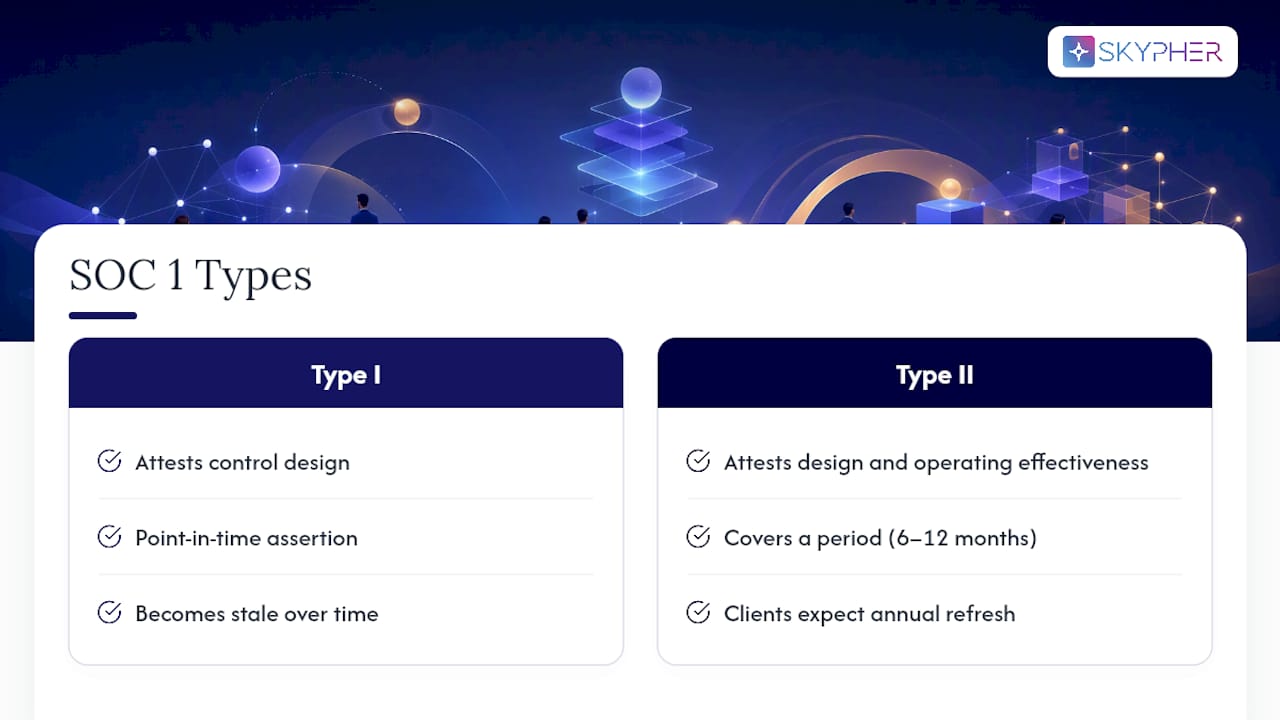
The difference sounds small on paper and turns out to matter enormously in practice. A Type I report tests whether controls were suitably designed at a single point in time, like a snapshot. A Type II report tests whether those same controls were suitably designed and operating effectively across an observation period, usually six or twelve months.
| Factor | Type I | Type II |
|---|---|---|
| What's tested | Design only, at one date | Design plus operating effectiveness over a period |
| Typical period | Single "as of" date | 6 or 12 months (varies by first engagement vs. repeat) |
| Evidence needed | Policy documents, control descriptions | Ongoing logs, transaction samples, continuous evidence across the period |
| When it's requested | New service orgs, first attestation | Recurring assurance, most enterprise procurement requirements |
Most enterprise buyers and user-entity auditors will insist on a Type II report once a vendor relationship matures past the pilot stage. A Type I report tells them your controls exist and look reasonable. It doesn't tell them the controls actually worked for six straight months, which is what a finance team's own auditors usually need to rely on your report during their own year-end close.
Timeline matters here. According to TCSA's ICFR readiness guidance, a first-time SOC 1 engagement commonly takes several months from scoping to report issuance, and that's before the observation period even starts for a Type II report. If you need a Type II covering a full 12-month window, and you haven't started collecting evidence yet, you're looking at over a year before the final PDF lands in your hand. Organizations that need assurance sooner often start with a Type I to satisfy an immediate customer request, then roll into a Type II observation period once policies and logging are stable. Our comparison of SOC 1 vs SOC 2 reports covers how this same Type I/Type II split shows up under a different framework, which is useful if your organization is weighing both attestations at once.
How to Read a SOC 1 Sample in Under Ten Minutes
You don't need to read a 60-page SOC 1 PDF front to back to know whether it's solid. Auditors and procurement teams who review dozens of these reports a year all use some version of the same shortcut.
- Open the auditor's opinion first. Confirm it's unqualified, and note the CPA firm name and any explanatory language around exceptions.
- Check the observation window. For a Type II, confirm the period actually covers the timeframe you care about. A report covering January through June won't help you if you need coverage through December.
- Read the system description's scope paragraph. Confirm the services you actually use are named explicitly, not implied.
- Find the subservice organization treatment. Look for the words "inclusive" or "carve-out." If a subservice organization critical to the service is carved out, you'll need separate assurance over it.
- Skim the testing matrix for exceptions. Search the PDF for the word "exception." If it appears, read the surrounding rows and the management response that should follow.
Watch for these red flags as you scan:
- No signed management assertion, or one buried without a clear signatory.
- Vague scope language like "our platform" instead of naming specific products or services.
- No testing matrix at all in what's labeled a Type II report. That's a structural problem, not a stylistic one.
- Broad, unexplained carve-outs covering infrastructure or processing that seems central to the service.
- Missing dates, meaning the observation period or the assertion date is unclear or inconsistent between sections.
If you're reviewing a vendor's report as part of procurement, keep a short note of anything from that list plus the auditor firm's name and credentials. Most CPA firms include a statement of independence somewhere in the front matter. Its absence isn't automatically disqualifying, but it's worth a follow-up question.
Annotated SOC 1 Samples Worth Downloading
Reading about report structure only gets you so far. These four PDFs, referenced earlier, are worth opening side by side because each one demonstrates something different.
- QAD's 2022 Type 2 SOC 1 report: a clean example of a modern software vendor's testing matrix, with control descriptions, procedures, and results laid out in a consistent, easy-to-scan table format. This is the sample to study if you're building your own matrix template.
- Morgan Stanley's SOC 1 Type II report: shows how a large regulated financial firm structures its auditor's report and appendices, including denser, more formal language around sampling methodology. Useful for benchmarking auditor-report tone against your own CPA firm's draft.
- ADP's public materials: a reference point for how a major payroll processor frames system description scope, since payroll processing controls appear in a huge share of SOC 1 engagements across industries.
- SIFMA's Asset Manager's Guide to SOC 1: written specifically for fund administrators and asset managers, with excerpted language for control objectives tied to fund accounting.
When you use any of these as a model, treat them as structural references, not copy sources. Borrow the shape of a control objective or the format of a testing matrix column header. Don't lift specific control wording verbatim, since your actual control activities need to reflect what your organization really does, not what someone else's auditor documented. If you're downloading a sample to share internally, redact anything you don't need, and keep the focus on structure and phrasing patterns rather than the specific numbers or names in someone else's report.
Preparing for a SOC 1 Audit: A Four-Phase Roadmap
Getting from "we've never done this" to "here's our clean Type II report" follows a fairly predictable path, and skipping steps is what causes exceptions to show up later. According to macpas's guidance on SOC 1 preparation, the process generally runs through four phases.
1. Scoping. Identify every service that could affect a client's financial statements, not just the obvious ones. This is also where you decide Type I vs Type II, and where you decide inclusive versus carve-out treatment for any subservice organizations you rely on. Most organizations that fail an initial readiness assessment do so because of scope creep or poorly defined boundaries, so it pays to map every in-scope service to a specific financial-statement line item early, whether that's revenue, expenses, assets, or liabilities. Vague scope statements are exactly what invite an auditor to expand the boundary mid-engagement, which can add weeks to your timeline.
2. Control design and documentation. Draft control objectives that trace directly back to those financial-statement impacts, then document the specific control activities, who owns each one, and how frequently they run. This is also when you'll want to name a control owner for every activity, since auditors will ask that person directly during fieldwork.
3. Evidence collection. Build a centralized evidence repository rather than scattering documentation across email threads and shared drives. For a Type II report, this means continuous logs and transaction samples across the entire observation period, not a single point-in-time snapshot. Typical evidence includes access provisioning and removal tickets, change-management approvals, reconciliations, exception logs, and supervisory sign-offs.
4. Pre-audit testing and remediation. Run your own internal tests that simulate how the auditor will sample the observation period, and fix what you find before fieldwork starts. This is arguably the highest-leverage step in the entire process. Internal pre-audit testing both reduces the odds of a formal exception landing in your final report and gives you time to draft and validate a management response before the auditor writes anything down.
Once fieldwork actually begins, expect it to follow the shape Schellman describes: auditor meetings with your control owners, documentation review, a draft report for your team to review, and then final issuance. First-time engagements typically run four to six months from kickoff to report, and that's before any Type II observation window. Repeat engagements move faster since the scope, control design, and evidence pipeline are already established.
Pro Tip: A readiness assessment before fieldwork starts is one of the cheapest insurance policies in the whole process. It surfaces scope and control gaps while you still have time to fix them, instead of finding out about a gap when it's already written into your final report as an exception.
Common Controls That Show Up in Almost Every SOC 1 Report
The specific control language varies by industry, but the categories repeat across nearly every sample worth reading.
- Access controls: provisioning and de-provisioning tickets, periodic privileged-access reviews, and evidence that terminated employees lost system access within a defined window.
- Change management controls: versioned change approvals, testing evidence prior to deployment, and deployment logs showing who pushed what and when.
- Financial processing controls: account reconciliations, supervisory sign-offs on journal entries, and transaction logs tying system outputs back to source documents.
- Incident management and exception handling: documented incident reports, root-cause analysis, and remediation evidence showing the issue was actually closed, not just logged.
These categories map directly to what auditors sample during a Type II observation period, and they're the same evidence types listed in most SOC 1 readiness guidance, including macpas's overview of exam preparation.
ISAE 3402 vs SOC 1: What Changes Across Borders
Functionally, SOC 1 and ISAE 3402 report on the exact same thing: controls at a service organization that matter to a user entity's financial reporting. The difference is jurisdictional. SOC 1 is the AICPA/US-based framework, governed by SSAE 18 and AT-C Section 320. ISAE 3402 is the international equivalent, issued under the International Auditing and Assurance Standards Board's standards.
If you're reading a sample and want to confirm which one you're looking at, check the auditor's opinion for the specific professional standard cited. That single line tells you everything.
- SOC 1 reports cite AICPA standards and typically use US audit terminology throughout.
- ISAE 3402 reports cite the international standard directly and may use slightly different terminology for control types and testing procedures.
- Global buyers with operations across multiple regions sometimes request both, since some regulators and auditors don't automatically cross-recognize one for the other, even though the underlying assurance is nearly identical.
If your customer base spans both US and international entities, it's worth asking your auditor directly whether a single dual-purpose report is possible, since many CPA firms now offer combined SOC 1 / ISAE 3402 engagements to avoid running two nearly identical audits in parallel.
Why Annotated Samples Matter More Than Checklists
Most compliance teams don't fail SOC 1 preparation because they lack a checklist. They fail because they've never actually seen what a finished, audited report looks like, so they're guessing at the right level of specificity for a system description or the right granularity for a control objective. That's the real value of working from a sample like QAD's testing matrix or SIFMA's asset manager excerpts. They show you the calibration, not just the categories.
The teams that use samples well borrow structure and clarity, never verbatim control language, since a control activity copied from someone else's report almost never matches what your organization actually does. Where samples earn their keep is procurement conversations and internal readiness work, both moments when someone needs to understand a report's shape fast, whether that's a security reviewer comparing a vendor's report against their own risk framework or an internal team trying to align its draft control language before an auditor ever sees it. PwC frames this well: SOC reporting done right lets an organization "assess once and report to many," cutting down on the repetitive, one-off audit requests that eat into a compliance team's year.
Speed Up Evidence Collection Without Slowing Down Your Audit
Every phase of SOC 1 readiness, especially evidence collection and the endless follow-up questions from customer security teams, runs faster when your organization isn't hunting for the same policy document or control description for the fifth time this quarter. Skypher's AI-driven questionnaire automation tool cuts the manual work out of answering repetitive security and audit questions by pulling verified answers from a centralized knowledge base instead of starting from a blank page every time.

This isn't a substitute for the audit itself. You still need real controls, real testing, and a CPA firm's opinion to get a SOC 1 report. What Skypher handles is the surrounding workload: the customer questionnaires, vendor risk assessments, and internal evidence requests that pile up around every audit cycle and eat time your compliance team could spend on actual control design and remediation. With integrations across more than 40 third-party risk platforms and real-time collaboration for your team, it's built for organizations juggling audit prep alongside a steady stream of customer security reviews. If your team is buried in repetitive questionnaire responses while trying to get ready for a Type II engagement, take a look at Skypher's security questionnaire automation tool and see how much of that manual work can move off your plate before your next audit cycle starts.
Frequently Asked Questions
What is a SOC 1 report, in plain terms? A SOC 1 report is a CPA-issued attestation confirming whether a service organization's internal controls over financial reporting are suitably designed (Type I) or suitably designed and operating effectively over a period (Type II). It exists so a client's own auditors can rely on it during their financial statement audit.
Where can I find a real SOC 1 audit report sample to review? Publicly available examples include QAD's 2022 Type 2 report, Morgan Stanley's Type II report, ADP's published materials, and SIFMA's asset manager guide, which includes sector-specific sample excerpts.
How long does a SOC 1 report stay valid? A Type I report reflects a single point in time, so it doesn't expire in the traditional sense but becomes stale as time passes since the assertion date. A Type II report covers an observation window, commonly 6 or 12 months, and most clients expect a new report annually to maintain continuous coverage.
Who actually needs a SOC 1 report? Any service organization whose processing could affect a client's financial statements, think payroll processors, fund administrators, loan servicers, or SaaS platforms handling billing and revenue recognition, typically needs one if enterprise or regulated clients request it as part of vendor due diligence.
What's the difference between a sample internal controls report and a full SOC 1 report? A sample internal controls report often refers narrowly to the control descriptions and testing matrix, while a full SOC 1 report bundles that alongside the management assertion, system description, and auditor's opinion into one complete document.
How is a SOC 1 report different from SOC 2? SOC 1 focuses on controls relevant to a client's financial statements. SOC 2 focuses on security, availability, processing integrity, confidentiality, and privacy, unrelated to financial reporting. Our SOC 1 vs SOC 2 comparison breaks down which one applies to your situation.
How do SOC 1 reports relate to frameworks like COSO or SSAE 18? SOC 1 examinations are performed under SSAE 18 (AT-C Section 320), the AICPA's attestation standard, and many control frameworks reference COSO's internal control components when documenting control design. A sample report's system description often implicitly reflects COSO's control environment and monitoring components even without naming COSO directly.
Sources
- How to Prepare for a SOC 1 Examination | SOC 1 Reports
- SOC 1 Audit Preparation: Complete ICFR Readiness Guide | TCSA
- PDF Asset Manager's Guide to SOC 1 - SIFMA