

TL;DR:
- Request a SOC 1 Type II report when controls affect your financial statements or internal reporting.
- Request a SOC 2 Type II report for security, availability, confidentiality, or privacy controls that operationally impact your organization.
If your external financial auditors are asking for assurance on a vendor's controls, request a SOC 1 Type II. If your security or procurement team needs evidence that a vendor protects your data, request a SOC 2 Type II. If you want a public-facing attestation you can post on your website without an NDA, a SOC 3 is the right output — but only after a SOC 2 Type II is already in place. That's the core of the SOC 1 vs SOC 2 vs SOC 3 decision, and the rest of this guide fills in the practical detail.
Two clarifications matter before you go further. First, Type I vs Type II: a Type I report evaluates whether controls are designed and implemented correctly at a single point in time, while a Type II report tests whether those controls actually operated effectively over an observation period. Enterprise buyers almost always require Type II. Second, SOC 1 and SOC 2 are restricted-use reports shared under NDA with specific parties; SOC 3 is a general-use document with no distribution restrictions.
Quick next steps by audience:
- Financial auditors and finance teams: Ask your vendor for a SOC 1 Type II report covering the control objectives that affect your financial statements.
- Security and procurement teams: Request a SOC 2 Type II under NDA, specifying the Trust Services Criteria (TSC) categories relevant to your risk profile.
- Marketing and executive communications: Request a SOC 3 only after confirming a SOC 2 Type II is the underlying audit; a SOC 3 alone is not sufficient for due diligence.
Table of Contents
- SOC 1 vs SOC 2 vs SOC 3 at a Glance
- What SOC Reports Are and How the AICPA Framework Governs Them
- What SOC 1 Covers and Who Should Request It
- What SOC 2 Covers and How to Scope It Effectively
- What SOC 3 Is and When It Actually Makes Sense
- SOC 1 vs SOC 2 vs SOC 3: Full Side-by-Side Comparison
- How to Choose the Right SOC Report for Your Situation
- Practical Tips for Avoiding Common SOC Pitfalls
- Key Takeaways
- The Pattern Enterprise Buyers Actually Follow
- Faster Security Reviews Start Before the Audit Does
- Useful Sources and Further Reading
SOC 1 vs SOC 2 vs SOC 3 at a Glance
The table below maps each report type to its primary use case and the most important practical note for each.
| Report | One-Line Recommendation | Type I vs Type II Note | First Request When Engaging a Vendor |
|---|---|---|---|
| SOC 1 | Request when the vendor's controls affect your financial statements | Type II is the standard; Type I is an acceptable interim only | Ask for SOC 1 Type II if the vendor processes payroll, payments, or loan data |
| SOC 2 | Request when you need evidence of data security, availability, or privacy controls | Type II is expected by enterprise procurement; Type I is a starting milestone | Ask for SOC 2 Type II under NDA, specifying which TSC categories apply |
| SOC 3 | Use for public trust signals and marketing; never as a substitute for SOC 2 in due diligence | SOC 3 is always based on a Type II engagement | Request only after confirming the vendor holds a current SOC 2 Type II |
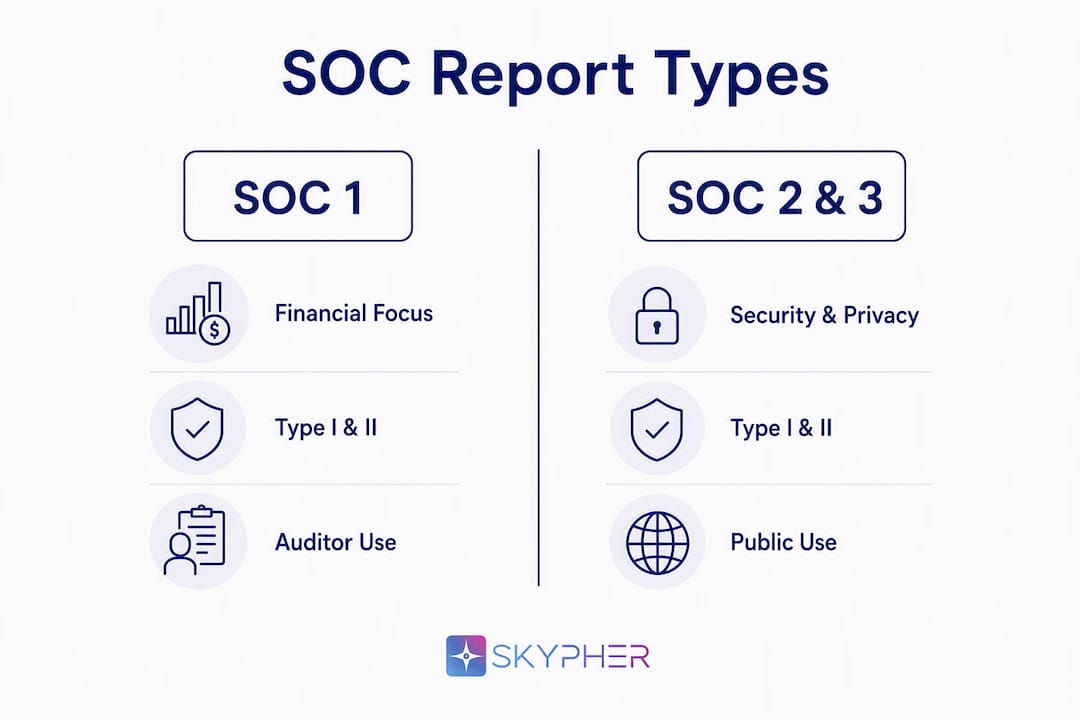
What SOC Reports Are and How the AICPA Framework Governs Them
SOC reports are formal attestation engagements performed by independent CPA firms under standards set by the American Institute of CPAs (AICPA). The governing attestation standard is the Statements on Standards for Attestation Engagements (SSAE), with SOC 1 conducted under AT-C Section 320 and SOC 2 under AT-C Sections 105 and 205. That regulatory anchor is what separates a SOC report from a vendor-produced security white paper: the opinion comes from a licensed, independent auditor, not the vendor itself.

The three report types serve three distinct audiences. SOC 1 is an auditor-to-auditor communication, primarily used by external financial auditors evaluating a service organization's impact on a user entity's financial statements. SOC 2 is directed at customers, prospects, and internal risk teams who need evidence of operational and security controls. SOC 3 is designed for the general public and can be freely distributed without restriction.
The Trust Services Criteria (TSC) connect SOC 2 and SOC 3 to a common framework. The five TSC categories are security, availability, processing integrity, confidentiality, and privacy. Security is the only mandatory category in a SOC 2 engagement; organizations select additional categories based on what their systems actually do and what their customers require.
- Security — controls protecting systems against unauthorized access
- Availability — controls ensuring systems are available as committed
- Processing integrity — controls confirming system processing is complete, valid, and accurate
- Confidentiality — controls protecting information designated as confidential
- Privacy — controls governing the collection, use, and disposal of personal information
SOC 1 does not use the TSC at all. Its scope is defined entirely by the control objectives relevant to a user entity's internal control over financial reporting (ICFR).
What SOC 1 Covers and Who Should Request It
SOC 1 exists for one specific purpose: providing assurance on the controls at a service organization that could affect a user entity's financial statements. If your company outsources payroll processing, transaction processing, loan servicing, or claims management, the vendor handling those functions almost certainly needs a SOC 1. The AICPA's attestation framework places SOC 1 squarely within the ICFR domain, and external auditors rely on it when evaluating whether they can place reliance on a service organization's controls during a financial statement audit.
Concrete examples of controls typically tested in a SOC 1 engagement include:
- Payroll processing controls: authorization of payroll runs, segregation of duties between payroll preparation and approval, reconciliation of payroll outputs to source records
- Transaction authorization: approval workflows for financial transactions above defined thresholds, exception reporting for unauthorized attempts
- Change management for financial systems: formal change request and approval processes, testing requirements before production deployment, rollback procedures
- Reconciliation controls: daily or period-end reconciliation of transaction totals, exception resolution procedures, escalation paths for unresolved items
Type I vs Type II for SOC 1
A SOC 1 Type I report tells your auditor that controls were designed and implemented correctly as of a specific date. A SOC 1 Type II report goes further: it tests whether those controls actually operated as designed across the full observation period, an extended observation period, with the auditor sampling transactions and evidence throughout. External financial auditors generally require Type II because they need to rely on controls operationally, not just confirm their existence on a single day.
Who asks for SOC 1? Primarily, the external auditors of companies that outsource material financial processes. Finance teams at those companies also use SOC 1 reports to satisfy their own internal governance requirements, particularly in environments subject to Sarbanes-Oxley (SOX) compliance.
Pro Tip: Scope your SOC 1 narrowly to the control objectives that directly affect financial reporting. Over-broad scoping inflates audit cost and introduces findings on controls that no financial auditor actually cares about. Work with your auditor to map the specific transactions and systems in scope before the engagement begins.
What SOC 2 Covers and How to Scope It Effectively
SOC 2 is the report that security and procurement teams encounter most often. It evaluates a service organization's controls against the AICPA's Trust Services Criteria, and its scope can be tailored to match the specific risks a customer cares about. SOC 2 testing always includes the Security category; organizations add Availability, Processing Integrity, Confidentiality, and Privacy based on their systems and customer requirements.

The flexibility is genuinely useful, but it creates a real procurement challenge. Because SOC 2 reports are not standardized beyond the TSC framework, two vendors can both hold "SOC 2 Type II" reports that cover entirely different control sets. A cloud storage provider might include Confidentiality and Availability; a SaaS analytics platform might cover only Security. Procurement teams that accept any SOC 2 without checking scope are not actually comparing like for like.
Mapping controls to each TSC category
Typical controls tested under each category give you a concrete sense of what to expect in a well-scoped report:
- Security: logical access controls, multi-factor authentication, vulnerability scanning, penetration testing, security incident response procedures
- Availability: uptime monitoring, redundancy and failover architecture, disaster recovery testing, capacity management
- Processing integrity: input validation, error handling, completeness checks on data processing jobs, output reconciliation
- Confidentiality: data classification policies, encryption at rest and in transit, access restrictions on confidential data sets
- Privacy: consent management, data retention and deletion schedules, privacy notice accuracy, data subject request handling
Type I vs Type II for SOC 2
A SOC 2 Type I confirms that controls are designed correctly at a point in time. Enterprise customers expect SOC 2 Type II because it demonstrates that controls operated consistently over the observation period, an extended observation period. Type I is a reasonable milestone for a vendor that is new to SOC 2, but it should not be accepted as a substitute for Type II in a mature procurement process.
Scoping checklist for procurement teams
When requesting a SOC 2 Type II from a vendor, confirm the following before accepting the report:
- System boundaries: Which specific systems, applications, and infrastructure components are in scope? Are any material systems excluded?
- TSC categories included: Does the scope cover the criteria relevant to your risk profile (e.g., Privacy if the vendor processes personal data)?
- Subservice organizations: Are any material functions outsourced to a subservice organization, and if so, are they covered under an inclusive or carve-out method?
- Observation period: What is the start and end date of the audit period? A period shorter than 6 months is a flag worth questioning.
- Complementary user entity controls (CUECs): What controls does the vendor expect your organization to implement? These are your responsibilities, not theirs.
Pro Tip: When requesting SOC 2 Type II evidence in an RFP or vendor assessment, include this language: "Please provide your most recent SOC 2 Type II report under NDA, including the full system description, management's assertion, and the auditor's opinion. Specify the observation period, TSC categories in scope, and any subservice organizations covered under the carve-out method." This prevents vendors from sending a Type I or a SOC 3 summary in response.
What SOC 3 Is and When It Actually Makes Sense
SOC 3 is a public-facing summary of a SOC 2 Type II engagement. It uses the same underlying audit work but omits the detailed control descriptions, test procedures, and specific results that make SOC 2 useful for due diligence. What remains is a CPA's opinion stating that the organization's controls met the relevant Trust Services Criteria, along with a brief system description. No NDA required, no restricted distribution.
That openness is the point. Organizations post SOC 3 reports on their websites, include them in marketing materials, and share them with prospects who are not yet in a formal procurement process. The AICPA seal that accompanies a SOC 3 provides a visible, independently verified trust signal without exposing the testing details that a SOC 2 contains.
The trade-off is real, though. A procurement or security team doing actual due diligence cannot rely on a SOC 3 alone. It tells them the auditor issued a clean opinion, but not which controls were tested, what the test results showed, or whether the scope covers the systems they care about. SOC 3 reports are almost always produced alongside a SOC 2 Type II from the same audit engagement, at incremental cost, because the underlying work is already done.
When SOC 3 makes sense:
- Your marketing team wants a publicly shareable attestation for the company website
- Executive stakeholders at a prospect need a high-level confidence signal before entering a formal procurement process
- You want to demonstrate compliance posture in a competitive RFP without disclosing testing details to all bidders
- You already hold a SOC 2 Type II and want to extend its value to a broader audience at minimal additional cost
When SOC 3 is not sufficient:
- A security or procurement team is conducting formal vendor due diligence
- A financial auditor needs to rely on controls for a financial statement audit
- A customer contract requires a detailed SOC 2 report as a deliverable
- Your buyer asks for specific control evidence, test results, or scope confirmation
SOC 1 vs SOC 2 vs SOC 3: Full Side-by-Side Comparison
| Dimension | SOC 1 | SOC 2 | SOC 3 |
|---|---|---|---|
| Primary purpose | Assurance on controls affecting user entities' financial reporting (ICFR) | Assurance on security, availability, processing integrity, confidentiality, and/or privacy controls | Public summary of SOC 2 results; general-use trust signal |
| Primary audience | External financial auditors, finance and compliance teams | Security teams, procurement, customers, enterprise buyers | General public, marketing audiences, executive stakeholders |
| Controls / scope | Control objectives defined by financial reporting impact | Trust Services Criteria (Security mandatory; others optional) | Same TSC as SOC 2, but without detailed control descriptions |
| Trust Services Criteria | Not applicable | Yes — Security required; Availability, Processing Integrity, Confidentiality, Privacy optional | Yes — same as SOC 2 (summary only) |
| Level of detail | High — includes system description, control objectives, tests, and results (Type II) | High — includes system description, management assertion, control tests, and results (Type II) | Low — opinion and brief system description only; no test details |
| Distribution | Restricted use — shared under NDA with specified parties | Restricted use — shared under NDA with specified parties | General use — no NDA required; freely distributable |
| Type I vs Type II | Type I: design at a point in time. Type II: design + operating effectiveness over 6–12 months | Type I: design at a point in time. Type II: design + operating effectiveness over 6–12 months | Always based on a Type II engagement; no standalone Type I equivalent |
| Typical use cases | Payroll processors, payment processors, loan servicers, accounting platforms | SaaS providers, cloud platforms, data centers, any vendor handling sensitive customer data | Website trust seals, marketing collateral, executive briefings |
| Public availability | No | No | Yes |
| Typical cost range | Type II: comparable to SOC 2 Type II | — | Incremental cost when produced alongside SOC 2 |
Key takeaways from this comparison:
- If a vendor's services touch your financial statements, SOC 1 Type II is the report your external auditor needs. SOC 2 does not substitute for it.
- For operational security assurance, SOC 2 Type II is the standard. Accept Type I only as a documented interim step with a committed timeline to Type II.
- SOC 3 adds marketing value at low incremental cost once SOC 2 Type II is complete. Requesting SOC 3 without first confirming a SOC 2 Type II exists is a procurement gap.
How to Choose the Right SOC Report for Your Situation
The decision comes down to three questions. Work through them in order.
1. Does the vendor's service affect your financial statements? If yes, you need SOC 1. Payroll processors, payment processors, loan servicers, and accounting platforms are the clearest examples. If the vendor's controls could cause a material misstatement in your financial reporting, your external auditor will expect a SOC 1 Type II.
2. Do you need evidence of data security, availability, or privacy controls? If yes, you need SOC 2. This covers the majority of SaaS vendors, cloud infrastructure providers, and data processors. Specify which TSC categories matter for your risk profile, and always request Type II for enterprise-level reliance.
3. Do you need a publicly shareable attestation? If yes, and you already have a SOC 2 Type II, add a SOC 3. If you do not yet have a SOC 2 Type II, the SOC 3 question is premature.
Questions to ask vendors and internal stakeholders
- Which systems and applications are in scope for the report?
- What TSC categories are included, and why were others excluded?
- What is the observation period start and end date?
- Are subservice organizations covered inclusively or carved out?
- What complementary user entity controls does the vendor expect from us?
- Has the report been issued by an AICPA-accredited CPA firm?
Timeline and cost reference
| Report Type | Observation Period | Typical Audit Duration | Estimated Cost Range |
|---|---|---|---|
| SOC 2 Type I | None (point in time) | 4 weeks | — |
| SOC 2 Type II | 6–12 months | 3–6 months (active audit phase) | — |
| SOC 1 Type II | 6–12 months | Comparable to SOC 2 Type II | Comparable to SOC 2 Type II |
| SOC 3 | Same as underlying SOC 2 | Incremental | Incremental to SOC 2 cost |
Cost figures are order-of-magnitude ranges from published auditor guidance; actual fees vary by auditor firm, scope complexity, and organization size.
Red flags that should escalate your request
- A vendor offers only a SOC 3 in response to a formal security questionnaire
- The SOC 2 report covers a period shorter than 6 months without explanation
- The system description excludes infrastructure or subservice organizations that are clearly material
- The vendor refuses to share the full SOC 2 under NDA
- The report was issued more than 12 months ago with no bridge letter or updated report in progress
When to accept Type I as an interim step
Type I is a reasonable starting point for a vendor that is new to SOC compliance and has committed to a Type II within a defined timeframe. Document that acceptance formally, set a deadline for the Type II, and do not renew the vendor relationship without it. For any vendor handling sensitive data or material financial processes, SOC operations maturity matters as much as the report itself.
Practical Tips for Avoiding Common SOC Pitfalls
Getting the report type wrong is the most expensive mistake in SOC compliance. Advisory firms consistently flag that requesting the wrong SOC report wastes audit budget and fails to satisfy the stakeholder who originally asked for assurance. A finance team that receives a SOC 2 when their auditor needed a SOC 1 has to start over.
Common pitfalls to avoid:
- Requesting SOC 2 when SOC 1 is required: If your external auditor is asking for ICFR assurance, a SOC 2 does not answer their question, regardless of how thorough it is.
- Accepting a SOC 3 as due diligence: SOC 3 confirms an opinion was issued; it does not tell you what was tested, what failed, or whether the scope covers your systems.
- Over-broad SOC 2 scope: Including TSC categories that are not relevant to your business inflates cost and creates findings on controls that no customer actually cares about.
- Misreading Type I as sufficient: A Type I confirms design, not operation. Enterprise buyers rely on Type II evidence; accepting Type I without a documented escalation path is a governance gap.
- Stale reports: A SOC 2 Type II more than 12 months old without a bridge letter or renewal in progress is not current evidence.
Audit preparedness checklist
Before your first Type II cycle, confirm these are in place:
- Evidence retention policy with defined ownership for each control
- Change management logs covering the full observation period
- Access review records (quarterly at minimum) for all in-scope systems
- Incident response documentation, including any events during the observation period
- Vendor management records for subservice organizations in scope
Where automation reduces recurring audit labor
Collecting evidence manually for a Type II audit is time-consuming, particularly for controls that require continuous sampling across 6–12 months. Automated evidence workflows, where systems push logs, access reviews, and configuration snapshots directly into a centralized repository, reduce the manual effort significantly. Mapping collected evidence to specific control objectives before the auditor arrives also shortens fieldwork time. Organizations that invest in continuous evidence collection before their first Type II tend to find subsequent annual audits far less disruptive.
Red-flag examples that commonly cause findings in a first Type II cycle:
- Access reviews not completed on schedule during the observation period
- Change management tickets missing required approvals for in-scope systems
- Incident response procedures documented but never tested
- Encryption configurations that changed mid-period without a corresponding control update
- Subservice organization oversight not documented for the full audit window
Key Takeaways
SOC 1 maps to financial auditors, SOC 2 maps to security and procurement teams, and SOC 3 is a public summary that only adds value once a SOC 2 Type II is already in place.
| Point | Details |
|---|---|
| SOC 1 is for financial reporting | Request SOC 1 Type II when a vendor's controls affect your financial statements or ICFR obligations. |
| SOC 2 Type II is the enterprise standard | Enterprise procurement should require Type II, covering a 6–12 month observation period, not just a point-in-time Type I. |
| SOC 3 supplements, never replaces, SOC 2 | SOC 3 is a public summary with no test details; it is not sufficient for security due diligence or financial audits. |
| Scope defines the report's value | A SOC 2 with narrow or misaligned TSC categories may not cover the risks you actually care about — always verify scope. |
| Skypher accelerates evidence workflows | Skypher's questionnaire automation and Trust Center help teams collect, map, and share SOC evidence faster across the full audit cycle. |
The Pattern Enterprise Buyers Actually Follow
Most articles about SOC reports treat the three types as parallel choices of equal weight. In practice, that framing misleads organizations that are new to the process. Enterprise buyers do not weigh SOC 1, SOC 2, and SOC 3 against each other as alternatives. They use them in sequence and for different audiences simultaneously.
The pattern we see consistently is this: a vendor starts with a SOC 2 Type I to establish a baseline and satisfy early-stage procurement requests. Within 12 months, they complete a SOC 2 Type II because enterprise customers will not accept Type I as ongoing evidence of operational control. Once the Type II is in place, they produce a SOC 3 at incremental cost to support marketing and public trust signals. If the vendor also processes financial data for clients, a SOC 1 Type II runs in parallel, scoped specifically to the control objectives that affect those clients' financial statements.
What gets organizations into trouble is treating Type I as a destination rather than a milestone. A vendor that holds a SOC 2 Type I for two or three years without progressing to Type II is signaling something about their audit readiness, whether they intend to or not. Enterprise procurement teams notice. The SOC 1 vs SOC 2 differences matter less in practice than the Type I vs Type II distinction, which is the real line between a vendor that can demonstrate sustained control operation and one that cannot.
For organizations preparing their first SOC 2 Type II, the investment in evidence infrastructure before the observation period begins pays back in shorter fieldwork, fewer findings, and a cleaner report. That preparation is where the real compliance work happens, not in the audit itself.
Faster Security Reviews Start Before the Audit Does
Security questionnaires and SOC evidence requests arrive constantly for any vendor going through enterprise procurement. Responding to them manually, tracking down the right documents, and coordinating across security, legal, and compliance teams adds weeks to sales cycles and renewal conversations.

Skypher's questionnaire automation platform gives security and compliance teams a centralized place to store SOC reports, map evidence to control frameworks, and respond to incoming questionnaires in a fraction of the usual time. With integrations across over 40 third-party risk management platforms and real-time collaboration built in, your team spends less time hunting for documents and more time on the work that actually moves deals forward. The Trust Center lets you share your SOC 3 and other public attestations with prospects on demand, without a back-and-forth email chain every time someone asks. If your organization is preparing for a Type II cycle or managing recurring vendor assessments, explore what Skypher can do for your evidence workflows.
Useful Sources and Further Reading
The sources below back the factual claims in this guide and give you a starting point for deeper research, vendor conversations, and auditor briefings.
- AICPA SOC for Service Organizations: The primary source for all SOC standards, report types, and attestation guidance. Use this when you need to verify the authoritative basis for any SOC requirement.
- CPA Exams Mastery — SOC Report Families: A detailed breakdown of SOC 1, SOC 2, SOC 3, and SOC for Cybersecurity, including AT-C section references and use-case mapping. Useful for audit and compliance teams who want the full standards context.
- KirkpatrickPrice — SOC 1 vs SOC 2 vs SOC 3: Practitioner-level explanation of the three report types and the most common selection mistakes. Good for sharing with stakeholders who are new to SOC.
- Schellman — SOC Report Type I vs Type II: Focused comparison of Type I and Type II implications for enterprise vendor assessments. Use this when briefing procurement leadership on why Type II is the standard expectation.
- vCSO.ai — SOC Report Types, Purpose, and How to Use: Includes order-of-magnitude cost ranges for SOC 2 Type I and Type II engagements; useful for procurement budgeting conversations.
- Rapid7 — SOC Reports: Types, Use Cases, and Risk Insights: Practical overview of the Trust Services Criteria and how SOC 2 scope decisions affect risk coverage.
- SGS — The Differences Between SOC 1, 2 and 3: Explains how SOC 3 is produced alongside SOC 2 and why sequencing matters for organizations planning their first public attestation.
- Skypher Blog — SOC 2 Compliance Requirements: Detailed reference for SOC 2 requirements relevant to procurement and security teams, including current compliance expectations.
- Skypher Blog — Complete Guide to SOC Type II Reports: Practical guidance on preparing for and managing Type II engagements, including evidence workflows and timeline planning.