

TL;DR:
- A secure HQ combines layered physical controls, converged cybersecurity, and compliance programs into a unified, auditable system. Key layers include perimeter, building envelope, and sensitive areas, which must have appropriate access controls like biometrics and door sensors. Automating security questionnaires improves compliance speed, accuracy, and real-time risk visibility for security teams.
A secure HQ is defined as a headquarters environment protected by layered physical controls, converged cybersecurity measures, and continuously managed compliance programs that together reduce risk across people, assets, and data. The industry term for this approach is "defense-in-depth," and it applies as much to server rooms as it does to parking lots. For security professionals and compliance officers, the challenge in 2026 is not choosing between physical and cyber controls. It is integrating both into a single, auditable program. Standards like ISO 27001 Annex A 7.3 now set specific technical thresholds for physical access controls, and automated tools like Skypher's Questionnaire Automation Tool are closing the compliance gap that manual processes leave open.
What are the key layers of physical security for a secure HQ?
A defense-in-depth strategy structures HQ protection as concentric rings, with the most restrictive controls reserved for the innermost sensitive assets. Each layer serves a distinct function: the outer layers deter and detect, while the inner layers delay and deny. Skipping a layer does not simplify security. It creates a gap that adversaries exploit.
Layer 1 through 3: Perimeter, parking, and building envelope
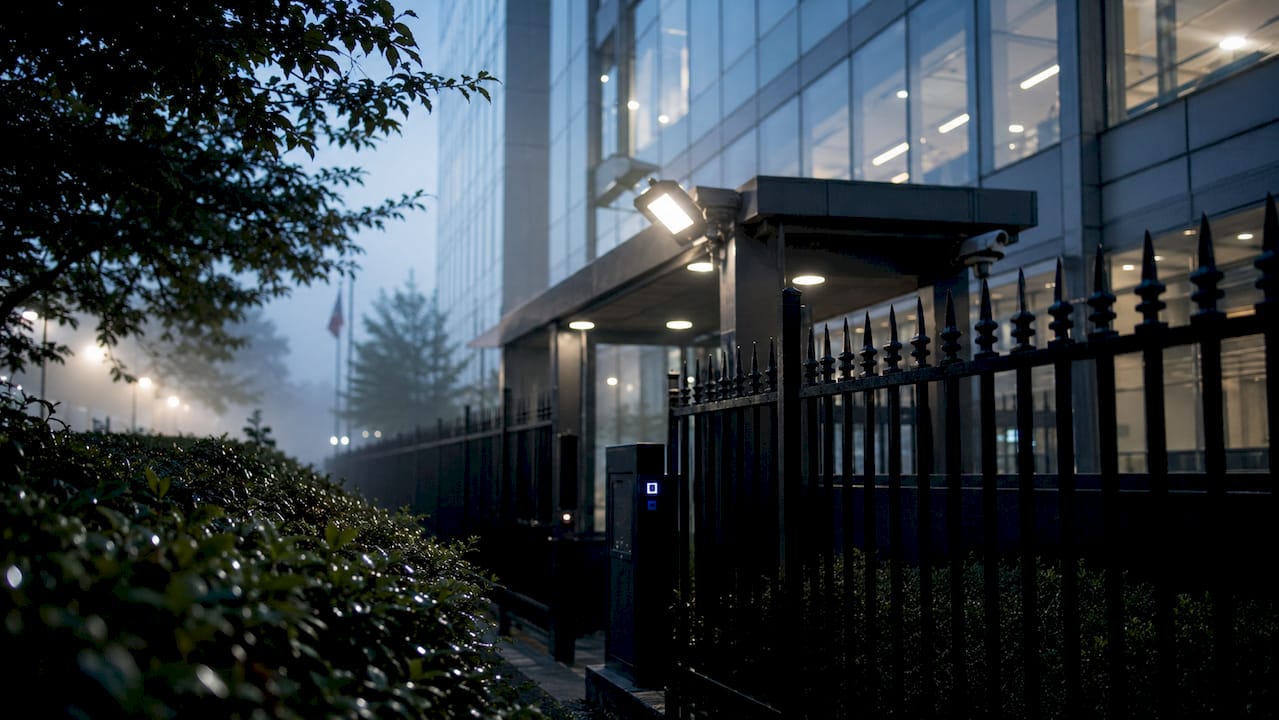
The perimeter is your first line of identification and deterrence. Fencing, lighting, and camera coverage define the boundary and signal that the facility is monitored. Transitional zones like parking lots are common failure points because intruders use them to observe staff routines and wait unnoticed. Lighting and camera coverage in parking areas are not optional extras. They are baseline controls.
The building envelope includes exterior doors, loading docks, and roof access points. Each entry point requires access control hardware, and loading docks deserve particular attention because they often operate outside normal security hours. Camera coverage at the building envelope should overlap so that no angle is blind.
Layer 4 through 7: Lobby, interior zones, and sensitive rooms
The lobby is a controlled transition point, not a public space. Visitor management, reception staffing, and turnstile or mantrap configurations all belong here. Interior movement controls use role-based access to limit where employees can go based on their job function, not just their employment status. This is the practical application of need-to-access principles.
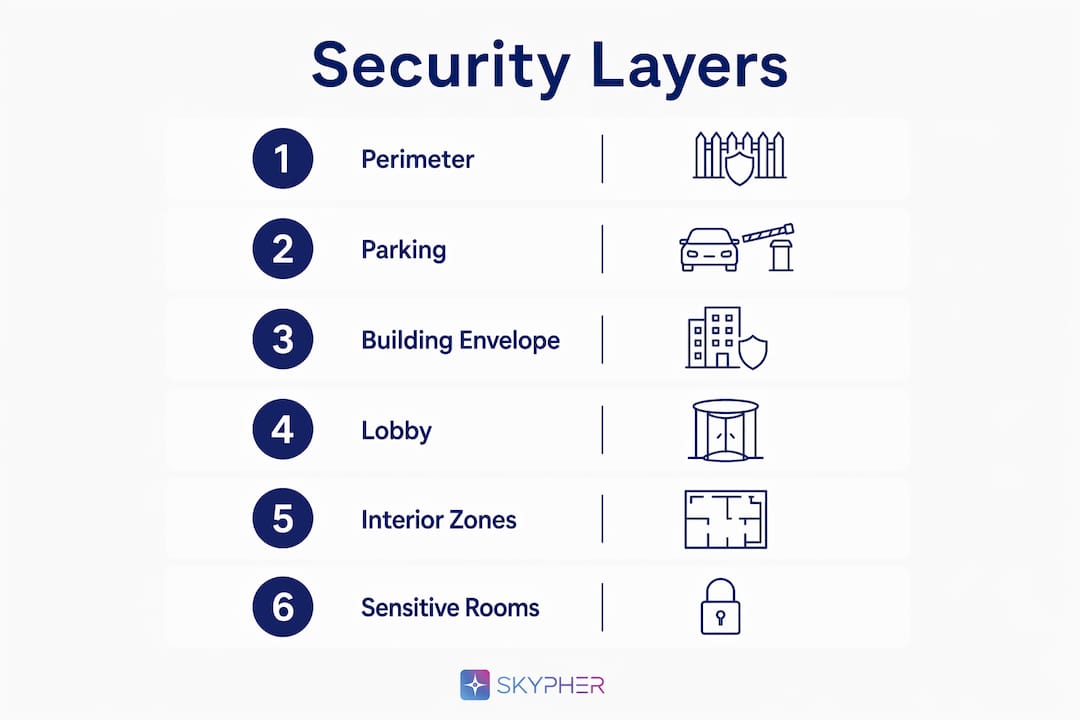
Sensitive rooms, including server closets, communications rooms, and executive areas, require the highest control density. ISO 27001 Annex A 7.3 mandates door-ajar sensors that trigger alerts if a secure door is held open for more than 20 seconds. That 20-second threshold is not arbitrary. It is calibrated to catch tailgating before an intruder is fully inside.
Pro Tip: Zone your facility into risk tiers before selecting hardware. A tier-one zone like a server room justifies biometric readers and mantrap configurations. A tier-three zone like a general office floor may only need card readers. Matching control cost to risk tier prevents both overspending and underprotection.
How do cybersecurity best practices integrate with physical security?
Physical and logical security convergence is the practice of connecting badge access systems, network controls, and monitoring tools into a unified operational picture. Linking physical access events with room booking software gives security teams occupancy ground truth that supports both emergency response and post-incident audits. Without that link, you have two separate data streams that rarely talk to each other.
Key integration controls include:
- Network segmentation for physical security devices. Cameras, access controllers, and intercoms should sit on a dedicated network segment, isolated from corporate IT traffic. A compromised workstation should not be able to reach your CCTV management server.
- Multi-factor authentication for security system access. Anyone administering badge access software or reviewing CCTV footage should authenticate with at least two factors. Credential theft is the most common path to system manipulation.
- Regular firmware updates and removal of default credentials. Default passwords on IP cameras and access controllers are a well-documented attack vector. Audit every device on your physical security network at least quarterly.
- Badge and CCTV log reviews. Regular audits on badge readers and CCTV logs are recommended monthly or quarterly. Logs that are never reviewed provide no security value.
Pro Tip: Assign a named owner to each physical security device in your asset register. Ownerless devices are the ones that never get patched. A named owner creates accountability for firmware updates, credential rotation, and decommissioning.
ISO 27001 compliance requirements extend directly into physical security controls, and security professionals who treat them as a checklist rather than a framework miss the integration opportunity entirely.
What operational policies are essential to a secure HQ environment?
Technology controls fail without supporting policies. A card reader on a server room door means nothing if the access list is never reviewed or if contractors receive permanent badges. Operational policies are the connective tissue between hardware and human behavior.
Core policy controls for a secure HQ include:
- Role-based access control (RBAC) for physical areas. Access rights should follow job function and be reviewed whenever someone changes roles or leaves the organization. Quarterly flash inventory audits of active badges catch orphaned access rights before they become a liability.
- Visitor and contractor management. Visitor badge escort policies with full PACS logging create accountability and prevent unauthorized access through guests or third-party vendors. Every visitor should be logged in, escorted, and logged out.
- Clear desk and workstation lock policies. Sensitive documents left on desks and unlocked screens are physical security failures, not just IT hygiene issues. Clear desk policies reduce the value of physical access to an attacker who has bypassed perimeter controls.
- Continuous employee security training. A structured security training program reduces the human error that technology cannot eliminate. Staff who recognize tailgating, social engineering, and phishing attempts are a control layer in their own right.
- Red team physical penetration testing. Regular physical pen tests reveal gaps that internal teams normalize over time. An external tester will find the propped fire door that staff have stopped noticing.
A well-integrated HQ security program distributes responsibilities across multiple teams and layers of controls rather than concentrating them in a single security function. That distribution is also a resilience strategy. If one team fails, others compensate.
How can security questionnaire automation enhance HQ compliance?
Security questionnaires are the primary mechanism through which organizations demonstrate their security posture to clients, auditors, and regulators. For HQ security programs, they translate physical and cyber controls into documented evidence. Manual completion of these questionnaires is slow, error-prone, and pulls skilled staff away from higher-value work.
Automated security questionnaires transform compliance by enabling real-time risk visibility and reducing the manual bottlenecks that slow governance programs. The practical impact is significant. Where a compliance officer might spend days completing a single detailed questionnaire manually, an AI-driven platform can process the same document in minutes by drawing from a centralized, pre-approved knowledge base.
The benefits of automation extend beyond speed:
- Accuracy. AI models trained on your organization's security documentation produce consistent answers. Manual responses vary depending on who completes the form and what documentation they can find.
- Audit readiness. A centralized answer library means every response is traceable to a source document. Auditors can verify claims without chasing down individual contributors.
- Posture visibility. When questionnaire data flows into a unified platform, security leaders can see patterns across assessments. Recurring gaps in physical security documentation, for example, signal where policy or evidence needs strengthening.
Pro Tip: Build your questionnaire knowledge base around your actual control evidence, not aspirational policy language. Auditors and clients notice when answers describe controls that do not appear in your supporting documentation. Ground every response in what you can prove.
What are best practices for implementing a secure HQ program?
Implementation quality determines whether a security program holds up under pressure or collapses at the first serious test. Several design and operational decisions have an outsized impact on long-term effectiveness.
Floor-to-slab wall construction is required for sensitive rooms because partitioning to suspended ceilings leaves a physical gap above the ceiling tiles. An attacker with ceiling access can bypass every door control you have installed. Server rooms, communications closets, and any room storing sensitive assets need walls that run from the structural floor to the structural ceiling above.
Privately managed internal access control is equally critical. Building master access systems, managed by your landlord or building management company, cannot secure your most sensitive internal zones. Your organization needs its own access control infrastructure for those areas, independent of building-wide systems.
Additional implementation priorities include:
- Regular audit cycles. Continuous audit cycles on physical security devices prevent system degradation over time. Hardware that is never audited drifts out of compliance silently.
- KPIs that measure outcomes, not activity. Track metrics like mean time to detect unauthorized access attempts, percentage of badges deprovisioned within 24 hours of departure, and percentage of devices with current firmware. Activity metrics like "number of audits completed" tell you what you did. Outcome metrics tell you whether it worked.
- Culture and convenience balance. Security controls that create excessive friction get bypassed. Design access flows that are secure and usable. A mantrap that takes 45 seconds to cycle will have a propped door within a week.
Modern turnkey secure facility solutions can compress facility delivery to 6–8 months from contract initiation, roughly half the timeline of traditional construction. That speed matters when business requirements change faster than conventional build programs can respond.
Key Takeaways
Securing a headquarters environment requires layered physical controls, converged cybersecurity practices, and automated compliance management working together as a single program.
| Point | Details |
|---|---|
| Defense-in-depth is the foundation | Layer controls from perimeter to sensitive rooms, with the strictest measures at the innermost zones. |
| Physical and cyber security must converge | Link badge access, network segmentation, and log reviews into one unified operational picture. |
| Policies close the gaps technology cannot | RBAC, visitor management, clear desk rules, and regular training prevent human-factor failures. |
| Automation accelerates compliance | AI-driven questionnaire tools reduce manual errors and give security leaders real-time posture visibility. |
| Design decisions have long-term consequences | Floor-to-slab walls and privately managed access control are non-negotiable for sensitive HQ areas. |
Why HQ security still fails despite good technology
The most common failure I see is not a technology gap. It is a governance gap. Organizations invest in access control hardware, CCTV systems, and network monitoring tools, then fail to connect them to each other or to the people responsible for acting on the data they generate. A camera that records but is never reviewed is not a security control. It is a liability.
Physical and cyber security teams still operate in silos at most organizations I have worked with. The physical security team manages badges and cameras. The IT security team manages firewalls and endpoint detection. Neither team has full visibility into what the other is doing, and the space between them is where attackers operate. Convergence is not a technology project. It is an organizational design decision, and it requires executive sponsorship to stick.
The other pattern I see consistently is over-reliance on compliance frameworks as a substitute for actual security thinking. ISO 27001 Annex A 7.3 gives you a solid baseline, but it does not tell you how to prioritize controls given your specific threat environment. A financial services firm in a downtown high-rise has a different threat profile than a technology company on a suburban campus. Use the standard as a floor, not a ceiling.
The organizations that get this right treat security as a continuous process, not a project with a completion date. They audit, they test, they train, and they update. The ones that struggle treat it as a box-checking exercise and wonder why their controls fail when tested.
— Gaspard
Skypher's role in your HQ compliance program
Security questionnaire management is one of the most time-consuming compliance tasks for HQ security teams. Skypher's AI-driven questionnaire automation platform changes that equation by processing even 200 questions in under a minute, drawing from a centralized knowledge base built on your actual security documentation.

Skypher integrates with over 40 third-party risk management platforms, including OneTrust and ServiceNow, and connects directly with Slack, Microsoft Teams, Confluence, and SharePoint. That means your security team can respond to questionnaires without leaving the tools they already use. The platform also supports a customizable Trust Center where you can share your security and compliance posture with clients and auditors on demand. For compliance officers managing HQ security programs, that combination of speed, accuracy, and visibility is a meaningful operational advantage.
FAQ
What is a secure HQ in cybersecurity terms?
A secure HQ combines layered physical access controls, converged cybersecurity measures, and documented compliance programs into a single, auditable security environment. The standard framework for this approach is defense-in-depth, formalized in standards like ISO 27001 Annex A 7.3.
What does ISO 27001 Annex A 7.3 require for physical security?
ISO 27001 Annex A 7.3 requires door-ajar sensors on secure doors that trigger alerts if a door is held open for more than 20 seconds, along with floor-to-slab wall construction and privately managed access control for sensitive areas.
How does security questionnaire automation support HQ compliance?
Automated platforms like Skypher process questionnaires in minutes by drawing from a pre-approved knowledge base, reducing manual errors and giving security leaders real-time visibility into their compliance posture across assessments.
Why are parking lots a security risk for headquarters facilities?
Parking lots are transitional zones where intruders can observe staff routines and wait unnoticed before attempting access. Lighting and camera coverage in these areas are baseline controls, not optional additions.
How often should badge and CCTV logs be reviewed?
Badge reader and CCTV log reviews are recommended on a monthly or quarterly basis. Logs that are never reviewed provide no operational security value and create a false sense of coverage.