

TL;DR:
- 2025 compliance standards increasingly focus on supply chain, AI privacy, and resilience controls.
- Organizations must integrate these updates into system architecture rather than treat them as checkbox exercises.
- Tools like automation platforms help streamline responses across multiple frameworks and ensure audit readiness.
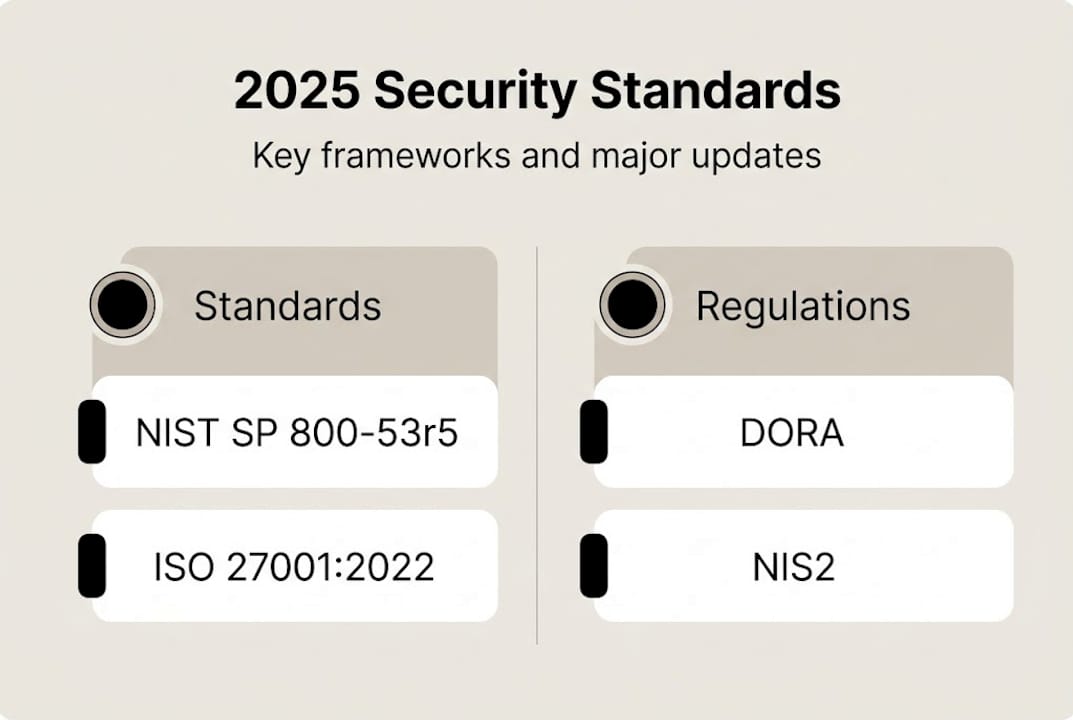
The pace at which information security standards are evolving in 2025 is catching even experienced compliance teams off guard. New mandates, revised frameworks, and tightening deadlines are converging at once, and misreading what actually changed versus what stayed the same can leave your organization exposed during audits. NIST SP 800-53r5.2.0 dropped in August 2025, the ISO 27001:2022 transition window closes, and DORA plus NIS2 are reshaping how finance and tech firms think about third-party risk. This guide breaks down each update clearly, so you can move from confusion to confident implementation.
Table of Contents
- Evolving standards: What's changing for 2025
- Deep dive: NIST SP 800-53r5.2.0 & software supply chain
- ISO 27001:2022 transition and global impacts
- AI privacy, DORA, NIS2: New regulatory dimensions
- A practical perspective: What most organizations miss in the 2025 rush
- How Skypher accelerates your compliance success
- Frequently asked questions
Key Takeaways
| Point | Details |
|---|---|
| 2025 standards overhaul | Major updates to NIST, ISO 27001, and privacy frameworks reshape compliance strategies. |
| Supply chain & SBOM priority | Demands for software supply chain transparency and SBOMs are central to new controls. |
| AI, DORA, NIS2 expansion | AI privacy mandates and financial sector rules bring new regulatory dimensions. |
| Action beats paperwork | Practical control integration and resilience-focused implementation drive real security. |
Evolving standards: What's changing for 2025
With your priorities set, let's clarify which standards and updates truly matter in 2025. The compliance landscape shifted on multiple fronts simultaneously, and organizations that treat each update in isolation will struggle to keep up. The real challenge is understanding how these frameworks interact and where your gaps are most likely to surface.
Here is a quick reference for the major updates in play:
| Standard | Key 2025 Update | Primary Impact Area |
|---|---|---|
| NIST SP 800-53r5.2.0 | Software supply chain, SBOM, resiliency | Federal contractors, tech vendors |
| ISO 27001:2022 | Transition deadline, cloud/threat intel controls | All certified organizations |
| NIST Privacy Framework 1.1 | AI privacy risk, CSF 2.0 alignment | Any org processing personal data |
| DORA | TLPT testing, third-party ICT register | EU financial entities |
| NIS2 | Supply chain security, expanded scope | ICT providers serving EU customers |
The NIST SP 800-53 revision issued in August 2025 focuses on software supply chain security, resiliency by design, developer testing, update management, and software integrity, all driven by Executive Order 14306. Separately, the NIST Privacy Framework 1.1 draft released in April 2025 aligns with CSF 2.0 and adds a dedicated AI privacy risk management section with targeted revisions to the Govern and Protect functions.
What these updates share is a common thread: organizations can no longer treat software provenance, AI data flows, and third-party dependencies as secondary concerns. They are now front-and-center audit targets.
Key areas driving the 2025 compliance workload include:
- Software supply chain transparency, including Software Bill of Materials (SBOM) requirements
- AI privacy governance, covering how personal data is processed within automated systems
- Cyber resiliency design, meaning systems must be architected to recover, not just resist
- Third-party risk registers, especially for financial entities under DORA
- Cloud security controls, now embedded in ISO information security standards
For medium to large tech and finance organizations, these changes affect operational processes, technology stack decisions, and how compliance reporting is structured. The organizations that adapt fastest are those treating these updates as architectural inputs, not just checkbox exercises.
Deep dive: NIST SP 800-53r5.2.0 & software supply chain
Drilling down, here's what the keystone NIST revision demands and how to tackle it practically. The r5.2.0 changes introduce new controls for software supply chain security, resiliency by design, software integrity verification, and structured update management, all responding directly to Executive Order 14306.
Understanding what changed versus what existed before is essential for scoping your remediation effort:
| Control Area | Legacy SP 800-53r5 | SP 800-53r5.2.0 Enhancement |
|---|---|---|
| Software supply chain | General vendor risk controls | Explicit SBOM integrity and provenance tracking |
| Developer testing | Optional security testing guidance | Mandatory developer security testing requirements |
| Update management | Patch management policies | Root cause patch analysis and structured update cycles |
| Resiliency | Availability controls | SA-24 cyber resiliency by design architecture |
To implement these requirements without losing momentum, work through these steps in order:
- Inventory your software components. Build or validate your SBOM for every product and internal system. This is the foundation everything else depends on.
- Establish provenance tracking. Document where each component originates, who maintains it, and what your update cadence looks like.
- Integrate developer security testing. Shift security checks left into CI/CD pipelines rather than treating them as a pre-release gate.
- Implement root cause patch analysis. Every patch cycle should produce a brief root cause report, not just a ticket closure.
- Map SA-24 controls to your architecture. Review how your systems are designed to absorb disruption and recover, not just resist attack.
For teams working through efficient security review strategies, the SA-24 resiliency controls are frequently underestimated. Most organizations focus on the SBOM requirements because they are visible and auditable, but the resiliency by design controls are where auditors are increasingly probing for depth.
Pro Tip: When conducting your root cause patch analysis, document not just what was patched but why the vulnerability existed in the first place. Auditors reviewing r5.2.0 compliance are looking for evidence of systemic improvement, not just reactive fixes. Pairing this with software compliance tools that automate tracking will save significant manual effort.
ISO 27001:2022 transition and global impacts
With NIST demands clear, the next critical piece is ISO 27001:2022's mandatory transition. The October 2025 deadline means organizations still operating under the 2013 version of the standard are running out of runway. Audits conducted after that date must be performed against the 2022 controls, and certification bodies will not accept the old version.
The 2022 revision introduced 11 new controls and reorganized the Annex A structure significantly. The areas that matter most for tech and finance organizations include:
- Threat intelligence (A.5.7): You must now demonstrate a formal process for collecting, analyzing, and acting on threat intelligence relevant to your environment.
- Cloud services security (A.5.23): Cloud usage must be governed by documented policies covering acquisition, use, management, and exit.
- ICT readiness for business continuity (A.5.30): Business continuity planning must explicitly address ICT systems, not just business processes.
- Data masking and deletion (A.8.11, A.8.10): Data lifecycle controls are now more granular and audit-ready evidence is expected.
"Organizations that crosswalk ISO 27001:2022 requirements against their existing NIST or DORA control sets before their audit will spend significantly less time in evidence collection and significantly more time demonstrating genuine maturity."
Before your audit, verify these items are in place: your Statement of Applicability reflects the 2022 Annex A structure, your risk treatment plan references the new controls, your internal audit program has been updated to test the new requirements, and your cloud vendors have been assessed under A.5.23.

For organizations pursuing ISO 27001 automation, the transition is actually an opportunity to eliminate manual evidence collection that has been slowing audit cycles for years. The ISO 27001 vs SOC 2 comparison is also worth revisiting if your organization holds both certifications, since the 2022 revision brings the two frameworks closer in several areas.
Pro Tip: Map your new ISO 27001:2022 controls directly to your NIST SP 800-53r5.2.0 control catalog before your audit. Many of the cloud and supply chain controls overlap significantly, and demonstrating that crosswalk to your auditor signals program maturity rather than siloed compliance work.
AI privacy, DORA, NIS2: New regulatory dimensions
Beyond core controls, 2025's landscape is shaped by AI governance and expanding financial regulations. These three regulatory dimensions are distinct but increasingly interconnected, especially for organizations operating across both tech and finance.
The NIST Privacy Framework 1.1 draft released in April 2025 adds a dedicated AI privacy risk management section and aligns with CSF 2.0. In practical terms, this means organizations using AI systems for customer data processing, fraud detection, or automated decision-making now need to document how those systems handle personal data, what bias and transparency controls exist, and how individuals can exercise their rights.
DORA, which applies to EU financial entities and their critical ICT providers, introduces:
- TLPT (Threat-Led Penetration Testing): Required every three years for critical IT functions, with specific scoping and execution requirements
- Third-party ICT register: Financial entities must maintain a complete register of all ICT service providers, including concentration risk analysis
- Incident classification and reporting: Standardized reporting timelines and severity thresholds that differ from existing national requirements
NIS2 extends supply chain security obligations to ICT providers that serve EU customers, even if those providers are headquartered outside the EU. For tech companies with European clients in critical sectors, this means supply chain risk assessments and security incident notification obligations are now part of your compliance scope.
"The finance sector's cyber maturity gap is narrowing, but organizations that delay DORA alignment risk not just regulatory penalties but also losing contracts with EU financial institutions that are required to assess their ICT providers' compliance posture."
For teams exploring AI for security compliance, the intersection of AI governance and privacy frameworks is where the most complex questions are emerging. The key is integrating privacy-by-design into AI development workflows before deployment, not retrofitting controls after the fact.
A practical perspective: What most organizations miss in the 2025 rush
Stepping back, let's cut through the noise with lessons from in-the-trenches practitioners. The most common mistake we see is organizations treating compliance as a documentation exercise. They update policies, revise their SoA, and collect evidence, but the underlying systems and processes remain unchanged. Auditors are getting better at spotting this gap.
What experienced practitioners actually prioritize is different. They tighten update management processes first because that is where real vulnerabilities accumulate. They integrate privacy-by-design into product development early, before the architecture is locked. They use control mapping aggressively to reduce audit preparation time across overlapping frameworks.
The contrarian insight worth sitting with: a compliance certificate does not equal a secure organization. In a dynamic threat landscape, resilience and adaptability matter more than any single audit outcome. Organizations that build genuine control maturity will handle the next framework revision with far less disruption than those chasing certifications.
Pro Tip: Run a structured post-audit retrospective within 30 days of every major audit. Document what controls were questioned, what evidence was weak, and what auditor comments revealed about your program's blind spots. Feed those findings directly into your annual compliance roadmap. For teams following security review expert advice, this practice alone closes more gaps than most gap assessment tools.
How Skypher accelerates your compliance success
To make these standards actionable, the right tools multiply impact. Managing NIST, ISO, DORA, and NIS2 requirements simultaneously means your team is fielding a high volume of security questionnaires, evidence requests, and vendor assessments. That workload compounds fast.

Skypher's security questionnaire automation platform maps your existing controls to incoming questionnaire requirements automatically, cutting response time from days to minutes. With integrations across 40-plus TPRM platforms, real-time collaboration, and AI-powered content management, your compliance team can focus on strategic decisions rather than manual evidence gathering. Whether you are preparing for an ISO 27001 audit, responding to DORA-related vendor assessments, or managing SBOM documentation requests, Skypher keeps your responses accurate and audit-ready. Get started with Skypher and see how automation transforms your 2025 compliance program.
Frequently asked questions
What are the most important new controls in NIST SP 800-53r5.2.0 for 2025?
NIST SP 800-53r5.2.0's critical updates include software supply chain security controls, SBOM integrity verification, cyber resiliency by design architecture, and structured root cause patch management. These controls directly address vulnerabilities exposed in recent supply chain incidents.
What is the deadline for transitioning to ISO 27001:2022?
The ISO 27001:2022 transition deadline is October 2025. Organizations must complete their audit under the new version by then, or their certification will lapse until a conforming audit is completed.
How does DORA affect financial organizations in 2025?
DORA requires EU financial entities to conduct TLPT testing every three years for critical functions, maintain a full third-party ICT provider register, and align incident reporting with standardized EU cyber risk requirements.
What are the AI privacy risk management requirements in the 2025 NIST Privacy Framework?
The NIST Privacy Framework 1.1 draft adds specific guidance for AI privacy risks, requiring organizations to document how AI systems process personal data and align governance and protection activities with CSF 2.0 principles.