

TL;DR:
- Staff security training transforms employees into active defenders by teaching them to recognize and prevent cyber threats. Continuous, role-based micro-learning, simulated phishing with coaching, and leadership engagement are essential for meaningful behavioral change. Effective programs track suspicious email reporting and training completion to ensure compliance and reduce organizational risk.
Staff security training is the systematic process of educating employees to recognize, respond to, and prevent cyber threats, turning your workforce into an active line of defense. Human error contributes to over 70% of data breaches, which means technology controls alone cannot close the gap. Structured programs that combine phishing simulations, micro-learning modules, and role-based frameworks have proven they work: mature programs reduce phishing click rates from 30–40% at baseline to under 5% within 12 months. Compliance frameworks including HIPAA, PCI DSS v4.0, and the FTC Safeguards Rule all mandate documented employee security training, making this a legal requirement as much as a security one.
What makes staff security training actually work?
Most organizations run annual training and call it done. That approach fails because knowledge fades within weeks without reinforcement. Effective employee IT security training is built on four components that work together continuously.
Micro-learning over marathon sessions
Micro-learning modules of 10–15 minutes delivered monthly or bi-weekly maintain awareness without disrupting workflows. Short, focused sessions on a single topic, such as recognizing a spear-phishing email or handling a USB device found in a parking lot, stick far better than a two-hour annual video. Frequency matters as much as format.
Role-based content that matches real risk
Role-based security awareness training tailored to job functions significantly improves engagement compared to generic programs. A finance team member faces wire fraud attempts. A developer faces supply chain attacks. A customer service rep faces social engineering calls. Giving all three the same training content wastes time and misses the threats that actually target each group. Mapping content to roles closes the gaps where breaches actually happen.

Phishing simulations with coaching, not punishment
Phishing simulations are the most direct way to test real behavior under realistic conditions. The key is what happens after someone clicks. Constructive, immediate coaching after a failed simulation produces better awareness and reporting rates than punitive responses. Treat simulations as a learning moment, not a trap.
Ongoing reinforcement
- Monthly phishing simulations with personalized feedback
- Quarterly policy refreshers tied to current threat trends
- Security newsletters or Slack alerts covering real incidents
- Annual recertification for compliance documentation
Pro Tip: Run a risk-based tier system: weekly touchpoints for high-risk roles like finance and IT admins, monthly for the general workforce. This keeps your highest-exposure employees sharp without overwhelming everyone else.
How to design a training program for your organization
Building a security awareness program that fits your organization requires more than picking a vendor and assigning videos. Follow a structured approach to get results.
Step 1: Conduct a human risk assessment. Identify where your people are most vulnerable. Review past incident reports, phishing test results, and access logs to find patterns. Which departments click the most? Which roles have the broadest system access? This data drives every decision that follows.
Step 2: Segment your workforce by risk profile. Group employees into tiers based on their threat exposure and access level. Executives, finance staff, and IT administrators belong in a high-risk tier. General employees form a standard tier. Each tier gets different training frequency and content depth.
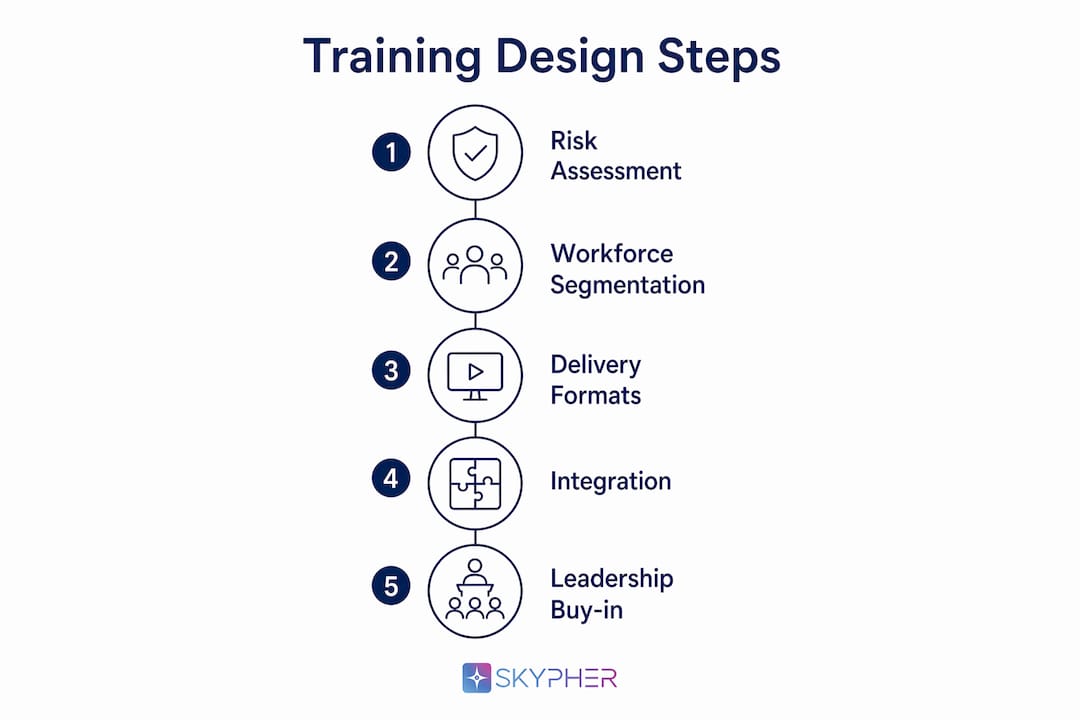
Step 3: Choose delivery formats that fit how your people work. A field-based workforce needs mobile-friendly, self-paced modules. A remote engineering team may respond better to short video series integrated into tools like Slack or Microsoft Teams. The format must remove friction, not add it.
Step 4: Integrate training with HR systems and document everything. HIPAA, PCI DSS, and the FTC Safeguards Rule require documented training records with a minimum three-year retention period. Connect your training platform to your HR system so completion records are automatic and audit-ready.
Step 5: Secure leadership buy-in before launch. Security culture starts at the top. When executives participate visibly in training and reference it in communications, participation rates and seriousness increase across the organization. A CISO or COO who skips the training sends a louder message than any policy document.
| Implementation Stage | Key Action | Success Indicator |
|---|---|---|
| Risk Assessment | Identify vulnerable roles and past incidents | Risk tier map completed |
| Content Design | Match modules to role-specific threats | Role-based curriculum approved |
| Delivery Setup | Integrate with HR and communication tools | Automated enrollment active |
| Launch | Executive participation and communication | 90%+ completion in first cycle |
| Ongoing Review | Monthly simulations and quarterly refreshers | Click rate below 5% within 12 months |
Pro Tip: Treat your security awareness program launch like a product rollout. Write internal communications, brief managers, and set a clear timeline. Programs that launch quietly die quietly.
What metrics actually measure training success?
Completion rates are the most common metric and the least useful one. An employee who finishes a video but still clicks every phishing link has learned nothing. Behavioral change is the real measure of success.
The two metrics that matter most are phishing click rates and suspicious email reporting rates. Phishing reporting rates are more telling than click rates alone because they show whether employees trust the system enough to flag threats rather than ignore them. A workforce that reports suspicious emails actively shrinks your incident response window.
Use simulation results to identify repeat offenders and tailor coaching to them individually. Someone who clicks three consecutive simulations needs a different intervention than someone who clicked once. Aggregate data hides this nuance.
| Metric | Baseline (Untrained) | Target (12 Months) |
|---|---|---|
| Phishing click rate | 30–40% | Under 5% |
| Suspicious email reporting rate | Low or near zero | Measurably increasing |
| Training completion rate | Varies | 95%+ per cycle |
| Repeat simulation failures | High | Declining quarter over quarter |
Compliance documentation is a separate but equally important output. Auditors for HIPAA and PCI DSS require evidence of training completion, assessment scores, and remediation actions. A training certificate process that captures this automatically saves significant time during audits and removes the risk of missing records.
What are the biggest challenges in security training?
Even well-designed programs run into predictable problems. Knowing them in advance lets you build around them.
Training fatigue sets in when employees see security content as repetitive or irrelevant. The fix is variety and relevance. Rotate formats between video, scenario-based exercises, and live workshops. Use real incidents from your industry, not generic examples from five years ago.
Fear-based culture is the most damaging outcome of poorly run phishing simulations. Punitive simulations create a culture of fear and encourage employees to hide mistakes rather than report them. When people fear consequences, incidents go unreported and dwell time increases. Reframe every simulation as a coaching opportunity.
Generic content is the most common reason programs fail to change behavior. One-size-fits-all training is a primary cause of program failure because it fails to connect with the actual threats each role faces. A warehouse worker and a cloud architect do not share the same threat model.
Outdated threat scenarios are a growing problem as AI-powered social engineering advances. Modern AI-driven attacks have made grammar-error spotting obsolete as a detection method. Training must now teach verification protocols, such as calling back a sender through a known number, regardless of how legitimate a message appears. Teach process, not pattern recognition.
- Rotate content formats every quarter to prevent fatigue
- Use current threat examples from your sector, not generic case studies
- Frame simulations as learning tools in all internal communications
- Update AI-related threat content at least twice per year
"The goal of security training is not to catch employees failing. It is to build the habit of pausing before acting, every time."
Pro Tip: For distributed or shift-based workforces, offer asynchronous formats with a two-week completion window. Forcing everyone into a single live session creates resentment and low retention. Flexibility increases completion and engagement.
Key takeaways
Effective staff security training requires continuous behavioral reinforcement, not annual compliance checkboxes, to meaningfully reduce organizational cyber risk.
| Point | Details |
|---|---|
| Behavior change is the goal | Measure phishing reporting rates and click reductions, not just video completions. |
| Role-based content outperforms generic | Map training content to each job function's actual threat exposure for better results. |
| Simulations need coaching, not punishment | Immediate, constructive feedback after failed simulations builds trust and improves reporting. |
| Compliance requires documentation | HIPAA, PCI DSS, and FTC rules mandate training records retained for at least three years. |
| Leadership drives culture | Visible executive participation in training sets the standard for the entire organization. |
Why most security training programs stay stuck at compliance
I have reviewed dozens of security training programs across tech and finance organizations, and the pattern is consistent. The programs that fail share one trait: they were built to satisfy an auditor, not to change behavior. Leadership signs off on an annual video series, HR logs the completions, and the security team checks the compliance box. Then a wire fraud attempt succeeds because a finance analyst did not recognize a spoofed email from the CFO.
The programs that actually work treat security training as a continuous rhythm, the same way finance teams run monthly closes or HR runs quarterly reviews. They are never finished. They adapt when new threats emerge, they respond when simulations reveal weak spots, and they involve leadership in ways that are visible to the whole organization.
The uncomfortable truth is that most organizations underinvest in the behavioral science side of training. They buy a platform, assign modules, and assume the work is done. Real behavior change requires repetition, relevance, and psychological safety. Employees need to feel that reporting a mistake is safer than hiding it. That culture does not come from a video. It comes from how leadership responds the first time someone admits they clicked a bad link.
If you want to know whether your program is working, skip the completion dashboard. Ask your security team how many suspicious emails got reported last month. That number tells you everything.
— Gaspard
How Skypher supports your security training compliance
Security training generates a significant paper trail: completion records, assessment scores, simulation results, and remediation logs. Managing that documentation manually across hundreds of employees creates audit risk and wastes time your security team does not have.

Skypher's AI Security Questionnaire Automation tool helps organizations manage the compliance documentation that security training programs produce. When clients or auditors send security questionnaires asking about your training practices, Skypher answers them accurately and fast, pulling from your existing documentation. The platform's automated review cycles and duplicate detection keep your responses current without manual effort, so your audit readiness stays strong between review periods. For tech and finance teams running structured training programs, that means less time on paperwork and more time on the training itself.
FAQ
What is staff security training?
Staff security training is a structured program that educates employees to recognize and respond to cyber threats such as phishing, social engineering, and data handling risks. It combines awareness content, simulations, and behavioral reinforcement to reduce human-caused security incidents.
How often should employees complete security training?
Compliance frameworks like HIPAA and PCI DSS require annual training at minimum, but effective programs run monthly micro-learning sessions and monthly phishing simulations. High-risk roles such as finance and IT administrators benefit from weekly touchpoints.
What is the most important metric for measuring training success?
Suspicious email reporting rate is a stronger indicator than phishing click rate alone, because it shows whether employees trust the process enough to flag threats actively. Behavioral change metrics reveal far more about program effectiveness than completion rates.
Why do phishing simulations sometimes backfire?
Punitive simulations that shame or penalize employees for clicking create a fear-based culture where mistakes get hidden rather than reported. Framing simulations as coaching tools with immediate, supportive feedback produces better long-term reporting behavior and awareness.
Does security training satisfy compliance requirements on its own?
Training must be documented to satisfy HIPAA, PCI DSS v4.0, and FTC Safeguards Rule requirements. Records of completion, assessment results, and remediation actions must be retained for a minimum of three years. Training without documentation does not meet audit standards.