

TL;DR:
- A TPRM questionnaire is a structured tool that evaluates a vendor’s security, compliance, and risks throughout the relationship. It guides onboarding and ongoing monitoring, ensuring risk assessments are documented and consistent.
- Effective programs depend on using industry-standard frameworks, risk-tiered questionnaires, independent validation, and automated workflows to avoid delays and ensure regulatory compliance.
A TPRM questionnaire is the structured information-gathering document that risk teams use to evaluate vendor security, compliance, and operational controls before and during a third-party relationship. It sits at the center of every vendor risk assessment program, from initial onboarding through ongoing monitoring. Frameworks like the Shared Assessments SIG and the CSA CAIQ have become the industry standard for building these assessments. Without a well-designed questionnaire process, third party risk management collapses into guesswork and audit gaps.
What is a TPRM questionnaire and why does it matter?
A TPRM questionnaire is defined as a structured vendor evaluation tool covering governance, security controls, data privacy, business continuity, subcontractor dependencies, and ESG policies. That scope makes it the single most complete picture of a vendor's risk profile available before a contract is signed. Financial institutions, healthcare organizations, and regulated technology companies rely on it to satisfy both internal governance requirements and external regulatory scrutiny. Without it, risk teams have no documented basis for approval or escalation decisions.
The questionnaire also drives monitoring after onboarding. A vendor's answers at intake become the baseline against which future responses are compared. Drift between those answers signals control degradation or changed business circumstances. That ongoing comparison is what separates a mature third party risk management program from a one-time checkbox exercise.
What types of vendor risk questionnaires exist?
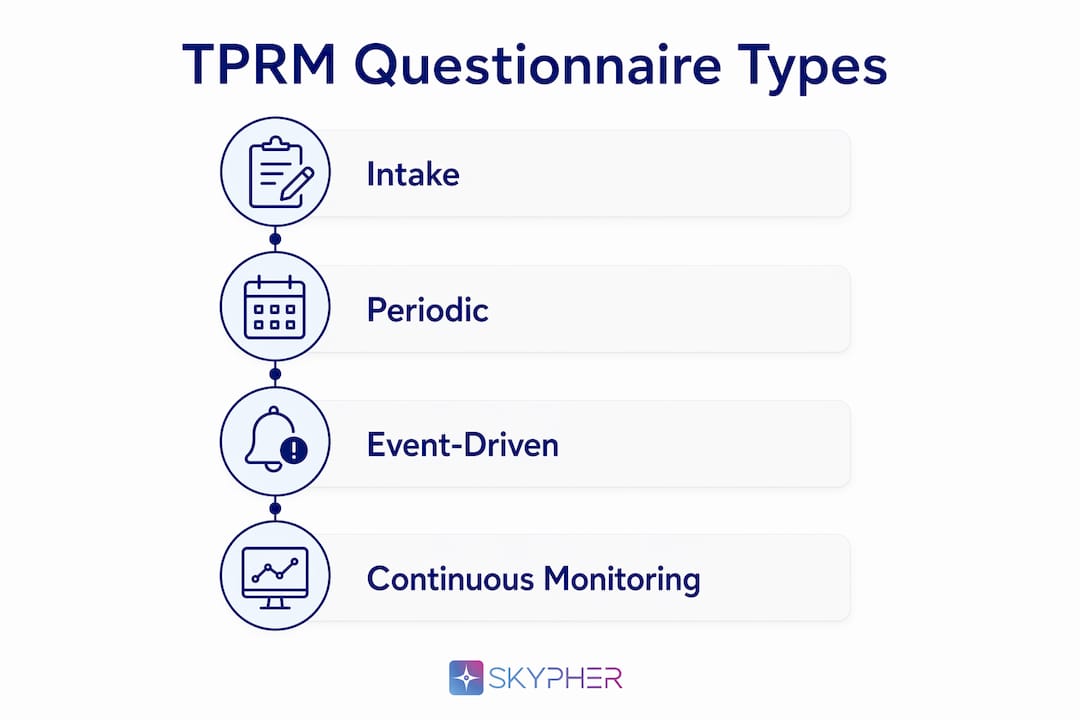
Four major questionnaire types exist in TPRM programs, each serving a distinct purpose and creating distinct operational challenges.
- Initial intake questionnaires collect baseline data to classify vendors by inherent risk tier. They are typically shorter, focused on business profile, data handling, and access scope.
- Periodic assessments are the most detailed and the most operationally demanding. They align to control frameworks like SIG or CAIQ and are sent on an annual or biannual cycle. Periodic assessments frequently cause backlog, with cycle times extending beyond six weeks and sometimes stretching to months.
- Attestations and certifications such as ISO 27001 and SOC 2 reports serve as alternate evidence. They reduce the question burden on vendors who already hold recognized third-party certifications.
- Event-driven questionnaires are triggered by incidents, regulatory changes, or urgent customer requests. They are ad hoc by nature and often compete with periodic assessment workloads for analyst time.
Each type creates a different workflow problem. Intake questionnaires pile up during vendor onboarding surges. Periodic assessments create predictable seasonal backlogs. Event-driven requests arrive without warning and demand fast turnaround.
Pro Tip: Build separate routing rules and SLA targets for each questionnaire type. Treating all four as a single queue is the fastest way to miss deadlines on the ones that matter most.
What domains does an effective TPRM assessment cover?
The most widely used frameworks define the content domains that a supplier risk questionnaire should address. The Shared Assessments SIG spans 21 risk domains, including access control, cloud services, incident management, compliance, supply chain risk, and privacy. The CSA CAIQ covers 17 cloud security domains with 261 yes/no questions mapped to the Cloud Controls Matrix. Both frameworks give risk teams a pre-built question bank rather than a blank page.

The table below maps the core domains to the types of questions typically asked within each.
| Domain | Typical TPRM assessment questions |
|---|---|
| Access control | Who has privileged access? How is it reviewed and revoked? |
| Data privacy | What data is collected, stored, and shared? Where is it processed? |
| Incident management | What is the breach notification timeline? Who is the security contact? |
| Business continuity | What is the RTO/RPO? Has the BCP been tested in the past 12 months? |
| Subcontractor risk | Which fourth parties process your data? Are they assessed? |
| ESG and compliance | Are there active regulatory sanctions or litigation? |
Tailoring questionnaire depth to vendor risk tier is the key design principle. A low-risk SaaS tool that processes no personal data does not need the same 200-question assessment as a core banking infrastructure provider. Risk-tiered questionnaire depth keeps the program proportionate and prevents vendor fatigue that leads to low-quality responses.
Standardized frameworks also serve a governance function. Using SIG, CAIQ, and similar models reduces the assessment burden, improves vendor comparability across your portfolio, and gives auditors a recognized reference point. That comparability is what allows risk teams to spot outliers and prioritize remediation.
How do you optimize a TPRM questionnaire program for efficiency?
Operational management of questionnaires is as critical as questionnaire design. Volume, routing failures, and evidence rework are the three main causes of program breakdown. The following steps address each directly.
- Build a centralized evidence library. Map your organization's standard security and operational controls to common questionnaire domains. Maintaining an internal evidence answer library eliminates redundant vendor requests and cuts rework across multiple questionnaire formats. Teams that skip this step answer the same questions from scratch every cycle.
- Use SIG and CAIQ as internal scoring inputs. Treat vendor responses to these frameworks as feeds into your own risk scoring model rather than standalone documents. That approach maintains consistent domain coverage and makes comparative analysis across vendors straightforward.
- Apply risk tiering before distribution. Inherent risk scoring determines questionnaire depth. High-risk vendors receive full assessments with evidence requests. Low-risk vendors receive abbreviated intake forms. This prevents analyst time from being consumed by low-value reviews.
- Accept certifications as partial evidence. A vendor holding a current SOC 2 Type II report has already had its controls independently tested. Accepting that report in place of redundant questions reduces cycle time without reducing assurance.
- Automate routing and tracking. Manual email-based distribution is the single biggest source of cycle time delays. Platforms that connect to portals like OneTrust and ServiceNow remove the routing bottleneck and give risk teams real-time visibility into response status.
Pro Tip: Set a hard rule: no new questionnaire goes out without first checking the evidence library. That one habit cuts first-draft completion time significantly for most teams.
Automation also addresses the accuracy problem. AI-powered tools can validate vendor responses against prior answers and flag inconsistencies before an analyst reviews the file. That pre-screening catches errors that would otherwise require a follow-up cycle, adding days to an already stretched timeline.
How do TPRM questionnaires fit into the full risk management lifecycle?
A third party assessment form is not a standalone document. It fits into a defined sequence of steps that together constitute a complete TPRM process overview.
- Inherent risk scoring classifies the vendor before any questionnaire is sent. Data sensitivity, access scope, and geographic location drive the tier assignment.
- Questionnaire distribution sends the appropriate depth of assessment based on that tier. High-risk vendors receive SIG or equivalent; lower-risk vendors receive abbreviated forms.
- Response review and independent validation is where most programs underinvest. Questionnaire responses must be cross-checked against certifications, financial health data, and sanctions screening results. Relying solely on self-reported answers without verification is the most common gap auditors find.
- Risk scoring and documentation converts the validated responses into a risk rating. That rating feeds the approval decision and the ongoing monitoring schedule.
- Tiered monitoring sets the frequency of future assessments. Critical vendors may be reassessed annually or after any material incident. Lower-risk vendors may move to a two-year cycle.
"A questionnaire answer is a claim. Independent validation is the evidence. Programs that skip validation are auditing vendor intentions, not vendor controls."
Records from every step must be retained to satisfy regulatory requirements from bodies like the OCC, FCA, and DORA. Regulators do not accept verbal assurances that due diligence occurred. The questionnaire file, the validation notes, and the risk rating decision all need to be documented and retrievable.
Questionnaire insights also connect to financial and operational assessments. A vendor that scores well on security controls but shows signs of financial distress presents a different risk profile than the questionnaire alone would suggest. Integrating vendor risk analysis across security, financial, and operational dimensions gives the most complete picture.
Key Takeaways
A well-designed TPRM questionnaire program requires standardized frameworks, risk-tiered depth, independent validation, and automated workflow management to deliver accurate and audit-ready vendor risk assessments.
| Point | Details |
|---|---|
| Use recognized frameworks | SIG and CAIQ provide pre-built question banks that improve vendor comparability and satisfy auditors. |
| Tier questionnaire depth | Match assessment length to inherent risk score to protect analyst time and reduce vendor fatigue. |
| Validate responses independently | Cross-check answers against certifications, financial data, and sanctions screening before scoring. |
| Build an evidence library | Centralized, reusable answers eliminate redundant requests and cut cycle times across all questionnaire types. |
| Automate routing and tracking | Manual email distribution is the primary cause of backlog; platform integrations with OneTrust and ServiceNow resolve it. |
Why most TPRM questionnaire programs fail before they scale
The programs I see fail most often are not failing on questionnaire design. They have solid domain coverage, reasonable question sets, and the right frameworks on paper. They fail on operations. The questionnaire sits in an analyst's inbox for three weeks because no one owns the routing decision. The evidence library was started once and never maintained. The periodic assessment cycle launches in september and the backlog is still unresolved in december.
The second failure pattern is the one-size-fits-all questionnaire. Sending a 200-question SIG to every vendor regardless of risk tier is not thoroughness. It is a signal that the program was designed by a compliance team that never had to manage the response volume. Mapping questionnaires to specific regulatory obligations and customer requirements, rather than building a single universal form, is what separates programs that scale from programs that stall.
The third issue is treating certifications as a threat to the questionnaire rather than a complement to it. A vendor with a current ISO 27001 certificate has already answered most of your access control and incident management questions through an independent auditor. Accepting that evidence and skipping the redundant questions is not a shortcut. It is proportionate assurance.
The programs that work well share one trait: they treat the third-party risk checklist as a living operational process, not a document. They review routing rules quarterly, update the evidence library after every major assessment cycle, and adjust questionnaire depth as vendor relationships evolve. That discipline is what makes a questionnaire program audit-ready at any point in the year, not just during a regulatory review.
— Gaspard
How Skypher handles TPRM questionnaire automation at scale
Risk and compliance teams managing high questionnaire volumes need more than a well-designed form. They need a platform that removes the operational friction between receiving a questionnaire and delivering a validated, accurate response.

Skypher's AI-powered recommendation engine automates questionnaire response and validation, drawing on a centralized knowledge base to answer even 200 questions in under one minute. The platform connects to over 40 TPRM portals, including OneTrust and ServiceNow, and integrates with Slack, Microsoft Teams, Confluence, and SharePoint for real-time collaboration. Skypher's Trust Center gives vendors and customers a single, always-current view of your security and compliance posture, reducing back-and-forth on recurring requests. For teams managing periodic assessment backlogs and event-driven questionnaire surges, Skypher turns a weeks-long process into a same-day workflow.
FAQ
What is a TPRM questionnaire?
A TPRM questionnaire is a structured set of questions used to evaluate a vendor's security controls, compliance posture, and operational risk before and during a third-party relationship. It covers domains including data privacy, access control, business continuity, and subcontractor dependencies.
What is the difference between SIG and CAIQ?
The Shared Assessments SIG covers 21 risk domains and is used for broad vendor risk assessments across industries. The CSA CAIQ covers 17 cloud security domains with 261 yes/no questions and is designed specifically for cloud service providers aligned to the Cloud Controls Matrix.
How often should vendors complete a risk management survey?
Assessment frequency depends on the vendor's risk tier. Critical or high-risk vendors are typically reassessed annually or after a material incident. Lower-risk vendors may move to a two-year cycle based on their inherent risk score and control stability.
How do certifications like SOC 2 and ISO 27001 affect questionnaire requirements?
Current certifications from recognized auditors can replace redundant questionnaire sections. A vendor with a valid SOC 2 Type II report has already had its controls independently tested, which reduces the question burden without reducing assurance quality.
What causes TPRM questionnaire backlogs?
Backlogs are primarily caused by manual routing, lack of an evidence library, and sending the same full-length assessment to all vendors regardless of risk tier. Periodic assessments are the most common source, with cycle times frequently extending beyond six weeks when workflow automation is absent.