

TL;DR:
- Most executives believe risk mitigation aims to eliminate threats entirely, but it mainly involves managing risks within an acceptable level.
- Effective strategies include avoiding, reducing, transferring, or accepting risks, often combined for best results in organizational resilience.
Most executives assume a risk mitigation strategy is about eliminating threats entirely. It isn't. A solid risk mitigation strategy is about deciding which risks to reduce, which to transfer, which to accept, and which to avoid altogether. According to Pathlock, risk mitigation is a structured set of controls and procedures designed to treat identified risks within an acceptable risk appetite, not wipe them from the board. Get this distinction wrong, and you end up either paralyzed by over-caution or blindsided by threats you never planned for.
Table of Contents
- Key Takeaways
- What is risk mitigation strategy: definition and core concepts
- The four primary risk mitigation strategies
- Implementing risk mitigation: frameworks and best practices
- Measuring effectiveness and evolving your approach
- My perspective on risk mitigation and strategic resilience
- How Skypher helps you operationalize risk mitigation
- FAQ
Key Takeaways
| Point | Details |
|---|---|
| Mitigation is not elimination | Effective strategies manage risk to acceptable levels, not zero, balancing resources against real threats. |
| Four core strategies exist | Avoidance, reduction, transfer, and acceptance each serve distinct contexts and risk profiles. |
| Implementation gaps are widespread | Only 7% of organizations have ERM fully integrated into strategic decisions despite near-universal belief in its value. |
| Measurement drives improvement | KPIs and periodic reviews keep mitigation plans aligned with evolving threats and business priorities. |
| Compliance is not the ceiling | Organizations that treat mitigation as a strategic tool, not just a checkbox, gain measurable competitive advantage. |
What is risk mitigation strategy: definition and core concepts
The definition of risk mitigation is precise: it is a proactive, structured process of identifying potential threats and implementing controls to reduce their likelihood or impact before they materialize. This separates mitigation from crisis response, which is reactive by nature.
Risk mitigation operates within a broader risk management framework but focuses specifically on the treatment phase, the point where you decide what to do about a risk once you have identified and assessed it. The controls you put in place can be technical, procedural, contractual, or behavioral. All of them serve the same purpose: keeping risk within the organization's defined tolerance.
Three concepts anchor the definition:
- Risk appetite: The level of risk an organization is willing to accept to pursue its objectives. Mitigation strategies exist to keep actual risk exposure within this boundary.
- Risk tolerance: The specific acceptable variation around the risk appetite. Tolerance is narrower and more operational. A company may accept market volatility as a category (appetite) but cap maximum portfolio drawdown at 15% (tolerance).
- Residual risk: What remains after controls are applied. No mitigation strategy removes all risk. The goal is to reduce residual risk to an acceptable level, not to zero.
Pro Tip: Before selecting any mitigation tactic, document your organization's risk appetite formally. Without it, your teams have no objective standard for deciding when a risk is "handled," which leads to either overcautious inaction or dangerous under-investment in controls.
The reactive alternative, waiting for a risk to become an incident before acting, costs significantly more in both financial and reputational terms. Proactive mitigation is also more adaptable. When your controls are designed in advance, you can monitor them, adjust them, and test them before they face a real challenge.

The four primary risk mitigation strategies
ISO 31000 and NIST SP 800-30 define four primary risk response strategies that every risk professional should understand deeply, not as abstract categories, but as practical tools with real trade-offs.
| Strategy | What it means | Business example |
|---|---|---|
| Avoidance | Stop or change an activity that generates unacceptable risk | Declining to enter a heavily regulated market where compliance costs exceed projected returns |
| Reduction | Apply controls to lower the likelihood or impact of a risk | Implementing multi-factor authentication to reduce the probability of unauthorized access |
| Transfer | Shift the financial or operational burden to a third party | Purchasing cyber liability insurance or using contracts to assign liability to a vendor |
| Acceptance | Acknowledge the risk and tolerate it, with planned monitoring | Accepting the minor risk of occasional small billing errors in a low-volume product line |
These four strategies are rarely used in isolation. Most mature risk programs use a combination, often layering reduction on top of transfer or pairing acceptance with clear monitoring thresholds.
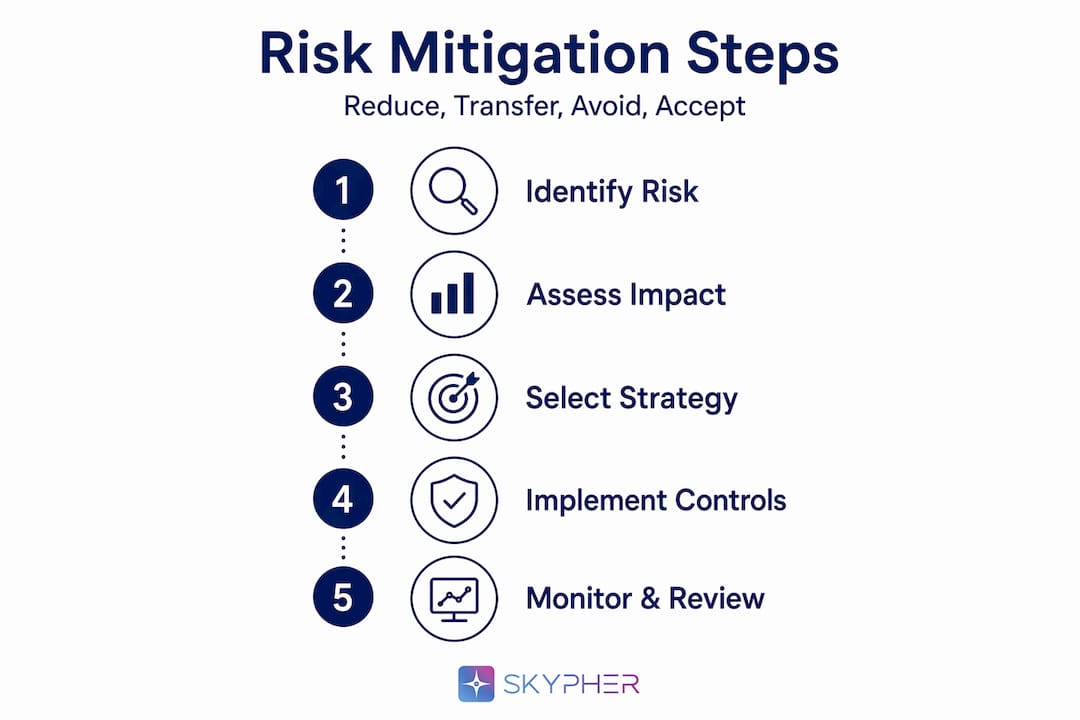
Consider a concrete example from the retail sector. One retail company reduced fraud losses from $150,000 to $12,000 over 18 months by combining data-driven detection tools (reduction) with staff training and internal audit cycles (also reduction) while maintaining insurance coverage for residual losses (transfer). That is an examples of risk strategies working together rather than competing.
Pro Tip: When building your risk register, tag every identified risk with its assigned strategy from the start. This forces prioritization, prevents the "we'll deal with it later" trap, and gives leadership a clear picture of where the organization's risk posture actually sits.
Risk avoidance sounds appealing but carries its own cost: you may avoid not just the risk but the opportunity attached to it. A financial services firm that avoids all use of third-party cloud infrastructure to eliminate data exposure risk may also forfeit the speed and cost advantages that competitors are gaining. Avoidance is a legitimate strategy, but it requires a deliberate trade-off analysis, not just fear-driven reflex.
Implementing risk mitigation: frameworks and best practices
Knowing the four strategies is not enough. The gap between knowing and doing is exactly where most programs fail. Only 7% of organizations have ERM fully integrated into strategic decision-making, despite 98% believing it matters. That gap is operational, not philosophical.
Here is how high-performing organizations close it:
-
Conduct a structured risk assessment. Map threats to business processes, score them by likelihood and impact, and build a risk register. Without a baseline, mitigation has no target.
-
Prioritize using a tiered approach. A tiered mitigation approach using Minimal, Balanced, and Comprehensive tiers prevents resource wastage on low-priority risks while securing critical assets. Not every risk deserves the same investment.
-
Select controls aligned to risk velocity. Practitioners categorize controls as preventive, detective, and reactive. Preventive controls stop risks from occurring. Detective controls identify them when they do. Reactive controls contain the damage. The best programs use all three layers in proportion to how fast a given risk can escalate.
-
Assign ownership explicitly. Every mitigation action needs a named owner, a completion date, and a review schedule. Anonymous accountability is no accountability.
-
Integrate with decision-making processes. Risk mitigation works only when it informs real decisions. Capital allocation, vendor selection, product launches, geographic expansion. Each of these should include a formal risk review before commitment.
-
Leverage automation for real-time visibility. Spreadsheet-based risk registers become outdated within weeks. Automation tools that connect to live data sources, track control status, and flag threshold breaches give leadership the real-time picture they need to act, not just report. You can explore risk management with automation as a practical starting point.
-
Build a risk-aware culture. Frameworks and processes are only as strong as the people following them. Leadership must model risk awareness in everyday decisions, not just during annual reviews.
Embedding risk thinking into everyday decision-making requires simplicity and intention, not perfect programs. Start with the highest-priority risks, get the process working, then expand systematically. Perfectionism in ERM is its own risk.
Measuring effectiveness and evolving your approach
A mitigation strategy that never gets measured is just a document. The organizations that get real value from risk management treat it like any other performance function: they define success metrics, track them, and act on what they find.
Useful KPIs for mitigation effectiveness include:
- Control effectiveness rate: The percentage of tested controls that perform as designed. Anything below 80% signals a systemic problem.
- Risk residual trend: Are residual risk scores increasing or decreasing over time? This tells you whether controls are actually working.
- Incident rate by risk category: If risks you classified as "mitigated" are still generating incidents, your controls need redesign.
- Mean time to detect and respond: Particularly relevant for cybersecurity risks. Faster detection means lower impact.
- Coverage ratio: What percentage of identified risks have active mitigation actions assigned? Gaps here are exposure.
Periodic comprehensive reviews are not optional add-ons. They are the mechanism that keeps mitigation aligned with reality. Business contexts shift. Regulatory environments change. New threat categories emerge. A static risk plan built in 2023 is not adequate for the threat environment of 2026.
Beyond measurement, the most forward-looking executives are repositioning risk mitigation as a competitive function. Organizations with mature risk programs can move faster into new markets because they have already assessed the threat profile. They can win more enterprise contracts because they can demonstrate a documented, tested security and compliance posture. For deeper context on this, the risk management guide for tech and finance pros covers how leading organizations operationalize these principles.
Risk management is evolving from a defensive compliance activity to a strategic enabler driving operational resilience. That shift requires changing how leadership thinks about the function, not just the tools it uses.
My perspective on risk mitigation and strategic resilience
I've spent years working with organizations that treat risk mitigation as a once-a-year compliance exercise. They fill out the framework, tick the boxes, present the board report, and move on. Then something goes wrong, and they wonder why their beautifully documented plan didn't help.
The uncomfortable truth I've seen repeatedly: more than half of organizations still view ERM primarily as compliance, limiting its strategic potential entirely. That mindset is the actual risk.
In my experience, the organizations that build genuine resilience do something different. They treat risk conversations as normal business conversations, not special events. They let risk data influence budget decisions and vendor choices in real time. They don't wait for an annual review to realize a control has drifted.
What I've learned is this: the gap between knowing what risk mitigation means and actually embedding it into how your organization operates is not a knowledge gap. It's a discipline gap. The tools, frameworks, and guidance exist in abundance. The real work is building the habit of using them consistently, at every level of the business.
— Gaspard
How Skypher helps you operationalize risk mitigation
Risk mitigation strategy only delivers value when it's connected to real operational processes. For tech and finance organizations, one of the most frequent pressure points is the security questionnaire process. Incoming vendor assessments, customer due diligence requests, and compliance audits create a constant demand for accurate, up-to-date risk and security data.

Skypher's security questionnaire automation tool lets teams answer even 200 security questions in under a minute, pulling from a continuously updated knowledge base that reflects your actual security posture. The AI-powered recommendation engine suggests the most accurate answers based on your existing documentation, reducing both response time and error rates. Combined with the Trust Center platform, your organization can proactively share its compliance and security posture with stakeholders, turning what used to be a reactive burden into a strategic trust signal.
FAQ
What is a risk mitigation strategy?
A risk mitigation strategy is a structured plan that identifies potential threats and applies controls to reduce their likelihood or impact to within an acceptable risk tolerance. It covers four core approaches: avoidance, reduction, transfer, and acceptance.
What is the difference between risk mitigation and risk management?
Risk management is the full process of identifying, assessing, treating, and monitoring risks. Risk mitigation is specifically the treatment phase, where you decide how to respond to risks that have already been identified and prioritized.
What are examples of risk strategies in business?
Common examples of risk strategies include purchasing cyber liability insurance (transfer), implementing multi-factor authentication (reduction), declining entry into a high-regulatory-burden market (avoidance), and accepting minor operational inefficiencies below a financial threshold (acceptance).
How do you measure whether a risk mitigation strategy is working?
Track control effectiveness rates, residual risk trends, incident rates within mitigated categories, and mean time to detect and respond. Periodic comprehensive reviews aligned with ISO 31000 guidance keep your metrics connected to the current threat environment.
Why do so many organizations fail at risk mitigation?
The primary reason is treating mitigation as a compliance obligation rather than an operational practice. COSO research shows only 7% of organizations have ERM fully integrated into strategic decision-making, which means the majority are managing risk on paper rather than in practice.