

TL;DR:
- Risk mitigation involves planning and implementing options to reduce risk severity and likelihood, not eliminating it entirely.
- Effective programs incorporate continuous assessment, ownership, and real-time monitoring aligned with frameworks like ISO 31000 and NIST.
Risk mitigation is one of the most misunderstood concepts in security compliance. Many teams treat it as synonymous with risk elimination, which is both impossible and counterproductive. What it actually means, as AWS defines it, is planning and implementing options to reduce the likelihood or severity of risks to an acceptable level. For compliance professionals in tech and finance, understanding the difference is not academic. It shapes how you allocate budgets, prioritize controls, respond to vendor assessments, and ultimately defend your organization's risk posture to the board.
Table of Contents
- Understanding risk mitigation in modern frameworks
- Types of risk mitigation strategies and their application
- Implementing risk mitigation through vendor risk assessments and security questionnaires
- Challenges and common pitfalls in risk mitigation programs
- Measuring and monitoring risk mitigation effectiveness
- Why risk mitigation must shift from compliance to strategic enabler
- How Skypher helps streamline risk mitigation and security questionnaires
- Frequently asked questions
Understanding risk mitigation in modern frameworks
Risk mitigation does not live in isolation. It sits inside a larger risk management cycle, and the frameworks your organization almost certainly references, ISO 31000 and NIST, treat it with much more rigor than most programs actually apply.
ISO 31000 frames risk treatment as iterative, driven by risk assessment outcomes and cost-benefit analysis, and always aimed at aligning residual risk to your organization's defined acceptance criteria. That word "iterative" matters. A single annual review is not risk treatment. It is a snapshot that becomes stale the moment your infrastructure or vendor landscape changes.
NIST treats cybersecurity risk as a portfolio, not a list. It prioritizes risks by enterprise-level business impact and tracks them through risk registers, which are living documents that capture probability, potential impact, current controls, and assigned owners. If your risk register is a spreadsheet someone updates twice a year, it is not functioning as a mitigation tool. It is filing.
Here is how both frameworks describe the core process:
- Identify risks through structured assessment activities, including vendor reviews and security questionnaires.
- Analyze risks by estimating likelihood and impact across the enterprise.
- Evaluate and prioritize which risks require treatment, and in what order.
- Apply risk treatment through one or more mitigation strategies.
- Monitor and review continuously, updating the risk register as conditions change.
- Communicate and consult with stakeholders in parallel throughout the entire cycle.
Key elements that support this process include:
- Risk registers that document both inherent risk and residual risk after controls are applied
- Defined risk appetite statements that give teams a threshold for acceptance
- Clear ownership so mitigation actions have an accountable person and a budget line
"Risk management is not just about avoiding threats. It is about making informed, prioritized decisions so the organization can pursue its objectives with confidence."
For a deeper look at how these frameworks connect, the risk management guide covers practical application in tech and finance contexts.
Types of risk mitigation strategies and their application
With the framework context in place, the next step is understanding the four core strategies. Risk mitigation uses four approaches: avoidance, transfer, reduction, and acceptance. Choosing correctly between them is where most programs either create real value or waste significant resources.
| Strategy | What it means | Finance example | Tech example |
|---|---|---|---|
| Avoidance | Eliminate exposure by changing plans | Exiting a high-risk market segment | Not deploying a legacy protocol with known vulnerabilities |
| Transfer | Shift the risk to another party | Cyber liability insurance | Outsourcing data processing to a SOC 2-certified vendor |
| Reduction | Apply controls to lower impact or likelihood | Encryption of customer financial data | Multi-factor authentication across all admin access |
| Acceptance | Acknowledge residual risk when treatment cost exceeds expected loss | Accepting minor UI fraud risk below the cost of full mitigation | Accepting low-severity bugs in non-critical internal tools |
The critical mistake most programs make is defaulting to reduction for every risk. That approach burns resources and creates control complexity without proportionate risk reduction. Avoidance is the most powerful strategy when the risk has no offsetting value. Transfer works when you need capability you cannot build internally. Acceptance requires documentation and a deliberate decision, not just inaction.
- Risk avoidance is often underused. If a planned integration with a vendor carries unacceptable data exposure risk and the business value is marginal, the right answer is to not do it.
- Risk transfer through contracts matters more than most teams realize. A strong data processing agreement with clear liability terms is a mitigation control.
- Risk reduction is the most common approach and includes both technical controls (encryption, patching, access management) and process controls (policy reviews, training).
- Risk acceptance must be formal. A verbal agreement to "live with it" is not acceptance. It requires sign-off, documentation, and a review date.
Pro Tip: When selecting a strategy, ask two questions. First, what is the maximum loss if this risk materializes? Second, what does mitigation cost over three years? If mitigation costs more, acceptance with strong monitoring is often the rational choice.
For more on how these risk treatment concepts connect to broader program design, the Skypher blog has practical guidance for compliance teams in both sectors.
Implementing risk mitigation through vendor risk assessments and security questionnaires
Vendor risk is the area where most medium and large organizations have the largest mitigation gap. Vendor risk is treated as the organization's own risk, meaning that a breach at your payment processor or cloud infrastructure vendor is your risk event, not theirs.

Security questionnaires are the most common tool for assessing third-party risk. But the majority of compliance teams use them wrong. They treat a completed questionnaire as a closed risk item. It is not. It is a starting point. The vendor risk assessment process should translate questionnaire answers into evidence of actual control effectiveness, then measure the gap between that and the risk appetite.
Here is how to operationalize this correctly:
- Distinguish inherent from residual risk. Inherent risk is the exposure before any controls. Residual risk is what remains after. A vendor claiming SOC 2 compliance reduces inherent risk but does not eliminate it. Map what remains.
- Assign ownership. Every risk identified through a vendor assessment needs an internal owner who is accountable for the mitigation plan and its progress.
- Estimate costs. Underfunded mitigation plans stall. For each identified risk treatment, attach a cost estimate and tie it to a budget cycle.
- Set monitoring cadences. Annual reviews are insufficient for high-criticality vendors. Quarterly reviews with interim alerts for material changes (breach notifications, ownership changes, new subprocessors) create a live risk picture.
- Track remediation, not just responses. Questionnaire completion is an input. Remediation of identified control gaps is the output that actually reduces risk.
Effective mitigation depends on translating questionnaire controls into measurable residual risk and funded response plans. Without that translation, questionnaires are documentation, not mitigation.
Pro Tip: Build a control effectiveness score into your questionnaire review process. Instead of binary yes/no on control presence, rate confidence that the control is operating as intended based on available evidence. That score becomes your residual risk proxy.
The security questionnaire best practices guide on the Skypher blog covers this translation process in detail.
Challenges and common pitfalls in risk mitigation programs
The biggest single obstacle to effective risk mitigation in large organizations is not technical. It is cultural. COSO notes an implementation gap where enterprise risk management programs are frequently treated as compliance exercises rather than strategic management disciplines. The result is a program that generates documentation but does not actually reduce risk.
Watch for these specific failure patterns:
- Checkbox mentality. Completing a questionnaire or passing an audit is treated as risk resolved. Actual control gaps remain open because they are no longer visible after the assessment closes.
- Documentation without decision-making. Risk registers that are maintained but never used to drive funding decisions or escalation conversations are artifacts, not tools.
- Ownership vacuum. Risks without a named, accountable owner do not get mitigated. They get inherited by the next person who finds them in an audit.
- Static risk registers. A risk register that was last updated at the previous annual review does not reflect a changing threat landscape, new vendor relationships, or organizational changes.
- Mitigation theater. Adding controls that generate evidence without meaningfully reducing exposure. Security awareness training as the only response to phishing risk is a common example.
"The organizations that manage risk well treat the risk register as a living decision-support tool, not a report they file."
Pro Tip: Review your risk register before your next budget cycle, not after. If you cannot point to specific risk treatment actions funded in the upcoming budget, your mitigation program is theoretical. Tie risk treatment costs to budget requests with explicit residual risk reductions as the expected return.
The strategic risk mitigation content on the Skypher blog covers how to reframe these conversations internally.
Measuring and monitoring risk mitigation effectiveness
You cannot improve what you do not measure. Most organizations track control presence. Few track control effectiveness. Those are different things. A firewall that exists is a control. A firewall configured correctly, tested regularly, and monitored for anomalies is an effective control.
Here is a practical approach to measuring mitigation effectiveness:
- Define inherent risk scores for each risk in your register before controls are applied.
- Assess control effectiveness using evidence, not attestation. Log data, penetration test results, and independent audits carry more weight than self-reported questionnaire answers.
- Calculate residual risk scores by adjusting inherent risk downward based on control effectiveness ratings.
- Set thresholds for escalation. Any residual risk above your defined appetite triggers an escalation path with a funded response.
- Schedule risk register reviews on a cadence tied to risk tier. Critical risks reviewed quarterly. High risks reviewed semi-annually. Medium and low risks reviewed annually.
Mature programs translate questionnaire answers into measurable control effectiveness and residual risk scores, enabling both prioritization and ongoing monitoring.
| Metric | What it measures | Why it matters |
|---|---|---|
| Inherent risk score | Exposure before controls | Baseline for measuring mitigation value |
| Control effectiveness rating | How well controls actually operate | Differentiates documented vs. functional controls |
| Residual risk score | Exposure after controls | The number that determines acceptability |
| Time to remediation | How long risk items stay open | Indicator of program velocity and ownership clarity |
| Risk register freshness | Date of last update per risk item | Proxy for whether the program is active or stale |
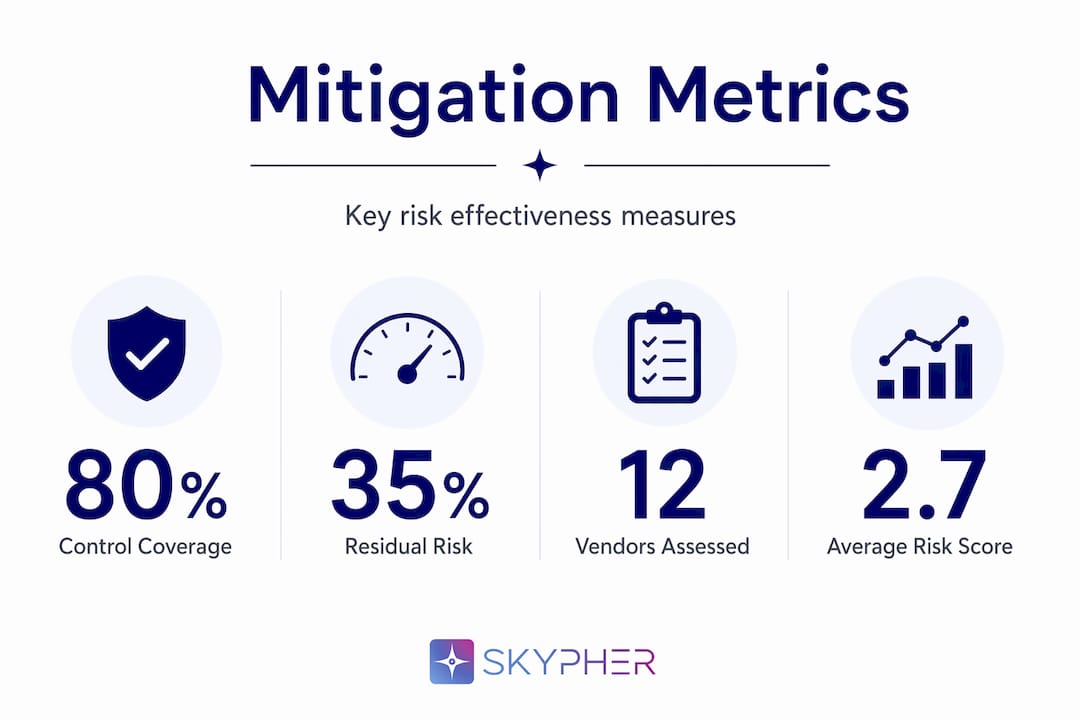
Pro Tip: Build a simple dashboard showing inherent versus residual risk by business unit or vendor tier. When residual risk is consistently close to inherent risk, controls are not working. That visual makes the conversation with leadership much easier.
Stay informed on how cybersecurity risk trends are shifting what these metrics need to capture.
Why risk mitigation must shift from compliance to strategic enabler
Here is the uncomfortable reality. Most risk mitigation programs in tech and finance organizations are built backwards. They start with frameworks and controls, map those to requirements, generate evidence, and call it done. That is compliance. It is not mitigation.
Practitioners broadly agree that enterprise risk management should be strategic, yet the majority of programs remain checkbox exercises. The gap exists because compliance has a finish line and strategy does not. Compliance feels completable. Strategy does not.
The shift requires changing what the program is optimized for. Compliance programs are optimized for audit readiness. Strategic mitigation programs are optimized for decision quality. The difference shows up in budget conversations. A compliance program tells the CFO which requirements are met. A strategic mitigation program tells the CFO which risks are costing the business the most, what treatments are available, what each costs, and what the residual exposure looks like after each option. That second conversation is how security leaders earn budget and credibility.
The other change is cultural, and it is harder. Risk ownership cannot live exclusively in the security team. Business unit leaders need to understand that a vendor with a poor security posture is their operational risk, not just a compliance flag. Finance teams need to see unresolved risk items as contingent liabilities. That framing changes behavior at the ownership level.
From our perspective at Skypher, the organizations that achieve this shift have one thing in common: they invest in making risk information fast to produce and easy to act on. When generating a vendor risk summary takes three weeks, it cannot inform a decision made in three days. Speed and accuracy of risk information are not just operational concerns. They are prerequisites for strategic risk management. See more on how compliance vs strategy insights apply in practice.
How Skypher helps streamline risk mitigation and security questionnaires
The challenges covered in this article, slow questionnaire processing, inconsistent control documentation, stale risk registers, and disconnected workflows, are exactly what Skypher was built to solve. Security questionnaire automation through Skypher reduces the time your team spends on manual responses, with AI-powered tools that can answer 200 questions in under a minute using your own documentation as the source of truth.

Automated review cycles and duplicate detection keep your response library current without requiring manual audits, so your risk evidence stays accurate over time. The AI recommendation engine goes further, guiding mitigation prioritization by surfacing control gaps and suggesting evidence collection pathways based on your existing risk posture. Skypher integrates with over 40 third-party risk management platforms, Slack, MS Teams, ServiceNow, Confluence, and more, connecting risk response workflows to the tools your team already uses. For medium to large tech and finance organizations managing high questionnaire volumes, that connection between speed and accuracy is where mitigation programs start to function at their actual potential.
Frequently asked questions
What is the core purpose of risk mitigation?
Risk mitigation minimizes the likelihood or impact of risks to keep them within an acceptable threshold. It is not about eliminating all risk, which is impossible, but about managing exposure to a level the organization can operate within.
What are the main types of risk mitigation strategies?
The four main types are risk avoidance, risk transfer, risk reduction, and risk acceptance. The right choice depends on the severity of the risk and the cost-effectiveness of each treatment option relative to the potential loss.
How does risk mitigation relate to security questionnaires?
Security questionnaires surface control information from vendors and internal teams. Questionnaire answers are translated into control effectiveness ratings and residual risk scores, which then drive prioritized treatment planning across your vendor and internal risk portfolio.
Why do some risk mitigation programs fail to deliver strategic value?
ERM programs often function as compliance exercises rather than strategic tools. Programs stall when they prioritize audit readiness over actual risk reduction, leaving identified risks underfunded and unassigned.
How can organizations measure if risk mitigation is effective?
Translate controls into measurable effectiveness ratings and calculate residual risk scores to compare against inherent risk. Regular risk register reviews and time-to-remediation tracking show whether the program is reducing exposure or just documenting it.