

TL;DR:
- Proper security documentation is essential for compliance and effective risk management.
- Living, regularly updated documentation improves incident response and cross-team collaboration.
- Connecting documentation to workflows and tools ensures higher use and better security outcomes.
Security documentation rarely gets the recognition it deserves. Most teams treat it as a compliance checkbox, something to produce before an audit and then shelve until the next one. That framing is costly. When documentation is treated as a living operational asset, it actively reduces breach impact, accelerates incident response, and creates the kind of cross-team clarity that prevents costly miscommunication. This article breaks down exactly how strong documentation practices translate into measurable security and business outcomes for tech and finance organizations managing complex regulatory demands.
Table of Contents
- Why security documentation is foundational to compliance
- Driving risk management and threat prioritization
- Enabling consistent controls and cross-team collaboration
- Accelerating incident response and reducing downtime
- From 'shelfware' to strategic asset: Best practices for living documentation
- The uncomfortable truth: Why most documentation fails and how to fix it
- Take your documentation and security workflows to the next level
- Frequently asked questions
Key Takeaways
| Point | Details |
|---|---|
| Compliance backbone | Security documentation is the foundation for meeting regulations and satisfying audit requirements. |
| Risk management | Up-to-date documentation enables smarter risk assessments and threat prioritization. |
| Collaboration clarity | Clearly documented controls and responsibilities streamline teamwork and reduce costly errors. |
| Faster incident response | Well-defined procedures minimize downtime and mitigate damage when breaches occur. |
| Ongoing business value | Treating security documentation as a living asset boosts resilience and aligns security with business goals. |
Why security documentation is foundational to compliance
Regulatory frameworks do not simply suggest documentation. They require it, in specific forms, with verifiable evidence. Security documentation is essential for frameworks like PCI DSS, GDPR, HIPAA, ISO 27001, SOC 2, and DORA, because auditors need written proof that controls exist, are applied consistently, and are reviewed regularly.
Understanding ISO security standards makes this concrete. ISO 27001, for example, requires a documented information security management system, including a risk treatment plan, statement of applicability, and evidence of internal audits. GDPR demands records of processing activities. PCI DSS requires network diagrams, access control policies, and vulnerability scan results. These are not suggestions. Missing any of them during an audit can trigger findings, remediation timelines, or outright penalties.
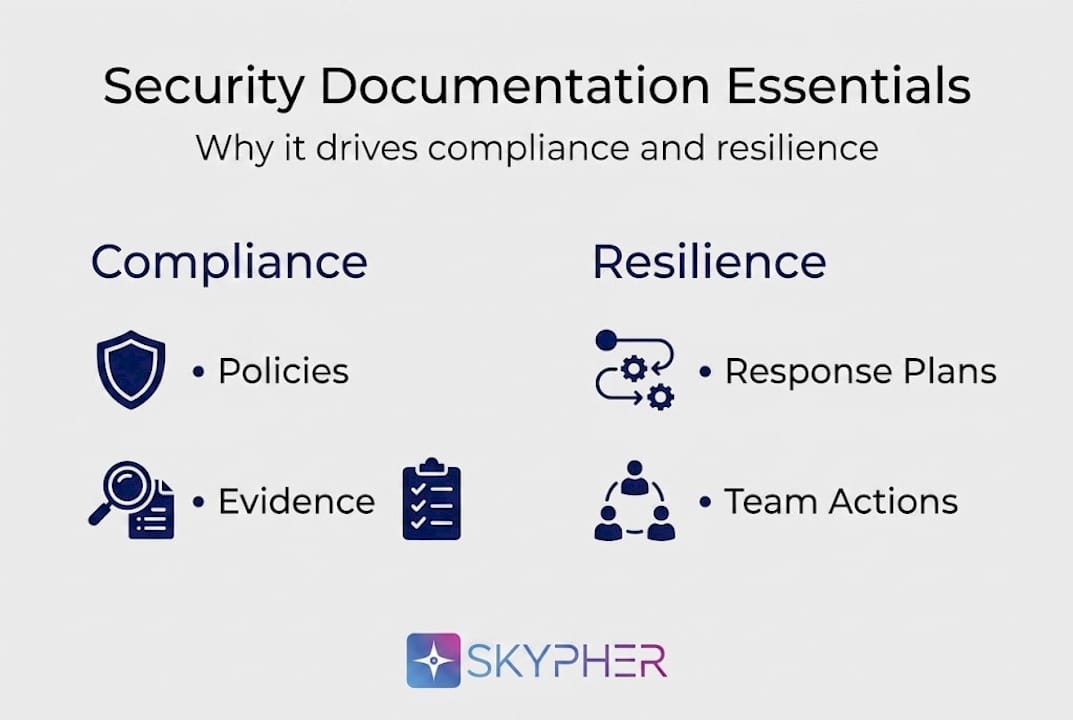
Auditors follow a clear pattern. They arrive with a control framework mapped to your environment, and they pull evidence against each control. If the evidence does not exist in writing, the control is treated as if it does not exist at all. Following audit best practices means understanding this dynamic before the auditor does.
Key documentation types auditors routinely request:
- Information security policies and acceptable use policies
- Access control procedures and user provisioning logs
- Incident response plans and post-incident reports
- Vulnerability assessment results and remediation tracking
- Business continuity and disaster recovery plans
- Vendor risk assessment records and third-party contracts
- Change management logs and system configuration baselines
Here is a quick comparison of what major frameworks require:
| Framework | Core documentation requirements |
|---|---|
| PCI DSS | Network diagrams, access logs, scan results, policies |
| GDPR | Records of processing, DPIAs, breach notifications |
| HIPAA | Risk analysis, workforce training records, BAAs |
| ISO 27001 | ISMS scope, risk register, statement of applicability |
| SOC 2 | System description, control evidence, monitoring logs |
| DORA | ICT risk framework, incident reports, resilience testing |
Handling PCI and HIPAA compliance simultaneously, which many finance and health-tech organizations must do, requires a documentation architecture that maps controls across frameworks to avoid duplication. Organizations that invest in this structure early spend far less time preparing for audits and far more time on actual security improvements. The cost of weak documentation is not just a failed audit. It is the remediation effort, the reputational damage, and the regulatory scrutiny that follows.
"Documentation is not the bureaucratic overhead of security. It is the evidence layer that makes security legible to regulators, auditors, and your own teams." — Security compliance practitioner
Driving risk management and threat prioritization
With compliance requirements as the foundation, organizations must also ask: how does documentation improve actual security? The answer lies in historical data. Documentation supports effective risk assessments by providing records of past incidents, access control changes, and known vulnerabilities, which allows security teams to prioritize threats based on evidence rather than instinct.
Consider the difference between two organizations facing the same phishing campaign. One has documented prior incidents, including attack vectors, affected systems, response timelines, and lessons learned. The other has no records. The first team can immediately cross-reference the new threat against known patterns, identify high-risk users, and escalate with precision. The second team starts from scratch every time.

A practical look at the difference:
| Scenario | With documentation | Without documentation |
|---|---|---|
| Phishing campaign detected | Cross-reference prior incidents, target response | Manual triage, no baseline for comparison |
| Access control review | Pull historical provisioning logs | Reconstruct access history manually |
| Vulnerability prioritization | Use documented asset criticality ratings | Treat all vulnerabilities as equal priority |
| Audit preparation | Retrieve existing evidence packages | Rebuild evidence from scratch |
Applying security review strategies that are grounded in documented risk data makes this process systematic. Here is how documentation integrates into a structured risk assessment workflow:
- Inventory assets and classify them using documented criticality ratings tied to business impact.
- Pull historical incident logs to identify which asset classes have been targeted most frequently.
- Map existing controls against documented threat scenarios to find gaps.
- Score residual risk based on documented control effectiveness, not assumed effectiveness.
- Prioritize remediation using a documented risk register that tracks owner, deadline, and status.
- Update the register after each remediation cycle to maintain an accurate risk picture.
This process only works if documentation is current and accessible. Stale records produce stale risk scores, which leads to misallocated security budgets. Understanding why security questionnaires matter is part of this picture. Questionnaires sent by clients and partners often surface documentation gaps that internal teams have missed, making them a useful external pressure test on your risk documentation quality.
Enabling consistent controls and cross-team collaboration
Once risk management is supported by robust documentation, team efficiency and collaboration become possible at scale. Documentation ensures consistent application of security controls across teams, reduces ambiguity in roles and processes, and streamlines collaboration in tech and finance organizations where security, engineering, legal, and compliance functions must work in sync.
Without clear documentation, controls drift. One team patches systems on a 30-day cycle while another patches quarterly because nobody wrote down the standard. One engineer provisions admin access based on a verbal request while another requires a ticket and approval chain. These inconsistencies create real vulnerabilities and make audits painful.
Top benefits of strong documentation for collaboration and role clarity:
- Eliminates ambiguity about who owns which control or process
- Reduces onboarding time for new security and compliance staff
- Creates a shared reference point for cross-functional incident handling
- Enables consistent vendor risk assessments regardless of which team member conducts them
- Supports knowledge transfer when key personnel leave the organization
- Provides a clear audit trail for decisions made during security incidents
Consider a real-world scenario. A financial services firm experiences a suspected data exfiltration event at 2 a.m. The on-call engineer needs to isolate affected systems, notify the CISO, engage legal, and preserve forensic evidence, all within a tight window. If the incident response plan is documented, with clear role assignments and escalation paths, that engineer can execute confidently. If it is not, they are making judgment calls under pressure, which is exactly when mistakes happen. Approaches to streamlining questionnaires and compliance workflow follow the same logic: documented processes reduce cognitive load and error rates.
Pro Tip: After every major organizational change, whether a merger, a leadership transition, or a significant product launch, revisit your role definitions and control ownership documentation. What was accurate six months ago may no longer reflect how your teams actually operate.
Accelerating incident response and reducing downtime
Consistent processes empower proactive prevention, but what happens when a breach does occur? Response speed becomes critical. Defined procedures, escalation paths, and roles in your documentation reduce downtime and data exposure during breaches, because teams spend time executing rather than deciding.
Research consistently shows that organizations with documented incident response plans contain breaches significantly faster than those without. The financial difference is substantial. Every hour of uncontrolled breach activity expands the blast radius, increases regulatory exposure, and compounds remediation costs.
A well-documented incident response plan follows a clear sequence:
- Detection and initial triage: Documented alert thresholds and monitoring criteria tell teams what constitutes an incident worth escalating.
- Containment: Pre-approved isolation procedures allow engineers to act immediately without waiting for approvals.
- Notification: Documented escalation paths specify who gets notified, in what order, and within what timeframe.
- Evidence preservation: Documented forensic procedures ensure logs and artifacts are captured correctly before systems are restored.
- Eradication and recovery: Step-by-step remediation guides reduce the chance of reinfection or incomplete cleanup.
- Post-incident review: Documented lessons-learned templates feed back into updated procedures, closing the loop.
Investing in training for secure development alongside documented response procedures creates a compounding effect. Teams that understand secure development practices generate fewer incidents, and when incidents do occur, they understand the technical context well enough to respond effectively.
Pro Tip: Test your incident response documentation at least twice a year through tabletop exercises. Walk your team through a realistic scenario and measure where the documentation creates clarity versus where it creates confusion. Update accordingly.
The organizations that recover fastest from security incidents are not necessarily those with the most sophisticated tools. They are the ones whose teams know exactly what to do because it is written down, tested, and practiced.
From 'shelfware' to strategic asset: Best practices for living documentation
Documentation is not just about emergency response. Its potential is maximized when treated as a continuously improved asset rather than a static artifact. The term "shelfware" describes documentation that was created to satisfy a compliance requirement and has not been touched since. It is more common than most organizations admit, and it creates a dangerous illusion of security maturity.
Empirical data shows that projects with active security policies, such as GitHub SECURITY.md files, score significantly higher on security practice metrics via tools like OpenSSF Scorecard, with better maintenance records and fewer code-level vulnerabilities. The act of maintaining documentation is itself a signal of security maturity.
Best practices for keeping documentation alive and useful:
- Schedule quarterly reviews of all core security policies, not just annual ones
- Assign a named owner to each document with accountability for keeping it current
- Involve stakeholders from legal, engineering, and business units in policy reviews
- Track document versions with change logs so teams can see what changed and why
- Tie documentation updates to measurable security outcomes, such as reduced audit findings or faster incident resolution
- Use third-party reviews periodically to surface blind spots your internal team may have normalized
"The most dangerous document in security is the one that was accurate 18 months ago and hasn't been reviewed since. It creates false confidence at exactly the wrong moment." — Information security advisor
Treating documentation as a strategic asset means connecting it to business goals. Security policies that reference business-critical systems by name, that tie control objectives to revenue protection or customer trust, are far more likely to receive the attention and resources they need to stay current.
The uncomfortable truth: Why most documentation fails and how to fix it
After working with organizations across tech and finance, a pattern becomes clear. Most documentation failures are not technical problems. They are cultural ones. Teams produce documentation because a framework requires it, not because they intend to use it. The result is a library of policies that nobody reads, procedures that do not reflect actual workflows, and incident response plans that have never been tested.
The check-the-box mentality is understandable. Compliance deadlines are real, auditor pressure is real, and writing documentation takes time that security teams rarely have. But the organizations that treat documentation as a living operational tool, not a compliance artifact, consistently outperform their peers when incidents occur. They also spend less time preparing for audits because their documentation is already current.
The fix is not more documentation. It is better integration. Connect your documentation to the tools your teams actually use. If engineers live in Confluence or Notion, put procedures there, not in a shared drive nobody opens. If your security team tracks incidents in ServiceNow, link your incident response plan directly to the ticketing workflow. Documentation that lives where work happens gets used. Documentation that lives in a compliance folder does not.
The organizations that get this right treat documentation review as a security activity, not an administrative one. They measure its effectiveness, update it based on real incidents, and hold teams accountable for keeping it current. That shift in framing is what separates genuinely resilient organizations from those that simply pass audits.
Take your documentation and security workflows to the next level
Strong documentation practices create the foundation, but maintaining them at scale across multiple frameworks, teams, and formats is where many organizations struggle. Skypher is built specifically for this challenge.

Skypher's AI-powered recommendation engine draws on your existing documentation to generate accurate, consistent responses to security questionnaires, keeping your answers aligned with your actual controls. The questionnaire automation platform integrates with over 40 third-party risk management tools, supports real-time collaboration, and can process even 200 questions in under a minute. With easy import and export workflows and connections to Confluence, Notion, Google Drive, SharePoint, Slack, and MS Teams, Skypher fits into the environments your teams already use, making documentation a natural part of daily security operations rather than a quarterly scramble.
Frequently asked questions
What are the main types of security documentation required for compliance?
Key documentation types include policies, procedures, access controls, incident logs, and risk assessments, which auditors routinely request for frameworks like PCI DSS and ISO 27001. Auditors require written evidence of controls, policies, and procedures to verify adherence and avoid penalties.
How often should security documentation be reviewed or updated?
Best practice is to review and update documentation at least annually or after major incidents or organizational changes. Compliance-only documentation quickly becomes irrelevant without regular reviews tied to current risks and operations.
What happens if an organization lacks proper security documentation during an audit?
Failure to provide documentation can result in failed audits, regulatory penalties, and increased operational risk. Auditors treat undocumented controls as nonexistent, regardless of whether those controls are actually in place.
How does security documentation support faster incident response?
Clear escalation paths and step-by-step procedures allow teams to respond efficiently, minimizing downtime and data loss. Defined procedures and roles reduce the time teams spend making decisions under pressure during active incidents.
Why is treating documentation as a 'living asset' more effective than a compliance-only approach?
Active, regularly updated documentation aligns security practices with business reality and adapts to evolving threats. Static compliance documentation creates false confidence and fails to reflect the actual controls and workflows teams rely on during incidents.