

A third-party vendor is any external organization or individual that provides goods, services, or resources to your company while operating independently and outside your direct organizational control. They are not on your payroll, and they typically operate under a written contract, though that is not always the case. Understanding what a 3rd party vendor is matters because your organization remains legally and operationally accountable for what they do on your behalf.
Why this definition matters in practice:
- Security exposure: A vendor with access to your systems or customer data can become an entry point for breaches you did not cause but will be held responsible for.
- Operational continuity: If a critical SaaS provider or logistics partner goes down, your operations can stall even though the failure was entirely external.
- Regulatory compliance: Regulators in banking, healthcare, and finance hold organizations accountable for their vendors' compliance posture, not just their own.
- Cost and scalability: Vendors let you access specialized capabilities without building them in-house, which is a real efficiency gain with real risk attached.
- Innovation access: Cloud platforms, AI tools, and specialized analytics are often vendor-delivered first, giving organizations faster access to new capabilities.
Two quick examples: a SaaS provider hosting your CRM holds sensitive customer data your team never touches directly. A payroll vendor processes employee compensation and tax filings on your behalf. Both are third-party vendors in the full sense of the term.
Table of Contents
- What exactly counts as a third-party vendor?
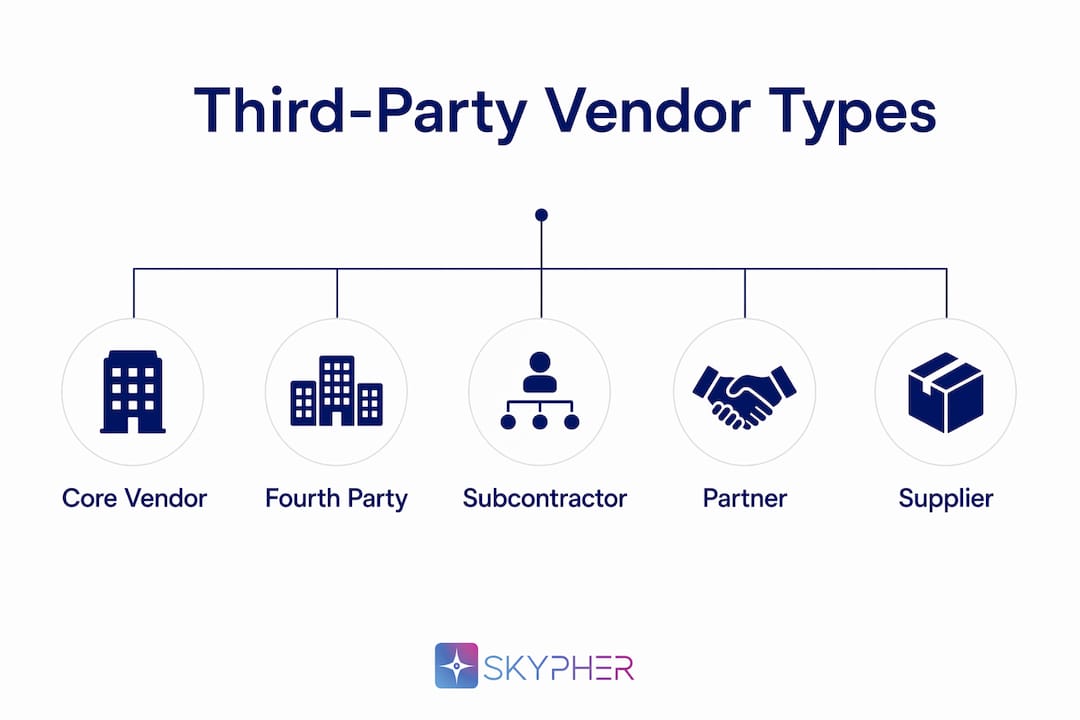
- What are the most common types of third-party vendors?
- Vendor vs. supplier vs. partner: why the label changes your risk approach
- Why organizations rely on third-party vendors
- What risks do third-party vendors introduce?
- How to manage third-party vendors: a TPRM checklist
- Common mistakes organizations make in vendor risk programs
- Key Takeaways
- The part most TPRM programs still get wrong
- Speed up your vendor security reviews with Skypher
- Authoritative sources and further reading
What exactly counts as a third-party vendor?
The clearest dividing line is employment status and operational control. If an entity is not on your payroll and you do not direct their internal processes, they are a third party. That covers a wide range: contracted software providers, outsourced managed services, independent auditors, marketing agencies, and even individual consultants who access your systems.
Fourth parties are one layer removed. They are the subcontractors and service providers your vendors rely on to deliver their services to you. You have no direct contract with them, but their failures surface directly in your operations. A cloud hosting provider that relies on a single network carrier, for instance, passes that carrier's outage risk straight to you.
Where organizations get into trouble is the noncontractual gray zone. A free analytics tool embedded in your web stack, a partner integration that reads from your database, or a vendor's subsidiary that handles support tickets can all carry significant risk even without a formal agreement in place. The absence of a contract does not reduce your exposure; it often increases it because there are no defined obligations or breach notification requirements.
Pro Tip: To detect hidden fourth-party exposure quickly, ask every critical vendor one question during your next review: "Which subcontractors or third-party services do you rely on to deliver this service to us?" The answers will almost always surface dependencies you did not know existed.
What are the most common types of third-party vendors?
Third-party vendors appear across every function of a modern organization. Here are the categories you will encounter most often, along with the primary risk signal for each:
- SaaS providers: CRM, ERP, collaboration tools. Watch for data residency, access controls, and uptime SLAs.
- Cloud hosting and infrastructure: IaaS and PaaS platforms. Watch for shared-responsibility model gaps and geographic concentration.
- Payroll and HR services: Tax filing, benefits administration. Watch for PII handling, regulatory compliance, and financial controls.
- Managed service providers (MSPs): IT support, network management, security operations. Watch for privileged access scope and incident response obligations. Organizations outsourcing IT management to an MSP should map exactly which systems the provider can access.
- Logistics and distribution: Shipping, warehousing, last-mile delivery. Watch for operational concentration and geographic single points of failure.
- Marketing agencies: Campaign management, data analytics, ad platforms. Watch for customer data sharing and consent compliance.
- Consulting and professional services: Legal, financial advisory, technical consulting. Watch for confidentiality obligations and data handling practices.
- Hardware vendors: Device supply, firmware updates. Watch for supply chain integrity and end-of-life support timelines.
The table below shows sample intake questions by vendor category to use during initial screening:
| Vendor Category | Sample Intake Questions |
|---|---|
| SaaS / software | Where is data stored? What is your SOC 2 or ISO 27001 status? |
| Cloud / infrastructure | What is your shared-responsibility model? Do you use subprocessors? |
| Payroll / HR | How do you handle PII? What is your breach notification timeline? |
| Managed services | What privileged access do you require? What is your incident response SLA? |
| Marketing / analytics | What customer data do you process? How do you handle consent records? |
| Logistics / distribution | What is your geographic redundancy? Who are your sub-carriers? |
Vendor vs. supplier vs. partner: why the label changes your risk approach
These three terms get used interchangeably, but they describe meaningfully different relationships with different risk profiles.

| Relationship | Who the end user is | Where they sit in your value chain | Primary risk focus |
|---|---|---|---|
| Vendor | Your organization consumes the service directly | Delivers finished goods or services to you | Service uptime, data access, security posture |
| Supplier | Your organization uses their inputs to produce something | Provides raw materials or components you transform | Production continuity, input quality, concentration risk |
| Partner | Shared customer or shared outcome | Operates alongside you, often with mutual data access | Data governance, joint liability, alignment of controls |
A payroll processor is a vendor. A component manufacturer feeding your hardware assembly line is a supplier. A co-selling technology firm with access to your customer list is a partner. The risk focus differs in each case: with a vendor, you prioritize data access and uptime; with a supplier, you prioritize production continuity and geographic concentration; with a partner, you prioritize data governance and contractual alignment.
Pro Tip: When classifying a new relationship, ask two questions: (1) Do they access our data or systems? (2) Would their failure stop us from delivering to customers? If yes to either, treat them as a vendor in your TPRM program regardless of what the contract calls them.
Why organizations rely on third-party vendors
The risk conversation is important, but it should not obscure why vendor relationships exist in the first place. The operational case is strong:
- Specialization: A dedicated cybersecurity firm brings depth your internal team cannot replicate at the same cost. The tradeoff is that you are trusting their controls as much as their expertise.
- Cost efficiency: Outsourcing payroll processing eliminates the overhead of maintaining tax compliance infrastructure internally, though it transfers compliance accountability to a party you do not fully control.
- Scalability: A cloud hosting vendor lets you scale compute capacity in hours rather than months, but your uptime is now tied to their infrastructure decisions.
- Speed to market: SaaS tools let product teams launch features without building backend infrastructure from scratch, compressing timelines that would otherwise take quarters.
- Access to innovation: AI analytics platforms, machine learning APIs, and specialized data services are typically vendor-delivered before they are feasible to build in-house, giving organizations a real competitive edge.
Each benefit carries a corresponding risk exposure. That is not a reason to avoid vendors; it is a reason to manage them deliberately.
What risks do third-party vendors introduce?
Vendor risk management starts with knowing which risk categories to watch for. The major ones are:
- Data breach and security risk: A vendor with access to your systems or customer data can be compromised independently of your own controls. Your organization bears reputational and regulatory consequences regardless of where the breach originated.
- Operational and service disruption: A vendor outage, whether from a cyberattack, infrastructure failure, or financial distress, can halt your operations. Single-vendor dependencies amplify this risk significantly.
- Regulatory and compliance risk: Vendors processing personal data, financial transactions, or health records must meet the same regulatory standards you do. A vendor's noncompliance becomes your compliance problem.
- Financial risk: Vendor bankruptcy or sudden service termination can force emergency transitions at significant cost and with minimal notice.
- Concentration and fourth-party risk: Multiple vendors relying on the same underlying infrastructure provider or cloud region create systemic exposure. A single outage at that shared dependency cascades across your entire vendor ecosystem.
Your organization remains accountable for vendor failures in the eyes of regulators and customers. The NCUA's guidance on third-party relationships makes this explicit for financial institutions, and the principle applies broadly: governance and continuous monitoring are required to demonstrate due diligence, not just a signed contract.
How to manage third-party vendors: a TPRM checklist
A defensible third-party risk management (TPRM) program follows a consistent lifecycle. Here is the workflow, step by step:
- Screening and selection: Verify the vendor's legal standing, financial health, and basic security posture before any agreement is signed. Check for sanctions, litigation history, and public breach disclosures.
- Risk classification: Score each vendor on two axes: sensitivity of data or systems accessed, and criticality to your business operations. This produces a risk band that drives everything downstream.
- Security and compliance assessment: Send a structured questionnaire covering data handling, access controls, business continuity, subcontracting practices, and relevant certifications (SOC 2, ISO 27001, HITRUST).
- Contractual controls and SLAs: Negotiate and document the must-have clauses before onboarding begins (see callout below).
- Onboarding: Provision access according to least-privilege principles. Document what data and systems the vendor can reach.
- Continuous monitoring: Review evidence, not just attestations. Track security ratings, certificate expirations, news alerts, and regulatory actions on an ongoing basis.
- Incident response and escalation: Define in advance how the vendor notifies you of a breach, what your escalation path is, and who owns the response internally.
- Offboarding: Revoke all access, confirm data deletion or return, and document the closure. Incomplete offboarding is one of the most common sources of residual exposure.
Must-have contract clauses:
- Data processing and transfer restrictions
- Audit and evidence rights
- Breach notification within 72 hours
- Subcontractor disclosure and approval requirements
- Defined SLAs with financial remediation triggers
- Termination rights for material breach or regulatory noncompliance
Sample vendor assessment questions to include (10–12 high-value items):
- Do you hold a current SOC 2 Type II or ISO 27001 certification? Can you provide the report?
- How do you manage privileged access to customer environments?
- What is your process for notifying customers of a security incident?
- Do you use subcontractors or third-party services to deliver this service? If so, which ones?
- Where is customer data stored, processed, and backed up?
- What is your recovery time objective (RTO) and recovery point objective (RPO)?
- How do you handle employee offboarding and access revocation?
- What encryption standards do you apply to data at rest and in transit?
- Have you experienced a security incident in the past 24 months? If so, what was the outcome?
- How do you validate the security posture of your own subcontractors?
- What regulatory frameworks do you comply with (SOC 2, HIPAA, PCI DSS, GDPR)?
- What is your patch management cadence for critical vulnerabilities?
For a deeper look at vendor risk assessment beyond the security checklist, including resilience and continuity dimensions, the full framework is worth reviewing.
Pro Tip: Tie reassessment frequency directly to vendor criticality. High-criticality vendors (those with sensitive data access or operational dependency) warrant quarterly reviews and continuous monitoring. Medium-criticality vendors can be reviewed annually. Low-criticality vendors with no data access can be reviewed every 18–24 months. This single rule prevents both over-investment in low-risk relationships and under-investment in the ones that actually matter.

Common mistakes organizations make in vendor risk programs
The most frequent failure in vendor risk programs is not a lack of process. It is applying the same process uniformly to every vendor regardless of actual risk. Treating a low-volume office supply vendor with the same rigor as a cloud provider holding your customer database wastes resources and creates false confidence.
Three patterns show up repeatedly in underperforming programs:
- Misclassification by contract status: Teams often assume that a formal contract equals adequate oversight. A noncontractual analytics tool with read access to your production database is higher risk than a contracted paper supplier. Risk follows data access and operational dependency, not paperwork.
- One-time assessments treated as ongoing assurance: A SOC 2 report from 18 months ago tells you what a vendor's controls looked like then. Continuous monitoring, including security rating services and certificate tracking, is what tells you what is happening now.
- Trusting vendor statements without evidence: Self-attestation is a starting point, not a conclusion. Require actual artifacts: audit reports, penetration test summaries, policy documents, and subcontractor lists.
The practical fix is a two-axis classification: score each vendor by (1) the sensitivity of data or systems they access and (2) their criticality to your operations. Vendors that score high on both axes get deep assessments, frequent reviews, and contractual audit rights. Vendors that score low on both get a lighter touch. This is the approach the NIST Cybersecurity Framework supports through its supply chain risk management controls, and it is consistent with OCC guidance for financial institutions managing third-party relationships.
Lightweight automation accelerates this classification step considerably. A criticality scan, where you run your vendor roster through a structured scoring model, can surface the 10–15% of vendors that warrant deep assessment and deprioritize the rest. Teams that mitigate vendor management risks effectively tend to combine automated intake questionnaires with a criticality filter before any human review begins, focusing analyst time where it actually changes outcomes.
Pro Tip: Before your next quarterly review cycle, pull your full vendor list and score each vendor on just two fields: data sensitivity (high/medium/low) and operational criticality (high/medium/low). Any vendor scoring high on both gets moved to your priority review queue. This takes under two hours and will almost certainly surface at least one vendor that has been under-monitored.
Key Takeaways
A third-party vendor is any external entity outside your direct control that delivers goods or services to your organization, and your accountability for their failures does not end at the contract boundary.
| Point | Details |
|---|---|
| Core definition | A third-party vendor is external, not on your payroll, and operates outside your direct organizational control. |
| Classification rule | Score vendors by data sensitivity and operational criticality, not by contract presence, to set the right oversight level. |
| Top risks to monitor | Data breaches, service outages, regulatory noncompliance, financial failure, and fourth-party concentration risk. |
| First three TPRM actions | Classify your vendor roster, send structured assessment questionnaires, and add subcontractor disclosure to every critical contract. |
| Skypher for questionnaire volume | When vendor assessment volume grows, Skypher's AI questionnaire automation and Trust Center help reduce review time and centralize evidence. |
The part most TPRM programs still get wrong
Most organizations I work with have a vendor list. Many have a questionnaire template. What they rarely have is a living, prioritized view of which vendors actually matter right now, updated as their vendor ecosystem changes.
The conventional wisdom says "assess all vendors." The practical reality is that you cannot, and trying to do so uniformly means your highest-risk vendors get the same attention as your lowest-risk ones. The teams that manage this well do one thing differently: they run a short criticality scan at the start of every quarter, not just at contract renewal. They ask: has this vendor's data access changed? Have they acquired a new subcontractor? Has their security rating moved? That 30-minute exercise, done consistently, surfaces more real risk than an annual deep-dive on a static vendor list.
If you want a concrete next step, prioritize your top vendors by spend or system access and score them on the two-axis model described above. This will help identify those that need immediate attention. Start there, and build the rest of the program around that prioritized core rather than trying to boil the ocean.
Speed up your vendor security reviews with Skypher
When your vendor roster grows past a few dozen relationships, or when regulators start asking for documented evidence of continuous monitoring, manual questionnaire management stops being a viable approach. Skypher's security questionnaire automation platform answers even 200 vendor assessment questions in under a minute, using AI-powered recommendations drawn from your existing knowledge base.

Skypher integrates with over 40 TPRM platforms, connects directly to Slack, Microsoft Teams, Confluence, and SharePoint, and gives your team a customizable Trust Center to share your own security and compliance posture with vendors and customers. The result is faster reviews, less analyst time spent on low-risk vendors, and a defensible audit trail when regulators ask for evidence. If your team is managing vendor assessments manually today, start a trial at skypher.co to see how much of that process can be automated.
Authoritative sources and further reading
These primary sources provide the regulatory and standards foundation for any serious TPRM program:
- NIST Cybersecurity Framework: The supply chain risk management (SCRM) controls in the CSF provide a structured mapping for vendor oversight requirements. The "Govern" and "Identify" functions are the most directly applicable to third-party classification and monitoring.
- OCC Third-Party Risk Guidance: The OCC's 2023 guidance for national banks sets out expectations for due diligence, contract requirements, and ongoing monitoring of third-party relationships. Directly relevant for any financial institution building or auditing a TPRM program.
- NCUA Third-Party Relationship Guidance: The NCUA's guidance for credit unions mirrors OCC expectations and is useful for understanding how regulators evaluate vendor oversight programs across the financial sector.
- CFPB Enforcement Actions: The CFPB's action against ACI Worldwide illustrates exactly how third-party payment processor failures translate into regulatory liability for the organizations that relied on them.
- AICPA SOC for Service Organizations: The SOC 2 framework is the most widely requested vendor certification in U.S. technology and finance. Understanding what a SOC 2 Type II report actually covers, and what it does not, is foundational to interpreting vendor evidence correctly.
This article is general information for educational purposes. For legal, regulatory, or compliance decisions specific to your organization, consult the primary sources above or a qualified professional.