

TL;DR:
- Due diligence involves a comprehensive, multidisciplinary investigation that verifies critical facts about a business before a transaction. It encompasses financial, legal, operational, commercial, IT, customer, and investigative analyses to identify potential risks and uncover hidden issues. Properly executed due diligence provides strategic insights beyond mere risk mitigation, revealing actual business operations and value creation opportunities.
Most business professionals have heard the term, but when pressed to define what due diligence actually covers, the answer is usually incomplete. "We checked the financials" is not due diligence. It is one slice of a much deeper investigation that, when done well, determines whether a deal creates value or destroys it. This guide breaks down the full due diligence meaning, the types of due diligence that matter most, how to perform due diligence across complex transactions, and where most professionals leave critical risks undiscovered.
Table of Contents
- Key takeaways
- What is due diligence, and what types exist
- The due diligence process, phase by phase
- Advanced investigative techniques that uncover hidden risks
- Comparing due diligence types and setting priorities
- How to perform due diligence and avoid common pitfalls
- My honest take on due diligence
- How Skypher accelerates due diligence workflows
- FAQ
Key takeaways
| Point | Details |
|---|---|
| Due diligence goes beyond financials | Legal, operational, commercial, and IT risks are just as critical as financial review in any serious transaction. |
| Process has defined phases | The due diligence process moves from pre-LOI screening through confirmatory review and pre-closing checks, each with distinct objectives. |
| Q&A phase drives deal timelines | The post-LOI Q&A phase can consume up to 70% of total deal time, so timeline management is non-negotiable. |
| Investigative depth separates good deals from bad | Standard audits miss shell companies, fraud patterns, and regulatory violations that only targeted investigative work uncovers. |
| Technology reduces gaps | Automated completeness checks and integrated workflows catch missing documents before they create blind spots in your analysis. |
What is due diligence, and what types exist
Due diligence is the structured process of independently verifying material facts about a business, asset, or counterparty before committing to a transaction, partnership, or investment. The due diligence meaning extends well beyond a financial audit. It is a multidisciplinary investigation designed to surface risk, validate assumptions, and give decision-makers a fact-based foundation.
The M&A due diligence process typically spans 30 to 90 days and covers 100 to 200 line items across key categories. Each category represents a distinct type of due diligence, and each targets a different class of risk:
- Financial due diligence: Reviews revenue quality, EBITDA normalization, working capital trends, debt obligations, and accounting policy choices. The goal is to understand what the business actually earns, not what it reports.
- Legal due diligence: Examines contracts, intellectual property ownership, litigation history, regulatory compliance, and corporate structure. Undisclosed liabilities and IP ownership gaps surface here.
- Commercial due diligence: Assesses market size, competitive positioning, customer concentration, and growth assumptions. This is where you validate the story the seller tells about the business's future.
- Operational due diligence: Looks at supply chains, organizational structure, technology infrastructure, and process efficiency. A business can look profitable on paper but operate on fragile foundations.
- IT and cybersecurity due diligence: Evaluates the technology stack, data security posture, software licensing compliance, and technical debt. For vendor risk assessment, this category has grown into one of the most consequential.
- Customer due diligence: Directly engages customers to test claims about retention, satisfaction, and switching costs. Most sellers overstate these.
- Investigative due diligence: Uses open-source intelligence, background checks, and forensic analysis to surface reputational, regulatory, and fraud-related risks that do not appear in managed documents.
Each type exists because no single lens captures the full picture. Treating due diligence as a financial exercise alone is how acquirers walk into expensive surprises.
The due diligence process, phase by phase
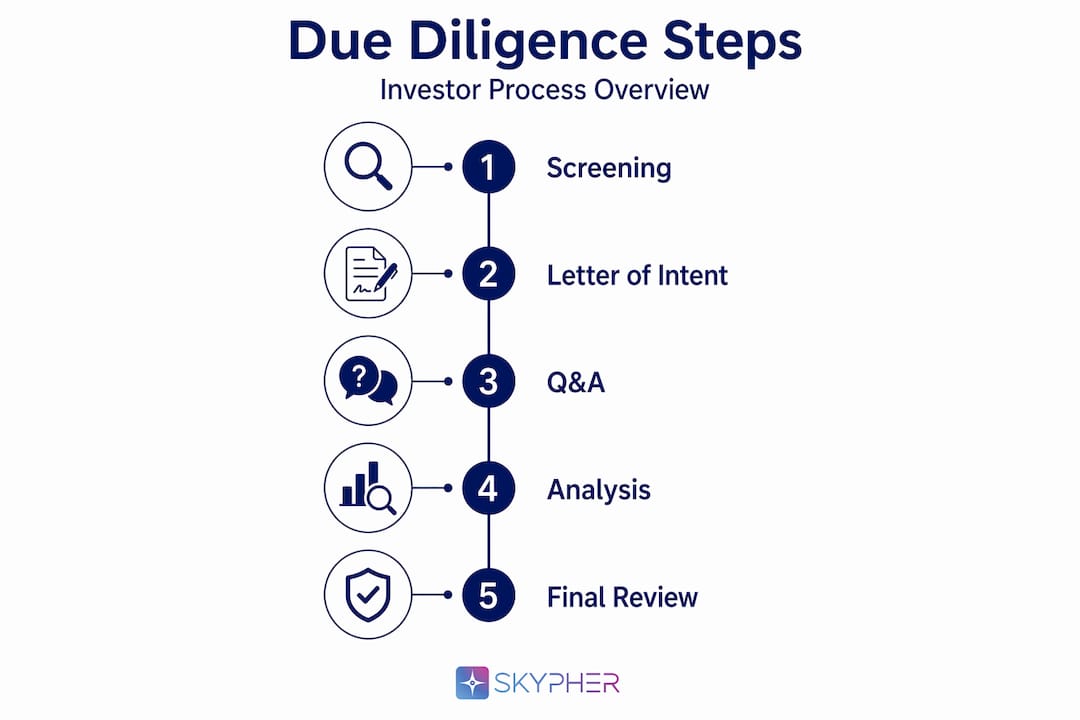
The due diligence process has three core phases, each serving a different strategic purpose.
- Preliminary due diligence (pre-LOI): Before signing a Letter of Intent, buyers conduct high-level screening to decide whether the deal warrants deeper investment. This phase covers public records, high-level financials, and initial management conversations. The objective is disqualification, not confirmation. Kill bad deals early.
- Confirmatory due diligence (post-LOI): This is the intensive phase. The buyer gains access to a data room, submits detailed information requests, and conducts in-depth analysis across all relevant categories. The Q&A phase that defines this period can absorb up to 70% of total deal time, as document exchange and verification require extensive back-and-forth with the seller.
- Pre-closing checks: In the final stretch, the team confirms that nothing material has changed since the confirmatory phase concluded. Updated financials, regulatory clearances, and final legal reviews happen here.
The LOI is not just a formality. It establishes exclusivity, which gives the buyer investigative leverage. Without exclusivity, sellers remain free to run competing processes, which creates pressure to rush. Rushed due diligence is where deals go wrong.
A useful way to think about scope and timing:
| Phase | Typical duration | Primary focus |
|---|---|---|
| Pre-LOI screening | 1 to 2 weeks | Red flag identification |
| Post-LOI confirmatory | 4 to 10 weeks | Full category deep-dive |
| Pre-closing verification | 1 to 2 weeks | Change-of-status checks |
Pro Tip: Negotiate milestone-based extensions for the Q&A phase rather than accepting a rigid calendar deadline. Milestone-based timelines reduce the pressure to proceed before all material questions are answered.
Advanced investigative techniques that uncover hidden risks
Standard financial audits capture what sellers choose to present. They rarely catch what sellers have an incentive to conceal. Standard financial audits often miss critical hidden risks like shell company networks, regulatory violations, and fraud patterns. This is where investigative due diligence earns its value.
Advanced investigative techniques include:
- Background checks and adverse media screening: Run key principals, not just the company, through regulatory databases, court records, and adverse media sources. Founders with prior regulatory sanctions or litigation histories do not always disclose this upfront.
- Forensic accounting: Goes beyond standard financial review to trace cash flows, identify related-party transactions, and detect revenue recognition manipulation. A business that accelerates revenue recognition before a sale will appear more profitable than it actually is.
- Operational site visits: Nothing replaces in-person verification. Visiting facilities, observing team dynamics, and meeting staff directly tests whether the business operates as described in the data room.
- Customer interviews: Venture capital investors are advised to conduct 5 to 10 interviews per deal to validate product-market fit and understand switching costs. Customers will say things about a business that no audit will ever surface.
- Independent reference verification: Sellers provide curated reference lists, which means every person on that list has been coached. Investors who bypass founder references and source independent contacts through LinkedIn and professional networks get far more candid assessments of the team's credibility and track record.
You can also complement investigative findings with a structured audit readiness review to spot regulatory red flags before they become deal blockers.
Pro Tip: When sourcing independent references, go two or three connections removed from anyone the seller introduced you to. The further you get from the seller's orbit, the more honest the feedback.

Comparing due diligence types and setting priorities
Not every deal warrants the same depth of investigation across every category. The importance of due diligence in each area scales with deal size, industry, and complexity. Here is a practical framework:
| Due diligence type | Core risk covered | Who leads it | Priority trigger |
|---|---|---|---|
| Financial | Earnings quality, hidden liabilities | CFO, financial advisors | All deals |
| Legal | Contract exposure, IP gaps | M&A legal counsel | All deals |
| Commercial | Market assumptions, revenue sustainability | Strategy team, consultants | Growth-oriented deals |
| Operational | Process fragility, integration risk | Operations and HR leads | Platform acquisitions |
| IT and cybersecurity | Data risk, technical debt, compliance | CTO, security specialists | Tech-heavy targets |
| Investigative | Fraud, regulatory history, reputational risk | External investigators | High-stakes or opaque deals |
Modern commercial due diligence is no longer just a pre-deal checklist exercise. Leading advisory firms now connect pre-deal analysis directly to post-close value creation plans. This integrated approach treats due diligence as the foundation for a 100-day operational playbook, not just a gating document for signing.
One area demanding increased attention in 2026 is AI tool procurement. Due diligence in AI contracting must begin early to negotiate critical safeguards around indemnities, data ownership, and model governance. Buyers who defer this investigation lose contractual leverage they cannot recover post-signing.
Pro Tip: For tech-sector acquisitions, treat cybersecurity and IT due diligence with the same weight as financial review. A single undisclosed data breach or misconfigured cloud environment can erode deal value faster than any revenue miss.
How to perform due diligence and avoid common pitfalls
Knowing what due diligence involves is not the same as executing it well. Here is how professionals organize a rigorous process:
- Build your team before you start. Assign clear ownership by category. Financial, legal, operational, and investigative workstreams should each have a designated lead with authority to escalate findings.
- Issue a structured information request list. Send the seller a comprehensive, categorized document request on day one. Ambiguous or incomplete requests let sellers provide minimal disclosure without technically withholding information.
- Run a completeness check on the data room. Automated completeness checks compare the data room contents against the request list and flag missing documents before analysis begins. Skipping this step means drawing conclusions from incomplete evidence.
- Never rely exclusively on seller-provided references. See the investigative section above. Treat curated references as a starting point, not a source of truth.
- Manage the Q&A log actively. Every question submitted to the seller and every response received should be tracked in a centralized log. Unanswered questions at closing are liabilities waiting to surface.
- Plan for timeline slippage. Complex deals almost always take longer than planned. Build buffer time into the schedule and tie deal-phase progression to documented milestones rather than calendar dates.
Using risk management automation tools to track document coverage and flag information gaps can meaningfully reduce the risk of an incomplete analysis under time pressure.
My honest take on due diligence
I have watched teams treat due diligence as a formality to get through rather than an investigation to learn from. The mindset matters as much as the process. When you enter due diligence expecting to find problems, you find them. When you enter hoping to confirm the investment case, you rationalize what you see.
The conventional framing of due diligence as purely a risk mitigation exercise also limits its value. In my experience, the most useful insight from a thorough process is not "here are the deal breakers." It is "here is how this business actually works, and here is where the real value creation opportunity sits." That reframing turns due diligence from a legal obligation into a strategic advantage.
The shortcut I see most often is overreliance on seller-prepared materials. A polished data room is a sales document. It is organized to present the business favorably. The signal is not what is in the data room; it is what is missing, inconsistent, or oddly absent. Train yourself to notice what you are not being shown.
The emerging challenge worth watching is AI-related due diligence. As more acquisition targets embed AI into core workflows, evaluating model governance, training data provenance, and contractual protections around AI outputs is becoming a non-negotiable workstream. Most buyers are not doing this rigorously yet, which means the professionals who develop this capability now will have a real edge.
— Gaspard
How Skypher accelerates due diligence workflows
The due diligence process generates an enormous volume of security questionnaires, compliance assessments, and information requests that eat up time your team does not have. Skypher's AI-powered questionnaire automation processes and responds to security reviews significantly faster than manual workflows, with accuracy that holds up to scrutiny.

Skypher integrates with over 40 third-party risk management platforms including OneTrust and ServiceNow, connects with Slack, Microsoft Teams, Confluence, and SharePoint, and supports multilingual enterprise setups. The platform's AI recommendation engine draws on your existing documentation to generate precise, consistent answers at scale. For teams managing multiple simultaneous due diligence tracks, Skypher eliminates the bottleneck that security and compliance questionnaires create at the worst possible moment in a deal.
FAQ
What is the due diligence meaning in business?
Due diligence is the independent verification of material facts about a business, asset, or counterparty before completing a transaction. It spans financial, legal, commercial, operational, and investigative workstreams to surface risk and validate assumptions.
How long does the due diligence process typically take?
The M&A due diligence process typically spans 30 to 90 days. The post-LOI confirmatory phase is the most intensive, often accounting for the majority of that time.
What are the main types of due diligence?
The primary types are financial, legal, commercial, operational, IT and cybersecurity, customer, and investigative due diligence. The types you prioritize depend on deal size, industry, and the specific risks associated with the target.
What does due diligence involve beyond financial review?
Due diligence involves legal contract review, commercial market validation, operational assessment, cybersecurity audits, customer interviews, and independent investigative research. Financial review is the starting point, not the full scope.
Why is due diligence important for investors?
Due diligence protects investors from undisclosed liabilities, inflated valuations, and operational risks that do not appear in seller-managed materials. It also establishes the fact base needed to negotiate price adjustments, representations, and warranties.