

TL;DR:
- Organizations without proper compliance controls pay about 2.71 times more annually than those with strong programs, risking higher costs from breaches and fines.
- Treating compliance as an operational discipline with continuous evidence collection and clear ownership strengthens security, reputation, and regulatory standing.
Compliance is often treated as overhead, a cost center to be minimized between audits. That framing is expensive. Organizations without adequate compliance controls pay roughly 2.71 times more annually than those that maintain them, with potential savings of $9.35 million from stronger programs. For CISOs and risk professionals in tech and finance, understanding why compliance matters is not an academic exercise. It determines whether your organization survives a breach, passes an exam, or retains a major client when a security questionnaire lands in your inbox.
Table of Contents
- Understanding the true cost of compliance versus noncompliance
- Compliance as a foundation for operational integrity in finance and tech
- Leveraging NIST checklists to create audit-ready, verifiable compliance evidence
- Why compliance is critical for client trust and reputational risk management
- Modern enforcement dynamics: proving compliance works in real time
- Balancing compliance priorities with business delivery in tech and finance
- What most compliance programs miss: clarity, continuous evidence, and capacity
- Streamline your compliance management with Skypher's AI-driven tools
- Frequently asked questions
Key Takeaways
| Point | Details |
|---|---|
| Compliance reduces cost | Effective compliance programs can save millions by preventing costly breaches and fines. |
| Operational integrity matters | Regulators require continuous proof that security controls are effective and integrated into risk management. |
| Evidence must be current | Regulators expect real-time, accessible proof of compliance, not retrospective documentation. |
| Client trust depends on compliance | Failing to execute compliance can cause reputational damage and financial harm to clients. |
| Balance requires leadership | Embedding compliance capacity into delivery with executive support avoids conflicts and improves outcomes. |
Understanding the true cost of compliance versus noncompliance
The instinct to cut compliance budgets during a tough quarter is understandable. It looks like savings until it isn't. The real cost comparison is not between your compliance program and zero. It is between your compliance program and a breach, a regulatory fine, a lost enterprise deal, and a 6-month remediation effort that consumes your entire security team.
Organizations without proper compliance management pay about 2.71 times more than those maintaining controls, with potential annual savings of $9.35 million from stronger programs. That gap funds multiple full compliance programs.
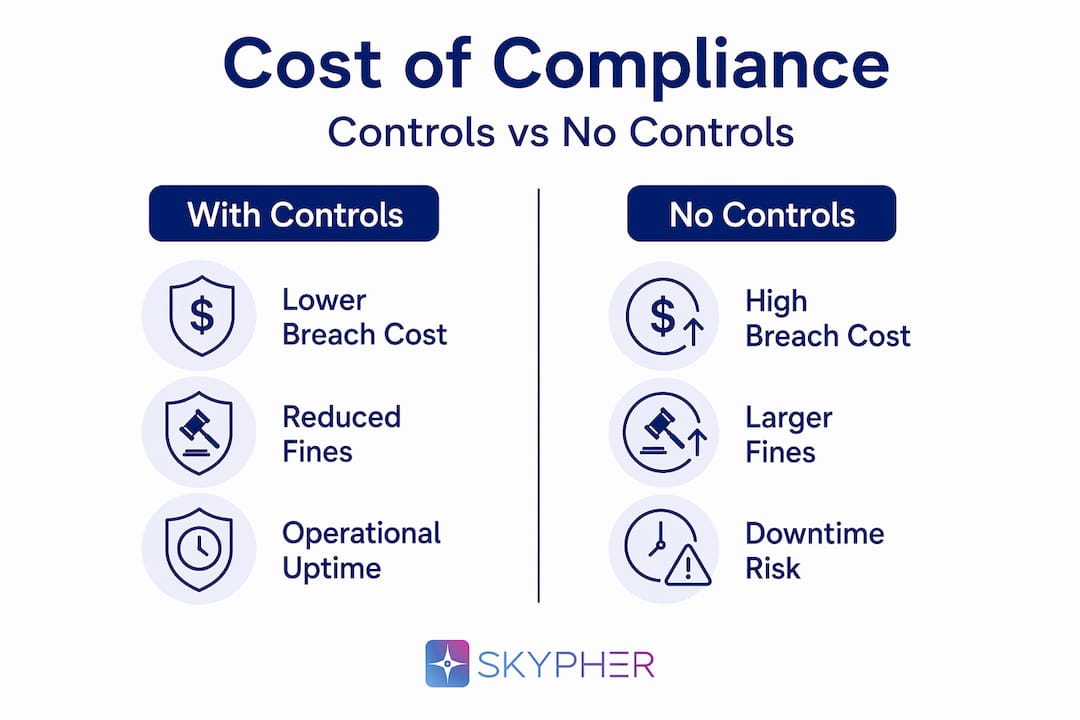
| Cost category | Without compliance controls | With compliance controls |
|---|---|---|
| Breach response and remediation | High (uncontrolled damage) | Reduced (contained and documented) |
| Regulatory fines | Full exposure | Mitigated by demonstrated controls |
| Cyber insurance premiums | Higher (elevated risk profile) | Lower (evidence of risk management) |
| Client onboarding friction | High (repeated questionnaires, delays) | Lower (trust center, faster approvals) |
The compliance risk impact extends beyond direct penalties. Insurance underwriters now review your control posture before quoting. Banks that cannot demonstrate adequate information security programs face capital adequacy questions. Tech firms lose deals at the proof of concept stage because they cannot answer vendor security questionnaires quickly or accurately.
Key financial risks when compliance is neglected:
- Regulatory fines that scale with the severity and duration of the lapse
- Breach costs inflated by delayed detection and poor incident documentation
- Insurance losses from claims denied due to insufficient controls
- Reputational damage that compounds every quarter after a public incident
Pro Tip: Treat your compliance investment as a risk transfer calculation. Every dollar in controls is measured against the probability-weighted cost of a breach or penalty. Your CFO will respond to that framing better than a policy document.
Understanding compliance significance through this financial lens changes every budget conversation you have. With the financial stakes clear, it is worth examining how compliance specifically supports operational integrity in regulated industries.
Compliance as a foundation for operational integrity in finance and tech
Policies sitting in a SharePoint folder do not constitute a compliance program. Regulators know this. The FFIEC expects a formal security program integrated into enterprise risk management, with documentation and evidence reviewed by examiners to verify control effectiveness, not just written acknowledgment that controls exist.

This is a critical distinction. Board-approved information security programs must be embedded in enterprise risk management processes. That means risk appetite statements, vendor risk tiers, and incident response procedures that executives have reviewed and signed off on. Not a policy the CISO wrote and filed.
What examiners actually look for in financial institutions:
- Risk assessments tied to business processes, not generic templates
- Security testing results including penetration tests and vulnerability scans with remediation tracking
- Incident response artifacts showing your IR plan was exercised, not just written
- Change management records demonstrating controlled configuration practices
- Vendor oversight documentation proving third-party risk is actively managed
The importance of compliance here is not about satisfying auditors for its own sake. Operational integrity means your controls actually work during an incident. Banks that failed examinations in recent cycles were not missing policies. They were missing evidence that those policies drove real behaviors.
Pro Tip: Map your key compliance frameworks to your control catalog, then trace each control to the evidence artifact it produces. If a control exists but produces no artifact, it is unverifiable. Examiners will treat it as nonexistent.
Strong compliance governance structures formalize accountability so that evidence production is someone's job, not everyone's assumption. And security documentation that is organized, timestamped, and accessible reduces examiner friction dramatically. Understanding compliance as an operational discipline rather than a filing exercise changes how your whole team works.
Leveraging NIST checklists to create audit-ready, verifiable compliance evidence
NIST's National Checklist Program is one of the most underused tools in enterprise compliance. Most organizations are aware it exists. Far fewer use it systematically. That gap shows up during audits.
NIST checklists support configuring IT products to a specific risk posture, verifying proper configuration, and producing artifacts to demonstrate compliance, minimizing attack surfaces in the process. That last phrase matters: minimizing attack surfaces is not just a security outcome, it is a compliance deliverable.
How to use NIST checklists as compliance evidence:
- Select applicable checklists for each IT product category in your environment (operating systems, web servers, databases, network devices).
- Baseline configurations against checklist requirements and document deviations with a business justification.
- Run automated scans against those baselines on a defined schedule to detect unauthorized changes.
- Generate compliance reports from scan results and attach them to your control evidence repository.
- Review and update checklists when NIST releases new versions or when your risk posture changes.
| NIST checklist function | Compliance benefit |
|---|---|
| Configuration baselining | Demonstrates controlled, policy-aligned system states |
| Automated verification | Produces repeatable, timestamped audit artifacts |
| Unauthorized change detection | Catches drift before it becomes a reportable incident |
| Attack surface minimization | Reduces breach probability, supports insurance arguments |
Information security checklists aligned to NIST give your team a testable, repeatable method for compliance evidence. They also give your auditors something concrete to review rather than a claim that systems are properly configured.
If your team needs support translating NIST requirements into your specific environment, an IT support consultation can help scope and prioritize the work. You can also review the software compliance software guide to identify tools that automate configuration scanning and evidence capture.
Pro Tip: Do not treat NIST checklist compliance as a one-time project. Unauthorized configuration drift is continuous. Your evidence collection needs to match that cadence.
Alongside these technical measures, how you manage client-facing compliance posture is equally consequential.
Why compliance is critical for client trust and reputational risk management
The link between compliance and client trust is not theoretical. It plays out in procurement cycles, contract renewals, and incident response headlines. When compliance lapses, customers pay for it. That changes the relationship permanently.
The 2015 Walmart Photo Center breach caused $1.3 billion in damages linked to awareness of compliance needs without effective remediation. The breach itself was damaging. The absence of remediation evidence is what made the legal exposure catastrophic.
"Knowing about a compliance gap and failing to close it is treated by regulators and courts as willful neglect. The compliance significance of documented-but-unaddressed risks cannot be overstated."
What compliance failures cost beyond the immediate incident:
- Customer attrition as affected clients move to competitors with stronger security postures
- Regulatory investigations triggered by the breach that surface other gaps
- Reputational penalties in the form of analyst downgrades and negative press coverage that extends the damage cycle
- Contractual liability when enterprise clients invoke security breach clauses in master service agreements
For cybersecurity essentials in finance, client trust is a quantifiable asset. Institutional clients score vendors on security posture before awarding contracts. A breach or a failed questionnaire response communicates the same thing: your controls are insufficient. Both outcomes cost you business.
Staying current on cybersecurity trends shaping risk helps compliance teams anticipate where new client requirements will emerge before they arrive as contract conditions. The shift in regulatory enforcement adds another layer to this challenge.
Modern enforcement dynamics: proving compliance works in real time
The enforcement question has changed. It used to be "Do you have a policy for this?" Today it is more demanding. Enforcement has shifted to "Can you show that it is working right now?", with penalties tied directly to an organization's inability to provide consistent, timely proof of compliance execution.
That shift has real operational consequences. Organizations that store compliance evidence across disconnected systems, email threads, and quarterly audit folders cannot meet that standard. The gap between having controls and proving controls work continuously is where modern fines originate.
Characteristics of organizations facing enforcement actions:
- Fragmented evidence stores with no single owner responsible for completeness
- Stale documentation that reflects configurations from six months ago
- Reactive incident response with no continuous monitoring to detect issues between audits
- Delayed reporting that regulators interpret as concealment rather than process failure
- Unclear accountability for control ownership at the team level
Pro Tip: Map every key control to a responsible owner, an evidence artifact, and a refresh cadence. Regulators do not penalize organizations for having incidents. They penalize organizations that cannot demonstrate they knew what was happening and responded appropriately.
The benefits of automating compliance are most visible here. Automation closes the gap between control existence and continuous verification. And structured compliance effectiveness documentation gives you the narrative layer that raw scan data alone cannot provide to regulators.
Balancing compliance priorities with business delivery in tech and finance
This is the tension every CISO manages. Engineering wants to ship. Finance wants the product live. Compliance has a regulatory deadline that does not move. The costs of compliance have risen sharply, and technology leaders now manage simultaneous demands of audit deadlines and business innovation, requiring explicit capacity planning and executive support.
The organizations that handle this well do not treat compliance as a separate workstream. They build compliance capacity directly into delivery cycles.
A practical framework for prioritization:
- Categorize compliance obligations by regulatory deadline, penalty exposure, and operational dependency. Fixed regulatory deadlines are not negotiable. Everything else can be tiered.
- Quantify the business impact of delaying each compliance obligation. Some gaps are low-risk for 90 days. Others create immediate exposure.
- Assign dedicated compliance capacity within engineering and security sprints rather than treating compliance work as a tax on feature development.
- Escalate trade-off decisions to executive leadership with explicit options and risk statements. This is not a security team decision; it is a business decision.
- Review capacity quarterly against your regulatory calendar. Surprises happen when no one owns the forward view.
Strong compliance governance structures at the executive level make these trade-offs visible before they become crises. And cybersecurity compliance tips grounded in practical delivery experience help teams prioritize without losing momentum. Understanding compliance as a capacity problem rather than a knowledge problem reframes the conversation with engineering and product leadership entirely.
What most compliance programs miss: clarity, continuous evidence, and capacity
Here is what experience shows, and what most compliance frameworks refuse to say plainly: the majority of compliance failures are not technology failures. Most compliance difficulties arise from missing governance clarity, policy scope, clear data lineage, workflow governance, and accountability rather than lack of controls or tools.
That is a striking finding for an industry that spends aggressively on compliance technology. The tools exist. The problem is that without clear ownership, defined scope, and a governance model that connects policy to execution, those tools produce noise rather than assurance.
What we see consistently is this: organizations invest in a GRC platform, map a control catalog, and pass their initial audit. Two years later, they cannot produce current evidence because no one owned the refresh process. The controls are still listed. The evidence is stale. The examiner is not impressed.
The uncomfortable truth is that governance clarity is harder to buy than software. It requires clear answers to uncomfortable questions: Who owns this control? What artifact proves it is working today? Who reviews that artifact and when? What happens if the answer is "no one"?
Continuous evidence is not a technical problem. It is a management discipline. The most audit-ready organizations we see are not necessarily running the most sophisticated tools. They are the ones where every control has a named owner, a defined evidence cadence, and an escalation path. Technology can automate the collection. Only governance can sustain the accountability.
Streamline your compliance management with Skypher's AI-driven tools
The article makes one thing clear: compliance evidence needs to be continuous, accessible, and complete. Gathering that evidence manually across security questionnaires, vendor reviews, and client audits is where programs break down.

Skypher's AI security questionnaire automation helps compliance and security teams respond to client and regulator requests faster and with greater accuracy, turning a process that previously consumed days into one that takes minutes. The AI-powered recommendation engine surfaces the most relevant answers from your existing knowledge base, reducing manual effort and improving consistency. And with easy import and export workflows, your team can handle every format without reformatting documents by hand. When compliance is a competitive differentiator, the right tooling is the difference between winning a deal and losing it on security review.
Frequently asked questions
Why is compliance more expensive to ignore than to maintain?
Ignoring compliance exposes organizations to fines, breach remediation costs, and insurance losses that collectively cost 2.71 times more than maintaining adequate controls, representing potential annual losses exceeding $9 million.
How do regulators verify compliance effectiveness?
They review formal documentation, risk assessments, security testing results, and evidence of continuous monitoring. FFIEC examiners specifically verify through audit trails, incident response documentation, and active monitoring records.
What role do NIST checklists play in compliance?
NIST checklists help configure and verify secure system settings, detect unauthorized configuration changes, and produce measurable audit evidence. NIST's configuration checklists enable testable, repeatable compliance verification across your IT environment.
Why are real-time compliance proofs required by regulators now?
Because regulators shifted focus to evidence that controls are working continuously, not just documented in a policy, penalizing organizations that cannot produce consistent or timely proof of execution.
How can CISOs balance compliance demands with business delivery?
By embedding compliance capacity directly into delivery planning and tying prioritization to regulatory deadlines and risk exposure. Strong executive sponsorship and explicit capacity planning reduce the conflict between compliance obligations and business initiatives before it becomes a crisis.