

TL;DR:
- Risk scoring is a governance-driven process that assigns numerical values to risks using predetermined criteria for objective prioritization. It relies on likelihood and impact calculations, integrated within enterprise risk management frameworks, to inform response strategies and compliance reporting. Effective programs emphasize documentation, validation, and periodic review, treating governance as essential for trustworthy risk assessment.
Risk scoring is widely misunderstood. Most people assume it's a simple formula that spits out a number, and that number tells you what to worry about. That assumption is where many organizations go wrong. What is risk scoring, really? It's a systematic, governance-driven process that assigns numerical values to identified risks using predetermined criteria, enabling objective prioritization and defensible decision-making across the enterprise. This guide breaks down the methodology, the frameworks, and the practical realities that every risk manager and compliance officer needs to understand before implementing or improving a scoring program.
Table of Contents
- Key takeaways
- What risk scoring is and how the methodology works
- Risk scoring within enterprise risk management frameworks
- Comparing risk scoring methodologies
- Pitfalls, governance gaps, and best practices
- My perspective: governance is the whole game
- How Skypher supports risk scoring and compliance workflows
- FAQ
Key takeaways
| Point | Details |
|---|---|
| Risk scoring is a process, not a number | Effective scoring requires documented scenarios, governance controls, and periodic review. |
| Likelihood × impact is the core formula | Most models multiply these two factors, but advanced methods add severity, velocity, and uncertainty. |
| Enterprise risk registers depend on scoring | Scores feed directly into prioritization, response strategy, and compliance reporting. |
| Governance is non-negotiable | Model risk management principles require validation, monitoring, and board-level accountability. |
| Context beats calculation alone | A score without a documented scenario is an opinion dressed up as data. |
What risk scoring is and how the methodology works
Risk scoring quantifies risk by assigning a numerical value to a given threat or vulnerability using predetermined criteria. The goal is to convert subjective judgments into something measurable, comparable, and defensible. Without scoring, you're left with gut instinct, which rarely survives regulatory scrutiny or board-level review.
The two most fundamental inputs in any scoring model are likelihood and impact.
- Likelihood measures how probable it is that a specific risk event will occur within a defined timeframe. Scales typically run from 1 to 5 or 1 to 10, with descriptive anchors like "rare," "possible," and "almost certain."
- Impact measures the potential consequence if the event occurs. This covers financial loss, operational disruption, reputational damage, and regulatory penalties.
- Severity is sometimes treated as a composite of both, particularly in cybersecurity frameworks where threat urgency matters as much as magnitude.
- Velocity captures how quickly a risk could materialize into harm, an input often overlooked in basic models but critical for incident response planning.
The most common calculation is straightforward: Risk Score = Likelihood × Impact. This formula guides defense and remediation priorities across both cybersecurity and enterprise risk management contexts. A vulnerability rated 4 on likelihood and 5 on impact produces a score of 20, which you can then rank against a score of 6 (a 2×3) to direct resources rationally.
The qualitative vs. quantitative distinction matters here. Qualitative models use descriptive ratings and relative scales. They're faster to deploy and easier for non-technical stakeholders to understand. Quantitative models use actual data, financial figures, and probabilistic methods. Advanced likelihood estimation can incorporate techniques like Monte Carlo simulations to quantify uncertainty more rigorously, which is especially valuable in complex or regulated environments.
Pro Tip: When building or auditing a scoring model, document the rationale behind every scale anchor. A "4 on likelihood" means nothing without a written definition. Undocumented scales are the single fastest way to lose governance credibility.
Risk scoring within enterprise risk management frameworks
A risk score on its own accomplishes very little. Its value emerges when it connects to a broader enterprise risk management (ERM) structure. Per NIST IR 8286B, risk priorities and projected cost information maintain a composite cybersecurity risk view across the enterprise, directly linking scoring outputs to prioritization decisions and response planning.
The operational home of risk scores is the enterprise risk register. Every scored risk should trace back to a documented scenario that describes who is affected, what could go wrong, what controls exist, and what the residual risk looks like after those controls are applied. Risk registers link scoring to response strategy, improving transparency for governance and audit purposes.
Here's how the scoring lifecycle typically flows within an ERM framework:
| Stage | Activity | Output |
|---|---|---|
| Risk identification | Document risk scenarios with context and narrative | Risk scenario library |
| Scoring | Apply likelihood × impact (or advanced model) | Numerical risk score |
| Prioritization | Rank scores against risk appetite thresholds | Prioritized risk register |
| Response planning | Assign treatment strategies and owners | Risk response plan |
| Monitoring | Review and re-score on a defined cycle | Updated risk register |
| Reporting | Communicate scores to governance and compliance | Risk dashboard or report |
Aligning scores with business objectives requires using business impact analysis to categorize assets and processes by mission criticality. A risk that scores a 16 against a non-critical system may warrant less investment than a risk scoring 12 against a mission-critical payment platform. Context, not just the number, drives the decision.
Pro Tip: Connect your risk register to your compliance reporting calendar. Scores that inform a quarterly board report need to be reviewed and refreshed before that report is written. Stale scores undermine every governance conversation that follows.
Comparing risk scoring methodologies
Not every organization needs the same model. Choosing the right methodology depends on regulatory exposure, organizational complexity, and the maturity of your risk function. The table below compares the most widely used approaches.
| Methodology | Complexity | Governance requirement | Best suited for |
|---|---|---|---|
| Likelihood × Impact (basic) | Low | Minimal | Small teams, initial program setup |
| Weighted scoring | Medium | Moderate | Organizations with multiple risk categories |
| Heat map scoring | Low to medium | Moderate | Visual communication with non-technical stakeholders |
| Quantitative (probabilistic) | High | Extensive | Financial institutions, regulated industries |
| Governance-enabled model | High | Full lifecycle oversight | Enterprise ERM, board-level accountability |
The basic likelihood × impact model works well as a starting point. It's fast to implement, easy to explain, and immediately useful for separating high-priority risks from noise. The limitation is that it treats all inputs equally and relies heavily on subjective judgment.
Governance-enabled models go further. They incorporate validation protocols, performance monitoring, and board accountability. This is the standard model risk management frameworks require in regulated industries, where a scoring model is treated as a risk object in itself. It must be developed with documented assumptions, tested against historical data, monitored for drift, and reviewed at defined intervals.
A few practical considerations when choosing your approach:
- If your organization is subject to financial regulation, a governance-enabled model is not optional. It is the expected standard.
- If you're scoring third-party vendor risk, weighted models that account for criticality and data access level will produce more accurate results than raw likelihood × impact.
- If your primary audience is a non-technical leadership team, heat map outputs can make scores instantly legible without requiring them to interpret raw numbers.
For technology risk management specifically, cybersecurity risk scoring often combines profiling steps before scoring, which means cataloging attack surfaces, asset sensitivity, and existing controls before a single number is calculated.
Pitfalls, governance gaps, and best practices
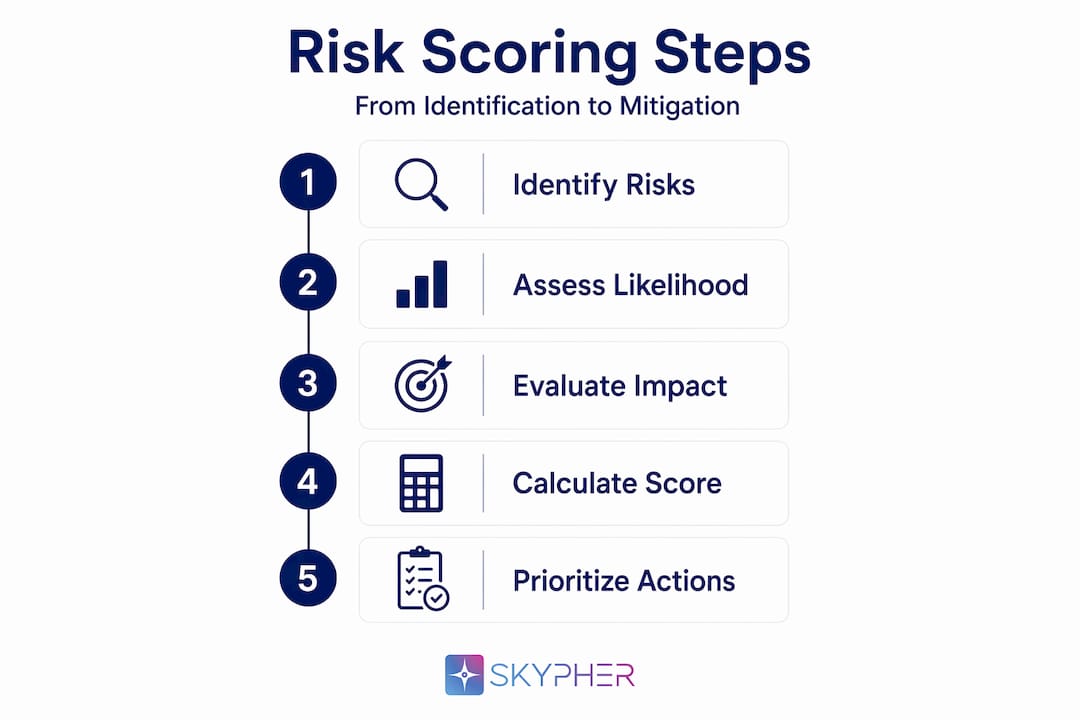
Risk scoring fails when organizations treat it as a mechanical exercise rather than a governance discipline. Here are the most common failure modes, and how to avoid them.

The most pervasive mistake is reducing a risk score to a standalone number without context. A score without a documented scenario is not a risk assessment. It's a guess with decimal places. Every score must be traceable to a written risk scenario that explains the threat, the assets at risk, and the assumptions behind the likelihood and impact ratings.
Governance gaps are the second major failure point. Periodic validation and monitoring are required to prevent risk score drift, which happens when the model's inputs no longer reflect the current operating environment. A scoring model built in 2022 that hasn't been reviewed since is almost certainly producing scores that no longer reflect actual risk exposure.
A few best practices that make a material difference:
- Define your risk appetite before you score anything. Scores are only meaningful relative to thresholds. Without an agreed-upon appetite, there's no way to decide what score warrants escalation.
- Separate identification from scoring. Practitioners who keep narrative risk inputs distinct from the scoring math enable better traceability for governance and audit.
- Profile before you score in cybersecurity contexts. Effective risk scoring depends on prior profiling to ensure scores reflect operational reality, not theoretical exposure.
- Build in a review cycle. Quarterly or semi-annual re-scoring keeps your register current and prevents the governance theater of reporting stale data with confidence.
The compliance risk implications of a poorly governed scoring model extend beyond internal risk management. Regulators increasingly expect organizations to demonstrate not just that they scored risks, but how they scored them and what they did as a result.
Pro Tip: Treat your scoring model documentation like audit evidence. Every assumption, every scale definition, every change log belongs in a governed repository. If your model can't survive a regulatory review, it can't be trusted to drive business decisions.
My perspective: governance is the whole game
I've reviewed risk scoring programs across organizations of very different sizes, and the pattern is consistent. The teams that get the most value from risk scoring are not the ones with the most sophisticated formulas. They're the ones who treat governance as the actual product.
What I mean is this: a likelihood × impact matrix maintained with discipline, reviewed quarterly, and documented properly will outperform a probabilistic quantitative model that's been left unvalidated for 18 months. The math is not the hard part. The hard part is building the organizational commitment to keep the model current, defensible, and connected to real decisions.
The uncomfortable truth is that most organizations invest heavily in building their first scoring model and then underinvest in everything that keeps it credible. Validation, documentation, change management, review cycles — these are not exciting activities. But they are what separate a risk scoring program that drives genuine prioritization from one that generates numbers nobody trusts.
My advice: before you add any new sophistication to your scoring methodology, ask whether your current model has documented assumptions, a validation history, and a defined review cycle. If the answer to any of those is no, fix the governance before you fix the formula.
— Gaspard
How Skypher supports risk scoring and compliance workflows
If your team manages security questionnaires as part of vendor risk assessment or compliance reviews, the quality and consistency of the data feeding your scoring models depends entirely on how those questionnaires are handled. Inconsistent responses, missed deadlines, and manual reconciliation introduce noise directly into your risk scores.

Skypher's AI-driven questionnaire automation eliminates that noise. The platform connects to over 40 third-party risk management platforms, integrates with Slack, Microsoft Teams, Confluence, and SharePoint, and processes questionnaires in multiple formats with accuracy that supports consistent risk data collection. For teams trying to maintain a defensible, well-documented scoring process, Skypher's smart security knowledge base provides the governance infrastructure that keeps your scoring inputs auditable and current. Less time on manual data collection means more time on the analysis that actually moves your risk posture forward.
FAQ
What is risk scoring in simple terms?
Risk scoring is the process of assigning a numerical value to a risk based on criteria like likelihood and impact, enabling organizations to rank and prioritize risks objectively rather than relying on subjective judgment.
How does risk scoring work in practice?
Most models multiply likelihood by impact to produce a score, then map that score to a prioritized risk register. Advanced programs layer in additional inputs like severity, velocity, and business impact to refine prioritization.
What is the most common risk scoring methodology?
The likelihood × impact formula is the most widely used starting point. Regulated industries often adopt governance-enabled models that include validation protocols, performance monitoring, and board-level accountability.
Why is governance important in risk scoring?
Without governance, scoring models drift out of alignment with current threats and business conditions. Regulatory frameworks require organizations to validate, monitor, and document their scoring models to maintain defensibility.
What is the difference between qualitative and quantitative risk scoring?
Qualitative scoring uses descriptive scales and relative ratings, making it faster and more accessible. Quantitative scoring uses data and probabilistic methods for greater precision, and is standard in complex or highly regulated environments.