

TL;DR:
- A structured, automated risk assessment workflow aligned with ISO 27005 is essential for efficient compliance and rapid responses. Automating questionnaire responses reduces errors, accelerates reviews, and strengthens auditability, giving teams a competitive advantage. Regular monitoring and continuous process improvement are crucial to adapting to evolving threats, regulations, and organizational changes.
Picture this: your sales team is two days from closing a seven-figure contract with a new enterprise client. The client's procurement team sends over a 150-question security questionnaire and expects a complete response within 48 hours. Your compliance team is already stretched thin, working through three other reviews manually, copy-pasting answers from spreadsheets and chasing subject matter experts over email. The deal stalls. The client moves on. That scenario plays out in tech and finance organizations every week, and it is entirely preventable. A well-designed, automated risk assessment workflow is the difference between a frictionless compliance process and a bottleneck that costs you business.
Table of Contents
- Understanding the risk assessment workflow
- Key requirements and tools for streamlining your workflow
- Step-by-step: Executing an effective risk assessment workflow
- Quality control and continuous workflow improvement
- Our perspective: Why automation is the future of risk assessment workflows
- Take your risk assessment workflow further with Skypher
- Frequently asked questions
Key Takeaways
| Point | Details |
|---|---|
| Follow a proven process | A structured, cyclical workflow grounded in ISO/IEC 27005 enables effective, repeatable risk assessments. |
| Leverage automation tools | Adopting automation dramatically reduces manual work, bottlenecks, and compliance risks. |
| Continuously improve | Regularly review and refine your workflow to align with new threats and regulations. |
| Document every stage | Thorough documentation ensures transparency, accountability, and easy audits. |
Understanding the risk assessment workflow
A risk assessment workflow is the structured sequence of activities your organization follows to identify, analyze, evaluate, and address information security risks. It is not just a checklist. It is a repeatable, auditable process that ties directly to your compliance posture, your vendor relationships, and your ability to respond quickly when a client or regulator asks hard questions.
Why does the workflow structure matter so much? Because without a defined process, every assessment is reinvented from scratch. Teams waste time, decisions lack documentation, and auditors find gaps. For organizations operating under frameworks like SOC 2, ISO 27001, or NIST CSF, an undocumented workflow is a liability.
ISO/IEC 27005 describes a 7-stage cyclical risk management process that provides the gold standard structure for information security risk assessment. Understanding each stage helps you build a workflow that is both rigorous and efficient.
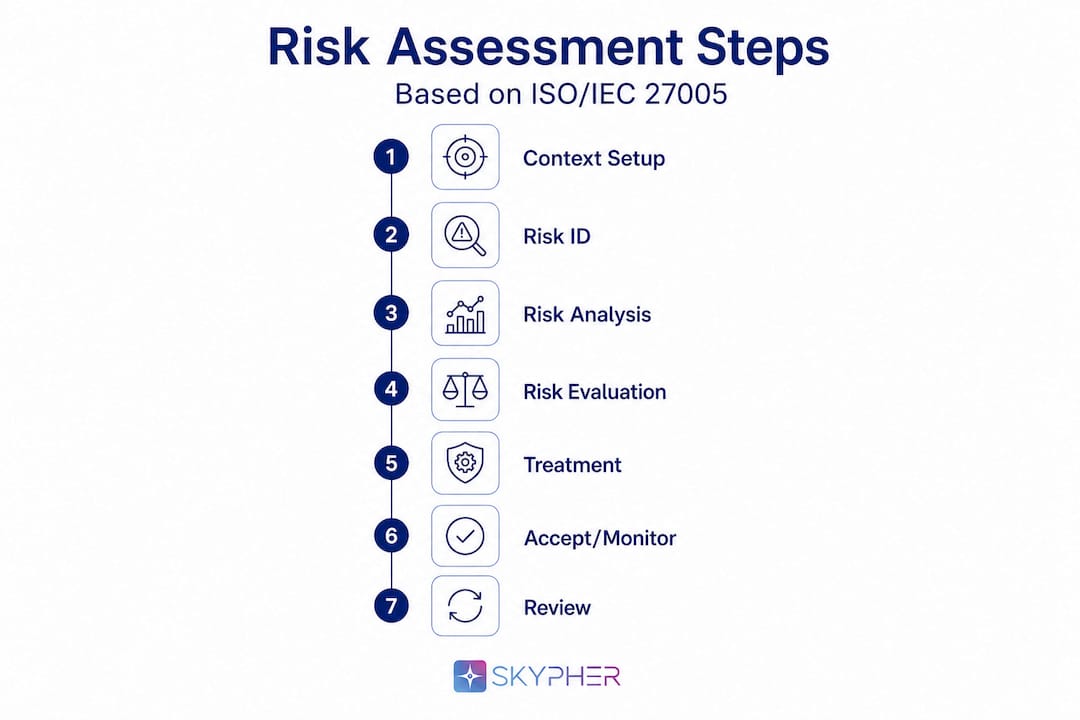
| Stage | Description |
|---|---|
| Context establishment | Define scope, objectives, and organizational constraints |
| Risk identification | Catalog assets, threats, and vulnerabilities |
| Risk analysis | Assess likelihood and potential impact |
| Risk evaluation | Compare risks against acceptance criteria |
| Risk treatment | Select and apply controls or mitigation strategies |
| Risk acceptance | Formally document accepted residual risks |
| Monitoring and review | Track changes, reassess periodically |
Each stage feeds the next, and the cycle repeats as your environment evolves. A critical point many organizations miss: risk communication is not a separate step. It runs throughout every stage. Stakeholders need real-time visibility into risk status, not a quarterly summary email.
Key workflow benefits include:
- Consistency: Every assessment follows the same defensible process
- Speed: Documented steps eliminate decision paralysis and duplicated effort
- Traceability: Every risk decision is recorded, making audits significantly faster
- Scalability: Structured workflows can be automated as volume grows
For teams building or strengthening their compliance foundation, understanding ISO 27001 security compliance requirements gives critical context for how risk assessment feeds into your broader information security management system. When you are ready to deepen that foundation, connecting with ISO 27001 consultants who specialize in risk management frameworks can accelerate implementation significantly.
"A poorly executed risk assessment workflow doesn't just create compliance gaps. It creates strategic blind spots that attackers and auditors alike are quick to exploit."
Key requirements and tools for streamlining your workflow
Before you optimize anything, you need to gather the right inputs and select the right tools. Skipping this preparation stage is one of the most common reasons workflow improvement projects stall after the first sprint.
A structured workflow is essential for repeatable, auditable risk assessments. That repeatability does not happen by accident. It requires three foundational prerequisites:
- Stakeholder buy-in across security, legal, IT, and business leadership
- A standardized process map that documents each stage, owner, and expected output
- Automation-friendly questionnaire templates that can be populated consistently and exported to multiple formats
Without all three, you will find yourself rebuilding consensus and reformatting documents every time a new assessment lands in your queue.
Manual vs. automated workflows: A direct comparison
| Factor | Manual workflow | Automated workflow |
|---|---|---|
| Response time for 100-question questionnaire | 3 to 5 business days | Under 1 hour |
| Error rate | High (copy-paste, version drift) | Low (AI-validated, single source of truth) |
| Auditability | Inconsistent | Full audit trail |
| Scalability | Breaks under volume | Scales linearly |
| Team coordination | Email chains and meetings | Real-time collaboration |
| Integration with TPRM platforms | Manual export/import | Native API connectors |
The contrast is stark. Manual workflows are not just slower. They introduce version control issues, create documentation gaps, and leave your team vulnerable during audits. When the same question appears across five different client questionnaires, a manual team answers it five different ways. An automated system pulls the approved answer from a centralized knowledge base every time.
Essential tools for a modern risk assessment workflow include:
- Risk management software for tracking risks, owners, and treatment status
- Questionnaire automation platforms that parse incoming questionnaires and suggest or auto-populate responses
- Documentation systems such as Confluence, Notion, SharePoint, or Google Drive that serve as the knowledge repository your automation tool references
- Communication integrations with Slack or Microsoft Teams for real-time collaboration and approval workflows
Pro Tip: Before selecting a platform, map your existing questionnaire volume. If your team receives more than 10 security questionnaires per month, manual handling is almost certainly costing you more than an automation platform would.
The value of automating risk review steps extends beyond time savings. Automation reduces the cognitive load on your security engineers, freeing them to focus on genuine risk analysis rather than administrative data entry. Explore proven questionnaire automation strategies to understand how leading teams are designing their response libraries and confidence scoring systems.

Step-by-step: Executing an effective risk assessment workflow
With your tools selected and your process mapped, it is time to run the workflow. The ISO/IEC 27005 process includes context establishment, identification, analysis, evaluation, treatment, acceptance, and review as its core sequence. Here is how to execute each phase efficiently.
-
Establish context. Define the assessment scope clearly: which systems, processes, and data types are in scope. Document your organization's risk appetite and any regulatory constraints. Common mistake: scoping too broadly. A sprawling scope leads to an assessment that takes months and satisfies no one.
-
Identify risks. Catalog your assets, the threats that could affect them, and the vulnerabilities those threats could exploit. Use your documentation system as the source of record. Automated tools can pull asset inventories directly from integrated systems, eliminating the spreadsheet-based asset registry that most teams dread maintaining.
-
Analyze risks. For each identified risk, assess the likelihood of occurrence and the potential business impact. Qualitative scales work well for speed; quantitative models provide better defensibility for executive reporting. Many automation platforms now offer AI-guided risk scoring that calibrates based on your industry, your organization's profile, and historical data.
-
Evaluate risks. Compare your analyzed risks against your documented risk acceptance criteria. Which risks fall outside tolerance? Which can be accepted as-is? This stage produces the prioritized risk register that drives your treatment decisions. Keep this output version-controlled so you can demonstrate how your risk posture evolves over time.
-
Treat risks. Select appropriate controls: mitigate, transfer, avoid, or accept. Map treatment decisions to specific control frameworks like ISO 27001 Annex A or NIST SP 800-53. Document the rationale for every decision. When a client or auditor asks why you accepted a particular residual risk, you need that rationale on record.
-
Accept residual risks formally. Get documented sign-off from the appropriate business owner or executive. This step is frequently skipped in manual workflows, leaving organizations with undocumented risk acceptance that creates audit findings.
-
Monitor and review. Schedule recurring reviews tied to business cycles, system changes, or regulatory updates. Set automated alerts for when treatment timelines lapse or when new vulnerabilities are published that affect in-scope assets.
Statistic callout: Organizations using automated questionnaire tools report completing security reviews up to 80% faster than teams relying on manual processes, dramatically reducing the lag between incoming questionnaire receipt and final submission.
Pro Tip: Assign a single workflow owner for each assessment who is accountable for moving it through every stage. Shared ownership almost always means delayed ownership.
The efficiency gains from streamlining questionnaire steps compound over time. As your response library grows and your AI confidence scores increase, new questionnaires require less and less human intervention. Teams that invest in workflow streamlining practices early find themselves with a significant competitive advantage when responding to enterprise procurement requirements.
Quality control and continuous workflow improvement
Completing one successful assessment cycle is a milestone, not a finish line. The ISO/IEC 27005 framework is explicitly cyclical because your threat environment, your technology stack, and your regulatory obligations never stop changing. Your workflow needs to keep pace.
Monitoring and review are essential parts of the cyclical ISO/IEC 27005 process, and they apply to the workflow itself, not just the risks it surfaces. Here is how to build continuous improvement into your operations:
- Peer review every assessment output before it goes to a client or executive. A second reviewer catches inconsistencies that the assessment owner will miss after hours of close work.
- Track completion time per stage to identify bottlenecks. If risk treatment sign-off consistently takes two weeks, the problem is probably the approval process, not the security team.
- Survey internal stakeholders after each assessment cycle. Ask what worked, what was unclear, and where they had to wait for inputs. This qualitative feedback surfaces process gaps that metrics alone will miss.
- Review your response library quarterly to ensure approved answers reflect your current security controls. Stale answers in an automated system are worse than no answers because they create false confidence.
- Schedule full workflow reviews at least annually and whenever your organization undergoes a significant change: a major product launch, a merger, a new regulatory requirement, or a significant security incident.
"The workflows that fail are the ones designed once and trusted forever. The best compliance teams treat their process documentation the same way they treat software: it needs maintenance, versioning, and regular testing."
Leveraging AI-guided risk assessment tools can surface patterns in your risk data that periodic manual reviews would miss entirely. These tools aggregate signals across assessments to show you where your controls are weakest and where client questions cluster, giving you data to prioritize control investments.
Following proven security review best practices helps your team stay ahead of emerging regulatory requirements and client expectations. The organizations that treat quality control as a continuous process rather than a pre-audit scramble consistently outperform their peers on vendor risk surveys and third-party assessments.
Our perspective: Why automation is the future of risk assessment workflows
Here is an uncomfortable truth: most organizations are not failing at risk assessment because they lack smart people or good intentions. They are failing because their workflows were designed for a regulatory and threat environment that no longer exists.
Regulations like DORA in financial services, emerging AI governance frameworks, and evolving supply chain security requirements are accelerating faster than manual compliance processes can adapt. A team that updates its risk templates twice a year will always be behind. An automated platform that pulls from a maintained knowledge base and integrates with your documentation systems can reflect control changes within hours.
The biggest mistake we see organizations make is treating automation as a cost-cutting measure rather than a capability investment. They automate the easy parts, like formatting questionnaire responses, and leave the high-value work, like risk analysis and treatment documentation, to ad hoc manual processes. The result is a patchwork system that is faster but no more defensible.
ISO 27001 security automation is not about replacing your security engineers. It is about giving them leverage. When your AI platform handles the initial population of 200 questionnaire responses with high-confidence answers, your engineers spend their time reviewing edge cases and refining nuanced answers rather than copy-pasting boilerplate.
The organizations getting AI-powered transformation right in compliance share one trait: they invested in a clean, well-maintained knowledge base before they deployed automation. Garbage in, garbage out is the oldest rule in information management, and it applies directly to security questionnaire automation.
Resistance to workflow automation in compliance typically comes from two sources: fear that automation will miss nuance, and concern about losing control over what goes out the door. Both are valid concerns with concrete solutions. Confidence scoring systems let your team focus human review where it matters most. Approval workflows ensure nothing leaves without the right sign-off. These are not obstacles to automation. They are features of mature automation design.
Take your risk assessment workflow further with Skypher
If the step-by-step process above resonates with the challenges your team faces every day, Skypher was built specifically to close those gaps for tech and finance compliance teams.

Skypher's security questionnaires automation platform can answer up to 200 questions in under one minute, powered by proprietary AI models that parse every format your clients and vendors send, including Excel, Word, PDF, and online portal submissions. With 30+ native API connectors to platforms like OneTrust and ServiceNow, your workflow integrates with the tools you already use. The AI-powered recommendation engine learns from your approved responses and improves accuracy over time, while easy import and export workflows ensure your team spends minutes, not days, on every assessment cycle. Real-time collaboration, Slack and Teams integrations, multilingual support, and enterprise-grade scalability make Skypher the platform compliance teams choose when they are serious about efficiency.
Frequently asked questions
What are the core stages of an effective risk assessment workflow?
The core stages follow the ISO/IEC 27005 framework: context establishment, risk identification, risk analysis, risk evaluation, risk treatment, risk acceptance, and ongoing monitoring and review. Each stage feeds directly into the next within a cyclical process.
How does automating the risk assessment workflow benefit compliance teams?
Automation eliminates manual errors, compresses completion times from days to minutes, and creates a full audit trail that makes regulatory reviews far less painful. A structured, automated workflow is essential for producing assessments that are both repeatable and defensible under scrutiny.
Are regular reviews mandatory for risk assessment workflows?
Yes. Monitoring and review are built into the ISO/IEC 27005 cycle as non-optional stages because threat environments, regulatory requirements, and organizational contexts all change continuously. Skipping scheduled reviews creates undetected compliance drift.
Which standards should guide a risk assessment workflow in tech organizations?
ISO/IEC 27005 is the primary international standard for information security risk management and is directly compatible with ISO 27001. Organizations in regulated sectors often layer NIST CSF or SOC 2 requirements on top of the ISO/IEC 27005 foundation.