

TL;DR:
- Continuous automation of compliance processes reduces audit exceptions and timeline.
- Effective audit readiness requires ongoing control testing, evidence collection, and vendor assessments.
- Building automated workflows into operations ensures consistent, risk-averse audit success.
Security audits should not feel like a fire drill every year. Yet for most compliance and risk teams in tech and finance, that is exactly what they are. Manual audit processes produce exceptions at rates between 60% and 75%, meaning the majority of organizations enter audits carrying preventable gaps. This article breaks down the essential components of an audit readiness checklist, shows where teams most commonly fail, and gives you a practical framework for building continuous, automated compliance that holds up when auditors arrive.
Table of Contents
- Core components of an audit readiness checklist
- Common audit exceptions and how to avoid them
- Comparing checklists: Governance vs. technical controls
- Vendor assessments and third-party risk: A make-or-break factor
- Continuous monitoring: Proving control effectiveness over time
- The uncomfortable truth most compliance teams overlook
- How Skypher can streamline your audit readiness
- Frequently asked questions
Key Takeaways
| Point | Details |
|---|---|
| Checklist essentials | Gap analysis, evidence management, and control testing form the backbone of audit readiness. |
| Avoid common exceptions | Automating access control and vendor reviews prevents the majority of audit failures. |
| Tailor your approach | Balance governance and technical controls to match your organization's audit needs. |
| Continuous monitoring | Ongoing evidence collection and control testing are key to maintaining compliance. |
| Leverage automation | Integrated workflows and AI tools speed up audit processes and minimize risk. |
Core components of an audit readiness checklist
With the stakes clarified, let's examine the core structure of an effective audit readiness checklist. Think of it less like a to-do list and more like a living system. Static checklists get outdated fast. The organizations that consistently pass audits with minimal exceptions treat readiness as an ongoing practice, not a pre-audit sprint.
Key methodologies include pre-audit assessments, mock audits, evidence collection in centralized repositories, control testing, and continuous monitoring. Each element plays a distinct role. Skipping any one of them is where exceptions start to appear.
Here is how to structure a solid audit readiness checklist:
-
Conduct a gap analysis. Compare your current controls against the target framework, whether that is SOC 2, ISO 27001, or another standard. Document every gap in a shared, version-controlled location so nothing falls through the cracks.
-
Run a mock audit. Assign an internal team or external consultant to simulate the audit process. This is one of the highest-value activities you can do. Mock audits surface issues that look fine on paper but fail under scrutiny.
-
Build a centralized evidence repository. Auditors need evidence, and they need it quickly. A centralized repository with tagged, organized files reduces retrieval time and removes ambiguity about what version of a document is current. Tools that integrate with security review best practices make this far easier to sustain.
-
Test controls systematically. Use sampling (reviewing a subset of transactions or events over a period) and frequency-based testing (confirming that daily, weekly, or monthly controls actually ran on schedule). Document the testing methodology and results in a way auditors can follow without additional explanation.
-
Establish continuous monitoring. Controls that work during testing must be shown to work throughout the audit period. Set up automated monitoring dashboards and alert systems that capture control performance in real time.
Pro Tip: Start documentation at the very beginning of your audit period, not three weeks before auditors arrive. Evidence collected mid-period is far more convincing than a document dated the week before the audit window closes.
Following cybersecurity tips for tech and finance organizations can also help you tailor controls to the specific threat landscape your auditors expect to see.
Common audit exceptions and how to avoid them
Understanding the essential checklist, it's crucial to address where audit processes most often fail. Exceptions are not random. They cluster around predictable failure points, and knowing them in advance gives your team a significant advantage.
The most common sources of audit exceptions include:
- Access deprovisioning delays. When employees leave or change roles, their system access should be revoked within a documented timeframe, typically 24 to 72 hours. A common pattern in exceptions is access remaining active for weeks or months after termination, which creates both audit and security risk.
- Missing vendor assessments for critical tiers. Auditors expect you to know which vendors handle sensitive data and to have documented assessments for them. Critical-tier vendors with no formal review on file are a consistent red flag.
- Untested incident response (IR) plans. Having an IR plan is not enough. Auditors want evidence that you have tested it. Tabletop exercises with documented outcomes satisfy this requirement; an untested plan does not.
- Policy to practice gaps. Your written policies say one thing, but your actual behavior says another. For example, a policy requiring quarterly access reviews that were last run eight months ago is a clear gap.
- Mid-period evidence inconsistencies. Evidence that does not cover the full audit period, or that shows sudden changes in process right before the audit, raises red flags. Auditors are trained to notice breaks in continuity.
- Undocumented change approvals. Every significant change to systems or configurations should have an approval trail. When that trail is missing, auditors treat the change as unauthorized.
Statistic callout: Manual checklists produce exceptions at rates between 60% and 75%, while automation can reduce overall audit timelines by 40%.
The solution to most of these is not more manual effort. It is building automated workflows that enforce process compliance continuously. A third-party vendor risk assessment process, for example, becomes far more consistent when it is triggered automatically based on vendor tier and contract renewal dates rather than relying on someone remembering to send a spreadsheet.

Following structured vendor risk review steps also helps eliminate the ad hoc approach that leads to missing assessments.
Pro Tip: Automate deprovisioning workflows through your HR and identity management systems. When a termination is logged in your HR platform, it should automatically trigger an access revocation ticket with a defined SLA. This one change eliminates one of the most common exception categories completely.
Comparing checklists: Governance vs. technical controls
To optimize your checklist, consider how approaches differ between traditional and modern compliance practices. Not all checklists are built the same, and the gap between a Big Four consulting firm's approach and a tech-driven compliance team's approach is significant.
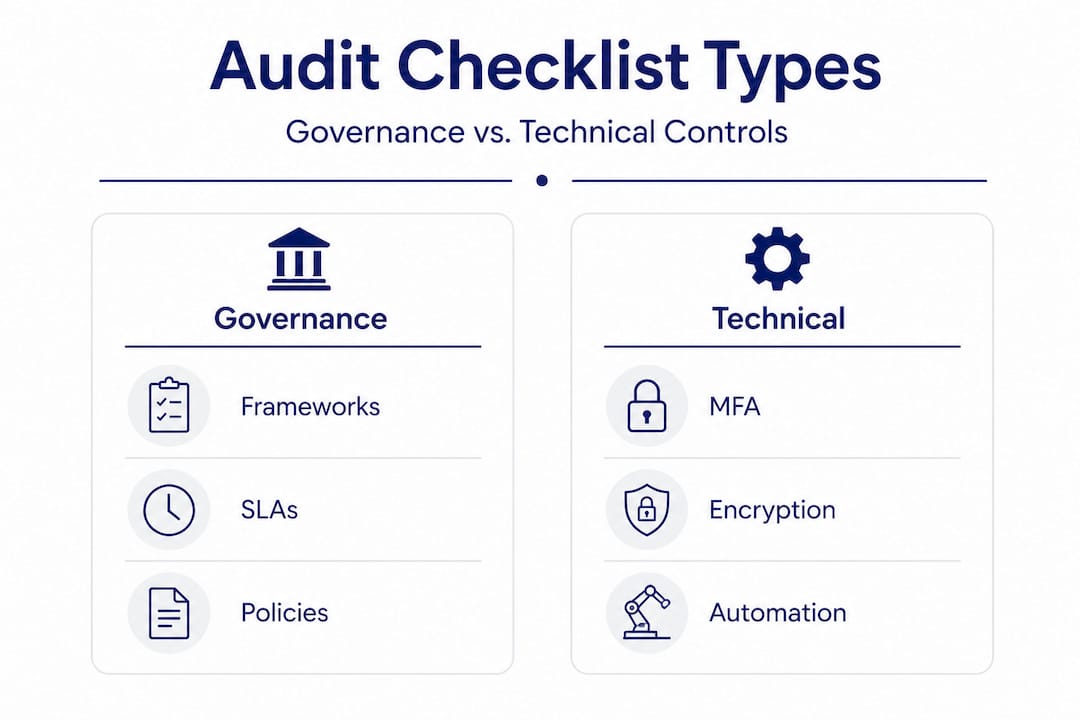
Big Four checklists emphasize governance frameworks, service level agreements (SLAs), and policy adherence. They work through structured interviews, documentation reviews, and formal sign-offs. They are rigorous but can be slow, and they often rely on manual evidence collection.
Tech-focused compliance teams tend to prioritize technical controls: multi-factor authentication (MFA), encryption at rest and in transit, logging and alerting, and automated policy enforcement. Their checklists are more tool-centric and easier to automate.
| Feature | Governance-focused (Big Four style) | Technical-focused (Tech org style) |
|---|---|---|
| Primary emphasis | Policy adherence, SLAs, governance | Encryption, MFA, automated logging |
| Evidence collection | Manual, document-heavy | Automated, real-time dashboards |
| Speed of preparation | Slower, weeks or months | Faster with tooling in place |
| Exception risk | Higher due to manual processes | Lower with automation coverage |
| Best suited for | Regulated industries, financial services | SaaS, cloud-native tech companies |
| Continuous monitoring | Less common | Often built into the platform |
The smartest approach is a hybrid. You need governance documentation to satisfy auditors who expect formal policy frameworks, and you need technical controls to actually protect your environment. Treating cybersecurity in SaaS platforms as a purely technical problem or a purely governance problem is the error that creates gaps.
"Automation can reduce timelines by 40%, giving compliance teams more time to focus on genuine risk rather than paperwork."
The key insight here is that automation does not replace judgment. It removes the manual, repetitive work so your team can focus on the nuanced issues that actually require expertise.
Vendor assessments and third-party risk: A make-or-break factor
With checklist types compared, it's essential to recognize vendor risk as a core failure or success factor. For tech and finance organizations, the vendor ecosystem is large and complex. Cloud providers, payment processors, identity platforms, analytics tools — each one represents a potential risk exposure that auditors will ask about.
Vendor assessments missing for critical tiers lead directly to audit exceptions, and this is one of the most preventable problems in the audit process. The fix is a structured tiering and assessment cadence.
| Vendor tier | Definition | Assessment frequency |
|---|---|---|
| Critical (Tier 1) | Handles sensitive data, core to operations | Annual, with mid-year review |
| High (Tier 2) | Significant access or data processing | Annual |
| Medium (Tier 3) | Limited data access, non-core services | Every 18-24 months |
| Low (Tier 4) | No data access, commodity services | As needed or on contract renewal |
Key steps for a robust vendor risk evaluation process:
- Inventory all vendors and assign tiers based on data access, criticality, and regulatory exposure. This is your foundation.
- Send security questionnaires to Tier 1 and Tier 2 vendors on a defined schedule. Use a vendor risk assessment checklist to standardize the questions.
- Review vendor responses and score them against your risk criteria. Flag gaps and require remediation plans where controls fall short.
- Track remediation through to completion and document the outcome. Auditors want to see that you identified a risk and resolved it, not just that you asked a question.
- Maintain a vendor risk register that is updated continuously. A snapshot taken once a year is not a risk management program — it's a wishlist.
Understanding third-party risk management as a discipline, not a one-time exercise, is what separates organizations that pass audits consistently from those that scramble. Looking at third-party risk management examples from comparable organizations also helps calibrate your program to industry expectations.
Continuous monitoring: Proving control effectiveness over time
Finally, ongoing monitoring is vital to sustaining audit readiness and minimizing risk. Passing an audit once is not the goal. The goal is demonstrating that your controls operate consistently over the entire audit period, which for most frameworks means 3 to 12 months.
Continuous monitoring to demonstrate operating effectiveness over 3 to 12 months is one of the most frequently cited requirements in SOC 2 and similar frameworks, and one of the hardest to satisfy without automation.
Here is a practical approach to building continuous monitoring into your compliance program:
-
Define control frequency and ownership. Every control should have a documented frequency (daily, weekly, monthly, quarterly) and a named owner. Ambiguity about who is responsible is how controls silently fail.
-
Automate evidence capture wherever possible. Use integrations with your cloud providers, identity management systems, and endpoint tools to pull evidence automatically. Manual screenshots taken once a quarter are a liability, not an asset.
-
Set up automated alerts for control failures. When a control fails — an access review is not completed on time, a log file is not generated — your team should know immediately, not when auditors flag it.
-
Conduct internal control reviews quarterly. Even with automation, a human review is valuable. Look at trends, flag anomalies, and adjust your monitoring thresholds based on what you learn.
-
Maintain an audit trail of all monitoring activities. The monitoring itself needs to be documented. Auditors will ask not just whether controls ran, but how you knew they ran.
Pro Tip: Use continuous monitoring in SaaS platforms to capture real-time evidence updates automatically. This removes the end-of-period evidence scramble that causes so many exceptions and gives auditors a clean, complete record.
The uncomfortable truth most compliance teams overlook
Here is what years of watching audit cycles reveals: most compliance teams treat their checklist as a project with a finish line. They sprint to gather evidence, run their mock audit, close their gaps, and then exhale when the auditors leave. And then they do it all again the following year, from nearly the same starting point.
That is not a compliance program. That is an annual performance.
The teams that consistently achieve clean audits with minimal exceptions operate differently. They do not think of compliance as a task — they build it into the fabric of how work gets done. Access deprovisioning is not a reminder on someone's calendar. It is a workflow that triggers automatically. Vendor questionnaires are not a spreadsheet sent at renewal time. They are a scheduled, tracked, scored process that runs on its own.
The shift from manual to automated is not just about productivity. It is about eliminating entire categories of risk. When evidence is collected continuously, there is no gap to fill. When vendors are assessed on a rolling schedule, there is no missing assessment to explain. When access is revoked automatically, there is no deprovisioning delay to document.
What we see again and again is that organizations invest in better checklists when what they actually need is better infrastructure. A perfectly designed checklist run manually will still produce exceptions because humans are inconsistent, busy, and working across dozens of other priorities. Automation removes the human failure point without removing human judgment.
The most mature compliance programs we see look more like third-party risk management success stories than audit war rooms. They are calm, continuous, and evidence-rich because they built systems that generate compliance as a byproduct of normal operations.
The checklist is still important. But the checklist should be the output of your program, not the program itself.
How Skypher can streamline your audit readiness
Having looked at both practical and strategic insights, here's a solution to operationalize everything discussed.

Skypher's security questionnaire automation platform is built for exactly the kind of continuous, integrated compliance program described in this article. Instead of manually tracking vendor responses and chasing down evidence before an audit, Skypher automates the entire workflow — from sending questionnaires to scoring responses and flagging gaps. The AI recommendation engine surfaces the right answers based on your existing documentation, dramatically reducing completion time and improving consistency. And with flexible import and export workflows, you can connect Skypher to the platforms your team already uses, including OneTrust, ServiceNow, Slack, and SharePoint, without rebuilding your existing processes.
Frequently asked questions
What is the most common reason for audit exceptions?
Access deprovisioning delays and missing vendor assessments for critical tiers are consistently the top causes, along with policy-to-practice gaps and mid-period evidence inconsistencies.
How can automation improve audit readiness?
Automation can lower exception rates significantly by eliminating manual errors in evidence collection and reducing overall audit timelines by up to 40%.
How often should evidence be collected for audits?
Evidence should be continuously collected and monitored across a 3 to 12 month audit period rather than gathered in a single push before the audit window closes.
Why are vendor assessments important to audit readiness?
Missing vendor assessments for critical-tier vendors are a leading source of audit exceptions, because auditors require documented evidence that you have evaluated every significant third-party risk.