

A compliance program is your organization's system of policies, people, and processes built to prevent, detect, and correct legal and ethical violations. An effective one always includes governance, documented policies, risk assessment, training, monitoring, enforcement, and remediation, and every element must scale to your actual risk profile. Regulators don't just check whether these pieces exist. They evaluate whether the program is well designed, applied honestly, and produces results.
TL;DR:
- Regular internal testing and annual external audits are essential to demonstrate that a compliance program effectively detects and addresses control failures.
- Documentation such as risk assessments, audit reports, remediation logs, and sign-offs is critical to prove the program's design, implementation, and ongoing effectiveness.
- Automating evidence collection through integrated governance systems simplifies audit preparation and enhances the ability to show applied good-faith compliance.
- Tailoring compliance efforts to organizational size and industry risks ensures resources are focused on high-impact areas and not wasted on low-risk activities.
- Most compliance failures stem from an inability to prove policies were applied, not from poor design, emphasizing the importance of continuous documentation and traceability.
Table of Contents
- What Is a Compliance Program, and Why Does It Matter to Leaders?
- What Are the Seven Core Elements of an Effective Compliance Program?
- How Do You Build a Compliance Program Step by Step?
- How Often Should You Audit and Monitor Your Compliance Program?
- How Should Compliance Programs Differ by Company Size and Industry?
- How Do Regulators Decide If Your Compliance Program Actually Works?
- What Changes When You Automate Compliance Evidence Collection?
- Why Most Compliance Programs Fail the Evidence Test, Not the Design Test
- Sources
What Is a Compliance Program, and Why Does It Matter to Leaders?
We think of a compliance program as the operating system underneath everything else your legal, risk, and security teams do. It's the combination of written policies, internal controls, designated people, and repeatable processes that keep your organization inside legal and ethical lines, and it only works when those pieces talk to each other instead of sitting in separate binders.
The business case is straightforward. A program that catches problems early prevents small violations from becoming expensive investigations, protects your reputation with customers and partners, and gives leadership operational clarity about where risk actually lives in the organization. That last part matters more than most executives realize. Without a functioning program, you're often making decisions blind.
There's also a direct regulatory incentive. The U.S. Department of Justice evaluates whether a company's program was well designed, applied in good faith, and works in practice when deciding how to charge or penalize misconduct. A documented, functioning program can meaningfully affect that outcome. Here's what that means in practice:
- Reduced likelihood that isolated violations escalate into systemic legal exposure
- Mitigation credit during DOJ charging decisions when misconduct does occur
- Faster detection of control failures before they compound
- Clearer accountability when something goes wrong, because roles and processes are already defined
None of this happens by accident. It happens because someone owns the architecture.
What Are the Seven Core Elements of an Effective Compliance Program?
The OIG's General Compliance Program Guidance lays out seven elements that show up, in some form, across nearly every regulatory framework in the United States. The guidance is explicit that there's no single model. You adapt these to your organization's size, sector, and risk exposure, but the categories themselves are close to universal.
Pro Tip: Don't treat the seven elements as a checklist to complete once. Regulators specifically look for evidence that each element is "living," meaning it changes as your risk profile changes. A policy that hasn't been touched in three years reads as neglect, not stability.
-
Policies and procedures. Written standards that translate legal obligations into specific, enforceable internal rules. Evidence of effectiveness includes version-controlled documents, defined review cycles, and sign-offs from accountable owners. Track the percentage of policies reviewed within their scheduled cycle.
-
Leadership and oversight. A designated compliance officer with real authority, plus board or committee-level visibility into program performance. Evidence includes committee charters, meeting minutes, and reporting lines that show the compliance function isn't buried three levels below decision-makers. Track meeting frequency and whether compliance reports reach the board directly.
-
Risk assessment. A structured process for identifying and ranking obligations by likelihood and impact. A risk-scoring matrix that ties each obligation to an owner, a control, a current rating, and a reassessment date turns a sprawling list of legal requirements into a prioritized work plan. Track the number of high-risk items with an assigned owner and a current mitigation status.
-
Training and communication. Role-specific training, plus channels employees actually use to raise concerns, including a hotline with real anti-retaliation protection. Evidence includes completion logs, quiz scores, and hotline case volume by category. Track training completion percentage by department and average time to close a reported concern.
-
Monitoring and auditing. Ongoing testing of whether controls function as designed, not just whether they exist on paper. Evidence includes internal review reports, control test results, and audit trails. Track the number of control tests conducted per quarter and the percentage that pass without exception.
-
Enforcement and discipline. Consistent consequences applied regardless of an employee's seniority or performance record. Evidence includes disciplinary logs showing consistent application across levels. Track the ratio of substantiated violations to disciplinary actions taken, since a gap between the two is a red flag regulators notice quickly.
-
Response and remediation. A documented process for investigating incidents, fixing root causes, and verifying the fix worked. Evidence includes investigation reports, remediation timelines, and follow-up testing. Track average time from incident detection to remediation closure.
Each element needs a paper trail. A program that exists only in someone's head, or in a policy manual nobody has opened since onboarding, doesn't hold up under scrutiny, no matter how well-intentioned it is.
How Do You Build a Compliance Program Step by Step?
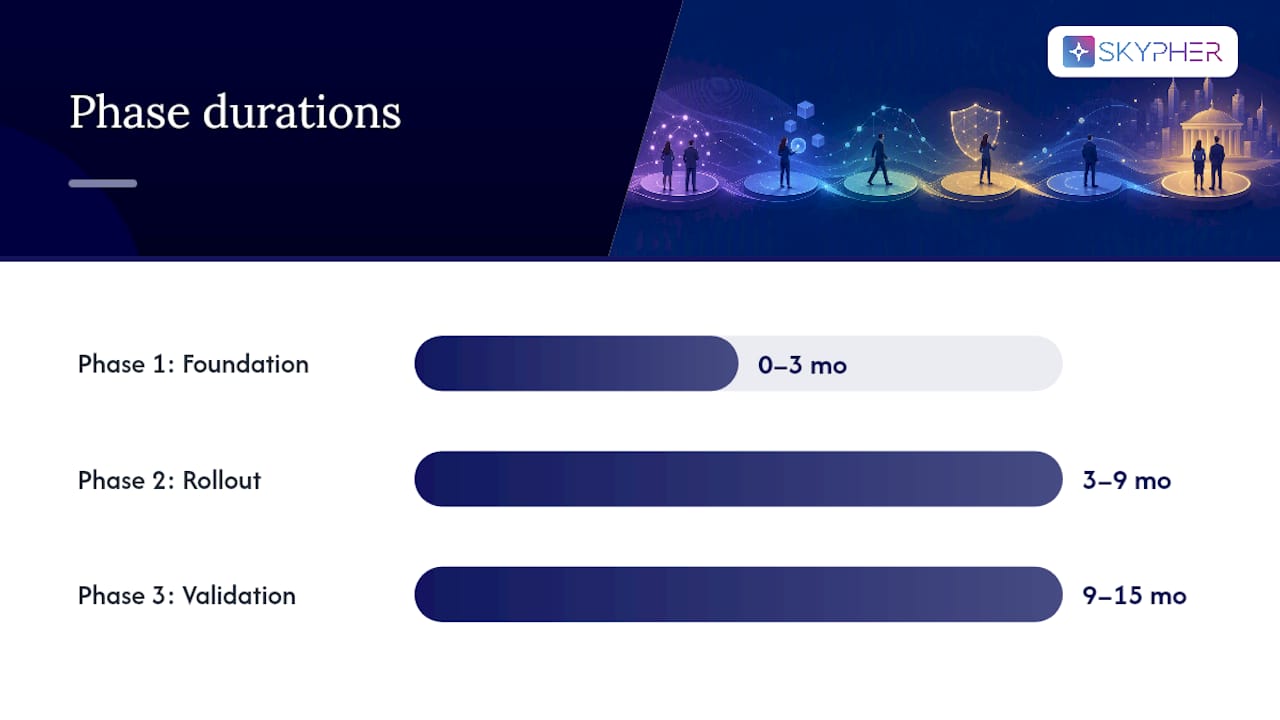
Building or overhauling a program works best as a phased rollout with named owners and real deadlines attached to each phase. Trying to do everything simultaneously is how programs stall out in month two.
Phase 1: Foundation (Months 0 to 3)
- Establish governance: designate a compliance officer and define reporting lines to leadership.
- Complete an initial risk assessment and obligations inventory.
- Draft baseline policies covering your highest-risk areas first.
- Set up the compliance committee's charter and first meeting cadence.
Phase 2: Rollout (Months 3 to 9)
- Deploy prioritized controls tied to your highest-risk findings.
- Launch role-based training and open a reporting hotline with anti-retaliation protections.
- Run your first internal audits against the new controls.
- Assign a control owner for every risk item on the matrix.
Phase 3: Validation (Months 9 to 15)
- Integrate technology to centralize policy documents, evidence, and version history.
- Commission a formal external audit.
- Close out remediation items identified during internal testing.
Phase 4: Continuous Operation (Ongoing)
- Conduct quarterly internal reviews.
- Commission an annual external audit at minimum.
- Reassess risk ratings as regulations, headcount, or business lines change.
Realistic timelines vary by organization size. A phased roadmap spanning six to twenty-four months is typical, with smaller organizations moving faster through fewer risk categories and larger enterprises needing the longer end of that range to cover multiple business units.
How Often Should You Audit and Monitor Your Compliance Program?
Proving a program works requires more than good intentions. It requires a testing rhythm and a paper trail that survives an outside review.
Industry guidance recommends quarterly internal reviews paired with a formal external audit at least once a year. That cadence catches control failures fast internally while giving an independent auditor enough distance to spot blind spots your own team might miss.
Testing should mix several methods rather than relying on one:
- Control testing against documented procedures
- Data reviews to catch discrepancies between what's reported and what's true
- Process walkthroughs with the people actually doing the work
- Anonymous employee surveys to surface concerns nobody wants to raise formally
A useful metrics dashboard tracks training completion rates, hotline case resolution times, the percentage of control tests passed without exception, and the average time from finding a violation to closing it out. Sudden drops in any of these numbers usually mean something upstream broke.
Documentation matters as much as the testing itself. Written audit reports, version-controlled policy history, and dated sign-offs are what separate a program regulators trust from one that just claims to work. When a test fails, root-cause analysis, not just a patch, determines whether the same failure shows up again next quarter.
How Should Compliance Programs Differ by Company Size and Industry?
A ten-person startup and a five-thousand-person multinational cannot run identical compliance programs, and trying forces the smaller organization to waste resources it doesn't have.
For a small team, the minimum defensible program includes a designated compliance owner (even part-time), written policies covering your top three or four risk areas, a basic reporting channel, and an annual review of what's changed. Enterprises need dedicated compliance staff, a standing committee with board visibility, automated monitoring across business units, and audit cycles that run continuously rather than annually.
Industry shapes priorities too:
- Healthcare organizations build around HIPAA and the sector-specific compliance program guidance the OIG publishes for providers.
- Financial institutions prioritize controls tied to SOX and anti-money-laundering obligations.
- Technology companies weight data privacy and security questionnaire response capacity heavily, since customer trust often hinges on how fast and accurately you can prove your posture.
When resources are tight, prioritize by risk score, not by what's easiest to implement. Phase in heavier controls once your highest-exposure areas are covered.
How Do Regulators Decide If Your Compliance Program Actually Works?
The DOJ's evaluation framework boils down to three questions: Is the program well designed? Is it applied in good faith, with real resources and authority behind it? And does it actually work in practice? Prosecutors weigh documented remediation and evidence of testing improvements heavily when making charging decisions, so a program that only looks good on paper won't hold up.
Evidence regulators and auditors expect to see includes a documented risk assessment, board or committee meeting minutes, written audit reports, and remediation logs showing that identified problems actually got fixed.
Pro Tip: Before an investigation ever starts, run your own gap check using the same three DOJ questions. If you can't point to a document proving design, application, and results for each core element, that's your next project.
A quick self-test before you assume your program would pass scrutiny:
- Can you produce a current, dated risk assessment?
- Do board minutes show the compliance officer actually reporting, not just attending?
- Are your last four quarters of internal audit reports on file with sign-offs?
- Can you show a specific violation, the remediation steps taken, and proof the fix held?
If any answer is no, that's where your next quarter of work should go.
What Changes When You Automate Compliance Evidence Collection?
We've watched compliance teams spend entire weeks before an audit hunting for the right version of a policy, chasing down who approved what, and reconstructing training records from three different spreadsheets. That scramble is almost always a symptom of a program that's real but poorly instrumented, not one that's failing.
Automation changes what "audit-ready" means. When policy documents, version history, and attestations live in one connected system instead of scattered folders, you're not reconstructing evidence under deadline pressure. You're pulling it. Structured governance tooling also makes the DOJ's "applied in good faith" test easier to demonstrate, because the system itself timestamps who did what and when.
Integrations with GRC platforms and collaboration tools matter here too. When your risk register, control tests, and remediation tracker connect directly to where your team already works, follow-up on open items happens faster, and fewer things fall through the cracks between review cycles.
Why Most Compliance Programs Fail the Evidence Test, Not the Design Test
Here's what the DOJ's framework reveals that most compliance discussions gloss over: programs rarely fail because the policies are wrong. They fail because nobody can prove the policies were applied. I've seen this pattern repeat across every industry the seven-elements framework touches. A company writes a strong code of conduct, assigns a compliance officer, runs training once a year, and genuinely believes it has a functioning program. Then an investigation starts, and the company can't produce a version history showing when a policy last changed, can't show which employees actually completed training versus who just clicked through it, and can't demonstrate that a reported violation led to a real fix.
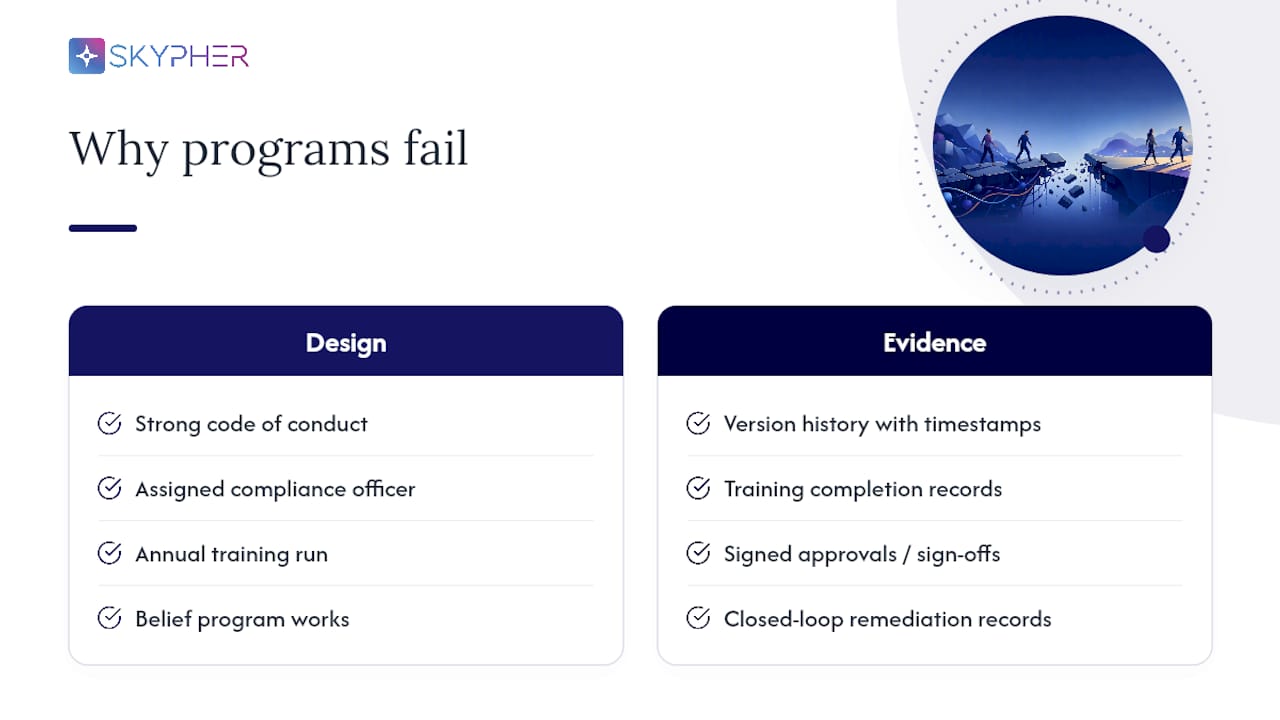
That gap between "we have a policy" and "we can prove the policy worked" is where most defensibility problems live, not in the design of the program itself. The seven elements are not complicated. Documenting them consistently, over years, across a growing organization, is the actual hard part. Leaders who treat their compliance program as a static document underestimate how much of the DOJ's evaluation hinges on trace evidence: timestamps, sign-offs, version history, and closed-loop remediation records.
If there's one uncomfortable truth in the OIG's own framing, it's that there is no template that protects you. Tailoring isn't optional language regulators add for flexibility. It's an acknowledgment that a copy-pasted program is often what fails first, because it was never actually shaped around your organization's real risks.
— Gaspard
Sources
- General Compliance Program Guidance — OIG
- Evaluation of Corporate Compliance Programs — U.S. Department of Justice
- Compliance program definition and guidance — Investopedia
- Compliance project plan template — LegalClarity