

A regulatory compliance requirement is a legally binding obligation issued by a government agency, legislature, or accredited standards body that an organization must follow to operate lawfully within its industry or jurisdiction. Unlike an internal policy your team writes for itself, a regulatory requirement carries external legal weight: skip it, and you face fines, sanctions, or loss of operating authority.
The practical implication matters more than the definition. Every requirement you're subject to has to be identified, translated into a working control, and backed by evidence you can hand to an auditor or regulator on demand. That's the whole game. Requirements typically come from a handful of sources:
- Statutes and laws passed by legislatures (federal, state, or international)
- Regulatory agencies that issue binding rules and enforcement guidance (the SEC, HHS, FTC, FDA, EPA, OSHA)
- Accredited standards bodies whose frameworks become de facto requirements through contracts or industry norms (ISO, NIST, PCI Security Standards Council)
- Contractual and industry mandates that function like regulation even without government origin (payment card rules, cloud security attestations)
We'll walk through how to tell a true regulatory obligation apart from an internal policy, why the stakes are higher than most teams assume, and how to build a program that turns scattered obligations into a system you can actually defend.
Key Takeaways
Regulatory compliance requires a documented, evidence-backed system that maps legal obligations to controls, monitors them continuously, and adapts as rules and vendors change.
| Point | Details |
|---|---|
| Definition drives action | A regulatory requirement is externally issued and legally binding, which means it must be inventoried, controlled, and proven with evidence. |
| Penalties reward preparation | Regulators weigh documented self-monitoring and remediation efforts more favorably than violations discovered with no compliance trail. |
| Framework alignment matters | Map ISO, NIST, or COSO frameworks to your actual legal obligations rather than adopting a standard because it sounds authoritative. |
| Vendor risk is your risk | Third-party gaps in onboarding checks or ongoing monitoring can undo years of internal control work. |
| Automation scales evidence, not judgment | Tools like Skypher speed up questionnaire responses and evidence retrieval, but governance and sign-off still require human ownership. |
Table of Contents
- What Counts as a Regulatory Compliance Requirement vs. Internal Policy?
- Why Regulatory Compliance Requirements Matter: Penalties and Business Impact
- Which Regulations and Frameworks Should You Know?
- What Are the Core Components of an Effective Compliance Program?
- How Do You Implement a Compliance Program Step by Step?
- How Do Compliance Priorities Differ by Industry?
- What Makes Compliance Implementation Difficult and Expensive?
- What Documentation Proves Regulatory Compliance?
- How Does Automation Support Regulatory Compliance Work?
- How Do You Build a Culture of Compliance Beyond Checkbox Activity?
- What Should Compliance Teams Prioritize in 2026?
- A Faster Path to Compliance Evidence at Scale
- Where to Verify Regulatory Requirements Directly
- Sources
What Counts as a Regulatory Compliance Requirement vs. Internal Policy?
Not every rule your organization follows is regulatory. A regulatory compliance requirement originates outside your company and carries legal consequences for violation. An internal policy, by contrast, is something your organization chooses to adopt, often to operationalize a regulation or to reflect a risk appetite that goes beyond what the law demands. Your password rotation policy might be stricter than anything a regulator requires, but that doesn't make it a regulatory obligation. It's a corporate choice.
The distinction matters because it determines how much flexibility you have. You can amend an internal policy at will. You cannot amend your way out of a legal requirement. Confusing the two categories is one of the most common reasons compliance programs drift: teams treat a self-imposed control as negotiable when it's actually a regulatory floor, or they over-invest in a policy that has no external teeth while an actual legal obligation goes unmapped.
Regulatory requirements tend to cluster into recognizable categories:
- Data privacy and security — obligations around how personal or sensitive data is collected, stored, and disclosed
- Financial reporting and market conduct — rules governing accuracy, disclosure, and executive accountability for public companies
- Health and safety — workplace and product safety standards enforced by labor and consumer protection agencies
- Environmental compliance — permitting, emissions, and waste handling rules tied to physical operations
- Product and industry-specific rules — sector rules like food safety protocols or payment card handling standards
Jurisdiction adds another layer of complexity. A single product launch can trigger requirements from multiple regulators at once. A healthcare software company selling into the European Union and operating in California, for instance, may simultaneously owe obligations under HIPAA for US patient data, GDPR for EU residents, and CCPA for California consumers. None of these frameworks defer to the others. You have to satisfy all of them concurrently, which is why multi-jurisdiction businesses tend to build a single obligation inventory rather than separate, siloed compliance efforts per market.
Why Regulatory Compliance Requirements Matter: Penalties and Business Impact
The financial exposure from non-compliance varies dramatically by regulation and by how severe the violation is judged to be, but it rarely stays small once regulators get involved. Agencies typically assess penalty severity based on the duration of the violation, whether it was willful or negligent, how many records or individuals were affected, and whether the organization had reasonable safeguards in place before the incident. Actual penalty schedules and rule text are published directly in the Federal Register, which remains the authoritative source for current fine amounts rather than any secondary summary.
Statistic Callout: Enforcement agencies consistently weigh self-reporting and documented remediation efforts when calculating penalties. A violation paired with a functioning, evidenced compliance program tends to draw a materially lighter response than the same violation discovered with no monitoring trail at all.
Money is only part of the exposure. A compliance failure tends to ripple across the business in ways that outlast the fine itself:
- Operational disruption — mandated corrective action plans, consent decrees, or temporary suspension of specific business activities
- Reputational harm — lost customer trust, especially in B2B sales cycles where a security or compliance failure disqualifies you from vendor shortlists
- Contractual fallout — breach of representations and warranties in customer or partner agreements, sometimes triggering termination rights
- Executive accountability — under frameworks tied to SEC oversight, certifying officers can face personal liability for reporting failures
The mitigating factor regulators consistently reward is evidence of active self-monitoring. An organization that can show ongoing internal audits, documented risk assessments, and a track record of catching and fixing its own gaps is treated differently than one that discovers problems only when a regulator or a breach forces the issue. That's not a loophole. It's the entire logic behind building a compliance program instead of reacting case by case.
Which Regulations and Frameworks Should You Know?
Most organizations operate under a mix of hard legal mandates and voluntary standards that function as de facto requirements once a customer or partner demands them. Knowing which is which helps you prioritize.
The legal mandates carry direct enforcement risk:
- HIPAA — governs protected health information and breach notification for covered healthcare entities in the US
- GDPR — the EU's data protection regulation, with extraterritorial reach for any organization processing EU residents' data
- CCPA/CPRA — California's consumer privacy law, with rights closely mirroring parts of GDPR
- SOX (Sarbanes-Oxley) — financial reporting controls and executive certification requirements for US public companies
- PCI DSS — the payment card industry's security standard for anyone storing, processing, or transmitting cardholder data
- FDA and EPA rules — sector-specific operational requirements, from food safety protocols to environmental permitting, published directly by the FDA
- OSHA — workplace safety standards enforced through inspection and citation
Standards frameworks aren't laws, but they're frequently how organizations prove they've met a legal obligation, and increasingly they're demanded contractually even where no law requires them:
| Framework | Primary use | Typically required by |
|---|---|---|
| ISO | Compliance management systems | Voluntary; often contractual |
| ISO | Information security management | Customer/vendor contracts, regulators in some sectors |
| NIST CSF | Cybersecurity risk management | US federal contractors; widely adopted voluntarily |
| COSO | Internal control and financial reporting | SOX-aligned public companies |
NIST publishes its Cybersecurity Framework specifically to give organizations a common map between technical controls and the risk outcomes regulators care about, which is why it's become a near-universal reference point even outside government contracting. Our own breakdown of how ISO and NIST frameworks streamline compliance work for tech and finance teams goes deeper on how to pick between them.
The practical move is aligning frameworks to your actual legal obligations rather than adopting a standard because it sounds authoritative. If you're not a public company, COSO's financial control structure isn't your priority. If you don't handle cardholder data, PCI DSS doesn't apply. Map the framework to the obligation, not the other way around.
What Are the Core Components of an Effective Compliance Program?
A compliance program that survives an actual audit has four load-bearing pieces, and skipping any one of them tends to be where enforcement actions find their opening.
- Governance and leadership accountability. Someone named, not a committee in the abstract, owns each regulatory domain. Boards and senior executives need visibility into compliance risk, and regulators increasingly expect documented evidence that leadership was informed and acted, not just that a policy existed somewhere in a shared drive.
- Policies mapped to specific obligations. Every internal policy should trace back to the external requirement it satisfies. A policy that exists but isn't linked to any actual regulation is dead weight; a regulation with no corresponding policy is a gap waiting to be found.
- Training, monitoring, and internal audit. Employees need to understand the obligations relevant to their role, and the organization needs a recurring mechanism, not a one-time check, to confirm controls are actually operating as designed.
- Reporting, escalation, and remediation. When monitoring surfaces a gap, there has to be a defined path for escalating it, fixing it, and documenting that the fix happened.
Pro Tip: Build a single obligation-to-control-to-evidence map before you build anything else. Most compliance programs fail not because they lack policies but because nobody can trace a straight line from "this is the law" to "here's the proof we follow it."
Governance deserves particular attention because it's the piece regulators scrutinize first in an enforcement review. A program with strong technical controls but no documented executive oversight structure looks, from the outside, like it happened by accident rather than by design. Our guide to building effective governance structures covers how to formalize that accountability chain without adding unnecessary bureaucracy.
How Do You Implement a Compliance Program Step by Step?
Turning scattered legal obligations into an operating program follows a predictable sequence, and most teams that struggle skip straight to controls without doing the inventory work first.
- Build the obligation inventory. List every applicable law, regulation, and contractual standard, scoped by jurisdiction and by business process. Capture the specific clause or requirement, not just the regulation's name, so you can trace exactly what you owe.
- Run a risk assessment. Not every obligation carries equal exposure. Rank obligations by likelihood of violation and severity of consequence, so limited compliance resources go where the actual risk sits.
- Design controls and map evidence. For each prioritized obligation, define the specific control that satisfies it and the evidence artifact that proves the control is operating: a log, a signed attestation, a scan report, a training completion record.
- Establish monitoring cadence. Decide how often each control gets tested, what metric confirms it's working, and who reviews the result.
- Build a change management trigger. Regulations shift, and your obligation inventory has to update when they do, not on a fixed annual schedule that misses interim rule changes.
Practical guardrails that keep this process from stalling:
- Scope the obligation inventory by both jurisdiction and business process, since a single product can trigger overlapping requirements
- Prioritize controls that address the highest-severity, highest-likelihood risks first, rather than working alphabetically through a regulation list
- Treat evidence mapping as non-negotiable: a control without a corresponding artifact isn't provable in an audit
- Revisit the inventory whenever you enter a new market, launch a new product, or a regulator issues updated guidance
A strong information security checklist is a useful starting template for the controls-and-evidence step, particularly for teams tackling their first formal mapping exercise.
How Do Compliance Priorities Differ by Industry?
Finance, healthcare, and technology each carry a distinct compliance center of gravity, and treating them identically wastes effort on the wrong controls.
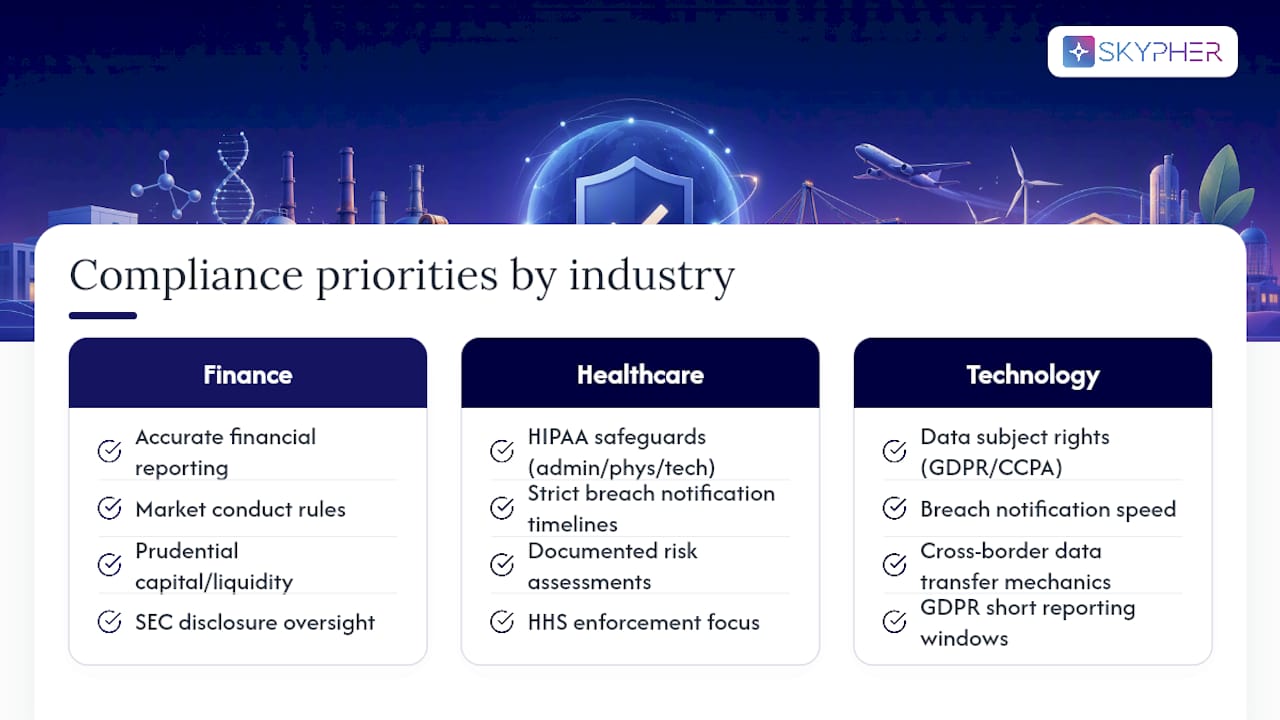
In finance, the priorities are accurate financial reporting, market conduct rules, and prudential capital or liquidity requirements. Public companies face SEC oversight of disclosure accuracy and executive certification under SOX, with governance failures carrying personal accountability for signing officers.
In healthcare, HIPAA sets the baseline: administrative, physical, and technical safeguards for protected health information, plus strict breach notification timelines once a compromise is discovered. HHS enforcement has increasingly focused on whether covered entities can produce documented risk assessments, not just whether a breach occurred.
In technology and data-driven businesses, the center of gravity is data subject rights, breach notification speed, and cross-border data transfer mechanics. GDPR's short reporting windows and CCPA's consumer rights requests both demand operational readiness, not just a written policy. Our tips for tech and finance teams navigating overlapping obligations cover the monitoring cadence these sectors tend to need.
What Makes Compliance Implementation Difficult and Expensive?
Most compliance programs don't fail because the requirements are unclear. They fail because coordinating across teams, vendors, and jurisdictions is harder than writing the policy itself.
- Cross-functional coordination stalls when legal, security, and engineering each own a piece of the obligation but nobody owns the whole picture
- Jurisdictional complexity multiplies fast once you're operating in three or more regions with overlapping but non-identical rules
- Vendor and third-party risk is often the largest blind spot: your compliance posture is only as strong as your weakest subcontractor's
- Onboarding checks for new vendors take real time if done properly, which pushes teams toward shortcuts that create future exposure
- Remediation costs compound quietly, since fixing a control gap discovered during an audit almost always costs more than building it correctly the first time
Pro Tip: Treat vendor onboarding as a compliance gate, not a procurement formality. A single unvetted subcontractor with access to regulated data can undo years of internal control work.
What Documentation Proves Regulatory Compliance?
Regulators and auditors don't take your word for it. They want the paper trail, and the specific records you need vary by category but follow a consistent pattern.
- Policies and procedures, version controlled, showing when they were adopted and last reviewed
- Training logs, showing who completed required compliance training and when
- Audit reports, internal and external, with remediation status tracked to closure
- Vendor risk assessments, refreshed on a defined cycle rather than only at initial onboarding
- Incident and breach records, including timeline of detection, notification, and resolution
Retention windows differ by category and by regulation, so check the specific rule rather than applying a blanket policy. Financial records under SOX-related obligations often carry multi-year retention expectations; healthcare records under HIPAA carry their own separate retention logic tied to state law and record type. When in doubt, retain longer rather than shorter, since destroyed evidence can't be reconstructed for an inquiry that arrives after the fact.
When presenting evidence to a regulator, structure matters as much as substance. A monitoring report that clearly states the control tested, the method, the result, and the remediation status (if any) reads as credible. A vague narrative summary does not. Our practical framework for compliance documentation walks through building that structure so it holds up under scrutiny.
How Does Automation Support Regulatory Compliance Work?
Every compliance program eventually runs into the same bottleneck: the evidence exists, but pulling it together, especially for customer and partner due diligence, consumes hours that could go toward actual risk reduction. Security questionnaires are the clearest example. A single enterprise customer's due diligence request can run 200 or more questions, each demanding a specific, current, evidence-backed answer.
Automation tools built for this problem work by parsing incoming questionnaires regardless of format, matching each question against a centralized knowledge base of your existing controls and evidence, and generating a draft answer with a confidence score attached, so your team reviews rather than writes from scratch. Skypher's Questionnaire Automation Tool, for instance, is built to answer large volumes of questions in minutes rather than days, drawing on a knowledge base that stays current as your controls evolve.
- Parses questionnaires in nearly any format and maps each question to existing evidence automatically
- Integrates with over 40 third-party risk management platforms so evidence stays synchronized rather than duplicated across systems
- Supports real-time collaboration, so security, legal, and sales teams work from the same draft instead of passing documents back and forth
- Offers a customizable Trust Center where partners can self-serve your current compliance posture instead of filing a new questionnaire
Pro Tip: Automation speeds up evidence retrieval and answer drafting, but it doesn't replace governance. Someone still has to own the underlying control, review the AI-generated answer, and sign off before it goes to a customer or regulator.
Automation earns its value most clearly when questionnaire volume is high and your evidence base is well organized already. It's least useful as a substitute for doing the obligation inventory and control mapping work in the first place. Tools accelerate a program that already knows what it owns; they don't create that clarity from nothing.

How Do You Build a Culture of Compliance Beyond Checkbox Activity?
Programs built purely around avoiding fines tend to be brittle. Research on organizational motivation suggests that relying solely on extrinsic deterrents like penalties can actually undermine sustained compliance behavior, since employees start treating rules as obstacles to route around rather than standards to internalize.
- Frame compliance as protecting customers and the business, not just avoiding punishment, when training teams on why a control exists
- Build compliance checkpoints into product and process design from the start, rather than bolting them on after launch
- Extend the same scrutiny to procurement decisions that you apply to your own controls, since a vendor's gap becomes your gap
- Measure program maturity on a recurring basis, not just readiness for the next scheduled audit
A mature program treats each audit as a data point in an ongoing improvement cycle, not a pass/fail event to survive and forget. That shift, from reactive to continuously improving, is usually what separates organizations that handle regulatory change smoothly from those that scramble every time a rule updates.
What Should Compliance Teams Prioritize in 2026?
The compliance teams handling 2026 well are the ones treating evidence as a living asset rather than an annual scramble. Regulations keep multiplying across jurisdictions, and the honest priority isn't chasing every new rule the moment it's published. It's making sure your obligation inventory and control mapping are current enough to absorb changes without a fire drill.
Vendor and third-party controls deserve more weight than most programs currently give them. Your compliance posture is increasingly judged by the weakest link in your supply chain, and regulators are paying attention to that dependency.
Where automation genuinely helps is compressing the time between "a customer needs proof of our compliance" and "they have it," without touching who owns the underlying control or who signs off on its accuracy. That distinction, between speeding up evidence production and outsourcing judgment, is the one I'd watch most closely this year.
A Faster Path to Compliance Evidence at Scale
If your team is buried in questionnaires, audits, and evidence requests every time a customer's procurement team asks for proof of your controls, you're not alone, and you're not stuck doing it by hand forever. Skypher's Questionnaire Automation Tool draws on a centralized, continuously updated knowledge base to answer even large security questionnaires in minutes, with a confidence score attached to each generated answer so your team reviews rather than starts from a blank page.

The platform's AI-powered recommendation engine works alongside import and export workflows that keep your evidence synchronized across the risk management and collaboration tools you already use, from Slack to ServiceNow. For partners who need to check your posture without filing a new request every time, a customizable Trust Center lets them self-serve current compliance documentation directly. If questionnaire volume is what's slowing your compliance team down, request a demo to see how much of that manual work Skypher can take off your plate.
Where to Verify Regulatory Requirements Directly
- SEC — filing requirements and enforcement guidance for public companies
- HHS HIPAA — health data safeguards and breach notification rules
- NIST — cybersecurity and risk management frameworks
- FDA — sector-specific operational and safety requirements
- Federal Trade Commission — consumer protection and data security guidance
- Federal Register — official rule text and penalty adjustments
Sources
- NIST (National Institute of Standards and Technology)
- U.S. Department of Health & Human Services — HIPAA
- U.S. Securities and Exchange Commission
- Federal Register