

Compliance risk management is the ongoing, risk-based process of identifying where your organization can fail to meet laws, regulations, or internal policies, then prioritizing and fixing those gaps before regulators or auditors find them first. It sits at the intersection of legal obligation and operational reality, and, when it works well, it gives leadership a defensible, evidence-backed picture of the organization's exposure at any point in time.
If you are starting or rebuilding a program, three actions matter most right now:
- Scope your obligations. Map every applicable law, regulation, and internal policy to the business processes they govern. Without this inventory, every subsequent step is guesswork.
- Run a targeted risk assessment. Score each obligation area by likelihood of failure and potential impact, then separate the high-residual-risk items from the noise.
- Assign named control owners. Every control without a named, accountable owner is effectively uncontrolled. Assign ownership before you do anything else.
Quick-start checklist (copy into your next team meeting):
- Document your regulatory obligation inventory
- Complete an initial impact × likelihood risk assessment
- Assign a named owner to each control
- Establish a centralized evidence repository
- Schedule a board or senior management briefing on compliance posture
Key Takeaways
Effective compliance risk management requires a repeatable, evidence-backed process that connects every regulatory obligation to a named control owner and verifiable evidence, with board-level visibility into residual risk.
| Point | Details |
|---|---|
| Start with obligations and ownership | Map every regulatory obligation to a process and assign a named owner to each control before anything else. |
| Score inherent and residual risk separately | Use impact × likelihood scoring to separate what controls reduce from what exposure remains. |
| Build remediation tickets with root-cause analysis | Include owner, due date, root cause, corrective action, verification steps, and evidence required in every issue. |
| Report by audience | Give operators an issue queue, executives a residual risk trend, and the board a posture summary with a narrative. |
| Integrate compliance into ERM | Use COSO ERM to map compliance risks into the enterprise register and NIST controls for technical obligation areas. |
| Skypher for evidence automation | Skypher's questionnaire automation platform reduces manual evidence assembly time and supports over 40 TPRM integrations. |
Table of Contents
- What does an effective compliance risk management program look like?
- How does a step-by-step compliance risk management process work?
- How do you score and prioritize compliance risks accurately?
- How do you build remediation plans that actually get completed?
- What KPIs and dashboards should you use for compliance monitoring?
- How do governance and ERM integration strengthen your compliance program?
- Which tool types speed up compliance risk management the most?
- What does the evidence show about questionnaire and evidence automation?
- What are the most common compliance program pitfalls?
- Two examples of compliance risk management in practice
- What does a 90–180 day startup roadmap look like?
- An experienced compliance leader's perspective on what actually drives program success
- How Skypher can reduce the manual burden of compliance evidence work
- Sources
What does an effective compliance risk management program look like?
A compliance risk management program is only as strong as its weakest component. NCUA supervisory guidance describes the components examiners evaluate when assessing a compliance management system (CMS): board oversight, policies, monitoring, training, third-party oversight, complaint handling, and root-cause analysis. Each component is interdependent, and gaps in one tend to cascade into others.
Here is what each component requires in practice:
- Governance and oversight. The board sets the tone and approves the compliance risk appetite. Management translates that appetite into a funded, staffed program. Without explicit board engagement, compliance becomes a back-office function with no authority to escalate.
- Policy library. Written policies must map to specific regulatory obligations and be reviewed at least annually. A useful control type here is a documented policy attestation, where employees confirm they have read and understood the relevant policy.
- Control design. Controls fall into three categories: preventive (approval workflows, access restrictions), detective (transaction monitoring, reconciliations), and corrective (remediation plans, root-cause analysis). Segregation of duties is the most commonly cited preventive control in examiner findings.
- Monitoring and testing. Microsoft's compliance guidance recommends moving from periodic point-in-time checks to continuous monitoring wherever the technology supports it. This shift catches drift between audits rather than discovering it during one.
- Evidence management. Evidence is what connects a control to its owner and its test date. A centralized repository with metadata (control ID, test date, tester, result, linked obligation) is the difference between audit-ready and audit-scramble.
- Remediation. Issues need root-cause analysis, not just a quick fix. Regulators look for evidence that the underlying process changed, not that someone patched the symptom.
- Training and communication. Role-based training tied to specific obligations, with completion tracking and attestation, gives examiners the documentation they need and gives employees the context they need to make good decisions.
- Third-party management. Vendors and partners who touch regulated processes extend your compliance perimeter. Due diligence questionnaires, contract provisions, and periodic monitoring are the standard controls here.
The dependency chain worth remembering: evidence ties monitoring to audit-readiness. If your monitoring program generates findings but no evidence trail, you cannot demonstrate to an examiner that the control actually worked.
How does a step-by-step compliance risk management process work?
A repeatable process is what separates a mature program from a reactive one. The five-step risk management flow (identify, analyze, evaluate, treat, monitor) provides a useful executive-level frame, but compliance risk management needs a more granular version that accounts for regulatory scoping and continuous improvement cycles.
The seven-step process
-
Scope obligations. Inventory every applicable law, regulation, contractual requirement, and internal policy. Map each obligation to the business process it governs. COSO ERM calls this "identifying the context"; NIST SP 800-37 calls it "system categorization." Either way, you cannot assess what you have not defined.
-
Identify risks. For each obligation area, identify the specific ways the organization could fail to comply. Use prior audit findings, regulatory examination reports, incident logs, and industry enforcement actions as inputs.
-
Assess and score. Apply an impact × likelihood matrix to each identified risk (see the methodology section below). Separate inherent risk (before controls) from residual risk (after controls). This is the step where most programs underinvest, and it shows in their prioritization.
-
Gap analysis. Compare the current control environment against what the obligation requires. Document control gaps, design weaknesses, and missing evidence. This step produces the remediation backlog.
-
Remediation. Build time-bound remediation plans with named owners, root-cause analysis, corrective actions, and verification steps. Regulators, including those following OCC and FFIEC supervisory expectations, expect evidence that remediation addressed the root cause, not just the symptom.
-
Monitoring. Implement ongoing controls testing and regulatory change monitoring. Feed results into the risk register and escalate exceptions on a defined schedule.
-
Continuous improvement. Review the program's design and effectiveness at least annually. Incorporate lessons from internal audits, regulatory examinations, and industry enforcement trends.
Recommended cadence and timeline
| Phase | Steps Covered | First-Cycle Timeline | Ongoing Cadence |
|---|---|---|---|
| Foundation | Scope, Identify | Days 1–30 | Annual refresh |
| Assessment | Assess, Gap Analysis | 90–180 days | Semi-annual or event-driven |
| Remediation | Remediate | 180–270 days | Rolling, issue-driven |
| Monitoring | Monitor | Days 120–180 | Continuous or quarterly |
| Improvement | Continuous Improvement | Day 180+ | Annual program review |
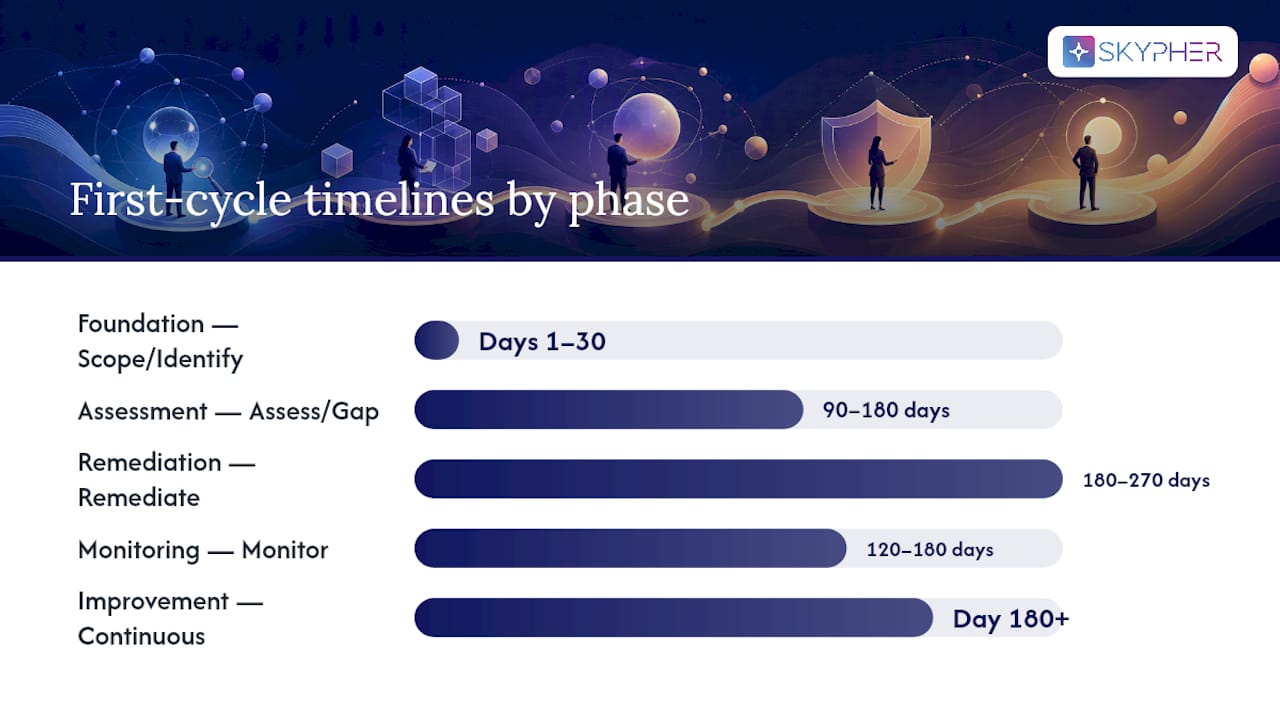
A first full cycle typically runs 90–180 days for a mid-size organization. Larger institutions with complex regulatory footprints often need 180–270 days for the initial assessment alone. The COSO ERM Framework guidance supports aligning this cycle with the organization's broader strategic planning and performance review calendar, which makes compliance risk a standing agenda item rather than a periodic project.
How do you score and prioritize compliance risks accurately?
Consistent scoring is what makes prioritization defensible to leadership and examiners. Without a defined methodology, risk ratings reflect whoever was loudest in the room, not the actual exposure.
Impact × likelihood scoring
The standard approach assigns a numeric score to both dimensions, then multiplies them:
-
Define your scales. A 1–5 scale for both impact and likelihood is common. Impact covers financial loss, regulatory penalty, reputational harm, and operational disruption. Likelihood covers frequency of the activity, historical failure rate, and control maturity.
-
Score inherent risk first. Inherent risk is the exposure assuming no controls exist. This tells you where the obligation is structurally dangerous regardless of what you have built.
-
Apply control effectiveness. Rate each control as strong (reduces risk by roughly two score points), moderate (one point), or weak/absent (no reduction). Subtract the control credit from the inherent score to get residual risk.
-
Prioritize by residual score. High residual risk items go to the top of the remediation queue, regardless of how much effort went into the controls already in place.
Example calculation:
An obligation area scores 4 (impact) × 4 (likelihood) = 16 inherent risk. A single detective control rated "moderate" reduces the likelihood score by one point: 4 × 3 = 12 residual risk. Adding a preventive control rated "strong" drops likelihood further: 4 × 2 = 8 residual risk. The gap between 16 and 8 shows the control's value; the remaining 8 shows what the organization still carries.
Sample risk matrix
Scores of 15–25 are high priority. Scores of 8–14 are medium. Scores of 1–7 are low, though they still need a named owner and a monitoring schedule.
Data sources for rating likelihood and impact
- Prior internal audit findings and control test results
- Regulatory examination reports and consent orders (your institution's and peers')
- Incident and complaint logs
- Regulatory change logs and agency enforcement action databases
- Third-party due diligence results and vendor risk assessments
Pro Tip: Build your risk assessment workflow around the data sources your team already maintains. Pulling from existing audit findings and incident logs reduces the time to complete an initial assessment by weeks and produces ratings that are easier to defend because they are grounded in your own history.
How do you build remediation plans that actually get completed?
A remediation backlog that grows faster than it shrinks is one of the most common signs of a program in trouble. The fix is not more tracking spreadsheets. It is a tighter issue structure and clearer escalation rules.
Prioritization matrix
Before building remediation tickets, triage the backlog using three dimensions:
- Severity. The residual risk score from the assessment.
- Exposure. How many customers, transactions, or regulatory obligations are affected.
- Detectability. How quickly the organization would identify a failure if the control missed it.
Items that score high on all three go to the front of the queue. When resources are constrained, focus first on high-severity items with low detectability, because those are the ones that can turn into regulatory findings before anyone notices.
Remediation ticket fields
Every issue in your remediation queue should carry:
- Owner. A named individual, not a team or department.
- Due date. A specific calendar date, not "Q3" or "next quarter."
- Root cause. The underlying process or design failure, not the symptom.
- Corrective action. The specific change being made to the process, policy, or control.
- Verification steps. How the owner will confirm the fix worked.
- Evidence required. The specific artifact (updated procedure, test result, training record) that closes the ticket.
The NCUA's examiner guidance explicitly looks for root-cause analysis and verification evidence in remediation documentation. A ticket that says "updated the policy" without a verification step and evidence link will not satisfy an examiner.
Escalation triggers
- Any high-severity item open past its due date by more than 14 days escalates to the CCO.
- Any item affecting a regulatory examination finding escalates to the board risk committee within 30 days of identification.
- Any item where the corrective action is "accept the risk" requires written approval from the CRO or CCO and a documented rationale.
What KPIs and dashboards should you use for compliance monitoring?
Metrics without an audience are just numbers. The goal is to give each stakeholder the view they need to make decisions, without burying them in data they cannot act on.
Recommended KPIs
- Open issues by severity. The count of high, medium, and low issues currently open, trended over time.
- Time-to-remediate. Average days from issue identification to verified closure, by severity tier.
- Control test pass rate. Percentage of controls that passed their most recent test, by obligation area.
- Training completion rate. Percentage of employees who completed required compliance training, by role and deadline.
- Control coverage. Percentage of identified obligations with at least one tested, owner-assigned control.
- Exceptions trend. Month-over-month change in the number of policy exceptions granted.
- Regulatory change response time. Days from a regulatory change publication to an updated obligation mapping and control review.
Three dashboard views
Operator view (compliance team and control owners). Show open issues by owner and due date, overdue items flagged in red, control test schedules, and evidence collection status. This view drives daily work.
Executive view (CRO, CCO, CFO). Show residual risk by obligation area, time-to-remediate trend, training completion by business unit, and top five open high-severity issues. One page, updated weekly or bi-weekly.
Board summary. Show overall compliance posture (high/medium/low by category), regulatory change pipeline, significant findings from the period, and remediation velocity. Quarterly, with a written narrative that explains the numbers.
Evidence management underpins all three views. A centralized repository with metadata (control ID, test date, tester, result, linked obligation, and evidence file) means any dashboard number can be traced back to a specific artifact. Without that traceability, board-level reporting is an assertion, not a fact.
How do governance and ERM integration strengthen your compliance program?
Compliance risk does not live in a silo. When it is managed separately from enterprise risk, the board sees two disconnected pictures and examiners see a program that cannot explain how compliance findings affect the organization's overall risk posture. RegScale's integration guidance recommends a single risk and compliance committee, shared control libraries, and coordinated monitoring that feeds one issues queue, which eliminates duplicate work and gives leadership a single view of residual risk.
Role and responsibility guidance
- Board of directors. Approves compliance risk appetite, receives quarterly compliance posture reports, and holds management accountable for remediation velocity.
- Chief Risk Officer (CRO). Owns the ERM framework and ensures compliance risks are mapped into the enterprise risk register with consistent scoring.
- Chief Compliance Officer (CCO). Owns the compliance program design, the obligation inventory, and the monitoring program. Reports to the board independently of the CRO.
- First-line control owners. Business unit managers and process owners who are accountable for the day-to-day operation of assigned controls and the collection of evidence.
- Internal audit. Provides independent assurance that the compliance program is designed and operating effectively. Findings feed back into the remediation queue.
This is the three-lines-of-defense model: first line operates controls, second line (compliance and risk) designs and monitors them, third line (internal audit) assures them. GRC 20/20's analysis makes the conceptual boundary clear: compliance is binary (you either meet the obligation or you do not), while risk management is probabilistic. The two functions must collaborate, but they should not merge, because collapsing them removes the independent check that regulators expect.
Mapping compliance risk into COSO ERM and NIST
The COSO ERM Framework maps compliance activities to five components: governance and culture, strategy and objective-setting, performance, review and revision, and information and communication. Compliance risks belong in the "performance" component alongside credit, market, and operational risks, scored on the same scale and reported in the same register.
For technical compliance areas (data security, access control, system integrity), NIST SP 800-53 and the NIST Cybersecurity Framework provide a control catalog that maps directly to regulatory requirements like GLBA, HIPAA, and PCI-DSS. Using NIST controls as the technical layer under your compliance program means you are not reinventing the wheel for each regulation. You can find practical guidance on NIST alignment for tech and finance organizations that connects these frameworks to operational controls.
OCC supervisory materials and 12 CFR Part 30 Appendix D treat compliance risk as a formal risk category alongside credit, market, and operational risks. Federal Reserve supervisory materials list compliance exam focus areas that emphasize governance and monitoring. Examiners increasingly expect a single, coordinated view of compliance posture and residual risk rather than siloed compliance-only reporting.
Which tool types speed up compliance risk management the most?
The right technology does not replace judgment, but it eliminates the manual work that consumes most of a compliance team's time: chasing evidence, tracking remediation deadlines, and assembling reports. Riskonnect's practitioner guidance identifies three high-value capabilities: a single control library, automated regulatory change feeds, and a unified issues queue that reduces duplicate control libraries and conflicting risk ratings.
Tool categories and the problems they solve
| Tool Category | Core Problem Solved |
|---|---|
| GRC platform | Centralizes the risk register, control library, and issues queue in one data model |
| Regulatory change feed | Monitors agency publications and flags changes that affect your obligation inventory |
| Continuous controls monitoring (CCM) | Automates control testing on a defined schedule rather than relying on periodic manual tests |
| Questionnaire and evidence automation | Reduces the time to collect, assemble, and respond to security and compliance questionnaires |
| Evidence management repository | Centralizes artifacts with metadata, audit trail, and access controls |
For a deeper look at how AI advantages apply to risk management in tech and finance contexts, the scoring and prioritization use cases are particularly well-developed.
Integration checklist for vendor evaluation
When evaluating any compliance tool, confirm it can:
- Connect via API to your existing systems (HRIS, ticketing, document management)
- Support single sign-on (SSO) protocols your organization already uses
- Export evidence in formats your auditors and examiners accept
- Maintain a tamper-evident audit trail for every record change
- Map controls to multiple regulatory frameworks simultaneously
- Generate exam-ready reports without manual reformatting
Vendor selection should prioritize data model alignment over feature count. A tool with a flexible data model that matches your obligation-to-control-to-owner-to-evidence chain is worth more than one with a long feature list that forces you to adapt your process to its structure. A roundup of compliance management software options can help you compare platforms against these criteria before committing to a pilot.
What does the evidence show about questionnaire and evidence automation?
The manual effort of collecting, organizing, and responding to compliance questionnaires is one of the most underestimated drains on compliance team capacity. GAN Integrity's practitioner summary reports that in a Nasdaq survey, 55% of compliance officers cited fully understanding regulations and their operational impact as their top near-term priority. That finding points to a resource problem: teams spending hours on evidence assembly have less time for the analytical work that actually reduces risk.
Automation addresses this directly. Platforms that use AI-driven document parsing and retrieval-augmented generation can pre-fill questionnaire responses from a centralized knowledge base, reducing the time to assemble a response from hours to minutes. The practical benefits, where vendor and practitioner data support them, include:
- Faster evidence collection, with responses to standard security questionnaires assembled in a fraction of the time required for manual lookup
- Reduced error rates from copy-paste and version-control failures
- A single source of truth for compliance artifacts, accessible to all stakeholders with appropriate permissions
- Shorter audit preparation cycles because evidence is already organized and linked to controls
Adoption considerations
Change management is the most common reason automation pilots stall. Before deploying any tool, complete a content mapping exercise: identify which existing policies, procedures, and evidence artifacts will feed the system, and assign an owner to each content category. Without this step, the tool's knowledge base is incomplete and responses are unreliable.
Integration is the second consideration. Tools that connect to your document management system (Confluence, SharePoint, Google Drive, OneDrive) and your workflow tools (Slack, Microsoft Teams, ServiceNow) reduce the friction of adoption because teams do not have to change where they work. They just get better answers faster.
Adoption checklist for a pilot
- Define the pilot scope: one obligation area or one questionnaire type
- Set objective success metrics before launch (e.g., time-to-respond, evidence completeness rate, error rate)
- Identify the content owners who will validate AI-generated responses
- Map existing evidence artifacts to the tool's data model
- Assign a pilot lead with authority to escalate integration issues
- Build a rollback plan for data-model mismatches
- Schedule a 30-day review with all stakeholders
Pro Tip: Measure your baseline before the pilot starts. Log the current average time to assemble evidence for a standard questionnaire and the error rate in your last audit response. Without a baseline, you cannot demonstrate the pilot's value to leadership, and you cannot make an informed decision about scaling.
You can find a detailed breakdown of why automating compliance delivers measurable returns for finance and tech firms, including specific workflow improvements that translate directly to audit readiness.
What are the most common compliance program pitfalls?
Most compliance program failures are not dramatic. They accumulate quietly through small structural gaps that compound over time. Here are the red flags worth watching for, and what to do about each one.
-
No named control owners. Every control assigned to "the compliance team" or "IT" is effectively unowned. Fix: run a control ownership audit and assign a specific individual to each control within 30 days. A control without an owner is a finding waiting to happen.
-
Scattered evidence. Evidence stored in email threads, shared drives, and personal folders cannot be assembled quickly for an examiner. Fix: migrate to a centralized repository with a defined folder structure and metadata schema within 60 days.
-
Inconsistent risk ratings. When different assessors rate the same risk differently, the register loses credibility with leadership. Fix: publish a scoring rubric with anchored definitions for each impact and likelihood level, and calibrate assessors in a 90-minute workshop.
-
Missed remediation deadlines. A growing backlog of overdue items signals that the program lacks authority or resources. Fix: implement the escalation triggers described earlier and report overdue items to the CCO weekly.
-
Training completion gaps. Roles with regulatory exposure that have not completed required training are a direct examiner finding. Fix: pull a completion report by role and obligation area, and escalate gaps to business unit managers with a 14-day cure deadline.
-
No regulatory change process. Regulations change, and programs that do not monitor for changes discover the gap during an examination. Fix: assign a team member to monitor agency publications weekly and log changes to the obligation inventory within five business days.
When resources are constrained, fix in this order: control ownership first (it costs nothing and unlocks every other fix), evidence centralization second (it makes monitoring possible), and risk rating consistency third (it makes prioritization defensible). The risks introduced by compliance automation gaps are worth reviewing before you decide which gaps to address first.
Two examples of compliance risk management in practice
Example 1: A mid-size credit union achieving examiner readiness
A credit union with roughly $800 million in assets had received a Matter Requiring Attention (MRA) from its NCUA examiner related to BSA/AML monitoring gaps. The compliance team had controls in place, but evidence was stored across three shared drives with no consistent naming convention, and two of the five controls had no named owner.
The team ran a 60-day remediation sprint: they assigned owners to all controls, migrated evidence to a centralized repository with a standardized metadata schema, and implemented a quarterly controls testing calendar. They also added a root-cause analysis step to every remediation ticket, which the NCUA guidance explicitly requires.
At the next examination, the examiner reviewed the evidence repository directly. The MRA was closed. The lessons: ownership and evidence organization are the two fastest levers for examiner readiness, and root-cause documentation is not optional in a regulated environment.
Key outcomes:
- All five controls had named owners within 30 days
- Evidence completeness rate moved from roughly 60% to 95% within 60 days
- MRA closed at the subsequent examination cycle
Example 2: A fintech tightening third-party compliance risk
A payments technology company with 40 active vendor relationships had no formal third-party compliance risk assessment process. Vendor due diligence consisted of a one-time questionnaire at onboarding, with no periodic review and no mapping of vendor activities to specific regulatory obligations.
The compliance team built a third-party risk tiering model: vendors were scored by the sensitivity of data they accessed, the regulatory obligations they touched, and the criticality of their service. Tier 1 vendors (highest risk) received annual reassessments with updated questionnaires; Tier 2 vendors received biennial reviews; Tier 3 vendors received a simplified annual attestation.
Within 90 days, the team had completed initial tiering for all 40 vendors and identified three Tier 1 vendors with material control gaps. Remediation plans were in place for all three within 120 days.
Key outcomes:
- Third-party risk tiering completed for all vendors within 90 days
- Three high-risk vendor gaps identified and remediated within 120 days
- Regulatory examination the following year cited the third-party program as a program strength
What does a 90–180 day startup roadmap look like?
Getting a compliance risk management program off the ground requires a structured plan with clear milestones, defined owners, and measurable success criteria. The table below reflects a realistic first-cycle timeline for a mid-size U.S. organization.
| Milestone | Owner | Deliverable | Success Metric | Timeline |
|---|---|---|---|---|
| Obligation inventory | CCO | Regulatory obligation register | Comprehensive documentation | Days 1–30 |
| Risk assessment | CCO + CRO | Scored risk register | All obligations assessed; high-risk items identified | 90–180 days |
| Control mapping | Control owners | Control library with named owners | Every obligation has at least one control and one owner | Days 45–90 |
| Gap analysis | Compliance team | Remediation backlog | All gaps documented with severity scores | 90–180 days |
| Evidence repository | IT + Compliance | Centralized repository live | Evidence linked to controls for all high-risk items | 90–180 days |
| Monitoring program | Compliance team | Testing calendar and CCM setup | Quarterly testing scheduled for all high-risk controls | 180–270 days |
| Board reporting | CCO | First compliance posture report | Board receives and acknowledges report | 180–270 days |
Roles to involve immediately
- CCO or compliance lead. Program design, obligation inventory, and board reporting. Minimum 50% time commitment in the first 90 days.
- CRO or risk lead. Risk register integration and scoring calibration. Minimum 20% time commitment.
- IT or systems lead. Evidence repository setup and tool integrations. Minimum 25% time commitment in days 30–90.
- Business unit managers. Control ownership assignment and training completion. Minimum 10% time commitment, concentrated in days 45–90.
Quick wins in the first 30 days
- Publish the obligation inventory, even if incomplete. A draft inventory is more useful than no inventory.
- Assign control owners for the top 10 highest-risk obligation areas.
- Schedule the first board compliance briefing, even if the program is not yet fully built. Getting compliance on the board calendar establishes the governance rhythm.
An experienced compliance leader's perspective on what actually drives program success
The programs that survive regulatory scrutiny are not the ones with the most sophisticated technology or the thickest policy manuals. They are the ones where the board genuinely understands the compliance risk posture and where business unit managers feel personally accountable for their controls.
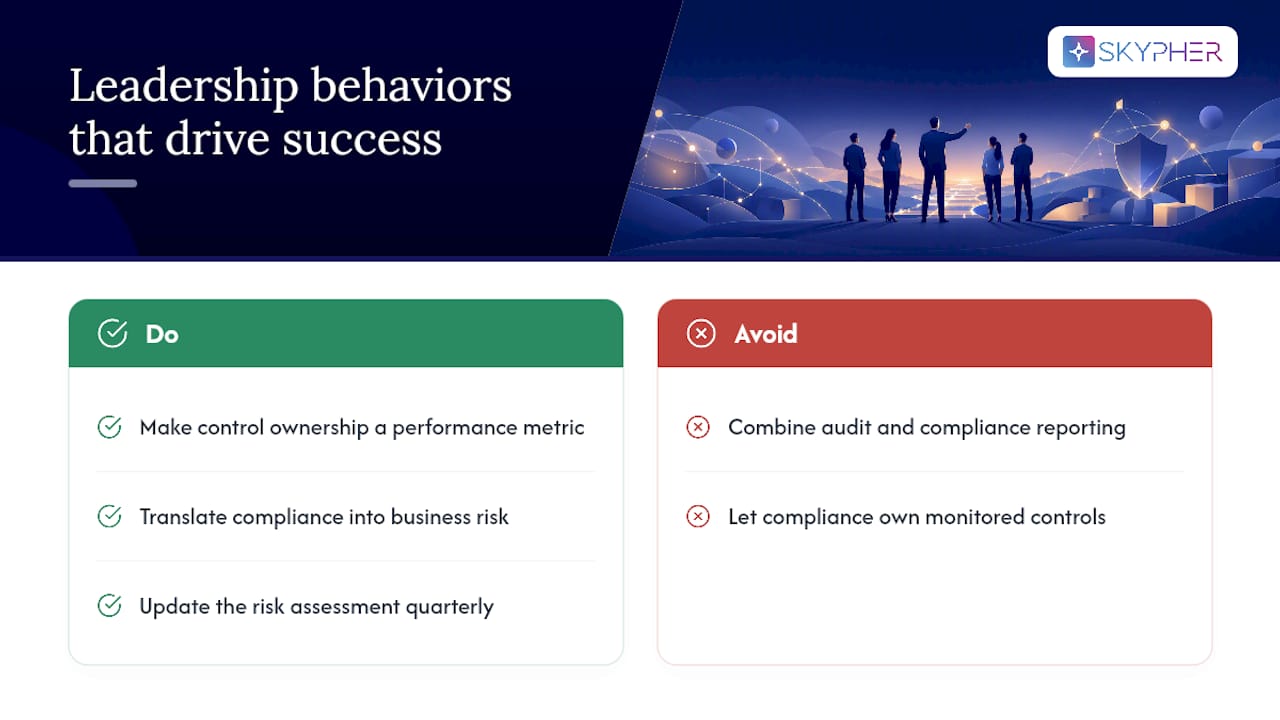
Three behaviors from leadership make the difference between a compliance program that works and one that looks good on paper:
First, make control ownership a performance expectation, not a compliance department request. When a business unit manager's annual review includes a metric for control test pass rates and remediation velocity, ownership becomes real. When it does not, the compliance team spends most of its time chasing evidence from people who have other priorities.
Second, speak to the board in business terms, not compliance jargon. A board that hears "we have 47 open medium-severity issues" will not act. A board that hears "three of our highest-volume product lines have untested controls in areas where the OCC has issued enforcement actions this year" will ask questions and allocate resources. The translation from compliance language to business risk language is one of the CCO's most important skills.
Third, treat the compliance risk assessment as a living document, not an annual project. The organizations that get caught flat-footed by regulatory changes are the ones that update their risk register once a year and file it away. A quarterly review cycle, even a lightweight one, keeps the register current and keeps leadership engaged.
One more thing worth saying plainly: the three-lines-of-defense model only works when the lines are actually separate. When internal audit reports to the CCO, or when the compliance team also owns the controls it is supposed to monitor, the independence that regulators expect disappears. Structural independence is not bureaucracy. It is the mechanism that makes the whole system credible.
How Skypher can reduce the manual burden of compliance evidence work
The most time-consuming part of compliance risk management for most teams is not the strategy. It is the evidence assembly: collecting questionnaire responses, organizing artifacts for audits, and keeping a centralized repository current across dozens of controls and vendors.

Skypher's questionnaire automation platform addresses exactly this problem. It uses AI-driven document parsing and retrieval-augmented generation to pre-fill security and compliance questionnaire responses from your existing knowledge base, with support for over 40 third-party risk management platform integrations including OneTrust and ServiceNow. Responses that previously took hours to assemble can be completed in minutes, with a confidence score attached to each answer so reviewers know where to focus their attention.
For a pilot, we suggest scoping to one questionnaire type or one vendor tier, setting a baseline time-to-respond before launch, and measuring completeness and accuracy at 30 days. Skypher integrates with Slack, Microsoft Teams, Confluence, SharePoint, Google Drive, and OneDrive, so your team works in the tools they already use. Please feel free to reach out to explore whether a pilot fits your current program stage.
Sources
These references are the primary sources practitioners and examiners cite most often. Bookmark the ones relevant to your regulatory environment.
- Compliance management systems and compliance risk - NCUA
- Compliance Risk Management: Applying the COSO ERM Framework — COSO
- Supervision & Regulation: Compliance - Federal Reserve
- What is compliance management - Microsoft Security
- Five Steps of the Risk Management Process 2025 - 360Factors
This article is general information, not a substitute for advice from a qualified lawyer. Consult a qualified legal professional about your own circumstances before acting on anything here.