

TL;DR:
- Information security is the broad discipline that protects all types of information, including physical and intellectual assets. Cybersecurity is a subset focused specifically on defending digital systems, networks, and data from cyber threats using technical controls.
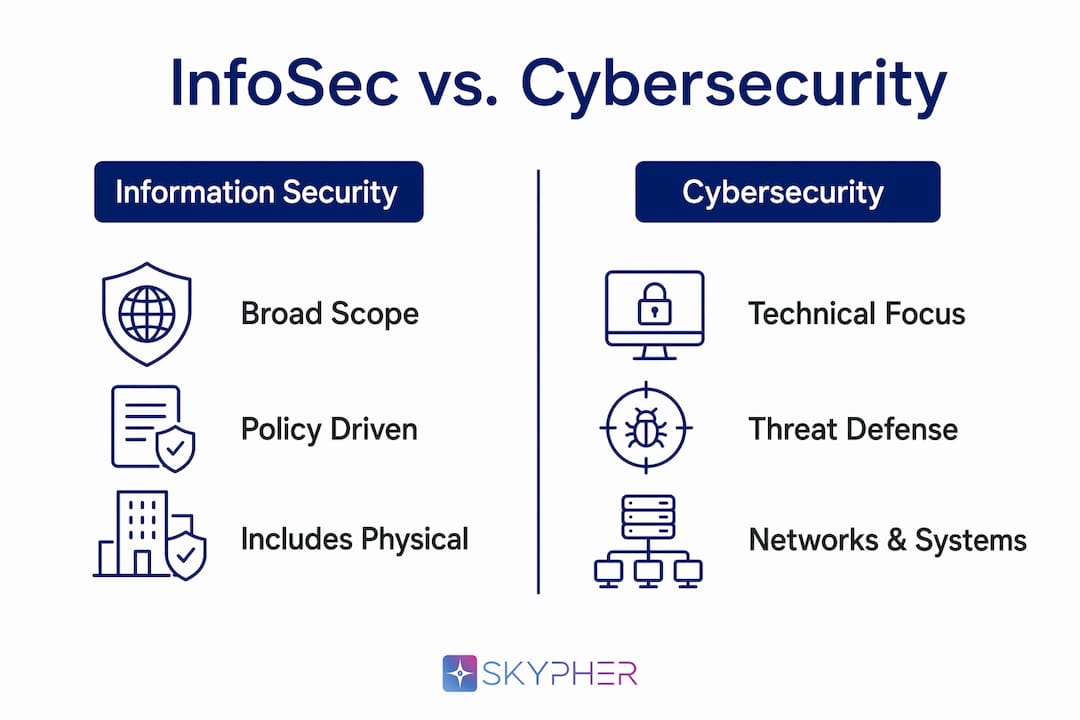
Information security (InfoSec) is the broader discipline. Cybersecurity is a subset of InfoSec focused specifically on protecting digital systems, networks, and data from cyber threats. If your organization needs governance frameworks, physical data protections, or regulatory compliance policies, you are working in InfoSec territory. If you need network defense, endpoint hardening, or incident detection, you are working in cybersecurity.
The confusion between the two is understandable. Both fields share foundational principles, both use the CIA triad as their operating model, and in smaller organizations, one person often handles both. But treating them as identical hides distinct risk models and creates real gaps in protection.
Table of Contents
- What is information security, and what does it actually cover?
- What does cybersecurity actually defend against?
- How InfoSec and cybersecurity overlap in practice
- Side-by-side comparison: InfoSec vs. cybersecurity at a glance
- How the CIA triad maps to each field differently
- What do NIST, ISO, and CISA say about each field?
- What roles and career paths belong to each field?
- Three scenarios that show the difference in action
- How should organizations apply both fields together?
- What do U.S. official sources say? The NIST definitions
- Key Takeaways
- Why the distinction matters more than most practitioners admit
- Sources and further reading
What is information security, and what does it actually cover?
InfoSec is the discipline of protecting information in any form, whether digital, physical, or intellectual, by ensuring its confidentiality, integrity, and availability. NIST defines it as "the protection of information and information systems from unauthorized access, use, disclosure, disruption, modification, or destruction in order to provide confidentiality, integrity, and availability."
That definition is deliberately broad. InfoSec covers far more than servers and software:
- Physical security: Locked filing cabinets, secure document disposal, badge-access rooms
- Administrative controls: Acceptable Use Policies, data classification schemes, access review cadences
- Regulatory compliance: Mapping controls to HIPAA, GDPR, SOC 2, and ISO/IEC 27001
- Risk governance: Conducting risk assessments, maintaining risk registers, and reporting to leadership
- Intellectual property protection: Safeguarding trade secrets, proprietary processes, and confidential contracts
An InfoSec program asks: What information do we hold, in what form, and what policies govern its protection? The answer shapes everything downstream, including which cybersecurity controls get implemented.
Pro Tip: The fastest way to spot an InfoSec gap is to look for asymmetry. If an organization has strong firewalls and endpoint detection but no formal access-review cadence or data classification policy, the technical controls are running ahead of the governance that should guide them. That gap is an InfoSec problem, not a cybersecurity one.
What does cybersecurity actually defend against?
Cybersecurity defends electronic systems, networks, cloud services, and the data they carry from cyberattacks and digital threats. Where InfoSec sets the policy, cybersecurity implements the technical enforcement layer.
The threats cybersecurity teams defend against include:
- Ransomware: Malware that encrypts production systems and demands payment for decryption keys
- Credential phishing: Deceptive emails or sites designed to harvest usernames and passwords
- Supply-chain compromise: Attacks that infiltrate software vendors or third-party tools to reach downstream targets
- Intrusion and lateral movement: Attackers gaining initial access and moving through a network to reach high-value assets
The technical controls cybersecurity practitioners deploy to counter these threats include firewalls, endpoint detection and response (EDR), multi-factor authentication (MFA), intrusion detection and prevention systems (IDS/IPS), network segmentation, patch management programs, and cloud security configurations. These are operational, hands-on disciplines. A cybersecurity analyst is watching dashboards, triaging alerts, and responding to incidents, not writing policy documents.
How InfoSec and cybersecurity overlap in practice

The two fields share significant operational ground, which is why the terms get conflated so often. InfoSec provides the governance framework; cybersecurity provides the tactical enforcement. Neither works well without the other.
Key areas of overlap include:
- Access control: InfoSec defines who should have access to what data; cybersecurity implements MFA, role-based access controls, and privileged access management
- Encryption: InfoSec policy specifies which data classifications require encryption; cybersecurity teams configure and maintain the encryption tools
- Incident response: Both fields participate. Cybersecurity detects and contains the breach; InfoSec manages disclosure obligations, regulatory notifications, and post-incident governance
- Logging and monitoring: Cybersecurity operates the SIEM and reviews logs; InfoSec defines retention requirements and audit policies
- Vendor risk management: InfoSec owns the third-party risk policy; cybersecurity assesses the technical controls of vendors
Think of it as a policy-to-control pipeline. An Acceptable Use Policy (InfoSec) drives endpoint configuration standards (cybersecurity). A data classification scheme (InfoSec) determines which databases require encryption at rest (cybersecurity). Monitoring requirements (InfoSec) define what the SOC team logs and for how long (cybersecurity). When these two layers communicate, the organization's security posture is coherent. When they operate in silos, gaps appear — secured servers sitting in physically unsecured locations being a classic example.
Side-by-side comparison: InfoSec vs. cybersecurity at a glance

| Dimension | Information Security (InfoSec) | Cybersecurity |
|---|---|---|
| Scope / what's protected | Information in any form: digital, physical, intellectual | Electronic systems, networks, cloud data |
| Primary threats | Insider leaks, physical theft, policy failures, regulatory violations | Malware, ransomware, phishing, intrusion, DDoS |
| Typical controls | Policies, data classification, access reviews, physical security, audits | Firewalls, EDR, MFA, IDS/IPS, patching, SIEM |
| Primary owners/teams | CISO, compliance manager, risk manager, data governance lead | SOC analyst, incident responder, penetration tester, cloud security engineer |
| Example scenario | Lost printed customer list from a locked office | Ransomware encrypting a production database |
| Measurement/KPIs | Policy compliance rate, audit findings, risk register age | Mean time to detect (MTTD), mean time to respond (MTTR), patch coverage |
Reading the table in practice: a breached database is primarily a cybersecurity response event (contain, eradicate, recover), but the post-incident notification obligations, regulatory reporting, and governance review are InfoSec responsibilities. A lost paper file never touches a cybersecurity tool, yet it can trigger the same HIPAA breach notification requirements as a server compromise.
Key takeaways from the comparison:
- Controls shift from administrative and physical (InfoSec) to technical and operational (cybersecurity)
- Threat types shift from human error and policy failures to deliberate digital attacks
- KPIs shift from audit-based metrics to real-time operational metrics
- Both fields share incident response as a joint responsibility
How the CIA triad maps to each field differently
The CIA triad — confidentiality, integrity, and availability — is the shared language of both disciplines. Every control in both fields traces back to protecting at least one of these three properties. The difference is in emphasis and application.
- Confidentiality: InfoSec enforces it through data classification and access governance; cybersecurity enforces it through encryption, MFA, and network segmentation
- Integrity: InfoSec addresses it through change management policies and audit trails; cybersecurity addresses it through hash verification, code signing, and intrusion detection
- Availability: Cybersecurity defends it operationally against DDoS attacks and ransomware; InfoSec addresses it through business continuity planning and disaster recovery governance
The triad also surfaces trade-off decisions that require both fields to collaborate. Consider a critical security patch that requires taking a production system offline for two hours. Applying the patch preserves confidentiality and integrity. The downtime reduces availability. Who decides? The cybersecurity team owns the technical urgency; the InfoSec or risk team owns the business impact assessment and the final call. That decision point is where data security best practices require both governance and technical input working in concert.
What do NIST, ISO, and CISA say about each field?
The United States has authoritative guidance that treats InfoSec and cybersecurity as distinct but connected. NIST's glossary defines information security with explicit scope across all information forms, while NIST's cybersecurity guidance, particularly the Cybersecurity Framework (CSF) and the SP 800 series, focuses on protecting digital infrastructure.
Key frameworks and where they land:
- NIST CSF: Primarily a cybersecurity operational framework organized around Identify, Protect, Detect, Respond, and Recover functions. Used widely by U.S. organizations to structure technical defenses
- NIST SP 800-53: A catalog of security and privacy controls used by federal agencies; spans both InfoSec governance controls and cybersecurity technical controls
- ISO/IEC 27001: An international standard for information security management systems (ISMS); governance-heavy and InfoSec-aligned, covering policies, risk management, and physical security
- CIS Controls: Prioritized technical safeguards aligned with cybersecurity operations; useful for SOC teams and practitioners implementing defenses
- CISA guidance: The Cybersecurity and Infrastructure Security Agency publishes operational advisories, threat intelligence, and incident response guidance for U.S. organizations
Compliance frameworks like HIPAA and GDPR sit in InfoSec territory — they govern what information must be protected and how — but they directly drive cybersecurity control selection. An organization's compliance posture in regulated sectors like healthcare and finance depends on both fields working from the same policy foundation.
What roles and career paths belong to each field?
The distinction between InfoSec and cybersecurity becomes most concrete when you look at job titles and daily responsibilities.
InfoSec-aligned roles:
- Chief Information Security Officer (CISO): Owns the organization's overall security strategy, risk posture, and board-level reporting
- Compliance manager: Maps regulatory requirements to internal controls and manages audit cycles
- Data governance lead: Defines data classification schemes, retention policies, and data lifecycle management
- Risk manager: Maintains the risk register, conducts risk assessments, and advises on risk acceptance or remediation
Cybersecurity-aligned roles:
- SOC analyst: Monitors alerts, triages incidents, and escalates confirmed threats
- Incident responder: Leads containment, eradication, and recovery during active breaches
- Penetration tester: Simulates attacks to identify exploitable vulnerabilities before adversaries do
- Cloud security engineer: Configures and monitors security controls across cloud environments
In smaller organizations, roles overlap significantly. A single security analyst may write the Acceptable Use Policy in the morning and respond to a phishing alert in the afternoon. Larger enterprises separate these functions into specialized teams with distinct reporting lines.
Pro Tip: For job-seekers, certifications signal which side of the line you operate on. CISSP and CISM map to InfoSec governance and leadership roles. CEH and OSCP signal hands-on cybersecurity skills in offensive and defensive operations. Holding both types strengthens your candidacy for senior roles that require fluency across governance and technical execution.
Three scenarios that show the difference in action
1. Ransomware on a production system
A manufacturing company's ERP system is encrypted by ransomware at 2:00 AM. The cybersecurity team leads the immediate response: isolating affected systems, identifying the attack vector, restoring from clean backups, and patching the exploited vulnerability. InfoSec takes over for post-incident governance: determining whether personal data was exfiltrated, assessing notification obligations under applicable U.S. state breach laws, updating the incident response policy, and briefing the board.
Immediate actions: isolate affected systems, engage incident response retainer, notify legal counsel. Longer-term: conduct a tabletop exercise to test the updated response plan.
2. Leaked printed customer lists from a locked office
A financial services firm discovers that printed customer account lists were removed from a locked records room by a terminated employee. No digital system was touched. This is entirely an InfoSec failure: inadequate physical access controls, no clean-desk policy, and insufficient offboarding procedures. Cybersecurity tools are irrelevant here.
Immediate actions: revoke all physical access credentials, secure remaining physical records, interview staff. Longer-term: implement a formal physical security policy with quarterly access reviews.
3. Misconfigured cloud storage exposing PII
A healthcare organization's AWS S3 bucket is left publicly accessible, exposing patient records. Both fields respond. Cybersecurity remediates the misconfiguration, audits other cloud storage buckets, and implements cloud security posture management (CSPM) tooling. InfoSec determines the data classification of the exposed records, assesses HIPAA breach notification requirements, and updates the cloud data governance policy.
Immediate actions: restrict bucket access, log all access events for forensic review, notify legal. Longer-term: integrate cloud configuration checks into the data classification policy.
How should organizations apply both fields together?
Integration between InfoSec policy and cybersecurity controls is not optional. Here is a practical sequence for building that integration:
- Identify critical information assets. List what data you hold, where it lives, and in what form (digital and physical).
- Classify data by sensitivity. Apply a classification scheme (e.g., Public, Internal, Confidential, Restricted) that drives downstream control requirements.
- Map technical controls to policy requirements. For each classification level, define the required cybersecurity controls: encryption standards, access restrictions, monitoring requirements.
- Implement monitoring and detection. Deploy SIEM, EDR, and logging tools calibrated to the risk levels your classification scheme defines.
- Test incident response jointly. Run tabletop exercises that include both policy owners (InfoSec) and technical responders (cybersecurity). This surfaces gaps before a real incident does.
- Run governance reviews quarterly. Audit whether technical controls still match current policy requirements, especially after system changes or regulatory updates.
Pro Tip: The highest-impact starter action most organizations skip is the cross-team tabletop exercise. Bringing InfoSec policy owners and SOC analysts into the same room to walk through a simulated breach reveals misaligned assumptions faster than any audit. Integrating policy and technical teams through joint exercises is one of the most consistently recommended practices for closing the governance-to-operations gap.
For organizations managing security questionnaires and vendor assessments, this integration becomes especially visible. Vendors ask about both governance policies and technical controls, and the answers need to be consistent.
What do U.S. official sources say? The NIST definitions
The most authoritative U.S. definitions come from NIST's Computer Security Resource Center (CSRC):
NIST on information security: "The protection of information and information systems from unauthorized access, use, disclosure, disruption, modification, or destruction in order to provide confidentiality, integrity, and availability."
NIST on cybersecurity: "Prevention of damage to, protection of, and restoration of computers, electronic communications systems, electronic communications services, wire communication, and electronic communication, including information contained therein, to ensure its availability, integrity, authentication, confidentiality, and nonrepudiation."
Notice the scope difference. The InfoSec definition covers "information and information systems" broadly. The cybersecurity definition specifies computers, electronic communications systems, and electronic communications services. NIST treats them as separate but connected topics, with cybersecurity as one component of an overall information risk strategy.
For U.S. practitioners, the SP 800 series (especially SP 800-53 and SP 800-61) and the NIST CSF are the go-to operational references. CISA's published advisories and the CSRC glossary are the fastest way to validate terminology in a U.S. regulatory context.
Key Takeaways
InfoSec is the governance umbrella that defines what must be protected and why; cybersecurity is the technical discipline that implements those protections across digital systems and networks.
| Point | Details |
|---|---|
| InfoSec is the broader discipline | It covers information in any form: digital, physical, and intellectual, including policy, compliance, and physical security. |
| Cybersecurity is a subset of InfoSec | It focuses on defending electronic systems, networks, and cloud services from digital threats like ransomware and phishing. |
| The CIA triad connects both fields | Confidentiality, integrity, and availability guide controls in both disciplines, with different emphasis and application in each. |
| NIST treats them as distinct but linked | U.S. official definitions scope InfoSec broadly and cybersecurity to electronic systems; both fields align with NIST CSF and SP 800 series. |
| Integration prevents critical gaps | Cybersecurity controls are the enforcement mechanism for InfoSec policies; siloed teams create vulnerabilities that neither field alone can close. |
Why the distinction matters more than most practitioners admit
Most security professionals I speak with know, intellectually, that InfoSec and cybersecurity are not the same thing. What surprises me is how rarely that knowledge changes how teams are structured or how reviews are run. Organizations invest heavily in technical controls — EDR, SIEM, cloud security posture management — and then discover during an audit or a breach that their data classification policy is three years out of date, or that their incident response plan has never been tested with the people who actually own the notification obligations.
The real risk of conflating these two fields is not semantic. It is operational. When cybersecurity teams implement controls without a current InfoSec policy to guide them, they are making governance decisions by default, often without the authority or context to make them well. And when InfoSec teams write policies without close coordination with the technical teams who implement them, those policies become shelf documents.
At Skypher, we see this gap show up constantly in security questionnaire responses. Vendors are asked about both their governance posture and their technical controls, and the answers frequently contradict each other because the policy team and the security operations team have never sat in the same room. Aligning those two functions, through joint reviews, shared documentation, and tools like a centralized Trust Center, is where the real security improvement happens. The terminology distinction is the starting point for that alignment, not the end goal.
Sources and further reading
The sources below are the most useful U.S.-focused references for readers who want to go deeper on either field.
For practitioners: NIST's CSRC glossary and the SP 800 series are the authoritative U.S. references. SP 800-53 covers the full control catalog spanning both InfoSec and cybersecurity; SP 800-61 covers incident response. Start at nist.gov and navigate to the CSRC publications.
- NIST CSRC Glossary — Information Security: The canonical U.S. definition; essential for anyone citing standards in regulatory or compliance work.
- CISA — What Is Cybersecurity?: The U.S. government's operational cybersecurity agency; best for practitioners tracking active threats and advisories.
- National University — InfoSec vs. Cybersecurity: A clear overview of the umbrella/subset relationship; good starting point for students and managers.
- Coursera — Cybersecurity vs. Information Security: Useful for learners mapping the fields to course and certification paths.
- Forbes Advisor — InfoSec vs. Cybersecurity: Covers compliance framework alignment; useful for managers evaluating regulatory drivers.
- IBM — What Is Cybersecurity?: Strong technical overview of cybersecurity threats and controls; best for practitioners and engineers.
- St. John's University — InfoSec vs. Cybersecurity: Explains the NIST framing and the CIA triad connection clearly; good for academic and practitioner audiences alike.
This article is general informational content, not legal, regulatory, or professional security advice. Confirm current standards and requirements with NIST publications, CISA guidance, or a qualified security professional for your specific situation.